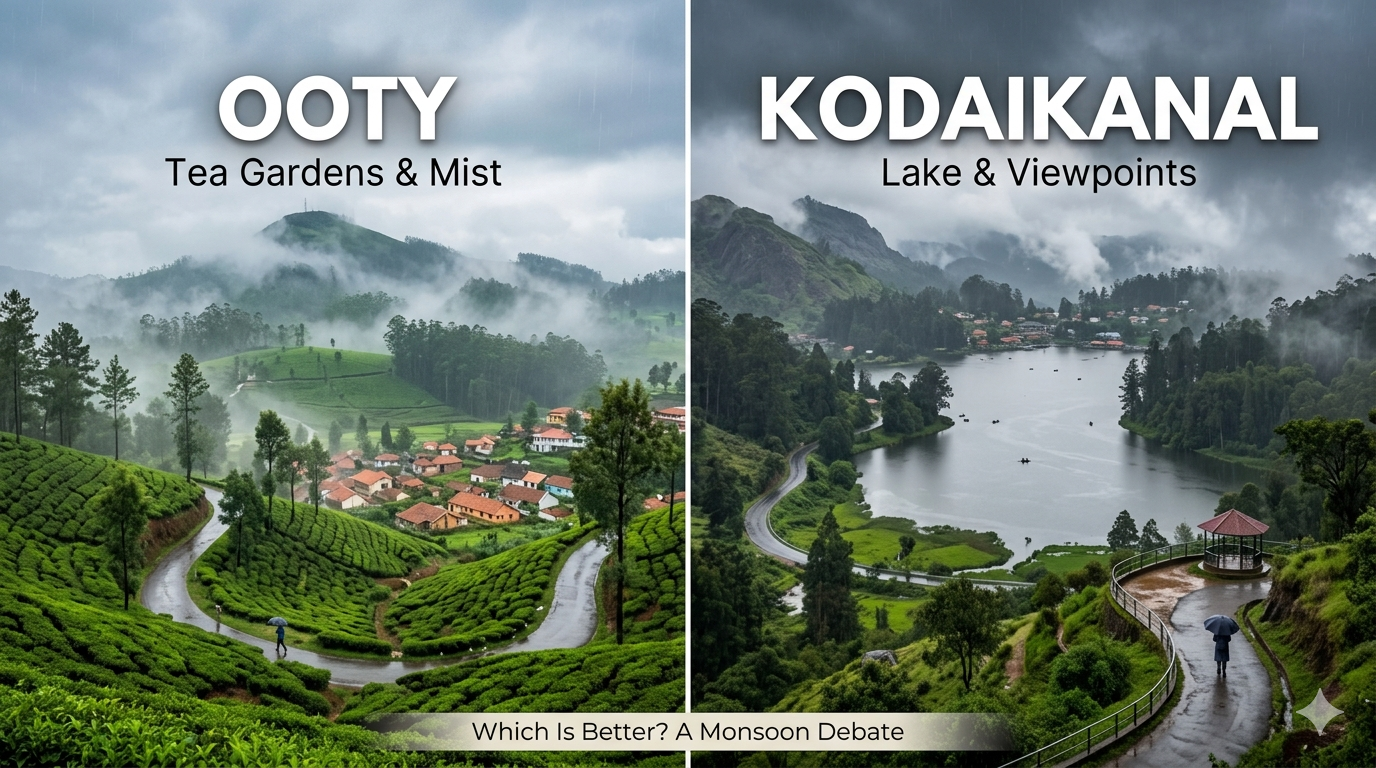
If you’re stuck choosing between Ooty and Kodaikanal in monsoon, yeah, I get it. I’ve done that confused tab-switching thing too... one window says Ooty is all tea gardens and toy train charm, another says Kodai is misty, quieter, more romantic, more raw. And honestly? Both are beautiful in rain. Both can also test your patience with traffic, leeches, damp socks, and that classic hill-station surprise where the view you came for is hidden behind one giant white cloud. Still, if you ask me straight — which is better in monsoon — the answer depends on what kind of trip you want. Ooty feels more active, more commercial, easier for families and first-timers. Kodaikanal feels moodier, greener, slower, and weirdly more emotional. Bit filmi, not gonna lie.
I’ve visited both during rainy months, not in some perfect postcard week, but during actual proper South Indian monsoon weather when roads get shiny, tea stalls become lifesavers, and every plan needs a backup plan. So this isn’t one of those generic “both are nice” posts. I mean, yes, both are nice, but not in the same way at all. If you’re planning a couple trip, family holiday, solo escape, quick Bangalore/Chennai/Coimbatore break, or even just trying to avoid making a booking mistake, this comparison should help.
First things first: how monsoon feels in Ooty vs Kodai
#Ooty in the rains feels lively. Even when the clouds roll in, there’s movement — more shops, more tour vehicles, more people out with umbrellas, more tea estates opening up around bends, more things happening in a compact loop. The rain there, at least in my experience, comes with that Nilgiris freshness. Eucalyptus smell, wet soil, cold breeze, roadside bhajji, hot chai in tiny paper cups... you know the vibe. It can get crowded, yes, specially on long weekends and school holidays, but there’s a kind of comfort to Ooty. It doesn’t feel too remote.
Kodaikanal in monsoon is different. Softer maybe. Darker too. It wraps itself in mist in a way that makes even a normal road feel cinematic. Sometimes you’re not really “seeing” Kodai, you’re feeling it. The lake gets all grey and dreamy, the pine forests smell richer, and Coaker’s Walk can disappear into fog within minutes. There were moments in Kodai where I was just standing with a cup of coffee thinking wow, this place is unfairly pretty. And then ten minutes later it would rain so hard I’d be hiding under a shop shade with three other strangers and one annoyed dog. So yeah, very romantic, very dramatic.
If you want the short answer, here it is
#- Choose Ooty in monsoon if you want easier sightseeing, more hotel options, better public familiarity, family-friendly energy, tea estate views, and slightly more to do even when weather is moody.
- Choose Kodaikanal in monsoon if you want misty quiet, a more intimate hill-station feel, cozy cafes, lake walks, forest vibes, and a slower trip that’s less about ticking places off.
- For honeymoon or couples, I’d lean Kodaikanal.
- For family with kids or senior citizens, I’d lean Ooty.
- For road-trip lovers, both are good, but Kodai’s approach roads in rain feel more dramatic while Ooty feels more established and predictable.
Weather and safety stuff you should actually know before booking
#Monsoon usually starts showing up strongly from June and runs through September, with some spillover depending on the year. July and August are the lushest, but also the trickiest for road conditions and outdoor plans. Light showers are one thing, but heavy downpours can mean reduced visibility, slippery steps, occasional route delays, and sudden changes in local plans. This matters more than people admit online. Don’t go expecting perfect sightseeing from 9 am to 6 pm. In monsoon, you have to be flexible or you’ll just get irritated for no reason.
Latest travel-wise, both destinations remain popular and active through the season, but hill travel in Tamil Nadu during heavy rain always means checking road updates before you leave. Landslide-prone stretches, temporary diversions, and fog-related slow driving are not everyday disasters, but they do happen from time to time. If you’re self-driving, start early, avoid late-night ghat driving, keep fuel topped up, and download offline maps. Buses and taxis continue to run, but delays happen. Also, this sounds basic but people still ignore it — wear shoes with grip. Not white sneakers for Instagram. Real grip. I learnt that the dumb way on a wet stone path in Kodai.
Getting there: Ooty is a little easier, Kodai takes more intention
#Ooty is usually reached via Coimbatore or Mettupalayam. From Coimbatore, you can hire a cab, take a bus, or combine train plus road. The Nilgiri Mountain Railway toy train from Mettupalayam to Ooty is still a huge draw and if the schedule works and weather permits, it’s honestly worth doing at least once. During monsoon it becomes extra pretty, with dripping greenery all around, though delays are possible. Ooty also gets a lot of package-tour traffic, so transport options feel more abundant.
Kodaikanal is commonly accessed from Kodai Road railway station, Madurai, Dindigul, or even Trichy depending on your route. But from the plains, you still have that winding uphill road section. Beautiful, yes. A little tiring if someone in your group gets motion sickness, also yes. Compared to Ooty, Kodai feels slightly less plug-and-play. Not difficult exactly, just less obvious. Once you arrive though, the compact town center makes moving around fairly simple.
Hotels, homestays, and what your money gets you in monsoon
#One thing I noticed very clearly — Ooty gives you more range. You’ll find budget lodges, old-school colonial properties, mid-range family hotels, tea-estate stays, and plenty of homestays around the main town and nearby areas like Coonoor side, Lovedale, Fern Hill, etc. In monsoon, prices can be a bit softer than peak summer unless it’s a weekend rush. Roughly speaking, budget stays can start around ₹1,200 to ₹2,000 if you’re okay with basic rooms, decent mid-range places usually sit around ₹3,000 to ₹6,500, and fancier heritage or view properties can go much higher. Always check if they have parking, hot water timings, power backup, and room heaters because cold damp rooms can really ruin the mood.
Kodaikanal has some lovely stays too, but the vibe is more cottage, homestay, boutique, and cozy-hotel than sheer volume. Budget places often start around ₹1,500 or so, mid-range around ₹3,500 to ₹7,000, and good scenic resorts or private villas can jump well beyond that. In rain, location matters a lot more than you think. Staying too far from the lake or town can be peaceful, but if it pours and roads are dark or patchy, you may end up ordering food in and not stepping out. Which is nice for one evening, maybe not for three. I personally liked staying close enough to Kodai Lake to walk when weather allowed.
My very unscientific rule: in Ooty, stay for convenience. In Kodaikanal, stay for atmosphere. That one line pretty much sums up the hotel difference.
Sightseeing in the rain: where Ooty wins and where Kodai wins
#Ooty has more straightforward sightseeing, especially if you’re going with parents or kids. Botanical Garden, Rose Garden, Ooty Lake, Doddabetta Peak, tea factory visits, and nearby Coonoor spots like Sim’s Park, Dolphin’s Nose, Lamb’s Rock — these are easy names, easy circuits, easy taxi plans. Even if one or two places get fogged out, your day doesn’t collapse. There’s enough around. Plus the roads around major attractions tend to be more tourist-ready. Not perfect, but manageable.
Kodaikanal’s attractions feel more weather-dependent. Coaker’s Walk, Pillar Rocks, Green Valley View, Pine Forest, Guna Caves area, Silver Cascade, Bryant Park, lake cycling — all lovely, but the monsoon can either make them magical or hide them completely. I went to Pillar Rocks once in such thick mist that there were basically no rocks, only faith. Funny now, irritating then. But when Kodai opens up after a shower, wow. The valleys, the wet pine trunks, the drifting cloud sheets — it has a more haunting beauty than Ooty. Less polished, more memorable.
Food scene, and this matters more in cold rain than people admit
#Let’s be honest, in monsoon a destination is only as good as the hot food available nearby. Ooty scores for comfort food and easy access. Lots of restaurants, bakeries, tea shops, homemade chocolates, varkey, hot corn, fried snacks, and South Indian meals. You’ll get everything from Tamil meals to basic North Indian gravies to biryani to old bakery stuff that tastes ten times better in cold weather. Tea in Ooty just hits different, maybe because you’re surrounded by the source, maybe because your fingers are freezing a bit.
Kodaikanal’s food scene is smaller but more charming. There are cozy cafes, homemade chocolate shops, fresh bread places, momos in some corners, simple mess food, and nice little spots for coffee, soup, and breakfast. The café culture is stronger there in a soft, hill-town way. Not metro fancy, just warm. I had one mushroom toast and filter coffee combo near the lake on a drizzly afternoon and for some reason that tiny meal is stuck in my head more than fancier meals elsewhere. Kodai is also good for pears, plums, homemade cheese in some stores, chocolates, and seasonal local produce.
Crowds, traffic, noise — the annoying but important part
#Ooty gets crowded faster. That’s the truth. Even during monsoon, if a weekend lines up with a holiday, traffic near the lake, market area, and major junctions can get properly messy. Parking can become a mini battle. So if your idea of peace is zero honking, empty viewpoints, and birdsong... Ooty may frustrate you a little. It’s popular for a reason, but popularity comes with noise. Also commercialisation. Some parts feel more hill-station bazaar than mountain escape.
Kodai is not empty either, let’s not pretend, but it generally feels less hectic than Ooty. The crowd spreads differently. Around the lake and central market it can get busy, sure, yet the overall mood stays calmer. Quieter roads, fewer giant tourist group vibes, more couples and small family groups, more people just walking. If your trip is less about “covering everything” and more about breathing a bit, Kodaikanal wins here. Easily.
Best for couples, families, solo trips, and friend gangs
#- Couples: Kodaikanal. The mist, lake, pine forests, cozy weather, slower evenings — it all works. Even doing nothing feels romantic there.
- Families with kids: Ooty. More accessible attractions, more hotel inventory, easier meal options, more flexible itineraries.
- Senior citizens: Slight edge to Ooty, mostly because logistics are simpler and there are more comfortable stop-and-go sightseeing options.
- Solo travelers who want quiet journaling, cafe time, long walks: Kodaikanal.
- Friend groups wanting road trip plus sightseeing plus food runs: Ooty probably gives a more packed and social trip.
A few lesser-known spots and small things I liked
#In Ooty, if the main town starts feeling too crowded, move toward Coonoor side or explore smaller roads near tea estates where allowed. Even a random drive in drizzle can feel worth it. Tea factory visits are touristy, yes, but still fun if you enjoy seeing the process and buying fresh tea. Also, don’t ignore simple pleasures there — a roadside chai stop with onion pakoda can beat a fancy planned café moment. Happens all the time.
In Kodaikanal, beyond the regular viewpoints, what I really liked were the quieter patches near the lake early in the morning, small bakery-cafe stops, and just walking into the mist without obsessing over a checklist. There are village-side experiences and farm stays around the broader region too, which some newer travelers are choosing because they want less market-area noise and more nature. If you’re into responsible travel, this is a good trend actually. Just book verified properties and ask about road access in rainy weather before paying.
Things people don’t tell you enough about monsoon trips here
#- Clothes won’t dry properly. Carry extras, especially socks.
- Mobile signal can wobble in certain patches, more on drives than town centers.
- Viewpoints may show you exactly nothing and still charge parking nearby. Life is like that.
- Leeches are not everywhere all the time, but on foresty/wet paths, be aware.
- Hot water and power backup matter more than pool, gym, or fancy decor. Trust me.
- Buffer time is everything. In the hills, 6 km can feel like 40 minutes.
Also, monsoon is not the best season if you want a super packed itinerary with constant outdoor movement. It is, however, fantastic if you enjoy weather itself — the smell, the silence, the clouds rolling over roads, that whole atmosphere. Some people go to hill stations and get upset that it’s rainy. Which is... I mean. It’s monsoon. Let the place be wet a little.
So, Ooty or Kodaikanal: which one would I pick again?
#If I was planning a safe, easy, family-friendly monsoon holiday where I want good hotel choice, lots of food options, convenient sightseeing, and less guesswork, I’d pick Ooty. It’s reliable. Not always peaceful, not always charming in every corner, but reliable. Good for first-timers too. You can land there with a broad plan and still have a nice trip.
But if I was going with my partner, or alone, or with one close friend and I wanted a rain-drenched hill station that feels a little more intimate and less performative, I’d choose Kodaikanal. Kodai has that thing... hard to explain properly. It stays with you. Ooty impresses you quickly. Kodaikanal slowly gets under your skin. Bit dramatic to say, maybe, but true.
My final verdict? Kodaikanal is better in monsoon for vibe, romance, and that deep misty hill-station feeling. Ooty is better in monsoon for convenience, variety, and practical travel. So the better destination isn’t one universal answer. It depends on whether you want ease or atmosphere. Me, personally, in the rains — I’ll pick Kodai by a small margin. On another day I might argue for Ooty, so yeah, maybe I’m contradicting myself a bit. But travel is like that. Places are moods.
Whichever you choose, go with realistic expectations, leave room in your schedule, eat the local snacks, speak kindly to drivers and hotel staff, and don’t spend the whole trip chasing perfect photos through fogged-up phone cameras. Some trips are better felt than documented. And if you like these slightly messy, honest travel comparisons, you can find more on AllBlogs.in.