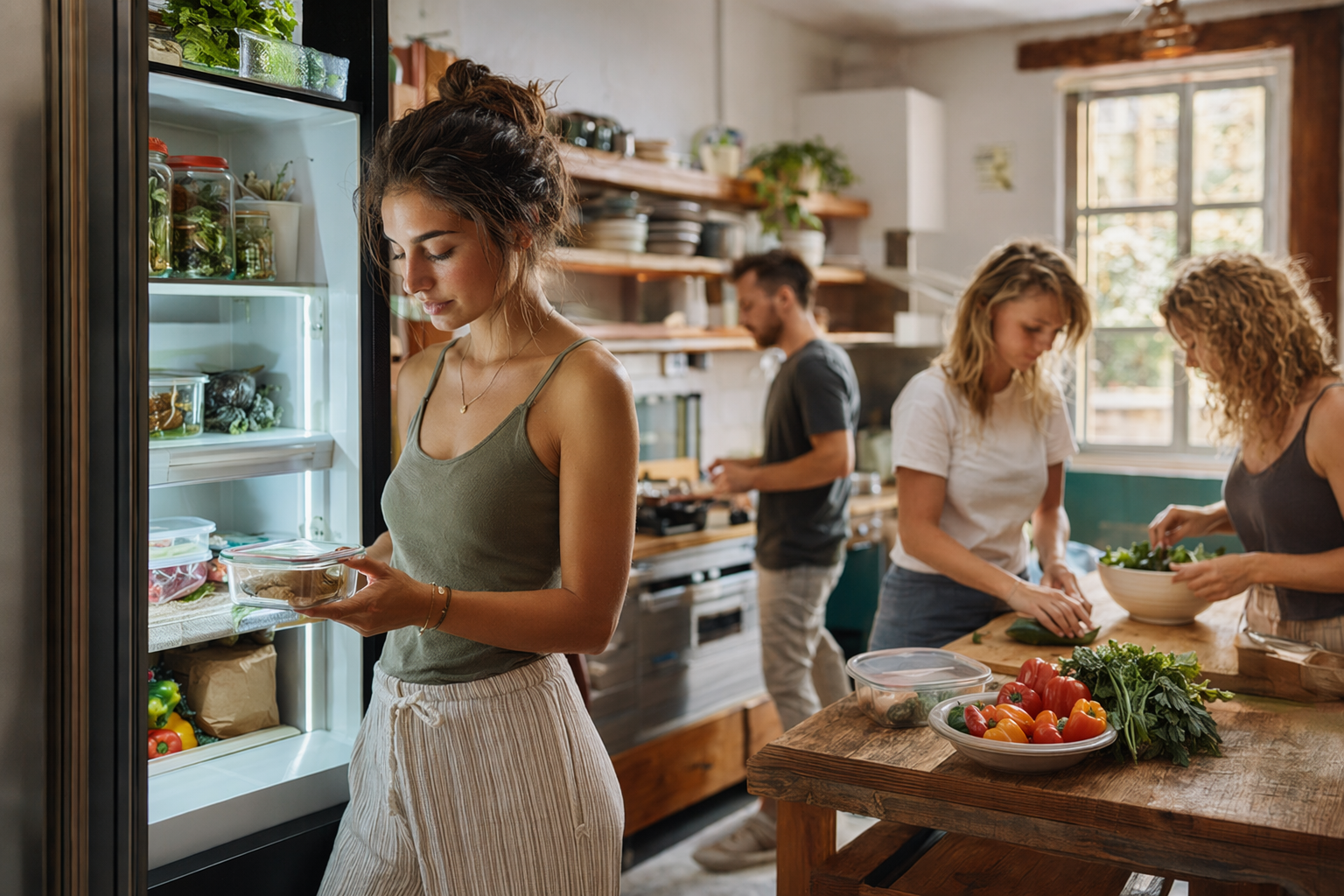
I used to think the most dangerous part of budget travel was night buses. Or maybe scooter taxis in Bangkok when the driver has one hand on the throttle and the other hand holding iced coffee. But no. After years of cooking my way through hostels from Lisbon to Oaxaca to Osaka, I’m pretty sure the real danger is a shared hostel fridge on a Sunday morning. It looks innocent, humming away in the corner beside a bin that should’ve been emptied yesterday, but inside? Mystery hummus, half a raw chicken wrapped in a grocery bag, yogurt with no name, three sad carrots, and somebody’s “meal prep” rice that has been there since, I dunno, the Roman Empire.
And listen, I love hostel kitchens. I really do. Some of my best travel meals weren’t in famous restaurants, they were cooked on scratched pans with five strangers hovering around one working burner. I’ve eaten hand-rolled tortillas in Mexico because a girl from Puebla felt sorry for my supermarket wraps. I learned to make proper shakshuka in Budapest from an Israeli backpacker who was very intense about tomatoes. In Copenhagen, me and this Australian guy made open-faced rye sandwiches with smoked fish from Torvehallerne and felt ridiculously fancy, even though we were eating on plastic chairs under a flickering light.
But a shared kitchen is also where good intentions go to get food poisoning. So this is my love letter and warning label to hostel cooking: how to use the fridge without being a menace, how not to poison yourself with leftover noodles, and how to cook great travel food while still being, you know, a decent human being.
The Hostel Kitchen Is Basically a Culinary United Nations, With Worse Knives
#If you’re into food travel, the hostel kitchen is secretly one of the best places to hang out. People bring ingredients from markets, random spice packets from home, and strong opinions about how rice should be cooked. I’ve seen German hikers making lentil stew beside Korean students frying kimchi rice, while a Brazilian guy tried to explain farofa to everyone and somehow convinced us to put it on pasta. Was it traditional? Absolutely not. Was it good? Weirdly, yes.
This is especially true now, with the way food travel has been changing. The big thing I keep seeing in 2026 travel circles is that people don’t just want to “eat at the best restaurant” anymore. They want markets, cooking classes, fermentation workshops, refill stores, neighborhood bakeries, low-waste cafés, and the kind of local food experience that doesn’t require a white tablecloth. Cities like Oaxaca, Lisbon, Bangkok, Taipei, Naples, Seoul, and Copenhagen still get talked about constantly, but not only for fine dining. It’s mole tastings, tinned fish bars, night markets, natural wine, coffee omakase, vegan street food, heritage grains, zero-waste bakeries… basically food with a story attached.
And for budget travelers, the hostel fridge is where that story continues. You buy too much at a market because everything looks gorgeous, then suddenly you’re trying to fit goat cheese, strawberries, leftover curry, and half a bottle of vinho verde into a fridge already packed like a Ryanair overhead bin. That’s when etiquette matters. Food safety too, obviously, unless you enjoy spending your one day in Florence hugging a toilet. Which, no thanks.
The Fridge Rule Nobody Wants to Talk About: Cold Means Cold
#Here’s the boring but important bit: a hostel fridge should be cold. Like properly cold. Food safety guidance in many countries says refrigerators should be around 4°C / 40°F or below. Freezers should be frozen, not “soft ice cream with emotional issues.” If you open the fridge and it feels barely cool, or there’s condensation everywhere and milk smells like a wet sock, don’t store risky food in there. Especially not seafood, meat, cooked rice, dairy, or those lovely little custard tarts you bought and promised you’d eat later.
I learned this the stupid way in Porto. I’d bought fresh sardines at a market because I was feeling very local and romantic about it. The hostel fridge was stuffed, the door didn’t close right, and I thought, ah it’ll be fine for one night. It was not fine. The next day the fish smelled like a harbor at low tide and my whole dorm probably hated me. I didn’t even cook them. I just performed a little walk of shame to the bin.
- If the fridge door doesn’t seal, tell reception. Don’t just shrug and put raw chicken in there anyway.
- Keep high-risk foods cold: meat, fish, dairy, cooked leftovers, cut fruit, cooked rice and pasta.
- Don’t leave groceries on the counter while you “just shower quickly.” Two hours at room temp is often the limit people quote, and in hot places it can be less.
- If something smells wrong, feels slimy, or you can’t remember when you bought it, stop negotiating with it. Bin it.
I know wasting food feels awful, especially when you’re travelling on a tight budget. I’ve been the person scraping lentils into a container thinking, “future me will be grateful.” But future me has also had stomach cramps on a bus in Croatia, so I’m a little stricter now.
Label Your Food Like You’re Not Living in a Jungle
#There is one universal hostel law: if you don’t label it, someone will either eat it, move it, or silently resent it. Most decent hostels have masking tape and a marker, but I carry a tiny roll of tape now because I’m old in backpacker years and I’ve seen things. Write your name, check-out date, and maybe the date you cooked it. Not a novel. Just enough.
In Oaxaca, I stayed at a hostel where everyone cooked after the markets, and the fridge was a masterpiece of labels. “Maya - mole negro - 12 Jan - DO NOT TOUCH I WILL CRY.” “Tom - eggs - leaving Friday.” “Free salsa, spicy, serious.” It sounds silly but it worked. Nobody stole anything, and when people left, they put usable food on a free shelf. That free shelf became dinner some nights: tomatoes, cilantro, half an onion, and tortillas. Boom. Hostel tacos.
But unlabeled food? That’s chaos. One time in Berlin, someone ate my yogurt. Not dramatic, except I had been dreaming about that yogurt after walking like 20,000 steps and eating only a pretzel. I’m still annoyed, which is maybe petty, but backpacker hunger is real hunger.
My basic hostel fridge label system, not fancy but it works
#- Name: so people know it belongs to an actual human and not the communal gods.
- Date cooked or opened: because “Monday pasta” becomes “science project pasta” fast.
- Check-out date: staff can clear it after you leave, and you won’t become the legend of the rotting hummus.
- Allergen note if needed: especially if you’re storing peanut sauce, shellfish, or anything super strong-smelling.
Also, don’t write “do not touch” on every single thing like you’re guarding royal treasure, unless theft is actually happening. A normal label is enough. Usually.
Raw Meat Goes on the Bottom Shelf. Always. I Will Die on This Hill.
#If you remember nothing else from this whole ramble, remember this: raw meat, poultry, and seafood go on the bottom shelf, sealed, ideally in a container or a bag that doesn’t leak. Not above someone’s berries. Not beside open cheese. Not balanced on top of a salad because “it’s only for a few hours.” Bottom. Shelf.
This is where hostel etiquette and food safety become the same thing. Your raw chicken juice is not just your problem. It’s everybody’s problem. In Bangkok, I once opened a hostel fridge and saw a bag of raw chicken dripping onto mango sticky rice leftovers. I still think about that scene like it was a crime documentary. The owner of the chicken was like, “Oh sorry bro,” and moved it. Sir, the mango rice has already entered the danger zone spiritually and physically.
Use sealed containers. If you’re buying meat from a market, double-bag it. If the hostel has a tray or plastic box for raw stuff, use it. If it doesn’t, improvise with a bowl. And please wash your hands after touching raw meat. I know that sounds like something your teacher says when you’re five, but I have watched grown adults touch raw sausages and then grab the fridge handle. Travel really teaches you humility, mostly because people are disgusting sometimes.
Cooked Rice, Pasta, and the Backpacker Leftover Trap
#Backpackers love rice and pasta because they are cheap, filling, and emotionally supportive. I get it. A big pot of rice can become fried rice, curry rice, burrito filling, breakfast rice if you’re brave. But cooked rice can be risky if it sits around too long at room temperature. Same with pasta, noodles, and grains. The issue people talk about is Bacillus cereus, a bacteria that can survive cooking and cause nasty food poisoning if cooked rice or pasta hangs out warm for ages.
So don’t cook rice at 8 p.m., forget it on the counter while you go drinking, then put it in the fridge at 2 a.m. and call it meal prep. That is not meal prep, that’s a dare.
- Cool leftovers quickly. Spread rice or pasta in a shallow container if you can, instead of one giant hot mountain.
- Get it into the fridge within about two hours, sooner if the kitchen is hot.
- Reheat until steaming hot all the way through. Not lukewarm, not “meh it’s fine.”
- Don’t keep cooked rice forever. I try to eat it next day, maybe within two days if I trust the fridge. In hostels, I trust nothing that much.
I made a ridiculous fried rice in Taipei once with leftover market greens, egg, soy sauce, and a chili crisp I’d been carrying like a sacred object. It was perfect. But I also cooled the rice properly because Taipei humidity is not playing around. Hot climates make hostel kitchen mistakes more dramatic, honestly.
Smell Etiquette: Your Fermented Fish Is Not Everyone’s Spiritual Journey
#I love bold food. Give me kimchi, blue cheese, durian candy, anchovies, pickled herring, funky shrimp paste, all of it. I once planned half a day in Seoul around eating banchan and another half day trying to find the best hotteok. But shared spaces require a tiny bit of social awareness. If your food smells huge, seal it properly. Don’t leave open tins of sardines in the fridge. Don’t microwave fish at midnight in a dorm-adjacent kitchen unless you want enemies.
Lisbon has made tinned fish trendy with all those beautiful conserva shops, and I’m completely onboard. Sardines, mackerel, tuna belly, gorgeous packaging, little picnic with bread and tomatoes. But in a hostel fridge? Put that leftover tin in a sealed container, or better, just eat it all. Same with strong cheeses from France, kimchi from Korean marts, and anything garlicky enough to announce itself from another room.
The funny thing is, smell can become community too. In Naples, I stayed somewhere with this tiny kitchen and a guy from Sicily cooked pasta alla Norma. Eggplant, tomato, basil, ricotta salata. The whole hostel drifted in like cartoon characters following a scent trail. He fed six of us because he had made “too much,” which I think was a lie, he just liked feeding people. That’s the good side. The bad side is burnt oil, old fish, and mystery soup bubbling over the stove while the cook has vanished.
The Free Food Shelf: Blessing, Trap, or Both?
#Many hostels have a free food shelf or basket. I love these. They’re low-waste, budget-friendly, and sometimes hilarious. You’ll find half a bag of oats, three kinds of salt, weird instant soup from Poland, pancake mix, chili flakes, and one lonely potato. In 2026, low-waste travel is not really a niche thing anymore, at least among the people I keep meeting. More hostels are nudging guests toward composting, refill stations, food-sharing boxes, and local market cooking instead of endless takeaway containers. I’m into it.
But the free shelf needs rules too. Shelf-stable unopened pasta? Great. Olive oil someone left yesterday? Probably fine. Open milk on the free shelf, unrefrigerated? Absolutely not. Cooked leftovers with no date? Nope. A jar of sauce with crust on the rim? I am walking away emotionally and physically.
- Only put food on the free shelf if it’s actually safe and usable, not because you feel guilty throwing it out.
- Don’t donate half-eaten takeaway or leftovers unless the hostel clearly allows it and it’s labeled, dated, and chilled.
- Check expiry dates, but also use common sense. A sealed bag of rice is different from opened cream cheese.
- If you take from the free shelf, don’t be greedy. Leave some pasta for the next broke traveler, yeah?
My favorite free shelf find ever was in Granada: saffron. Real saffron, just sitting there in a tiny container because someone had cooked paella and left town. We made the most chaotic hostel rice dish with peppers, chickpeas, smoked paprika, and that saffron. Was it paella? No Spanish grandmother would approve. Was it golden and delicious after a day hiking? Very much yes.
Market Shopping Without Turning the Fridge Into a Disaster Zone
#Food markets are the reason I can’t travel with people who hate wandering. I need at least two hours to look at tomatoes, sniff peaches, and debate cheese. Mercado de la Merced in Mexico City, Borough Market in London, Nishiki Market in Kyoto, Or Tor Kor Market in Bangkok, La Boqueria in Barcelona even though it’s touristy as anything, I don’t care, I still like it. Markets make me want to cook.
But here’s the thing: buy what you can actually store and cook. I have made this mistake so many times. You go to the market hungry and suddenly you own fresh prawns, soft cheese, herbs, berries, a bottle of local yogurt, and no plan. Then the hostel fridge is full, the stove is busy, and the only pan has something burnt welded to it. Romantic food travel turns into stress cooking.
Now I shop like a hostel realist. One protein, one vegetable, one carb, one fun thing. In Oaxaca that meant tortillas, mushrooms, avocado, salsa macha. In Copenhagen it was rye bread, smoked fish, cucumber, dill, and skyr. In Bangkok, I mostly gave up cooking because street food was better and cheaper than anything I’d make, but I still kept fruit and yogurt in the fridge for breakfast. In Japan, convenience stores and tiny hostel kitchens taught me minimalism: rice balls, miso soup packets, eggs, pickles. Done.
A hostel fridge is not your home fridge. It’s a temporary negotiation with strangers, bacteria, and limited shelf space.
Clean As You Go, Because Nobody Is Your Travel Parent
#There is no romance in a sink full of other people’s dishes. None. I can forgive a lot in hostels: snoring, loud zippers, someone turning the dorm light on at 5 a.m. because they “couldn’t find their socks.” But leaving greasy pans for the morning? Criminal.
Shared kitchen etiquette is basic but apparently not obvious. Wash your dishes right after eating. Wipe the counter. Don’t leave food scraps in the sink. If you spill in the fridge, clean it. If your lentil soup explodes in the microwave, don’t pretend you didn’t see it. We all saw it. The soup is on the ceiling.
I once stayed in a hostel in Ljubljana where the kitchen had a little sign that said, “Your mother does not work here, but she would be disappointed.” Honestly, perfect. That kitchen was spotless because the staff were strict and the travelers were scared, in a good way. A clean kitchen changes everything. People cook more, share more, and don’t have that low-level dread before opening the fridge.
Allergies, Dietary Stuff, and Not Being Weird About Other People’s Food
#Hostel kitchens are full of different diets: vegan, halal, kosher, gluten-free, pescatarian, “I’m trying to save money so I eat peanut butter with a spoon,” all of it. The etiquette here is simple: respect people’s food and don’t contaminate things.
If you use someone else’s knife for peanut butter and then stick it in communal jam, that can be a real problem for someone with allergies. Same for crumbs in butter if someone is gluten-free for medical reasons. I know not every hostel has separate chopping boards and perfect systems, but you can still be careful. Wash utensils. Don’t double dip. Keep allergen-heavy foods sealed. Ask before using shared spices or oils if they look personal.
In Tel Aviv, a traveler I met had a severe sesame allergy, which in that city is basically travelling in boss mode because tahini is everywhere and delicious. She cooked most of her meals in the hostel and was so careful with surfaces. Watching her made me realize how casual the rest of us are with crumbs and sauces. Food freedom is a privilege, really. I try to remember that now when I’m spreading chili peanut sauce on everything like a maniac.
When to Eat Out Instead of Cooking
#I’m all for cooking in hostels, but sometimes the safest and most joyful choice is to eat out. In cities where street food is central to the culture, cooking every meal can almost feel like missing the point. Bangkok night markets, Mexico City taco stands, Osaka okonomiyaki counters, Naples pizza, Hanoi bowls of phở, Istanbul simit and meze, Taipei night market snacks… these are not “extras,” they’re the trip.
Also, if the kitchen is dirty, the fridge is warm, or you’re too tired to cook safely, go eat something made by professionals. Or semi-professionals. Or a grandmother with a cart and a line of locals. Use your judgement. I’ve had some of the safest-feeling meals from street vendors because turnover was fast, food was cooked hot in front of me, and locals were lining up. Meanwhile I’ve seen hostel leftovers that could qualify as biohazards.
Food travel right now feels very split in a good way: people still chase reservations, sure, but they also want everyday food. Bakeries at 7 a.m. Natural wine bars where the staff talk about soil like poetry. Tiny noodle shops. Market counters. Cooking with strangers. I think the hostel kitchen belongs in that trend, if we treat it with respect. It’s not glamorous, but neither is licking your fingers after the best tomato sandwich of your life while standing over a sink in Seville.
My Personal Hostel Fridge Checklist Before I Trust Anything
#I don’t want to sound paranoid, because I’m not. I’ll eat fermented shark in Iceland, bugs in Mexico, raw-ish seafood when it’s from a trusted place, and cheese that smells like socks if a French person tells me it’s correct. But I am cautious with shared fridges because the risk isn’t exciting, it’s just dumb.
- Does the fridge feel properly cold when I open it?
- Is the door closing fully, or is someone’s giant watermelon blocking it?
- Are raw meats sealed and on the bottom, or is there poultry roulette happening?
- Is my food labeled and dated?
- Can I eat this within a day or two, or am I pretending I live here?
- Do I have a sealed container, or am I about to balance curry in a paper cup like an idiot?
That last one is from experience. In Prague, I tried to store soup in a takeaway coffee cup because I had no container. It tipped. The fridge smelled like paprika for two days. I apologized so much the receptionist started laughing, which was kind, but I deserved shame.
The Little Tools I Travel With for Better Hostel Cooking
#I don’t travel with a full kitchen, don’t worry. I’m not that person at airport security with a cast iron pan. But a few tiny things make hostel cooking safer and less annoying. A reusable container with a tight lid is the big one. Also zip bags or silicone bags, a spork, a small spice mix, and tape for labels. If I’m travelling longer, I carry a small bottle of dish soap because some hostels somehow always have none, which is wild.
A lot of newer hostels and coliving-style places have upgraded kitchens now: induction hobs, better recycling, compost bins, filtered water taps, QR-coded house rules, and sometimes actual fridge baskets per room. I’ve even seen hostels with “eat me first” boxes to reduce waste. Love that. But don’t rely on the hostel being clever. Bring your own basic system.
- One leakproof container for leftovers or market snacks.
- Masking tape and a pen for labels, because markers vanish like socks.
- A tiny spice kit: chili flakes, cumin, smoked paprika, or whatever makes sad pasta less sad.
- Reusable cutlery, partly for picnics and partly because hostel forks disappear.
- Hand sanitizer is useful, but soap and proper handwashing still wins in the kitchen.
A Few Meals That Actually Work in Hostel Kitchens
#Some meals are just hostel-friendly. They don’t need five pans, they don’t create huge mess, and they use ingredients you can find almost anywhere. My favorite is “market toast,” which sounds like a fake café item but is basically bread plus whatever looked good that day. In Lisbon: bread, tinned sardines, tomato, parsley, lemon. In Athens: bread, feta, cucumber, olives. In Copenhagen: rye, smoked fish, dill, pickles. In Mexico: tortillas instead of bread, obviously, with beans and salsa.
Another one is one-pan eggs with vegetables. Shakshuka-ish if you have tomatoes and spices, tortilla-ish if you have potatoes, fried rice-ish if you have leftover rice handled safely and an egg. Lentils are great too, especially the pre-cooked kind in packets or cans. Pasta is fine, but please don’t make enough for eight days unless you have containers and a fridge you trust.
The best hostel meal I ever had might still be in San Sebastián, not at a pintxos bar, even though those were amazing. It was after the bars, actually. A group of us came back hungry and cooked eggs, peppers, leftover potatoes, and some cheese someone had bought at a market. We ate it with bread and cheap wine at 1 a.m. Was it safe? Yes, because we cooked it fresh and cleaned up. Was it elegant? Not even a little. But it tasted like travel, which is to say, chaotic and generous.
Don’t Steal Food. Seriously. Even a Little Bit.
#Food theft in hostels is one of those small things that feels huge when it happens to you. Maybe you think taking a splash of milk doesn’t matter. Maybe it doesn’t. But maybe that milk was someone’s breakfast before a 6-hour train. Maybe those eggs were counted. Budget travel means people plan their food money closely, and taking from them is just lousy.
If you need something, ask. Travelers are often generous. I’ve shared olive oil, salt, coffee, pasta, onions, all kinds of things. Most people would rather give you a spoonful of butter than have you sneak it. And if something is marked free, great. If it’s not, leave it alone. The fridge is not a treasure hunt.
Same goes for moving people’s food. If you must rearrange because the fridge is packed, do it carefully. Don’t put raw meat above ready-to-eat food. Don’t crush fruit. Don’t leave someone’s yogurt on the counter because you needed space for beer. Actually, beer taking up half the fridge is another whole essay. Beer is nice, yes, but it should not evict dinner.
The Emotional Side of Shared Food While Travelling
#This might sound dramatic, but shared kitchens are where loneliness gets softened. Travel can be weirdly lonely, even when you’re surrounded by people. You arrive in a city, you don’t know the language, your feet hurt, your phone is dying, and then someone asks if you want some pasta. Suddenly you’re okay again.
I remember a rainy night in Edinburgh, when I was cold in that deep damp way that gets into your bones. I’d bought soup ingredients from a supermarket and was making something very basic: leeks, potatoes, stock cube, too much black pepper. A woman from Malaysia asked what I was cooking, then added fried shallots from her bag. A guy from Chile offered bread. Someone else had butter. We ate together, and for half an hour the kitchen was warmer than any restaurant could’ve been.
That’s why I care about etiquette. Not because I’m obsessed with rules, although maybe a little. It’s because when the kitchen works, it becomes a tiny community. When it doesn’t, everyone retreats to instant noodles in silence and mistrust.
Final Thoughts From a Person Who Has Opened Too Many Hostel Fridges
#Shared hostel kitchen food safety isn’t sexy, I know. Nobody books a flight thinking, “Can’t wait to label my leftovers and store raw chicken correctly.” But if you love food and travel, these little habits protect the good stuff: the market hauls, the late-night pasta, the communal curry, the breakfast you actually get to eat before catching a bus.
So keep the fridge cold. Label your food. Raw meat on the bottom. Cool leftovers quickly. Don’t steal. Clean your mess. Respect allergies. Seal the smelly stuff. Eat local when cooking doesn’t make sense, and cook when the market is too beautiful to ignore. Basically, act like your fellow travelers are real people with stomachs and budgets and dreams of not getting sick in a dorm bathroom.
And if you do mess up, because we all do eventually, own it. Apologize. Clean the soup off the microwave ceiling. Throw away the suspicious rice. Buy replacement yogurt if you accidentally ate someone’s, though honestly how do you accidentally eat someone’s yogurt? Anyway. Hostel kitchens are imperfect, funny, occasionally gross, and sometimes magical. Treat them well and they’ll feed you more than dinner. For more food travel rambles and practical trip stories, I’d say have a wander through AllBlogs.in sometime.