The evening Jodhpur turned damp, blue, and dangerously hungry
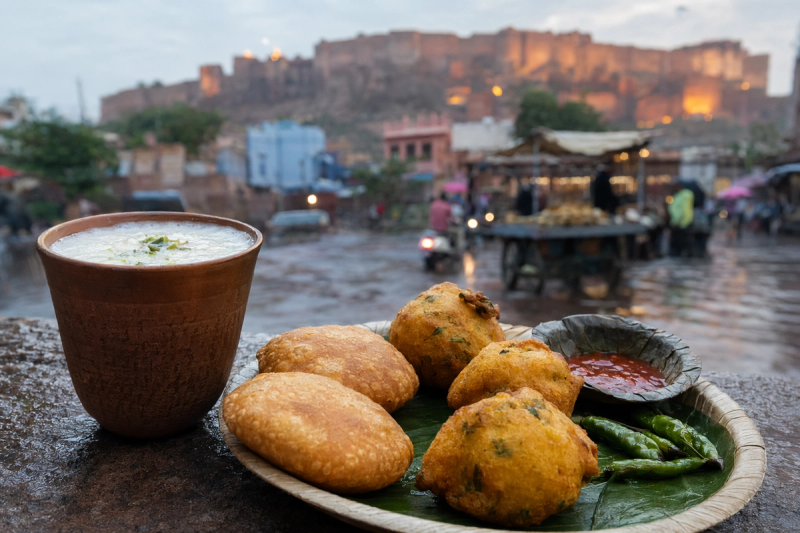
#I reached Jodhpur on one of those evenings when the sky can’t decide if it wants to be dramatic or just moody. You know that pre-rain smell, when dust rises from hot stone and then suddenly the whole city feels like someone sprinkled water on a tandoor? That was my welcome. The blue houses around the old city looked deeper, almost ink-like, and Mehrangarh Fort was sitting above everything like it already knew I was about to make bad snack decisions. I had come with a neat little food plan, very sensible, very traveler-blogger type. But rain ruins plans in the best way. By the time I got near Ghanta Ghar and Sardar Market, my umbrella had flipped once, my shoes were wet from the sides, and all I could think was: vada, kachori, lassi. In that order. Or maybe all together. Honestly, Jodhpur makes you greedy.
Rainy evenings in Rajasthan have a funny romance to them. People imagine desert cities as dry and golden all the time, but when it rains even a little in Jodhpur, everything changes. The sandstone glows, scooters slow down, shopkeepers pull tarpaulin covers over counters, and the smell of frying oil becomes louder than traffic. I’m not even exaggerating. Hot oil has a sound, and in Jodhpur it kind of calls your name. There’s mirchi vada being fried till blistered and golden, pyaaz kachori stacked like flaky little planets, samosas cracking open, and then somewhere nearby, a steel glass of makhaniya lassi wearing a crown of malai, saffron, and cardamom. It’s too much. But also not enough.
First stop: the Clock Tower area, because all roads lead to snacks
#If you’re staying anywhere near the old city, the Clock Tower area is the obvious snack battlefield. Ghanta Ghar is not exactly peaceful, especially in the evening. It’s noisy, cramped, full of spice shops, tourists looking up at the tower, locals bargaining like it’s a competitive sport, and cows who clearly have more confidence than most humans. But for food? It’s perfect. I wandered toward the lanes around Sardar Market because that’s where the smell was strongest. I don’t always trust online lists blindly, but some Jodhpur names keep coming up for a reason: Janta Sweet Home, Shahi Samosa, and Mishrilal Hotel near the Clock Tower are the kind of places travelers mention again and again because they sit right in the snack memory of the city. Still, I always say this: don’t treat famous shops like temples. Treat them like starting points. The best bite might be two shops away, from someone who doesn’t care about Instagram at all.
My first bite that evening was a mirchi vada from a stall where the cook had that calm, bored confidence of a man who has fried ten thousand chillies and maybe judged all of us silently. The vada was big, not cute-big, but proper Jodhpur-big. A fat green chilli, slit and filled with spiced potato, dipped in besan batter, then fried till the surface bubbled and crisped. The rain was tapping on the plastic sheet above us, oil was hissing, and I burned my tongue because I have learned nothing in life. The first taste was heat, then tangy masala, then the soft potato, then the chilli waking up late like “hello, I am here also.” I stood there nodding like an idiot. The vendor asked if I wanted chutney. Of course I did. Then I spent the next minute trying to act normal while the chilli climbed into my ears.
Mirchi vada is not just spicy, it’s theatrical
#What I love about Jodhpur’s mirchi vada is that it doesn’t pretend to be delicate. It’s not one of those snacks that needs explaining with tiny plates and foam and some chef whispering about texture. It is a chilli stuffed with potato and deep fried. That’s it, and that’s the genius. The outside should be crisp but not hard, the batter should cling properly, and the potato filling has to have enough amchur or tang to stop the whole thing from becoming heavy. On a rainy evening, it makes complete sense because your body is asking for warmth and drama. The better ones are fried fresh, not reheated, and you can tell from the crust. Fresh vada shatters a little. Old vada sits there like it has regrets.
I ate mine under a ledge with three other strangers who were also sheltering from the rain, and this is one of my favourite parts of food travel. Nobody was making big conversation. We just stood shoulder to shoulder, holding hot snacks in paper, trying not to drip chutney on our clothes. A man beside me said, “Jodhpur aaye aur mirchi vada nahi khaya toh kya khaya?” which basically means if you came to Jodhpur and didn’t eat mirchi vada, what did you even eat. I agreed too fast, with my mouth full, and some chutney went the wrong way. Very elegant. Very travel writer.
Then came the kachori, flaky and slightly dangerous
#After the vada I should’ve stopped for ten minutes. Sensible people pause. I do not. I saw kachoris being lifted from a kadhai, and that was that. Jodhpur kachori has its own personality. Jaipur gets a lot of love for pyaaz kachori, and honestly it deserves it, but Jodhpur’s versions have this robust, almost rough-around-the-edges charm. Some are stuffed with onion masala, some with dal, some are served crushed with chutneys, curd, or spice mixtures. On rainy evenings, I prefer the simpler way: hot kachori, a little chutney, eaten while standing. The crust should be layered and flaky, with that deep-fried aroma that makes you forget every health article you ever read.
There’s a small ritual to eating kachori in rain. First, you break the edge, because biting directly can punish you with steam. Then you peek inside like it’s a secret. If the filling smells of asafoetida, coriander, fennel, chilli, and fried onion, you’re in good hands. My kachori that evening had a filling that was sharper than I expected, a bit sweet from onion, a bit sour, nicely greasy in the way monsoon snacks are allowed to be. The chutney was served from a steel container, and here I’ll be honest, I checked it before eating. If it looks watery, tired, or has been sitting uncovered while rainwater is splashing around, I skip it. I’m brave with chilli, not with stomach infections. There’s a difference.
If you’re doing Rajasthan as a snack trail, Jodhpur and Jaipur make a fun comparison. Jaipur’s pyaaz kachori scene has its own monsoon mood, especially when you start noticing oil freshness, timing, and that whole lassi pairing habit. I wrote more about that kind of rainy snack walk in Jaipur Pyaaz Kachori in Monsoon: Food Walk Guide, and honestly the two cities feel like cousins who argue over who fries better. Jaipur may be more polished in places, Jodhpur feels more direct. Less fuss. More punch. But ask me after a second kachori and I’ll probably say both are perfect, because I have no loyalty when hot pastry is involved.
How I choose a kachori stall when the weather gets messy
#Rain makes street food magical, but it also makes you pay attention. Water, mud, crowding, and uncovered chutneys are not small things. I don’t want to sound like someone’s worried uncle, but a little caution keeps the trip fun. My basic rule in Jodhpur was to eat where the food is moving fast. If the kachoris are coming out fresh and disappearing quickly, that’s usually a good sign. If a tray is sitting sadly with flies holding a conference above it, no thank you. I also watch the oil. Not in a dramatic way, like I’m judging a cooking show, but if the oil is black and smoking like a diesel engine, I move on.
- Go when locals are buying, usually late afternoon into evening, because turnover matters more than fancy signage.
- Pick hot fried snacks over anything assembled cold, especially when rain has made counters damp and crowded.
- Ask for chutney lightly if you’re unsure. You can always add more, but you can’t un-eat suspicious chutney. Sad but true.
- Carry tissues or wipes. Jodhpur snacks are not designed for clean fingers, and that is part of the joy also.
Makhaniya lassi: dessert, drink, and nap invitation
#After mirchi vada and kachori, I needed something cooling, but in Jodhpur that doesn’t mean a shy little drink. It means makhaniya lassi, thick enough to slow down time. The classic version is creamy, sweet, often scented with cardamom and saffron, and topped with a generous layer of malai or sometimes a scoop of something richer depending on the shop. Mishrilal Hotel near the Clock Tower is one of the old names people point you toward for makhaniya lassi, and yes, it is famous with travelers. I tried one there on a previous visit and remembered it as almost spoonable. This rainy evening I had another lassi nearby, served in a steel glass, and it was cold, buttery, and deeply comforting after the chilli attack I had happily invited upon myself.
But lassi is where I become slightly careful. Dairy and travel stomachs can have complicated relationships, especially in hot regions and during humid weather. I look for places with a steady crowd, clean serving glasses, and lassi that seems freshly handled, not something sitting around forever. I avoid added ice unless I trust the place. I also smell it, quietly, because yes I am that person. A good lassi smells fresh, sweet, milky, maybe cardamom-y. If it smells sour in a wrong way, not the natural yogurt tang but something tired, I don’t drink it. For a more detailed traveler checklist, the dairy safety notes in Is Lassi Safe in Indian Summer? Dairy Freshness Checks Before You Drink are worth reading before you start ordering giant glasses of happiness everywhere.
A proper Jodhpur rainy-evening snack crawl is basically this: burn your tongue on mirchi vada, forgive yourself with kachori, then pretend makhaniya lassi is a medical treatment.
The rain changes the city, and the food tastes different because of it
#I’ve eaten similar snacks in dry weather and they were great, but rain adds something. Maybe it’s the smell of wet stone. Maybe it’s how everyone crowds closer to the frying counter, so the whole scene becomes warmer and louder. Maybe it’s just that being damp makes you more dramatic. I remember standing near a blue wall, watching rainwater run down a narrow lane while a boy carried a tray of samosas above his head like some sacred offering. A scooter splashed through a puddle, a tourist shouted because her sandal got wet, someone laughed, and the vendor kept dropping batter into oil like none of this mattered. That’s the kind of travel moment I love. Not postcard-perfect. A little chaotic. Very alive.
Jodhpur’s old city is especially good for this because food, architecture, and everyday life are packed tightly together. You can spend the morning at Mehrangarh Fort, where the view makes the city look like a blue map folded into the desert, then come down into lanes where the real sensory overload begins. Spice shops smell of red chilli and turmeric. Sweet shops show off ghewar, mawa sweets, and laddoos. Tea stalls steam up in corners. During the monsoon, even if the rain is brief, the air cools just enough for fried food to feel necessary. I know, scientifically it may not be necessary. Emotionally? Completely necessary.
A small detour into chai, because obviously
#At some point, after the lassi, I made the questionable decision to drink chai too. This is where I contradict myself because I’d just had a cooling dairy drink and then wanted hot tea. But travel appetite is not logical. The chai came in a small glass, sweet and strong, with enough ginger to make me stand up straighter. I didn’t pair it with anything because even I have limits, but I watched other people dip pieces of kachori into tea and I respect that kind of confidence. Not sure I’m ready. Maybe next time. Or maybe after two more trips, when Jodhpur has fully corrupted me.
Tea stalls are also where you hear the best local advice. One man told me not to waste time chasing only “famous” food because every mohalla has its own champion. Another insisted that the best mirchi vada is always the one closest to your house, which is such a local answer. I asked which shop he liked. He smiled and said, “Aapko nahi milega,” meaning you won’t find it. Fair. Some food secrets stay protected. I actually like that. Not everything needs a pin on Google Maps.
What to eat first if you’ve only got one rainy evening
#If your Jodhpur trip is short and the clouds are being kind, don’t try to eat everything in one reckless sprint. I mean, I sort of did, but learn from my mistakes. Start near the Clock Tower before the market gets too late and too crowded. Have one mirchi vada while it’s fresh from the oil. Walk a bit. Let the spice settle. Then try a kachori from a busy shop, preferably one that’s frying continuously. After that, sit down for makhaniya lassi if you trust the dairy setup and your stomach is feeling friendly. If not, go for chai. You won’t suffer. Jodhpur chai on a rainy evening is still a very good ending.
- Begin with mirchi vada because it tastes best fiercely hot, even if it attacks your tongue a little.
- Move to kachori next, and don’t drown it in chutney before tasting the filling on its own.
- Finish with makhaniya lassi only at a place with strong turnover and clean handling, especially in damp weather.
- Walk between snacks. Not for fitness exactly, more like survival and digestion and pretending you are balanced.
A note on rainy street-food hygiene, without killing the mood
#I don’t like fear-based food travel advice. If you spend your whole trip worrying, you miss the point. But I also don’t believe in the “eat everything, nothing can hurt you” attitude. That’s how people lose two days of a trip to a hotel bathroom, and nobody wants that story. Rainy evenings are tricky because snacks look extra tempting, but moisture is everywhere. I usually stick to foods that are fried or cooked in front of me. I avoid cut fruit sitting outside, watery chutneys that look unattended, and anything with dairy if the stall seems slow. This is not just a Jodhpur thing either. I follow the same logic in other Indian snack cities. If you’re planning a similar wet-weather food walk in Gujarat, the hygiene and timing notes in Ahmedabad Rainy Snacks: Fafda, Khaman, Khichu & Hygiene have the same kind of practical thinking, just with a very different snack personality.
Also, carry cash in small notes. Some vendors take digital payments, some don’t, and rain has a way of making phone screens useless at the exact wrong moment. Wear footwear that can handle puddles. Don’t bring a giant backpack into crowded lanes unless you enjoy apologizing every thirty seconds. And if you’re photographing food, order first, pay properly, and don’t block locals who just want their evening snack. This sounds basic, but I’ve seen travelers turn a kachori counter into a photo studio and it makes me want to disappear into the nearest spice sack.
The snacks I’m still thinking about
#The mirchi vada stayed with me the longest, maybe because it was the first bite of that rainy evening and first bites get special treatment in memory. It had that perfect mix of pain and pleasure. The kachori was the snack I wanted again the next morning. Actually I did have one the next morning, cold-ish, which was not my proudest move but still tasty. The lassi was the one that made me slow down. That’s the thing about makhaniya lassi, it forces you to stop rushing. You can’t walk fast with it. You can’t casually sip it like water. You have to sit or at least stand still and accept that you’ve basically ordered a sweet dairy blanket.
What I love about Jodhpur’s rainy snacks is that they aren’t trying to impress outsiders, even though they absolutely do. They’re everyday foods, built for cravings, weather, and local habit. The city doesn’t need to explain itself. It just fries, pours, serves, and moves on. And as a traveler, that’s humbling in a nice way. You arrive with your camera and your list and your opinions, and then one hot vada in the rain makes you quiet. For me, that’s the best kind of food travel. The kind where a snack becomes a place, and a place becomes a taste you can’t quite recreate at home.
Final bite, with sticky fingers and a happy stomach
#If you’re going to Jodhpur in the rainy season, even for a quick stop, give yourself one unhurried evening for snacks. Not a polished restaurant dinner, not a rushed checklist, just a wander around the old city with space for getting a little wet and very full. Eat the mirchi vada hot. Respect the kachori. Choose your lassi with care, then enjoy it without guilt. Look up at the fort if the clouds break. Listen to the market. Let the city be messy. That’s where the good stuff is. And if you’re collecting food trails around India like I seem to be doing, keep an eye on AllBlogs.in, because I keep finding more reasons to plan trips around snacks, which is maybe not sensible… but honestly, it’s working out pretty well.