The Illusion of Silence: Why Noise Cancelling Isn't Sound Blocking
#When you slide on a pair of modern active noise cancelling headphones and flip the power switch, the auditory world undergoes a dramatic transformation. The thunderous roar of an aircraft jet engine drops into a gentle whisper, the rhythmic clatter of commuter train rails softens into a distant hum, and the droning vibration of an office ventilation system disappears entirely.
To most listeners, the experience feels like a triumph of physical isolation. It is tempting to imagine that the headphones act as an impenetrable acoustic bank vault, or that specialized materials inside the ear cups are somehow absorbing sound waves like a sponge soaking up water.
The actual physical reality is far more counter-intuitive: active noise cancelling headphones do not stop ambient sound waves from entering your ear. Instead, they fight sound by creating more sound. 
Silence inside the ear cup is not the absence of energy; it is the violent, microscopic collision of two opposing acoustic forces. To understand how modern personal audio achieves this illusion of quiet, one must examine the fundamental physics of sound waves, the mathematics of destructive interference, and the lightning-fast digital signal processing running inside your headphones.
Sound as Pressure Waves: Amplitude, Frequency, and Wavelength
#Sound is not an intangible, ethereal entity; it is a physical, mechanical pressure wave traveling through a material medium, typically air. When an object vibrates—whether it is a jet engine turbine, a subway wheel grinding against steel, or vocal cords oscillating in a throat—it alternately compresses and rarefies the surrounding air molecules:
- Compression: The vibrating surface pushes outward, shoving air molecules tightly together and creating a localized zone of positive air pressure above the ambient atmospheric baseline.
- Rarefaction: The vibrating surface pulls backward, leaving a temporary void that creates a localized zone of negative air pressure below the ambient baseline.
These alternating bands of high and low pressure radiate outward through the atmosphere in all directions like ripples across a pond. When these pressure oscillations strike your tympanic membrane (eardrum), they push and pull the delicate membrane, triggering mechanical vibrations that your auditory nerve translates into perceived sound.
Acoustic waves are defined by three interrelated physical variables:
- Amplitude: The physical magnitude of the pressure oscillation, representing the height of the wave crest and the depth of the wave trough. Amplitude is perceived by the human ear as volume or loudness, measured in decibels (dB).
- Frequency: The speed at which pressure cycles repeat per second, measured in Hertz (Hz). One Hertz equals one complete cycle (one compression peak plus one rarefaction trough) per second. Frequency is perceived as pitch. Human hearing spans from approximately 20 Hz (a deep, chest-rattling sub-bass rumble) to 20,000 Hz (an ultra-high, piercing whistle).
- Wavelength: The physical spatial distance between two consecutive compression peaks in the air.
Wavelength is governed by a fundamental physical formula: wavelength equals the speed of sound divided by the frequency. Under standard atmospheric conditions, sound travels through air at approximately 343 meters per second (1,125 feet per second). 
The mathematical relationship between frequency and wavelength dictates why noise cancelling technology behaves so differently across different types of sounds:
Wavelength vs Frequency Relationship (Speed of Sound = 343 m/s):
Frequency: 50 Hz (Jet Engine Idle)   ---> Wavelength: 6.86 meters (22.5 feet)
Frequency: 100 Hz (Subway Rumble)     ---> Wavelength: 3.43 meters (11.25 feet)
Frequency: 1,000 Hz (Human Speech)    ---> Wavelength: 34.3 centimeters (13.5 inches)
Frequency: 10,000 Hz (Sibilant Hiss)  ---> Wavelength: 3.43 centimeters (1.35 inches)
A low-frequency rumble has a massive physical footprint, spanning several meters across a room. A high-frequency treble sound completes its pressure cycle across a few tiny centimeters. This physical size disparity forms the entire foundation of active noise control.
The Core Physics: Destructive Interference and 180-Degree Phase Inversion
#Active Noise Cancellation (ANC) relies on a cornerstone principle of classical wave mechanics: the principle of wave superposition.
When two or more waves travel through the exact same physical space simultaneously, they do not bounce off one another like billiard balls. Instead, their instantaneous pressure values add together algebraically at every microsecond in time.
Constructive vs Destructive Interference
#The outcome of this wave summation depends strictly on the relative phase alignment between the two waves:
- Constructive Interference (In Phase): If two identical sound waves line up perfectly peak-to-peak and trough-to-trough (a zero-degree phase difference), their pressures reinforce each other. The positive pressure of Wave A adds to the positive pressure of Wave B ($1 + 1 = 2$). The volume doubles, creating a significantly louder sound.
- Destructive Interference (Out of Phase): If two identical sound waves line up so that the positive compression peak of Wave A arrives at the exact same physical point in space and time as the negative rarefaction trough of Wave B, the waves are 180 degrees out of phase. The positive pressure pushes air molecules forward with the exact same force that the negative pressure pulls them backward. The mathematical sum of the two pressures is exactly zero ($1 + (-1) = 0$).
When destructive interference occurs, the air molecules do not move at all. They remain at resting atmospheric equilibrium. Because your eardrum only detects changes in air pressure, and the air molecules are locked in static balance, your eardrum experiences zero physical movement. You perceive absolute silence.
Visualizing 180-Degree Phase Inversion:
Incoming Noise Wave:      [ + Peak ] ------------ [ - Trough ] ---> Travels to Ear
                                +                       +
Inverted Anti-Noise:      [ - Trough ] ----------- [ + Peak ]   ---> Emitted by Speaker
                                =                       =
Resulting Acoustic Sum:   [ Flat Baseline: Zero Pressure Delta ] ---> Silence at Eardrum
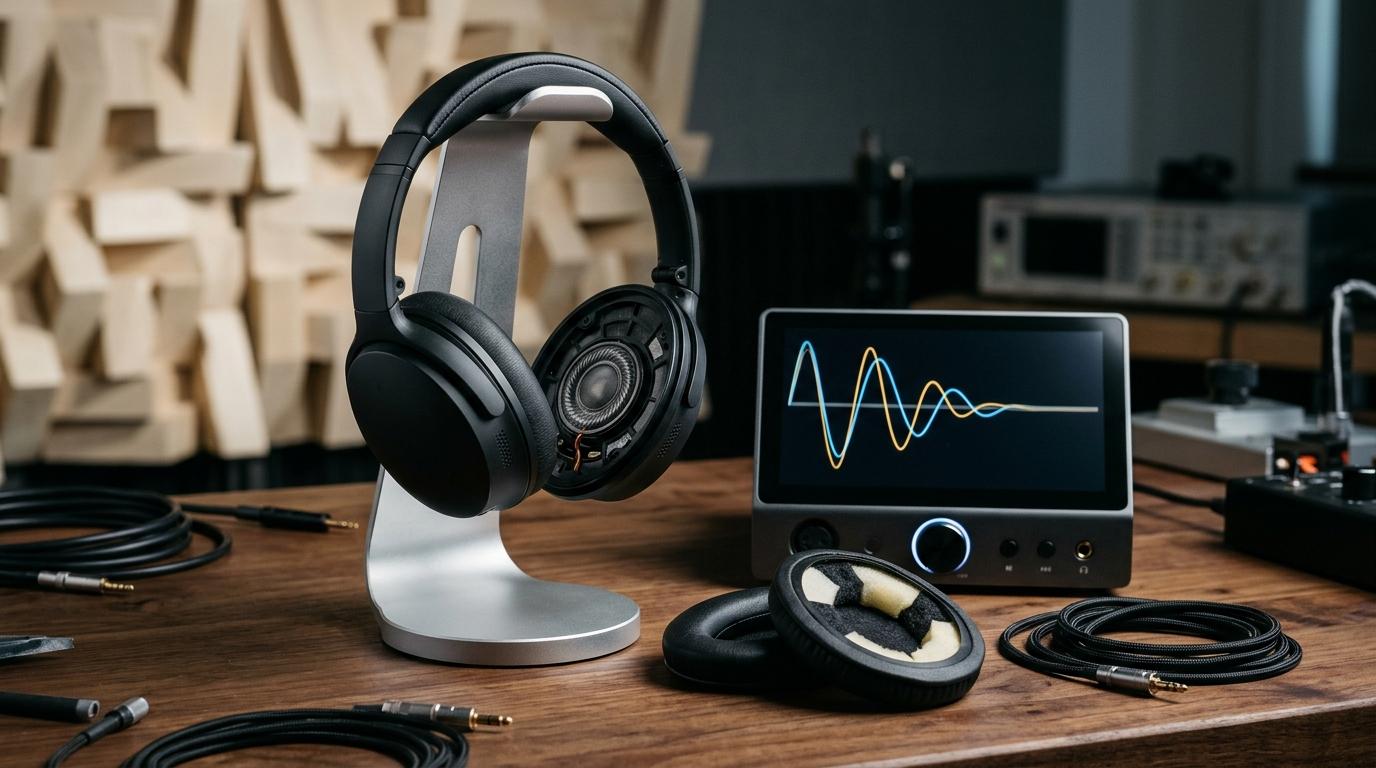
The inverted waveform generated by the headphones is known in audio engineering as anti-noise. Anti-noise is not an abstract electronic signal; it is real, physical sound projected by the headphone's internal speaker driver designed to collide with incoming ambient noise right at the entrance of your ear canal.
| Wave Superposition State | Relative Phase Difference | Algebraic Pressure Sum | Acoustic Outcome at Tympanic Membrane | Real-World Audio Engineering Example |
|---|---|---|---|---|
| Fully Constructive | 0 Degrees (Exact Phase Match) | +1.0 plus +1.0 equals +2.0 | Doubled sound pressure (+6 dB volume boost) | Dual subwoofers placed side-by-side reinforcing bass |
| Partially Constructive | 45 to 90 Degrees | +1.0 plus +0.5 equals +1.5 | Noticeable volume increase and phase comb filtering | Multi-microphone room bleed in recording studios |
| Neutral / Uncorrelated | 90 Degrees (Orthogonal) | +1.0 plus 0.0 equals +1.0 | Unchanged individual amplitudes, combined energy | Two unrelated instruments playing different pitches |
| Partially Destructive | 120 to 160 Degrees | +1.0 plus (-0.7) equals +0.3 | Substantial attenuation (partial volume drop) | Misaligned loudspeaker placement in concert venues |
| Fully Destructive | 180 Degrees (Inverted Phase) | +1.0 plus (-1.0) equals 0.0 | Complete acoustic cancellation (Perceived silence) | Active Noise Cancelling headphones canceling engine rumble |
Passive Isolation vs Active Cancellation: The Frequency Divide
#A common source of confusion among consumers is distinguishing between passive noise isolation and active noise cancellation. In reality, any premium pair of ANC headphones relies on an integrated, two-part hybrid defense where passive and active systems divide the frequency spectrum down the middle.
Passive Noise Isolation: The Mass Law
#Passive isolation is entirely mechanical. It relies on physical density and acoustic damping materials—such as thick, high-density memory foam ear cushions, viscoelastic silicone ear tips, and heavy, sealed polycarbonate ear cup enclosures—to physically obstruct sound waves.
Passive isolation is governed by the Acoustic Mass Law: the sound transmission loss through a physical barrier is directly proportional to the surface mass of the barrier and the frequency of the sound wave. 
- The high-frequency advantage: For high-frequency sounds above 1,000 Hz, wavelengths are tiny (under 30 centimeters). The physical thickness of dense foam and silicone easily absorbs, reflects, and scatters these small wavelengths, providing between 20 dB and 35 dB of physical noise reduction without consuming a single milliwatt of battery power.
- The low-frequency failure: For low-frequency sounds below 200 Hz, wavelengths span several meters. Sound waves this large pass effortlessly through thin plastic ear cups and foam cushions, causing the entire headphone structure to vibrate. To passively block a 100 Hz rumble, an ear cup would need to be several inches thick and weigh over ten pounds, making wearable headphones impossible.
Active Noise Cancellation: The Electronic Solution
#This is where Active Noise Cancellation enters the equation. Active cancellation is completely ineffective at high frequencies, but it excels precisely where passive materials fail: the low-frequency realm below 1,000 Hz.
By combining physical acoustic foam to block treble and high midrange frequencies with digital phase inversion to neutralize low rumbles, modern headphones achieve full-spectrum noise attenuation across the entire 20 Hz to 20,000 Hz audible spectrum.
| Frequency Band | Typical Acoustic Sources | Dominant Attenuation Method | Typical Reduction Depth | Underlying Physical Barrier |
|---|---|---|---|---|
| Sub-Bass (20 Hz to 80 Hz) | Airplane cabin roar, ship engine idle, HVAC rumble | Active Noise Cancellation (ANC) | 20 dB to 30 dB reduction | Passive foam is completely transparent to multi-meter waves |
| Mid-Bass (80 Hz to 250 Hz) | Subway rail hum, bus engine vibration, road tire roar | Active Noise Cancellation (ANC) | 25 dB to 35 dB reduction | Maximum efficiency sweet-spot for digital phase inversion |
| Low Midrange (250 Hz to 800 Hz) | Distant office murmur, vacuum cleaners, lawnmowers | Hybrid Transition (Both ANC and Passive) | 15 dB to 25 dB reduction | Digital processing latency limits begin to restrict phase matching |
| Upper Midrange (800 Hz to 2.5 kHz) | Human speech, crying infants, cafe chatter, keyboard clatter | Passive Noise Isolation (Cushions / Tips) | 15 dB to 25 dB reduction | Waves change too rapidly for real-time DSP computation |
| Treble (2.5 kHz to 20 kHz) | Screeching brakes, whistling wind, glass clinking, hiss | Passive Noise Isolation (Acoustic Damping) | 25 dB to 40 dB reduction | Short wavelengths easily absorbed by viscoelastic foam |
The Three ANC Architectures: Feedforward, Feedback, and Hybrid Systems
#Not all noise cancelling systems are engineered identically. Over the past three decades, acoustic engineers have developed three distinct microphone topologies to capture ambient sound and calculate the anti-noise wave.
1. Feedforward ANC (External Reference System)
#In a feedforward ANC architecture, miniature Micro-Electro-Mechanical Systems (MEMS) microphones are positioned exclusively on the exterior outside surface of the headphone ear cup, facing the external environment.
- The operational workflow: The exterior microphone samples ambient noise before it has time to pass through the ear cup structure. The signal is sent to the digital signal processor (DSP), which inverts the phase, adjusts the amplitude, and commands the internal speaker driver to project the anti-noise into the ear canal just as the external noise penetrates the physical cup.
- The primary advantage: Speed. Because the microphone sits on the outside of the headphone, it detects incoming sound waves roughly 30 to 50 microseconds before they physically reach the ear canal. This gives the DSP crucial lead time to compute the inverted wave.
- The critical limitations: The feedforward microphone has zero ability to hear what is actually happening inside the user's ear canal. It cannot verify whether the cancellation was successful, nor can it correct for acoustic leaks caused by eyeglasses or imperfect ear cushion seals. Furthermore, because the microphone is exposed to the outdoor elements, it is exceptionally vulnerable to wind turbulence.
2. Feedback ANC (Internal Error System)
#In a feedback ANC architecture, the microphone is positioned inside the ear cup cavity, nestled directly in front of the speaker driver and facing the user's ear canal opening.
- The operational workflow: The internal microphone listens to the exact composite sound pressure reaching the user's eardrum—capturing both the incoming external noise that leaked through the physical ear cup and the audio playback from your music. The DSP compares this internal signal against the original music source, extracts the residual noise error, and commands the driver to emit an inverted correction wave.
- The primary advantage: Accuracy. Feedback systems are self-correcting. Because the microphone hears the true acoustic reality inside the ear, it automatically compensates for loose seals, changing ear canal shapes, and head movements.
- The critical limitations: Feedback systems have zero warning. The microphone only detects noise after it has already penetrated the ear cup, leaving the DSP with virtually zero processing time. Consequently, feedback ANC is mathematically unstable above 500 Hz and is prone to generating high-pitched acoustic squeals if the internal gain is pushed too high. Additionally, feedback systems can accidentally cancel the deep bass notes of your music, mistaking low-frequency basslines for unwanted ambient rumble.
3. Hybrid ANC (Dual-Microphone Fusion)
#Hybrid ANC combines both feedforward and feedback architectures into a unified, dual-microphone control loop. A modern hybrid ear cup contains at least two microphones: an exterior feedforward mic sampling the outside world, and an interior feedback mic monitoring the ear canal cavity.
- The operational workflow: The external microphone provides early warning, allowing the DSP to anticipate and synthesize the primary anti-noise wave. Simultaneously, the internal microphone acts as a quality control inspector, analyzing any residual noise that slipped past the primary cancellation and issuing real-time micro-corrections.
- The gold standard: Hybrid ANC eliminates the weaknesses of both individual topologies. It delivers wide-bandwidth cancellation up to 1.5 kHz, automatically compensates for imperfect cushion fit, avoids bass clipping, and suppresses wind noise through multi-mic beamforming algorithms. Nearly all flagship consumer ANC headphones and premium wireless earbuds utilize hybrid architectures.
| ANC Topology | Microphone Arrangement | Target Frequency Bandwidth | DSP Latency Headroom | Seal Dependency | Primary Engineering Tradeoff |
|---|---|---|---|---|---|
| Feedforward ANC | 1 or 2 External Mics Only | 50 Hz to 800 Hz | High Headroom (Catches sound 50 microseconds early) | Low (Ignores internal ear canal state) | Highly susceptible to wind noise, cannot self-correct |
| Feedback ANC | 1 Internal Mic (Inside Ear Cavity) | 20 Hz to 400 Hz | Zero Headroom (Hears noise only after entry) | High (Directly reads internal cavity volume) | Narrow bandwidth, risks bass cancellation and feedback squeal |
| Hybrid ANC | Combined External and Internal Mics | 20 Hz to 1,500 Hz | Balanced Real-Time Dual-Loop Optimization | Adaptive (Internal mic compensates for air leaks) | High battery consumption, complex DSP algorithm calibration |
The Digital Signal Processor: Latency, Sampling Rates, and the Speed of Sound
#The true hero of active noise cancellation is the Digital Signal Processor (DSP)—a specialized microprocessor engineered to execute complex mathematical algorithms at lightning speeds with minimal power draw.
In an active noise cancelling system, the DSP is locked in a relentless physical race against the speed of sound.
The 50-Microsecond Deadline
#Consider the physical dimensions of an over-ear headphone:
- The physical distance between the exterior feedforward microphone and the speaker driver inside the cup is approximately 1.5 to 2.5 centimeters.
- Sound travels through air at 343 meters per second, which translates to roughly 34.3 micrometers per microsecond, or approximately 0.034 millimeters per microsecond.
- A sound wave travels from the exterior microphone to the entrance of your ear canal in approximately 45 to 70 microseconds.
Within that microscopic 50-microsecond window, the headphone's electronic hardware must complete a staggering sequence of computational operations:
- Analog-to-Digital Conversion (ADC): The analog electrical voltage generated by the microphone diaphragm is sampled and digitized into a binary stream, running at studio-grade sampling rates of 192 kHz or 384 kHz.
- Digital Filtering and Inversion: The DSP routes the digital audio through an adaptive digital filter, universally based on the Filtered-X Least Mean Squares (FxLMS) algorithm. The algorithm analyzes the frequency spectrum, models the acoustic transfer function of the physical ear cup, and calculates the exact inverted anti-noise waveform.
- Digital-to-Analog Conversion (DAC): The calculated anti-noise binary data is converted back into an analog electrical current.
- Acoustic Amplification: An internal headphone amplifier drives the electrical current into the voice coil of the speaker driver.
- Physical Diaphragm Movement: The electromagnetic voice coil accelerates the speaker cone forward, projecting the anti-noise pressure wave into the air gap to collide with the incoming sound wave.
The Penalty of Phase Lag
#If this electronic sequence takes even 10 microseconds too long, disaster strikes.
At low frequencies (such as a 100 Hz engine rumble with a 3.4-meter wavelength), a tiny time delay represents an insignificant fraction of the overall wave cycle; the anti-noise arrives with a phase shift very close to 180 degrees, delivering clean cancellation.
However, as frequency climbs toward 2,000 Hz, the entire wave cycle completes in just 500 microseconds. A tiny processing delay of 100 microseconds causes the anti-noise to arrive at a 120-degree phase shift instead of 180 degrees. At 120 degrees out of phase, the anti-noise no longer cancels the incoming sound—it actively reinforces it, making the noise louder! This hard physical latency limit is the primary reason ANC cannot cancel high-frequency sounds.
Why Low Rumbles Disappear While Voices Pierce Through
#A universal experience among owners of noise cancelling headphones is the realization that while the roar of an airplane engine vanishes completely, the voices of nearby passengers, the crying of a baby, or the sudden clatter of fallen silverware remain distinctly audible.
This is not a flaw in your headphones; it is the predictable consequence of acoustics and information entropy.
Active noise cancellation requires predictable, repetitive waveforms. Sound sources in the natural world fall into two distinct acoustic categories:
1. Stationary Low-Frequency Periodic Noise
#Jet engines, subway train wheels, industrial air conditioning compressors, and refrigerator motors produce stationary periodic noise:
- Repetitive wave shapes: The sound wave repeats in smooth, highly predictable sinusoidal oscillations.
- Slow cycle duration: At 100 Hz, a single wave cycle takes 10 milliseconds to complete. Because the wavelength spans several meters, the pressure across the ear cup changes slowly.
- Perfect DSP anticipation: The adaptive FxLMS algorithm can easily model the repeating pattern, compute the inverted wave, and project it with near-perfect phase synchronization. Up to 95 percent of the acoustic energy is eliminated.
2. Non-Stationary High-Frequency Transient Noise
#Human speech, laughing, crying infants, barking dogs, and keyboard clicks represent non-stationary transient noise:
- Random, unpredictable impulses: Human speech consists of sharp, non-repeating consonant plosives (such as "T", "P", "K", and "S" sounds) that burst into existence without warning.
- Rapid cycle duration: Speech frequencies live between 1,000 Hz and 4,000 Hz, where wavelengths span just 8 to 30 centimeters.
- The impossibility of anticipation: A digital signal processor cannot invert a sound wave that it cannot predict. By the time the external microphone registers the initial transient spike of a spoken word, the acoustic wave has already entered the ear canal before the DSP can compute and output the anti-noise.
Any reduction in human voices you experience while wearing headphones is achieved purely by the physical passive isolation of the ear cushions, not by the active electronic cancellation circuitry.
The Mystery of Ear Pressure: Barometric Reality vs Neurological Illusion
#One of the most persistent complaints reported by first-time users of active noise cancelling headphones is an uncomfortable sensation of physical pressure on their eardrums—a feeling universally described as "ear suction," "headphone pressure," or the sensation of descending rapidly in an airplane.
Many users assume that the headphones are physically pumping air into the ear canal or creating a literal barometric vacuum.
Acoustic and medical science has definitively disproven this assumption:
- Physical barometric pressure is completely unchanged: When laboratory researchers place high-precision digital barometers inside headphone ear cups, the air pressure reading with ANC turned on is identical to the ambient barometric pressure of the room. The headphones do not alter static air pressure by a fraction of a millibar.
- The culprit is a neurological sensory illusion: The human brain relies on low-frequency acoustic baseline cues to understand its spatial environment. In the natural world, absolute low-frequency silence does not exist. Even in a silent room, ambient low-frequency room modes and atmospheric air movements stimulate your eardrum.
- The false barometric alarm: In human evolutionary history, there is only one natural circumstance where ambient low-frequency sound suddenly vanishes while high-frequency sound remains: when barometric air pressure drops rapidly, such as when climbing a mountain, riding a high-speed elevator, or flying in an airplane. In those situations, your eardrums bulge outward against the reduced atmospheric pressure.
- The tensor tympani reflex: When ANC eliminates all ambient low-frequency pressure variations in a fraction of a second, your brain is confronted with an acoustic situation it is evolutionary unequipped to interpret. The auditory cortex falsely concludes that the cabin pressure has dropped. In response, the brain involuntarily commands the tensor tympani and stapedius muscles in your middle ear to contract, tightening the eardrum to protect it from perceived barometric expansion. This muscle contraction creates the physical sensation of fullness, suction, and pressure.
For most listeners, the brain adapts within several days of regular use, recognizing the artificial acoustic condition and suppressing the tensor tympani reflex.
The Acoustic Seal: Why Fit and Cushion Density Dictate ANC Performance
#A final, indispensable reality of active noise control is that the most advanced digital signal processor in the world is completely useless without a proper physical acoustic seal.
The complex mathematical transfer functions programmed into the DSP are calibrated around a known, sealed acoustic volume inside the ear cup cavity:
- The acoustic short-circuit: If an ear cushion fails to form an airtight seal against your skull—caused by thick eyeglass frames, heavy facial hair, or an improper headband angle—an acoustic leak occurs.
- Phase cancellation leakage: When sound leaks through a gap, two failures occur simultaneously: external noise bypasses the front of the driver, and the low-frequency anti-noise generated by the speaker escapes out into the room rather than staying pressurized inside the ear cavity.
- Frequency response degradation: An acoustic leak destroys low-frequency performance, causing both the active cancellation and the musical bass response to collapse.
To maximize active noise cancellation performance, users must ensure their ear cushions seat flush against the skull without obstruction, replace compressed or hardened foam pads annually, and select silicone ear tips that form a fully occluded seal within the ear canal.