So, quick confession. For the longest time I honestly thought Maldives = only those fancy water villas you see on Instagram, 60–70k per night, romantic honeymoon, rose petals on the bed, the works. Basically, not for normal middle-class Indians like us who still check Indigo vs AirAsia vs Akasa before booking, you know.
Then I actually went. Stayed on local islands. Ate at small cafes where a full meal was cheaper than a Domino’s order in India. Took public ferries with locals carrying cartons of eggs and school kids in uniforms. And suddenly Maldives became this super real, super doable budget destination instead of just a screensaver.
First Things First: Is Maldives Really Possible on a Budget?
#Short answer: yes. Longer answer: yes, but only if you are okay skipping the private luxury resort experience or keeping it to just 1 night as a splurge. The real budget game is on the local islands.
Maldives has more than 1,000 islands, but only some of them are local inhabited islands where Maldivians actually live. Places like Maafushi, Thulusdhoo, Dhiffushi, Gulhi, Ukulhas, Rasdhoo etc. Here you get guesthouses, small hotels, homestays, local cafes, dive shops – all at prices that don’t give you heart attack when you convert to rupees.
Typical budget (per person, per day) if you plan smart:
- Stay: 3,000 – 6,000 INR (double sharing in a decent guesthouse)
- Food: 800 – 1,500 INR if you eat local food
- Activities: 2,000 – 4,000 INR (snorkeling, sandbank trips, etc.)
You can easily do a 5–6 day trip without burning your entire savings. Flights will still be the biggest chunk though.
How I Reached & Current Travel Scene for Indians
#I flew from Kochi to Malé because South India connections are honestly the best. Mumbai, Bengaluru, Chennai, Kochi, Delhi – all have pretty regular flights now, and new low-cost routes keep popping up as tourism bounces back. Keep an eye on IndiGo, SriLankan, Vistara, FlyDubai, Emirates type combos. Sometimes a one-stop via Colombo or Dubai weirdly turns out cheaper than direct.
For Indians, visa on arrival is still free for up to 30 days, as long as you:
- Have return/onward tickets
- Have hotel bookings (print or at least PDF saved)
- Can show basic funds if they ask (they rarely asked anyone on my flight, but still carry)
Entry rules keep getting updated slightly, but right now it’s fairly smooth: no quarantine nonsense, just usual immigration checks and sometimes quick health forms if there’s any outbreak anywhere. Always double-check once on the official Maldivian tourism or immigration site before flying though, things change randomly in this post-pandemic world.
Local Islands vs Resorts: What I Actually Chose
#I divided my trip:
- 3 nights on Maafushi (most popular local island, budget heaven, little crowded)
- 2 nights on Thulusdhoo (chill surfer vibes, less touristy, my fav)
- 1 night in a somewhat "affordable" resort just to see what the hype is about
If you’re going mainly for budget travel, honestly you can just do local islands and skip resort fully. The water is the same, the sunsets are the same, and you don’t suddenly become a Bollywood celeb just because you’re in an overwater villa. But ya, if it’s your dream, plan 1 night splurge instead of full week.
Where I Stayed & Realistic Price Ranges
#On Maafushi, I stayed in a small guesthouse 3–4 minutes walk from the bikini beach. Clean room, AC, attached bathroom, good Wi‑Fi, breakfast included. Cost me about ₹4,500 per night for two people. Nothing fancy, but honestly we were hardly in the room except to crash at night. Most guesthouses in Maafushi are in the ₹3,000 – ₹7,000 range now, depending on season and how last-minute you book.
On Thulusdhoo, things felt a bit more spaced out and relaxed. I stayed in a slightly newer property, super cute, with a tiny courtyard full of plants and a cat that adopted us. That one was around ₹5,000 per night. I noticed Thulusdhoo has fewer really cheap stays compared to Maafushi, but in exchange you get more peace, less crowd, especially at sunset.
Now about that resort night – I found a deal for around ₹18,000 per night including breakfast and speedboat transfer from Malé. This is actually considered budget by Maldivian resort standards. Some of the big names still go 60–1 lakh per night in peak season. If you’re going in off-season or mid-week, keep stalking booking sites, there are genuinely good deals popping up nowadays because resorts want to fill rooms.
Getting Around: Public Ferries, Speedboats & That One Time I Almost Missed Mine
#Public ferries are the actual hack that keep Maldives budget-friendly. They cost like 1–3 USD for routes around Malé Atoll. That’s basically ₹80–250. The catch? They’re slow, and timings are very fixed, often no late-night ferries, and some don’t run on Fridays (weekend there).
Typical options:
- Airport to Malé city: public ferry (around 10 minutes, ₹60–70) or airport taxi/boat
- Malé to Maafushi: public ferry (cheap, 1.5 hours), or shared speedboat (~30–40 USD)
- Maafushi to Thulusdhoo: I did a combo – Maafushi to Malé, then another boat to Thulusdhoo
One day I was chilling too long on the beach, lost track of time, and we literally ran with our backpacks to catch the public ferry. The crew guy was laughing seeing us panic and just casually said, “Don’t worry, we are running late anyway.” Island time is a different universe yaar.
What About Food? (And Yes, Veg Options)
#Food was honestly one of my fav parts because it reminded me a bit of Kerala mixed with Sri Lanka, with its own twist. Lots of tuna, coconut, rice, roshi (flatbread) and fried snacks.
Must-try local stuff:
- Mas huni: shredded tuna with coconut, onion, chilli, eaten with roshi for breakfast
- Bis keemiya: kind of like a mini samosa roll
- Garudhiya: clear fish soup with rice and lime
A basic meal in a local café cost me around 40–80 MVR (₹220–450) depending if I went full hungry hippo mode. Tourist restaurants facing the beach obviously charge more.
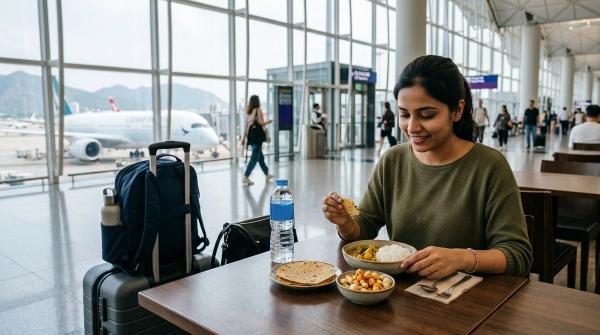
For my fellow vegetarians: you won’t starve, but don’t expect massive variety on local islands. You’ll get fried rice, veg noodles, some curries, snacks, fruit juices, sandwiches. Many guesthouses also cook custom veg meals if you tell them in advance. I met a Gujarati family in Maafushi who had convinced the staff to make aloo paratha type thing for breakfast, so ya jugaad always works.
Local Culture, Rules & That Whole Alcohol Situation
#Tiny but important point: local islands are Muslim, and they follow local laws quite strictly. So:
- No alcohol on local islands. Seriously, none. Not even in restaurants.
- Bikinis only on designated bikini beaches, not on public beaches used by locals
- Dress modestly when you’re walking around inside the village area
If you really want drinks, that’s only in resorts or special “floating bars” anchored off some local islands, where speedboats take you out. Honestly, I didn’t feel like I missed anything. Juice culture is strong there. I was busy overdosing on passion fruit juice and black coffee anyway.
Best Time to Visit & Weather Reality
#Broadly you’ll hear: November to April is the best season – blue skies, calmer seas, more expensive. May to October is wetter, with random showers and some rough seas, but cheaper deals and still plenty of sunshine. I actually went towards the end of the so-called rainy period, and it rained heavily one evening… then next morning was full postcard Maldives again.
If you’re planning for 2026 and beyond, I’d say pick shoulder months like November or March – you usually get a nice balance of price and weather. Just remember, climate has gone full drama mode everywhere, so don’t rely too much on predictions. Carry a light rain jacket, waterproof pouch for your phone, and just go with the flow.
Activities That Are Actually Worth Paying For
#I’m not that person who pays for every single excursion operators scream about. So I chose a few carefully. On the local islands, typical trips include:
- Snorkeling trips (2–3 spots): turtles, reef fish, sometimes sharks – around 25–40 USD
- Sandbank + picnic: they take you to a tiny island/sand strip, insanely beautiful – 30–50 USD
- Dolphin cruise: sunset trip, if you’re lucky you see full pods of dolphins
- Scuba diving: around 60–80 USD per dive for beginners
The best one for me was a half‑day snorkeling + sandbank from Thulusdhoo. We snorkeled near this reef where I saw my first shark in the wild. I panicked for 0.5 seconds, then the guide was like, “They don’t care about you, relax.” And he was right. The shark just glided past like I didn’t exist.
If you’re on a tight budget, at least do:
- One snorkeling trip
- One sandbank or picnic trip
The rest of the time, house reefs off the beach are already so good, you don’t need to keep spending.
Money-Saving Tips I Wish Someone Had Told Me Earlier
#Let me be blunt, I made some silly mistakes. Don’t repeat mine:
- Use USD smartly, but carry some MVR too: Most tours, stays quote in USD, but local cafes + shops often easier in Maldivian Rufiyaa. I used card a lot, but small places prefer cash.
- Book stays with breakfast included: Island food costs add up, one less meal to worry about.
- Public ferries whenever possible: Yes they’re slower, but super cheap and fun for people-watching.
- Tap water is generally not drunk, so you’ll buy bottles – bring a big bottle and refill from 5L canisters where available; some guesthouses provide filtered water.
- Don’t overpack. I basically lived in 2 shorts, 3 T‑shirts, 1 swimsuit, one loose dress, and a stole. That’s it.
Is It Safe? Especially for Solo or Couple Travellers from India
#I went with a friend, but I met two solo Indian girls staying in Maafushi and one solo guy in Thulusdhoo. All of them felt pretty safe. Local islands are small, people know each other, and crime rates are low, especially against tourists. Of course, basic common sense everywhere – don’t leave phones lying on the beach, don’t get into random boats with no name, check reviews before booking stays.
Health-wise, normal stuff: decent medical facilities are there in and around Malé, smaller clinics on some local islands. Travel insurance is honestly a good idea now. Seas can be rough on some days, so if you get motion sick like me and him did, carry that one tablet your mom always packs in your bag and says, “Just in case.”
Final Thoughts: Maldives Doesn’t Have to Be a Rich-People-Only Dream
#Standing on a tiny sandbank, water that unnatural turquoise colour all around, I had this funny moment – like, I’m just some random Indian kid who grew up thinking international trips are this huge, unreachable thing. And here I was, in Maldives, on a budget that didn’t murder my bank account.
If you’re planning Maldives on a budget in 2026 or later, focus on:
- Local islands over full‑time resort
- Guesthouses with breakfast
- Public ferries
- A couple of carefully chosen activities instead of everything
Do that, and trust me, it’ll feel less like a luxury magazine and more like a real place you actually connect with – faces you recognise at the café, same guy making your coffee every morning, kids playing football near the jetty at sunset, that sort of thing.
I’m already low-key plotting a second trip, maybe Rasdhoo + Ukulhas next time. If you’re also in that stage of 20 tabs open, comparing islands and hotels, you can totally deep dive more guides and ideas on AllBlogs.in – I keep landing there whenever I’m planning my next escape anyway.