So uh… it’s 2026, and I swear my phone has more opinions about my life than my actual friends. Like, it knows when I’m “stressed” (apparently my typing speed gives me away??), it knows when I slept bad, and it def knows when I’m doomscrolling at 1:17am with one eye open.
Anyway. I’ve been thinking a LOT about digital wellness lately, not in a preachy “delete all apps and move to a cabin” way (I’d miss delivery too much), but in a tiny, realistic, very human way. And the thing that’s actually worked for me is micro-habit stacking.
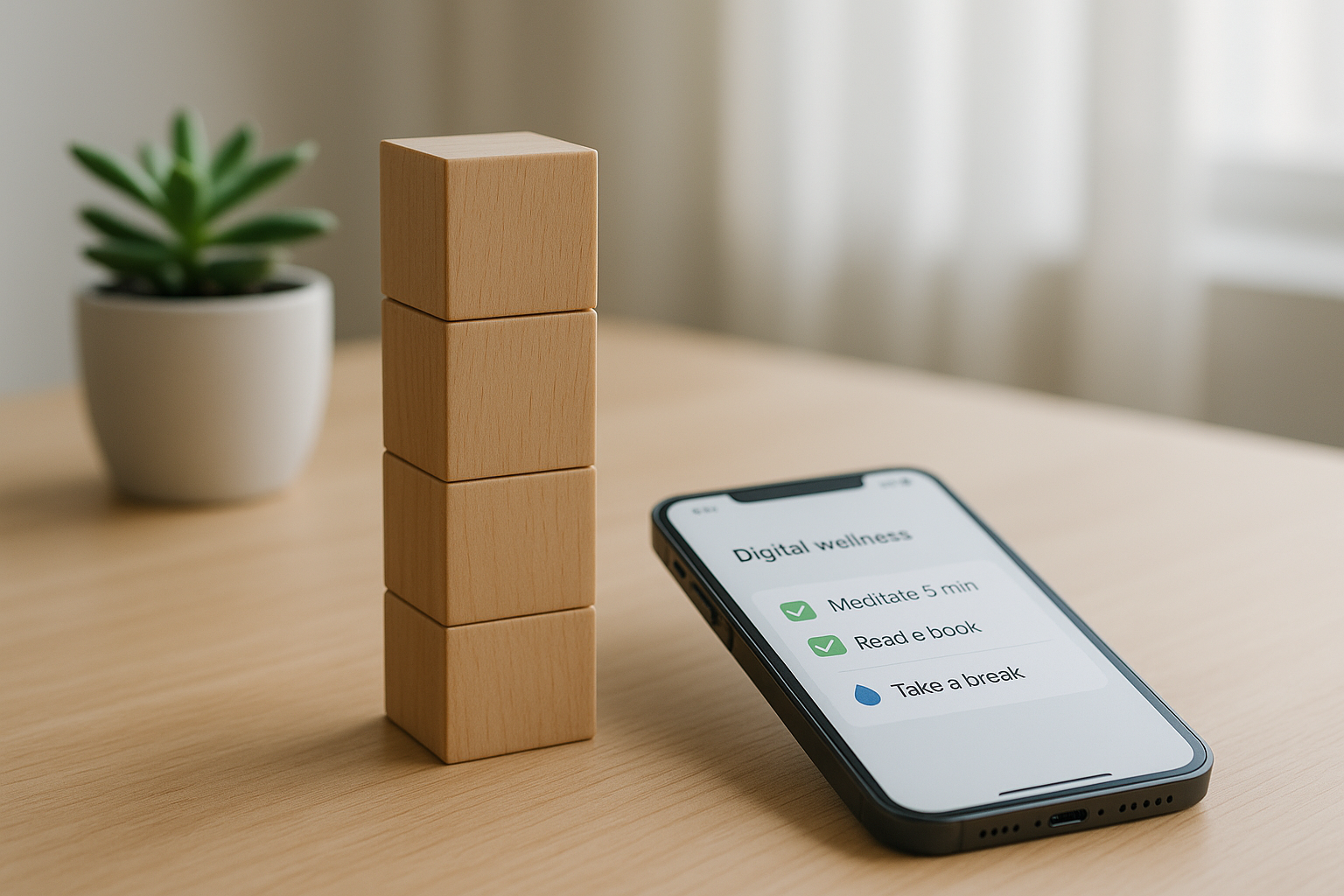
Not the big dramatic stuff. Not “I will meditate 45 minutes daily while journaling in Italian.” No. More like… I put my phone face-down when I sit to eat. That’s it. That’s the habit. And then I stack another tiny thing on top. And then another. Like little LEGO bricks for your brain.
Also yes, I’m writing this with coffee at my kitchen table, and I already spilled some on my sock, so we’re off to a strong start.
Wait, what even is micro-habit stacking? (without the self-help cringe)
#Habit stacking isn’t new-new. People have been doing it forever. It’s basically attaching a new habit to something you already do automatically, like brushing your teeth. Micro-habit stacking just makes it… smaller. Like laughably small.
Instead of “I will reduce screen time by 2 hours,” it’s “When I unlock my phone, I take one breath first.” That’s it. It feels almost too dumb to matter, and then somehow it does.
And in 2026, digital life is kinda… thicker? Like the internet isn’t just a place you go anymore. It’s in your glasses, your car dash, your watch, your fridge (why does my fridge want me to review my groceries??). So digital wellness can’t be a one-and-done detox. It’s more like hygiene. You do it a little, all the time, or it gets gross.
I think micro-habits are the only thing that scale with how insane our tech is getting.
Why 2026 specifically feels like the tipping point (at least to me)
#Okay, mild rant. The last year-ish has been wild for “attention tech.” Everything is optimized to keep you engaged, but now it’s not just social apps. It’s AI companions, auto-generated video feeds that literally never end, shopping streams, news summaries that update every 5 seconds, and workplace tools that ping you like a needy bird. And yes, we have more digital wellness features built-in now. Apple, Google, Microsoft… they all do the dashboards, Focus modes, bedtime nudges, etc. But most people I know just swipe those away. I do too, on occassion. (There, you got your typo.) Also, the vibes shifted. More people are openly talking about being mentally tired from being “always on.” Not like burnout from work only, but burnout from… everything having a notification. I don’t have perfect “2026 stats” because I’m not magically plugged into every research lab (and I’m not gonna fake it, that’s gross). But the trend is obvious: more screen time, more notifications, more content, more people saying they can’t focus like they used to. That part is real. You can feel it in your bones. So I started building a little system. Not strict. Not perfect. Just… better.
My actual turning point (spoiler: it was embarrassing)
#I remember this super specific moment: me and him (my partner) went out for lunch, and I kept checking my phone under the table like a teenager hiding a vape. Not even for anything important. Just… reflex.
And he goes, "Are you waiting for someone to die?"
Which is a terrible joke but also… yeah. Why am I acting like my lock screen is the emergency room.
That night, I checked my screen-time thing and it was… not cute. I’m not even gonna tell you the number because I’ll die twice.
So I didn’t do a digital detox. I did micro-habit stacking. I picked ONE moment in the day and made it slightly healthier. Then I stacked it onto stuff I already did, so I didn’t have to rely on motivation (because my motivation is a flake).
The core idea: pick “anchors” you already do on autopilot
#Anchors are basically routines you already do without thinking. Like:
- waking up and grabbing your phone (yep)
- making coffee
- sitting down at your desk
- using the bathroom (sorry but true)
- eating
- getting into bed
You take ONE anchor and attach a micro-habit to it. Then after a week-ish, you attach another micro-habit. The stacking part is important, but the “micro” part is what keeps it from turning into a whole personality.
Also, quick note: you don’t need 15 habits. Honestly 3-5 good ones changes your whole relationship with tech. More than that and you’ll rebel and start scrolling out of spite.
My 2026 micro-habit stack (realistic, not saint-like)
#Here’s what I do right now. I’m not saying it’s the best stack on Earth, it’s just what I can actually stick to even on messy days.
And yes, sometimes I mess up. Like yesterday I said I’d do “no phone in bed” and then I was reading about some random celebrity drama at 12:40am. So. You know.
Stack #1: The “unlock ritual” (takes literally 2 seconds)
#Anchor: unlocking my phone.
Micro-habit: before I open anything, I do one slow breath and ask: “What am I here for?”
That’s it. Breath + question.
Sounds cheesy. But it catches the mindless opens. Like… you know when you open your phone and suddenly you’re on an app you didn’t even choose? That.
Sometimes the answer is legit: “I need directions” or “I need to text my mom back.” Sometimes it’s “I am bored and scared of my own thoughts.” And then I’m like… okay, fair, but maybe we walk to the window instead.
Not always. But more than before.
- Tiny upgrade I added in 2026: I put the most distracting apps behind a second screen + inside a folder named “u sure??” (it works because it’s slightly annoying).
Stack #2: Notification dieting (not total fasting)
#Anchor: Sunday evening, when I’m already doing my “life admin” stuff.
Micro-habit: I review notifications for ONE app. Just one. Not the whole phone.
Week 1: turn off marketing promos from shopping apps.
Week 2: turn off random “recommended for you” pings.
Week 3: move non-urgent stuff to scheduled summaries.
A lot of phones and apps in 2026 have gotten better about bundling alerts into digests, and honestly that feature is underrated. The key is to not do the full “I turned everything off and now I miss my dentist appointment” thing. Been there, it’s not fun.
I keep calls, texts from real people, calendar, bank alerts. The rest has to earn it.
Digital wellness isn’t about becoming unreachable. It’s about deciding what deserves to reach you.
Stack #3: “First 10 minutes are analog” (my fave, but I still fail sometimes)
#Anchor: waking up.
Micro-habit: first 10 minutes, no screen. I can do anything else.
Sometimes I just sit there like a confused squirrel. Sometimes I stretch. Sometimes I stare at the wall and think about what emails I probably ignored. But it helps.
I used to wake up and immediately absorb the whole world’s problems via headlines + group chats + a weird AI summary widget that thinks I care about crypto (I do not).
That first 10 minutes being screen-free changes the day’s texture. Feels less jagged.
And yeah, if you have kids or a job that requires early contact, adjust it. Make it 3 minutes. The number doesn’t matter as much as the boundary.
Micro-habit stacking for work (because office tools got… intense)
#If you work on a computer all day in 2026, you already know: it’s not just email anymore. It’s Slack/Teams/Discord/whatever, plus AI copilots popping suggestions, plus docs that update live, plus meeting transcripts auto-summarizing (which is cool but also… why am I in the meeting then??).
So my work stack is built around reducing context switching, not being some productivity robot.
Anchor: opening my laptop.
Micro-habit: I open my task list FIRST, not my inbox.
Because inbox-first is like walking into a casino to “just check something.” You’ll lose two hours and gain 14 emotions.
- When I sit down at my desk, I write the ONE thing that would make today a win (on paper, not an app).
- Before I open chat apps, I do 25 minutes of “silent work” with notifications muted (even if it’s messy work).
- After any meeting, I stand up and look at something far away for 20 seconds. Sounds random but it stops the “meeting blob” effect where your brain melts.
Also, eye strain is real. I’m not a doctor, but I’ve noticed more people using those newer e-ink-ish secondary displays in 2026, or at least warmer color profiles. I just… remember to blink now. Which is sad, but here we are.
The sneaky part: AI is helpful, but it also adds noise
#I love AI tools. I use them. But the thing nobody tells you is: they increase the amount of “possible” you can do. Which increases the feeling that you should do more.
Like, if an assistant can summarize 30 articles, suddenly you feel behind if you didn’t read 30 articles. Even though nobody asked you to.
So one of my micro-habits is literally:
Anchor: when an AI tool offers “10 more options.”
Micro-habit: I pick ONE and move on.
I don’t need the 10 best caption ideas. I need a caption. My brain loves the buffet, but my life needs a meal.
Also, sometimes I purposely don’t automate stuff because the tiny friction keeps me sane. Automating everything makes life too… slippery. If that makes sense.
How to build your own stack (without doing that all-or-nothing thing)
#Here’s the method I’d tell a friend over coffee, not like a guru on a stage.
1) Pick ONE pain point. Like “I scroll in bed” or “I check work chat every 4 minutes.”
2) Pick ONE anchor that happens right before the pain point.
3) Add a micro-habit that is so small you can’t argue with it.
4) Keep it for a week.
5) Only then stack another.
And please don’t try to become a brand new person on Monday morning. Monday morning you is delusional. Wednesday afternoon you is the real decision-maker.
Examples (steal these, seriously, I stole most of mine too)
#A few stacks that work weirdly well:
Anchor: plugging in your phone at night → Micro-habit: phone charges outside the bedroom (or at least across the room)
Anchor: opening TikTok/Reels/Shorts → Micro-habit: watch ONE video, then put the phone down and ask “am I done?”
Anchor: getting a notification → Micro-habit: wait 5 seconds before tapping it
Anchor: finishing a YouTube video → Micro-habit: close the app before deciding on the next one (interrupt autoplay)
Anchor: walking into the bathroom → Micro-habit: leave phone outside (I know, scary)
Not all of these will fit your life. But one of them will probably annoy you a little, which is how you know it’s hitting the right spot.
The “friction is your friend” principle (ugh but true)
#We spent like a decade making everything smoother, faster, frictionless. One-tap buys. One-tap dopamine. One-tap “oh no it’s been 40 minutes.”
Micro-habit stacking works because it adds tiny friction in the exact place you leak attention.
Not huge walls. Not “delete everything.” Just… a speed bump.
Like putting your most addictive app one swipe farther away. Or logging out (yes, it’s annoying, that’s the point). Or turning your screen grayscale at night. I thought grayscale was dumb until I tried it and suddenly my phone was as exciting as a toaster.
Friction doesn’t have to be punishment. It’s just design.
Stuff I messed up (so you don’t have to, hopefully)
#Okay so, mistakes. I made plenty.
One time I tried to do a “perfect morning routine” stack: no phone, meditation, journaling, workout, cold shower (why), plus a gratitude list. And it lasted… two days. Then I felt like a failure and went right back to old habits, but worse, because now I was mad at myself.
Another time I turned off too many notifications and missed a package delivery update, and my box got stolen. So that was fun.
What I learned:
- If your micro-habit requires willpower, it’s not micro enough.
- If your stack makes you feel morally superior, it will eventually humble you. Life hates smug.
- If you break the habit, don’t “restart Monday.” Just do it next anchor. Next unlock. Next meal. Next bedtime.
- Also I keep trying to ban my phone from the couch. It’s… not going great. The couch is my weakness. I’m working on it lol.
A quick note about teens/kids (I’m not a parent, but I’ve watched my friends struggle)
#I’m not gonna pretend I have the perfect answer here. But I’ve noticed something with my friends who have kids: the more they focus on family micro-habits instead of policing apps 24/7, the calmer it gets.
Like:
Anchor: family dinner → Micro-habit: phones in a basket (adults too)
Anchor: after school → Micro-habit: 10 minutes of “decompress” before screens
Anchor: bedtime → Micro-habit: charging outside bedrooms
It’s not about being strict, it’s about making the default healthier.
And honestly, adults need this as much as kids. Maybe more. Because we’re the ones who pretend we’re “too busy” to be addicted, which is… a lie sometimes.
My favorite “lazy” stack for social media (because I’m not deleting it, sorry)
#I like social media. I’ve found recipes there. I’ve found funny niche communities. I’ve learned stuff.
But it also eats my brain if I let it.
So here’s my lazy but effective stack:
Anchor: opening any social app → Micro-habit: set a 7-minute timer. Yes, a literal timer.
When it rings, I either stop or I set it again on purpose. The on-purpose part is what matters.
And sometimes I ignore it. But even ignoring it, I noticed the timer makes me more aware. Awareness is half the battle, as they say. (Who is they? No idea.)
I’m not trying to use social media less. I’m trying to use it like I chose it.
Digital wellness tools in 2026 that I actually like (and don’t feel preachy)
#Some 2026-ish features that feel genuinely helpful lately:
- Scheduled notification summaries (less drip-drip-drip all day)
- Focus modes tied to location (work mode at work, chill mode at home)
- App limits that ask for a reason before extending (that tiny pause matters)
- “Downtime” that still lets your real people through
Also, I know more folks using minimalist launchers, or swapping to less addictive home screens. Like, boring wallpaper, no widgets screaming at you, just the essentials.
And weirdly… physical alarm clocks are back. I bought one. It’s ugly. I love it.
If you only do ONE thing this week, do this
#Pick ONE anchor you do every day.
Mine: making coffee.
Then stack ONE micro-habit onto it:
When the coffee brews, I don’t pick up my phone. I just… wait. Look out the window. Pet the cat. Think one thought all the way through (rare!).
That’s maybe 90 seconds. And it’s honestly the most peaceful part of my day sometimes.
If you do nothing else, do that. A tiny pocket of no-input. It’s like giving your brain a sip of water.
Last thing: don’t turn this into a new way to hate yourself
#Digital wellness can get weirdly moral, like if you scroll you’re “bad” and if you read books you’re “good.” Nah.
This is about feeling better in your actual life. Feeling less scattered. Less twitchy. Less like your attention got chopped into confetti.
Some weeks I’m great at my stack. Some weeks I’m a chaos goblin with 19 tabs open and my phone in my hand while I’m looking for my phone.
But micro-habit stacking is forgiving. You don’t “fail” it. You just return to the next anchor. That’s why I love it.
Alright, I’m gonna wrap this up before my coffee gets cold and I start rambling about notification typography or whatever.
If you try a stack, tell me what anchor you picked. I’m nosy and I love hearing what works for real people (not productivity cyborgs).
And if you’re in the mood to read more human-ish blogs about stuff like this, I’ve been poking around AllBlogs.in lately and there’s honestly some good gems on there.