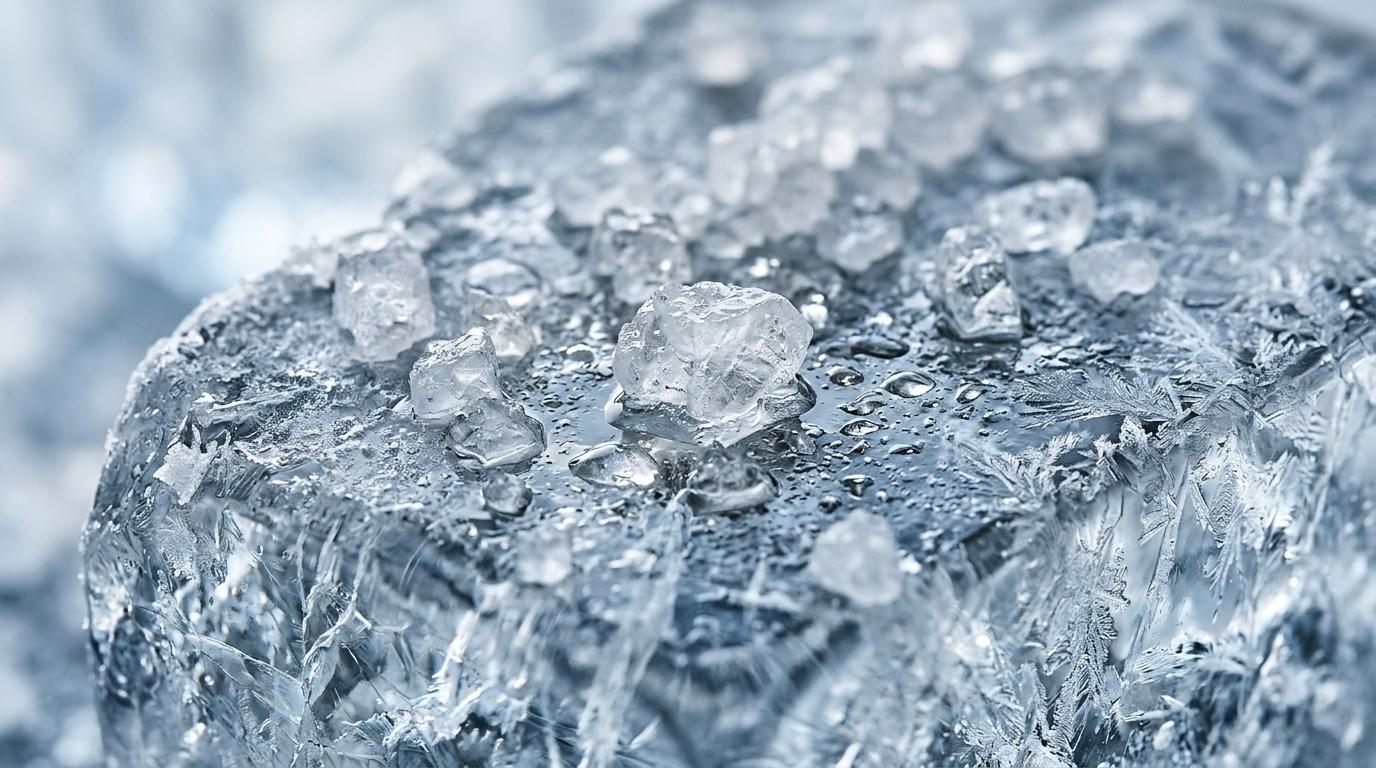
Every winter across temperate and sub-polar regions of the world, millions of tons of coarse white crystals are scattered across highways, pedestrian sidewalks, airport runways, and residential driveways. Within minutes of contact with treacherous frozen surfaces, the ice begins to pit, crack, and turn into a slushy brine. 
To the casual observer, it appears as though salt possesses some form of internal thermal magic—as if scattering sodium chloride onto frozen ground acts like an invisible blowtorch generating instant heat to melt solid ice.
In reality, salt does not melt ice by producing heat. In fact, the physical chemistry of dissolving salt in water is often endothermic, actually absorbing heat and lowering the temperature of the liquid. Salt melts ice through a fundamental thermodynamic principle of physical chemistry known as freezing point depression. By exploiting the microscopic battle between water molecules attempting to arrange into rigid crystal lattices, dissolved salt disrupts the thermodynamic balance of freezing, forcing solid ice into a liquid state at temperatures far below the normal freezing point of pure water.
Understanding why salt melts ice requires exploring the microscopic dynamics of ice surfaces, the colligative properties of chemical solutions, the chemical limits of eutectic mixtures, and the practical winter tradeoffs between common rock salt, calcium chloride, concrete durability, and environmental safety.
The Microscopic Reality: The Liquid Quasi-Liquid Layer
#To understand how salt interacts with ice, one must first dismantle a common misconception: solid ice is not completely dry.
Even in sub-freezing temperatures down to minus thirty degrees Celsius, the outer surface of any ice block or snowpack is coated in a microscopic, disordered film of mobile water molecules known in surface physics as the quasi-liquid layer (QLL). First hypothesized by the English physicist Michael Faraday in 1850 and confirmed through modern atomic force microscopy and X-ray scattering, this quasi-liquid layer exists because water molecules on the extreme surface lack neighboring water molecules above them to complete their four-coordinated hydrogen-bonded crystal lattice. As a result, surface molecules remain in a perpetually disordered, fluid-like state.
At exactly zero degrees Celsius (thirty-two degrees Fahrenheit) under standard atmospheric pressure, pure water and pure ice exist in a state of dynamic thermodynamic equilibrium:
- Water molecules in the solid ice lattice are constantly breaking free into the liquid layer at a specific rate (the rate of melting).
- Simultaneously, water molecules in the liquid film are constantly slowing down, aligning their hydrogen bonds, and locking back into the solid crystal lattice at an identical rate (the rate of freezing).
Because the rate of melting perfectly balances the rate of freezing, the net amount of ice and liquid water remains constant. If the ambient air temperature drops to minus five degrees Celsius, the rate of freezing exceeds the rate of melting, and the liquid film rapidly solidifies into solid ice. If the temperature rises to plus five degrees Celsius, the rate of melting exceeds the rate of freezing, and the ice block converts into liquid water.
This dynamic equilibrium is the exact biological and physical vulnerability that salt exploits.
Colligative Properties and Freezing Point Depression
#When you toss rock salt (sodium chloride, chemical formula NaCl) onto an icy sidewalk, the salt crystals cannot react with solid ice directly. Instead, the salt grains dissolve into the microscopic quasi-liquid film of moisture coating the ice surface.
As sodium chloride dissolves, the strong electrostatic attractions of polar water molecules pull the ionic crystal apart, splitting each NaCl formula unit into two independent, charged particles: a positively charged sodium cation (Na+) and a negatively charged chloride anion (Cl-).
This dissolution fundamentally alters the physical behavior of the liquid. In physical chemistry, properties that depend solely on the number of solute particles dissolved in a solvent—rather than the chemical identity or size of those particles—are called colligative properties. Freezing point depression is one of the classic colligative properties of matter.
In pure liquid water, molecules need only slow down and align their positively charged hydrogen atoms with the negatively charged oxygen atoms of adjacent water molecules to form open, hexagonal crystal rings. This unique geometric arrangement is also the exact reason water expands upon freezing, making solid ice less dense than liquid water—a foundational anomaly of nature explored in depth in our companion scientific guide on Why Does Ice Float?.
However, when salt is introduced into the water film, the dissolved sodium and chloride ions become surrounded by hydration shells of water molecules. These hydrated ions physically crowd the solution:
- They get in the physical path of water molecules attempting to approach the growing ice lattice.
- They disrupt the precise bond angles required to construct hexagonal ice crystals.
- Because a significant fraction of the surface area is now occupied by foreign salt ions, fewer pure water molecules can collide with and attach to the ice surface per second.
Crucially, the presence of dissolved salt does not slow down the rate at which molecules escape from the ice into the liquid; molecules continue to break away from the ice lattice at the normal rate determined by ambient temperature. But the salt severely slows down the rate at which liquid molecules can freeze back onto the ice.
Because the rate of melting now far exceeds the rate of freezing, the dynamic equilibrium collapses. Ice molecules break free into the liquid phase faster than they can re-freeze. The ice melts into liquid water—not because heat was added, but because the chemical freezing point of the mixture has been depressed below the ambient air temperature.
The Mathematical Physics: Blagden's Law and Particle Counts
#The degree to which a solute depresses the freezing point of a solvent is mathematically expressed by Blagden's Law (formulated by English physician and scientist Sir Charles Blagden in 1788):
51029\Delta T_f = i \cdot K_f \cdot m51029
Where:
- $\Delta T_f$ is the freezing point depression (the drop in freezing temperature in degrees Celsius).
- $ is the van 't Hoff factor, representing the number of discrete ions or particles a solute dissociates into when dissolved.
- $ is the cryoscopic constant of the solvent (for pure water, $ is a constant value of approximately 1.86 °C·kg/mol).
- $ is the molality of the solution (moles of solute per kilogram of solvent).
The van 't Hoff factor ($) reveals why different deicing chemicals possess dramatically different melting efficiencies:
- Sucrose (Table Sugar): Does not dissociate into ions; it dissolves as single intact molecules ( = 1$). A one-molal sugar solution depresses the freezing point of water by only 1.86°C.
- Sodium Chloride (Rock Salt, NaCl): Dissociates into two ions (one Na+ and one Cl-), yielding a theoretical van 't Hoff factor of = 2$. A one-molal salt solution depresses the freezing point of water by approximately 3.72°C.
- Calcium Chloride (CaCl2): Dissociates into three ions (one Ca2+ and two Cl-), yielding a theoretical van 't Hoff factor of = 3$. A one-molal calcium chloride solution depresses the freezing point by approximately 5.58°C.
- Magnesium Chloride (MgCl2): Dissociates into three ions (one Mg2+ and two Cl-), yielding = 3$.
Because calcium chloride and magnesium chloride release three active particles per molecule instead of two, they are inherently more potent freezing point depressors per mole than traditional rock salt.
The Thermal Paradox: Endothermic vs Exothermic Deicers
#A common household myth is that rock salt chemically heats up the ice. In truth, the dissolution of standard rock salt (sodium chloride) in water is an endothermic reaction—it requires an input of enthalpy ($\Delta H_{soln} > 0$), meaning it actually absorbs thermal energy from its immediate surroundings!
When solid sodium chloride dissolves in water, energy is consumed to break the ionic bonds holding the crystal lattice together. This energy exceeds the energy released when water molecules hydrate the separated ions. As a result, dissolving rock salt in water causes the temperature of the resulting brine to drop significantly.
This thermal absorption is the exact scientific principle behind traditional old-fashioned ice cream makers. When you pack an outer bucket with ice cubes and heavy rock salt, the salt dissolves into the melting ice film, depressing the freezing point. To satisfy the endothermic heat of solution and latent heat of fusion, the mixture pulls thermal energy out of the liquid ice cream base through the metal canister wall, cooling the saltwater slush down to minus ten or minus fifteen degrees Celsius—cold enough to freeze the churned cream into solid ice cream.
In sharp contrast to rock salt, modern premium chemical deicers such as calcium chloride ($ ext{CaCl}2$) exhibit a powerful exothermic heat of solution ($\Delta H{soln} < 0$). When dry calcium chloride pellets come into contact with moisture, they release substantial thermal energy into the surrounding environment as their ions undergo hydration. Calcium chloride deicers literally generate their own physical heat while simultaneously depressing the freezing point, allowing them to melt through thick ice layers with blistering speed.
The Eutectic Point: Why Rock Salt Stops Working at -9°C
#While rock salt is inexpensive, abundant, and widely used, it has strict, non-negotiable physical limits dictated by the phase diagram of water and sodium chloride.
As salt dissolves into ice, the brine solution becomes progressively more concentrated, lowering the freezing point further. However, you cannot dissolve an infinite amount of salt in water. Eventually, the water reaches its saturation limit. 
The point on a phase diagram where a chemical mixture achieves its absolute lowest possible freezing temperature is known as the eutectic point. For a sodium chloride-water system, the eutectic point occurs at a salt concentration of 23.3% by weight, which corresponds to a freezing temperature of -21.1°C (-6.0°F). In theory, a perfectly saturated salt brine will remain liquid down to -21.1°C.
In the real world of municipal roads and residential driveways, however, rock salt loses practical effectiveness long before it reaches this theoretical laboratory limit:
| Deicing Compound | Chemical Formula | Effective Field Temperature Limit | Theoretical Eutectic Point | Thermal Reaction Type |
|---|---|---|---|---|
| Sodium Chloride (Rock Salt) | NaCl | -9°C (15°F) | -21.1°C (-6.0°F) | Endothermic (absorbs heat) |
| Magnesium Chloride | MgCl2 | -15°C (5°F) | -33.0°C (-27.4°F) | Exothermic (mildly releases heat) |
| Calcium Chloride | CaCl2 | -29°C (-20°F) | -51.0°C (-59.8°F) | Exothermic (strongly releases heat) |
| Potassium Chloride | KCl | -4°C (25°F) | -10.6°C (12.9°F) | Endothermic (absorbs heat) |
| Calcium Magnesium Acetate | CMA | -7°C (20°F) | -27.5°C (-17.5°F) | Endothermic (absorbs heat) |
Why does rock salt fail when temperatures drop below minus nine degrees Celsius? 
Three physical bottlenecks emerge in deep sub-zero conditions:
- Disappearance of the Liquid Layer: At temperatures below -9°C, the surface quasi-liquid film on ice becomes vanishingly thin, meaning there is virtually no free liquid available to initiate salt dissolution.
- Sluggish Reaction Kinetics: Chemical dissolution rates decrease exponentially as temperature drops. Below -9°C, rock salt dissolves so slowly that the rate of ice melting becomes practically imperceptible.
- Dilution Penalty: As soon as salt melts a small pocket of ice, the resulting meltwater dilutes the salt concentration. In freezing air, this newly diluted brine immediately freezes back into solid ice, creating a slick sheet of black ice that is more dangerous than the original snowpack.
When Arctic air masses plunge temperatures below minus nine degrees Celsius, highway departments stop spreading solid rock salt and switch to liquid calcium chloride sprays, magnesium chloride, or abrasive traction agents like sand and crushed volcanic cinder.
Collateral Damage: Concrete Spalling, Corrosion, and Pets
#While deicing salts provide indispensable safety benefits for winter mobility, their chemical and physical actions impose heavy collateral costs on infrastructure, vegetation, and domestic animals.
1. Concrete Spalling and Scaling
#A widespread urban myth holds that salt chemically corrodes and eats concrete surfaces. In reality, standard sodium chloride does not chemically react with hardened Portland cement. The destruction of driveways and sidewalks is caused by a purely physical mechanical process: accelerated freeze-thaw cycles.
Concrete is a porous, sponge-like material permeated by microscopic capillary pores. Under natural winter conditions without salt, water inside these pores freezes and remains frozen for days or weeks. However, when salt is applied, it melts the ice into liquid brine during the day. As night falls and temperatures plunge below the brine's depressed freezing point, or as meltwater dilutes the salt within the pores, the liquid inside the concrete freezes. 
When water freezes, it expands by nine percent in volume. This expansion generates immense internal hydrostatic pressures exceeding one hundred megapascals, far surpassing the tensile strength of concrete. By artificially multiplying the number of freeze-thaw cycles from two or three times a month to three or four times a day, salt causes micro-fractures in the concrete matrix, eventually causing the top layer to pop off in thin, flaky sheets—a failure mode known as surface spalling or scaling.
2. Steel Reinforcement Corrosion
#While concrete itself does not react with salt, the steel rebar buried inside bridges, highways, and parking structures is highly vulnerable. Chloride ions are small, highly mobile, and electrochemically aggressive. Over time, salt brine seeps through concrete pores, penetrating the protective alkaline passivation layer surrounding internal steel rebar. Once in contact with steel in the presence of oxygen and moisture, chloride acts as a potent catalyst for electrochemical oxidation, accelerating rust formation. Rust occupies up to six times the volume of the original steel, generating internal stresses that crack the surrounding concrete from the inside out.
3. Pet Paw Safety
#Traditional rock salt crystals feature sharp, jagged crystalline edges that become lodged between the paw pads of dogs and cats walking on treated sidewalks. Furthermore, when dry rock salt dissolves in paw moisture, its endothermic action and high osmotic pressure pull moisture out of the animal's skin, leading to severe chemical irritation, painful cracking, redness, and burns. When pets lick their irritated paws, ingested deicing salts can cause gastrointestinal toxicity, vomiting, and hypernatremia (dangerously high blood sodium levels).
Best Practices for Winter Deicing
#To maximize safety while minimizing structural and environmental damage, follow these evidence-based winter deicing protocols:
- Shovel First, Salt Second: Deicers are formulated to break the chemical bond between ice and pavement; they are not designed to dissolve two inches of accumulated snow. Shovel or sweep away as much physical snow and slush as possible before applying any chemical deicer. Applying salt on top of deep snow merely creates a messy, freezing slurry that rapidly refreezes.
- Apply Sparingly: More salt does not melt ice faster; it simply runs off into storm drains and destroys roadside soil biology. An effective application rate for rock salt is approximately twenty to thirty grams per square meter (roughly a small handful per square yard). Grains should be spaced several centimeters apart, creating individual melt holes that spread outward to undermine the ice sheet.
- Match the Chemical to the Thermometer: Check the outdoor ambient air temperature before choosing a deicer. If the temperature is between 0°C and -7°C, inexpensive rock salt works reliably. If temperatures fall below -9°C, switch to calcium chloride or magnesium chloride.
- Use Pet-Safe Formulations: If you have dogs or cats, opt for deicers formulated with urea, calcium magnesium acetate (CMA), or rounded-pellet magnesium chloride, which lack the jagged edges and harsh caustic nature of coarse rock salt.
- Switch to Sand for Extreme Cold: When temperatures plunge below minus twenty degrees Celsius where even premium chemical deicers struggle, abandon chemical melting entirely and spread coarse masonry sand or grit to provide immediate mechanical friction.
The Takeaway: A Masterclass in Molecular Thermodynamics
#The sight of road salt melting away winter ice is an everyday marvel of applied physical chemistry hiding in plain sight. 
Salt does not work through mysterious internal heat or brute chemical force. It operates by exploiting the microscopic equilibrium of water molecules, using colligative freezing point depression to deny water the ability to assemble into its solid crystal lattice. It is a powerful reminder that with just a handful of common mineral crystals, human beings can manipulate the fundamental thermodynamics of nature to keep the modern world moving through the deepest winter freezes.