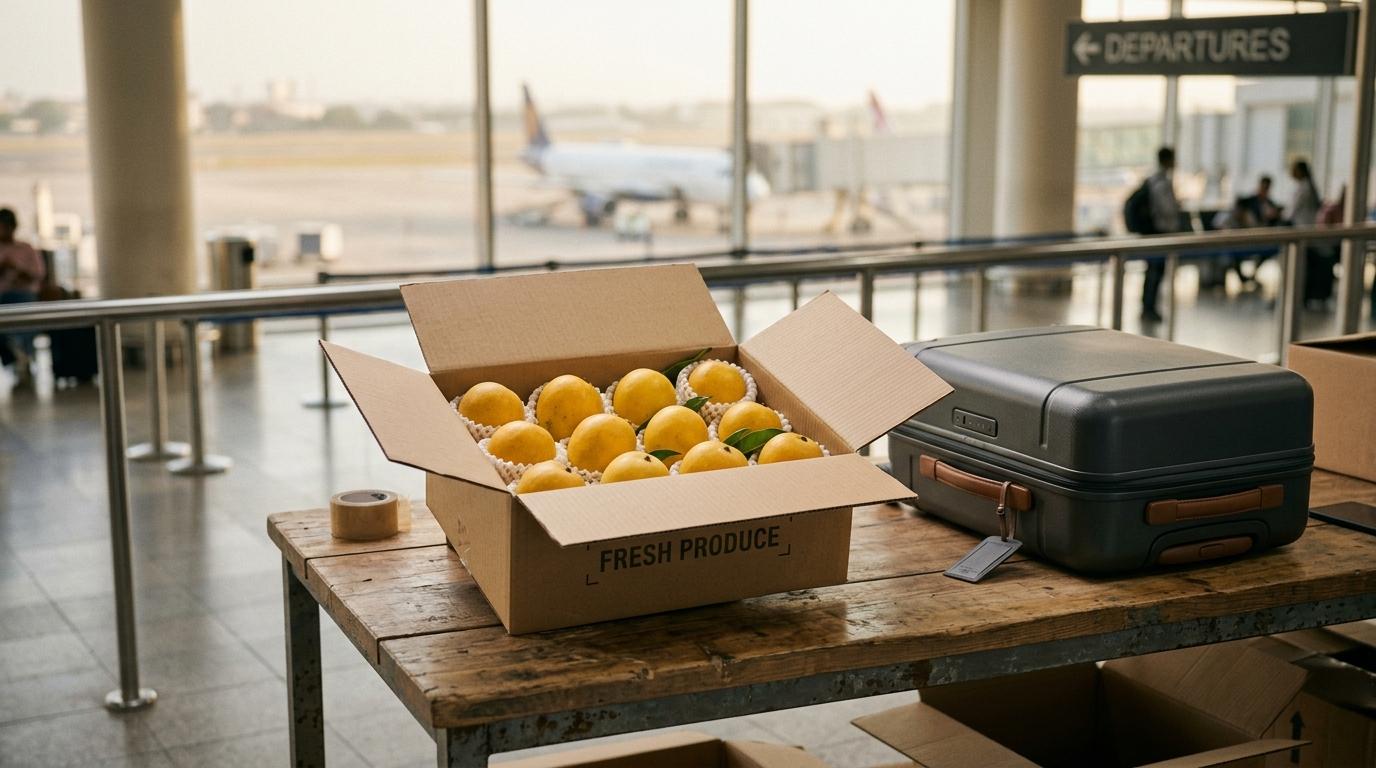
If you’ve ever travelled during mango season in India, you know how serious this question can get.
Maybe someone has asked you to bring Alphonso from Mumbai. Maybe you’re taking Dasheri from Lucknow, Kesar from Gujarat, or a carefully chosen box from home that everyone insists “must reach safely.” And because mangoes don’t wait politely for anyone, the real question becomes:
Can you carry mangoes on flights from India?
The short answer is: yes, usually — but it depends on where you’re flying and how the mangoes are packed.
Quick answer
#For domestic flights within India, you can usually carry whole mangoes in cabin baggage or check-in baggage, as long as they are packed properly and fit within your airline’s baggage rules.
For international flights from India, it is not that simple. The airline may allow the mangoes. Indian airport security may also let them through. But the destination country’s customs or agriculture department may not allow fresh fruit to enter.
Fresh fruit is often restricted because countries want to prevent pests, insects, plant diseases and soil from entering and affecting local farms.
A simple rule of thumb:
- Domestic flights in India: Usually fine, if packed well.
- International flights: Check the destination country’s rules before carrying mangoes.
- Whole mangoes: Easier to carry than cut mango or pulp.
- Mango pulp, aamras, juice, puree or wet cut mango: May be treated like liquid or gel in cabin baggage.
- When in doubt: Declare food at customs, or carry processed mango products instead.
This guide covers cabin baggage, checked baggage, customs rules, packing tips, leakage, smell, ripeness and safer alternatives.
Travel details at a glance
#- Best case: Domestic flights in India with firm, whole mangoes.
- Most risky case: International flights to countries with strict biosecurity or agriculture checks.
- Best baggage option: Cabin baggage for a small quantity; check-in baggage for larger boxes.
- Main problems: Leakage, smell, bruising, crushing and overripe fruit.
- Most important international rule: Declare food and agricultural items when required.
Domestic vs international flights from India
#The main issue is not the mango variety. It is not whether you’re carrying Alphonso, Langra, Kesar, Banganapalli or Dasheri.
The real question is: where are you flying?
Carrying mangoes on domestic flights in India
#On domestic routes, mangoes are generally treated like regular solid food.
So if you are flying from Mumbai to Delhi, Lucknow to Bengaluru, Ahmedabad to Kolkata, Chennai to Hyderabad, or any other route within India, whole mangoes are usually allowed in both cabin baggage and check-in baggage.
You still need to follow normal airline rules:
- Stay within the cabin baggage weight limit.
- Stay within your checked baggage allowance.
- Make sure the box or bag is not oversized.
- Pack the fruit so it does not get crushed.
- Prevent leakage and strong smell.
In most domestic cases, Indian airport security is not worried about whole mangoes. They are mainly checking for safety and security risks. The bigger problem is usually practical: the mango box is too heavy, too large, badly sealed, or already leaking.
Carrying mangoes on international flights
#International travel is where things get tricky.
You may clear Indian airport security without any issue. Your airline may also accept your bag. But that does not automatically mean the mangoes will be allowed into the country where you land.
Fresh fruit is controlled by the destination country’s customs, agriculture or biosecurity authorities. Their concern is not whether the mangoes are expensive, beautifully packed or meant as a gift. They are looking for pests, insects, soil, plant diseases and risks to local agriculture.
Some countries are especially strict about fresh produce. The USA, Australia and New Zealand are known for strong biosecurity checks, and fresh fruit in passenger baggage may be refused or confiscated. Canada may also have import requirements that make casual carrying difficult for regular travellers.
The UK may allow small personal quantities of some fresh fruit under certain rules, and mangoes are sometimes mentioned in that context. But rules can change, and the final decision is always with the border officer.
So for international travel, the safest advice is:
Check the official rules before you pack, and declare food when you arrive.
Cabin baggage vs check-in baggage: where should mangoes go?
#If mangoes are allowed on your route, the next question is where to pack them.
Both cabin and checked baggage can work, but the better option depends on how many mangoes you’re carrying, how ripe they are, and how well they are packed.
Mangoes in cabin baggage
#Carrying mangoes in cabin baggage makes sense when you have a small quantity and want to protect them from rough handling.
When cabin baggage is a good idea
#Cabin baggage is better if:
- You are carrying only a few mangoes.
- The mangoes are whole and firm.
- They fit within your cabin baggage weight limit.
- You want to avoid crushing or rough handling.
- You are flying domestically, or flying internationally to a place where fresh mangoes are allowed.
The main benefit is control. Your cabin bag stays with you. It is not thrown, stacked or squeezed like checked luggage. You can keep the mangoes upright and make sure nothing heavy is pressing on them.
Cabin baggage problems to watch for
#The biggest issue is weight. Mangoes are heavier than they look. A few large ones can quickly eat into a 7 kg or 8 kg cabin baggage allowance.
The second issue is smell. Firm mangoes usually smell pleasant and mild, but very ripe mangoes can have a strong fragrance in a closed aircraft cabin. If one is bruised or leaking, it can quickly become unpleasant.
Avoid carrying these in cabin baggage:
- Very ripe mangoes.
- Cut mango in weak containers.
- Large containers of mango pulp.
- Homemade aamras or puree in loose packing.
- Leaky bags or containers.
- Big cardboard boxes that do not fit cabin baggage size limits.
Mangoes in check-in baggage
#Check-in baggage is usually better if you are carrying a larger quantity, such as a full mango box or several kilos.
When check-in baggage makes sense
#Use check-in baggage if:
- You are carrying more mangoes than cabin baggage can handle.
- The box is too big for the overhead bin.
- The fruit is packed in a strong carton or rigid container.
- You are okay with some risk of rough handling.
- You are carrying mango pulp or puree in quantities larger than cabin liquid limits.
Checked baggage gives you more space and weight allowance, but it also brings more risk. Bags are stacked, moved quickly and sometimes handled roughly. A soft suitcase full of ripe mangoes can easily turn into a sticky disaster.
Check-in baggage problems to watch for
#The main risks are:
- Mangoes getting crushed.
- Juice leaking into clothes.
- Strong smell from bruised fruit.
- Delayed baggage causing the fruit to spoil.
- A box breaking open during handling.
If your checked bag is delayed, airlines usually do not treat spoiled fresh fruit like a valuable item. So avoid packing mangoes that are already fully ripe and ready to eat.
Whole mangoes vs cut mango or mango pulp
#The form of the mango matters a lot.
Whole fruit is easier to carry. Wet, cut, liquid or semi-liquid mango products can cause more problems during screening and travel.
Whole mangoes
#Whole mangoes are the simplest option.
They are:
- Solid.
- Easy to identify.
- Less likely to spill if firm.
- Easier to pack securely.
- Usually acceptable on domestic flights within India.
For international flights, remember that whole mangoes are still fresh fruit. Even if Indian security allows them, your destination country may not.
Cut mango
#Cut mango is much more troublesome.
It spoils faster, leaks faster, smells stronger and may raise hygiene concerns. If the pieces are very juicy or packed in syrup, they may be treated more like a liquid or gel during cabin baggage screening.
If you really need to carry cut mango:
- Use a tight, leakproof container.
- Keep the quantity small.
- Avoid very juicy or watery packing.
- Be ready for extra checks.
- Avoid carrying it internationally unless you have checked the destination rules.
For most travellers, cut mango is simply not worth the headache.
Mango pulp, puree, juice or aamras
#Mango pulp, puree, aamras, juice and similar items are not treated like whole mangoes.
In cabin baggage, they may fall under liquid, aerosol and gel restrictions. That means large containers of mango pulp or aamras should not go in cabin baggage.
If you are carrying more than the small cabin liquid allowance, pack it in checked baggage and seal it very carefully.
For mango pulp in checked baggage:
- Prefer factory-sealed packs.
- Avoid weak plastic containers.
- Use an extra plastic bag or liner.
- Keep it away from clothes, electronics and documents.
- Declare it as food when required on international trips.
Homemade pulp is especially risky. It can ferment, expand, leak or smell during travel. Even if it looks fine at home, pressure, heat and time can make it messy.
Customs and agriculture rules for international travel
#This is the part many travellers forget.
A mango can pass one checkpoint and still be stopped at the next one.
There are three separate checks to think about:
- Indian airport security: Checks whether the item is safe for air travel.
- Airline baggage rules: Checks weight, size, packing and carriage rules.
- Destination customs and agriculture authorities: Decide whether fresh fruit can enter the country.
Your mangoes may be fine for the first two and still be confiscated by the third.
Always declare food when required
#If your arrival form, customs kiosk or border officer asks whether you are carrying food, fruit, plants, seeds or agricultural products, answer honestly.
If you declare the mangoes and they are not allowed, they may simply be taken away. If you do not declare them and they are found later, you may face penalties, questioning or delays, depending on the country.
Do not hide fruit in clothes, gift boxes or side pockets. Strict airports often use X-ray machines, inspections and sniffer dogs to detect food and fresh produce.
Do not rely only on airline permission
#This is important: an airline allowing mangoes on board does not mean customs will allow them into the country.
Airlines mainly care about safety, baggage handling, leakage, smell, size and weight. Customs and agriculture departments care about import rules and biosecurity.
These are different systems.
Before flying internationally, check the official customs or agriculture website of your destination country. If the rules are unclear, it is safer to carry processed mango products instead of fresh fruit.
How to pack mangoes for a flight
#Good mango packing is not about making the box look pretty. It is about stopping movement, pressure, bruising, smell and leakage.
1. Choose firm mangoes
#Do not pack mangoes that are already soft, wrinkled, bruised or leaking.
Choose mangoes that are:
- Firm.
- Slightly underripe.
- Free from cuts.
- Not oozing sap.
- Not too fragrant.
A slightly firm mango can ripen after arrival. An overripe mango may burst before you even reach baggage claim.
2. Wrap each mango separately
#Individual wrapping helps stop mangoes from rubbing against each other.
You can use:
- Tissue paper.
- Newspaper.
- Soft paper.
- Foam fruit nets.
- Bubble wrap.
Do not wrap them too tightly. You want cushioning, not pressure.
3. Use a strong box or rigid container
#Loose mangoes in a soft bag are a bad idea.
Use:
- A thick cardboard mango box.
- A hard plastic food container.
- A rigid storage box.
- A strong suitcase section with padding.
Fill empty spaces with crumpled paper, cloth or soft packing material so the mangoes cannot roll around. Movement causes bruising.
4. Add leak protection
#Even firm mangoes can get damaged. One cracked mango can leak into the whole bag.
For checked baggage, add another protective layer:
- Put the mango box inside a plastic liner.
- Use a large zip-lock style bag for small quantities.
- Tape the outer bag or liner properly.
- Keep mangoes away from clothes that stain easily.
- Never place them next to laptops, chargers, documents or expensive gifts.
Do not trust one thin shopping bag. Mango juice always seems to find a way out.
5. Control the smell
#A strong mango smell usually means the fruit is very ripe or bruised. That is exactly the kind of mango you should avoid flying with.
To reduce smell:
- Choose firm mangoes.
- Avoid cut fruit.
- Do not pack damaged mangoes.
- Use a closed box or container.
- Keep the outer bag clean and dry.
If the box smells very strong before you leave home, it may not survive the journey well.
6. Place the box carefully
#If you are checking in a mango box, make sure it is properly sealed and does not look like it will fall apart. If the airline accepts it as checked baggage, ask whether it needs extra wrapping or tagging.
If you are packing mangoes inside a suitcase, keep them in the middle, surrounded by soft clothes. Avoid placing them near the edges, where the bag takes the most impact.
When fresh mangoes are not worth the risk
#Sometimes the smartest option is not to carry fresh mangoes at all.
Choose an alternative if:
- You are flying to a country with strict fresh fruit rules.
- You are unsure about the destination’s customs rules.
- You have a long layover.
- Your baggage may be delayed.
- The mangoes are already ripe.
- You are carrying gifts and cannot risk leakage.
- You do not want customs delays.
Better options include:
- Commercially packed mango pulp.
- Dried mango.
- Aam papad.
- Commercial mango pickle.
- Sealed processed mango products.
Processed mango items are usually easier than fresh mangoes, but they are still food. On international flights, declare them when required and check the destination country’s rules, especially for homemade or liquid items.
Final takeaway
#You can usually carry mangoes on flights from India when flying domestically, as long as they are whole, firm, well packed and within your airline’s baggage limits.
For international flights, be much more careful. Do not rely only on airline permission. Fresh fruit can still be stopped by customs or agriculture officers at your destination.
If you want the least trouble, carry firm whole mangoes on domestic routes, pack them like fragile items, prevent leaks and smell, and always declare food when international rules ask for it.