You open the fridge in the rainy season and there it is — that damp, sour, mixed smell that hits before you even see what caused it.
Maybe it is yesterday’s dal. Maybe a cut onion sitting uncovered. Maybe a milk packet leaked a little. Maybe the coriander has gone black and soggy in the vegetable tray. Or maybe there is one old dabba at the back that everyone has been quietly ignoring.
If you are dealing with fridge smell in monsoon, it is not just about bad odour. Humidity makes food spoil faster, moisture builds up inside the fridge, and even tiny spills can turn into a stubborn refrigerator smell. Spraying perfume, keeping a lemon slice forever, or shutting the door and hoping for the best will not solve it.
What works is simple: clean regularly, store food properly, and throw away anything that has become risky.
This checklist is made for real Indian kitchens — family homes, hostels, shared flats, small apartments, and busy fridges that are opened twenty times a day.
Quick Monsoon Fridge Safety Checklist
#- Clean and defrost regularly: During monsoon, clean your fridge more often. A good rule is to deep-clean and defrost it every two weeks.
- Do not leave cooked food outside for hours: Let hot food stop steaming, transfer it to shallow containers, and refrigerate it soon.
- Use airtight containers: Steel or glass containers with tight lids help control smell and protect food from extra moisture.
- Keep raw and cooked food separate: Raw meat, fish, eggs, and unwashed vegetables should not touch cooked food, dairy, or ready-to-eat items.
- Throw away doubtful leftovers: If food smells odd, looks slimy, has mold, or has been stored too long, discard it.
- Use food-safe odour absorbers: Baking soda, food-safe activated charcoal, or dry coffee grounds can help after cleaning. Do not use room fresheners inside the fridge.
Why Fridges Smell Worse in Monsoon
#A fridge keeps food cold, but it cannot rescue poor storage, old leftovers, wet vegetables, or hidden spills.
During the Indian monsoon, the air is full of moisture. Every time someone opens the fridge door, damp air enters. In a busy home or hostel, that happens all day. The moisture settles on shelves, lids, drawers, bottles, packets, and rubber door seals.
Then add everyday kitchen habits:
- Warm dal or rice is put inside before it cools properly.
- Milk packets leak and nobody notices.
- Coriander, spinach, or methi becomes wet and slimy.
- Cut onion is kept without a tight lid.
- Leftover curry is stored in an open bowl.
- The fridge is packed so tightly that cold air cannot circulate.
All of this creates a damp, closed space where smells get trapped. It also makes food spoil faster, especially cooked food, cut fruits and vegetables, dairy, and leftovers.
So if your fridge smells during the rainy season, treat it as a sign. Something inside needs to be cleaned, dried, sealed, moved, or thrown away.
2-Week Monsoon Fridge Cleaning Checklist
#For proper monsoon fridge cleaning, do a deep clean every two weeks. In between, wipe spills as soon as they happen. If the smell is strong, do not wait for your “Sunday cleaning plan” that may or may not happen.
Here is a practical fridge cleaning checklist for Indian kitchens.
Before You Start
#- Unplug the fridge before deep cleaning.
- Remove all food, including leftovers, milk, curd, paneer, sauces, vegetables, door items, and freezer items if you are defrosting.
- Handle perishables quickly. Milk, curd, paneer, meat, fish, eggs, and cooked food should not sit outside for long.
- Check dates and condition before putting anything back.
Step 1: Empty and Sort Everything
#Make three groups:
- Keep: Fresh food that is sealed well and smells normal.
- Use soon: Food that is still safe but should be eaten quickly.
- Throw: Spoiled, moldy, slimy, sour-smelling, leaking, or old food.
This one step solves many fridge smell problems. If the source of the smell stays inside, the odour will come back no matter how much you wipe.
Step 2: Remove Shelves, Drawers, and Door Bins
#Take out removable shelves, vegetable trays, egg trays, and door racks.
Wash them with mild dish soap and clean water. If there are sticky spills, soak the part for a few minutes before scrubbing gently.
Avoid very strong cleaners. Their smell can stay inside the fridge and affect food.
Let everything dry completely before putting it back.
Step 3: Wipe the Inside of the Fridge
#Clean the walls, ceiling, floor, corners, shelf grooves, and back area.
You can use:
- Mild dish soap diluted in water
- A mix of water and white vinegar for odour and grime
- A clean damp cloth for the final wipe
Do not spray strong chemical cleaners directly inside the fridge. The smell can linger and transfer to food.
Step 4: Clean the Rubber Door Seal
#The rubber gasket around the fridge door often collects moisture, crumbs, and blackish grime. During monsoon, this area can smell musty if ignored.
Use a soft cloth or old toothbrush with mild soapy water. Clean inside the folds carefully, then dry them well.
Also check if the door closes properly. A weak seal lets warm, humid air enter, which can make smells and spoilage worse.
Step 5: Defrost If Needed
#If your fridge or freezer has ice buildup, defrost it according to the appliance instructions. Extra frost can affect cooling and reduce space.
Do not use knives, screwdrivers, or sharp tools to break the ice. You may damage the fridge.
Step 6: Dry Everything Properly
#This step is very important in monsoon.
Before switching the fridge back on and reloading it:
- Dry shelves and trays fully.
- Wipe away visible droplets inside the fridge.
- Dry the bottom of containers before keeping them in.
- Make sure the vegetable drawer is not wet.
If you leave moisture behind, the smell can return quickly.
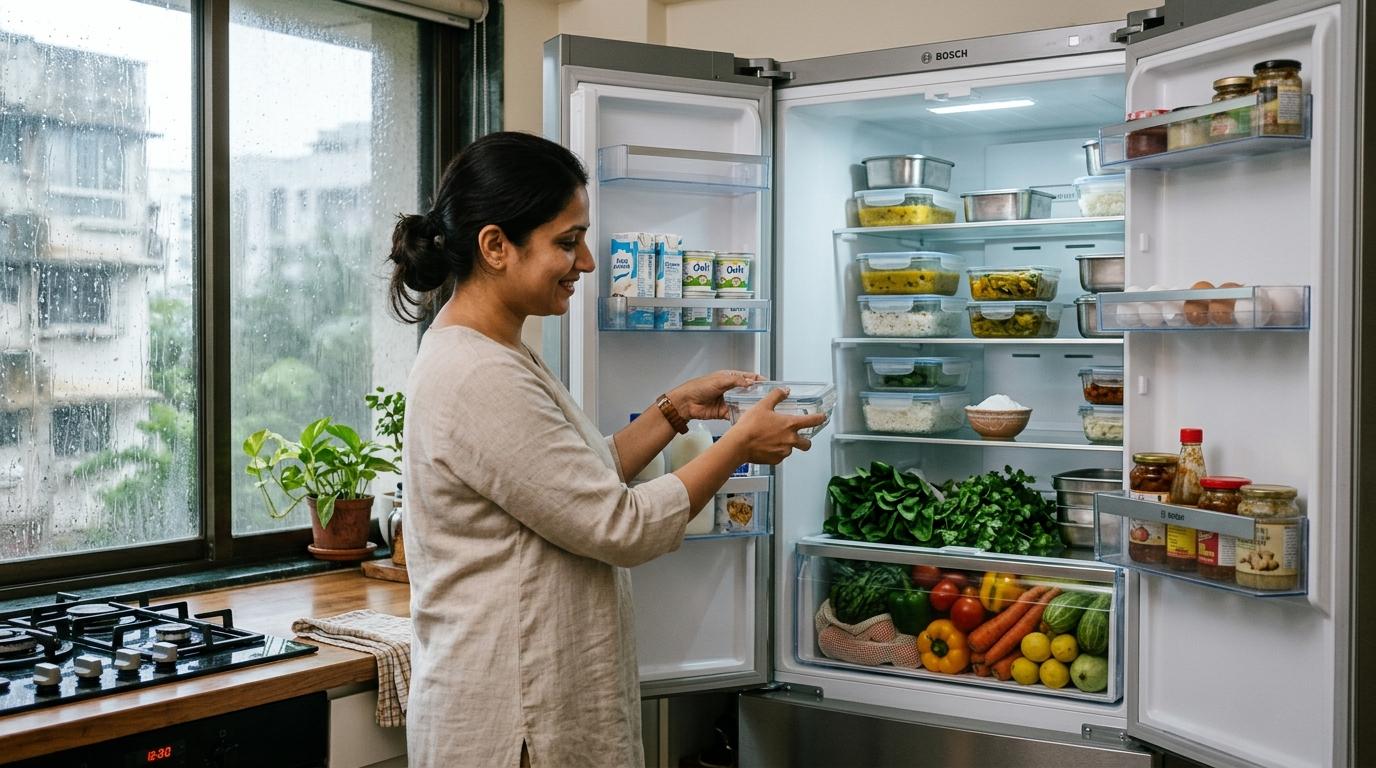
Step 7: Put Food Back the Right Way
#Reload the fridge in a way that reduces odour and cross-contamination.
- Cooked food and ready-to-eat items: Upper shelves
- Milk, curd, paneer, and dairy: Colder inner shelves, not the door if the door area gets warm often
- Raw meat, fish, and poultry: Sealed containers on the lowest shelf
- Vegetables: Dry, whole, and sorted in the crisper
- Strong-smelling foods: Airtight containers only
Do not overfill the fridge. Cold air needs space to move.
What to Keep and What to Throw During Monsoon
#Monsoon food safety is not only about cleaning. It is also about judgement.
Sometimes food looks okay but smells wrong. Trust that warning.
Throw It Away If You Notice
#- Leftovers with a sour, fermented, or unusual smell
- Cooked rice, dal, curry, sabzi, or non-veg leftovers stored too long
- Visible mold on any food
- Slimy coriander, spinach, methi, cucumber, beans, or other vegetables
- Milk, curd, or paneer that smells off
- Leaking packets or containers with unknown spills
- Cut fruits or cut vegetables that look watery, sticky, or discoloured
- Food that was left outside for a long time before refrigeration
- Food from a fridge that lost cooling during a long power cut
If there has been a power cut, do not rely only on smell. Some unsafe food may not smell bad. For more details, read AllBlogs’ guide on monsoon power cut food safety.
You Can Usually Keep
#- Freshly cooked food stored soon in clean, airtight containers
- Leftovers that are within a short, safe storage window and smell normal
- Whole vegetables that are dry and not slimy
- Unopened dairy that has stayed cold and is within date
- Pickles, chutneys, sauces, and condiments that are clean, sealed, and not contaminated
- Dry items stored in airtight jars
Do not taste suspicious food to check if it is safe. If it smells or looks doubtful, throw it away.
Leftover Safety Rules for Monsoon
#Leftovers are part of normal Indian kitchen life. Dal, rice, sabzi, idli batter, chutney, curries, and gravies often carry over to the next meal.
But during monsoon, leftovers need more care.
1. Do Not Leave Cooked Food Outside for Hours
#Cooked food should not sit at room temperature for a long time, especially during humid weather.
Be extra careful with:
- Cooked rice
- Dal
- Paneer dishes
- Chicken, meat, fish, and egg dishes
- Coconut chutney
- Dairy-based gravies
- Cooked sprouts or legumes
Let hot food stop steaming, then move it to shallow containers and refrigerate it soon. Large deep vessels stay warm in the centre for longer, so smaller portions cool faster and are safer.
2. Store Food in Clean, Airtight Containers
#Use clean steel or glass containers with tight lids. Airtight storage reduces moisture exposure and prevents strong smells from spreading.
Avoid keeping food in open bowls with only a plate on top. It may feel convenient, but in monsoon weather, it is not the safest option.
3. Label Food in Shared Fridges
#If you live in a hostel or shared flat, label containers with the date.
It sounds extra until the fridge has five similar dabbas and nobody knows which one is from Monday.
A small sticker or marker note can stop old food from hiding at the back.
4. Reheat Only What You Need
#Take out only the portion you plan to eat. Reheat that properly.
Avoid reheating the same container again and again. Repeated heating and cooling affects both food quality and safety.
5. Do Not Mix Fresh Food With Old Leftovers
#Do not pour fresh dal into yesterday’s dal. Do not top up old chutney with new chutney.
Finish or discard the older batch first. Wash the container before storing fresh food.
Dairy Safety in Monsoon
#Dairy can spoil quickly if the fridge is not cold enough, the door is opened too often, or there has been a power cut.
Be careful with milk, curd, paneer, cream, butter, cheese, and Indian sweets.
Milk
#- Keep milk refrigerated.
- Do not leave milk packets outside after delivery.
- If milk smells sour, looks curdled when it should not, or tastes off, discard it.
- After boiling milk, cool it safely and refrigerate it. Do not leave it outside for long.
Curd
#- Keep curd covered.
- Use a clean spoon every time.
- Do not dip used spoons back into the curd container.
- If curd smells unusually sour, has mold, or looks slimy, throw it away.
Paneer
#Paneer needs extra care in humid weather.
- Keep it refrigerated.
- Store it in a clean, covered container.
- Use it within a short period.
- Throw it away if it smells sour, feels sticky, or looks discoloured.
Indian Sweets and Cream-Based Foods
#Be careful with rasmalai, rabri, cream cakes, kheer, shrikhand, and other dairy-heavy foods.
Keep them refrigerated. Do not leave them on the counter for hours during monsoon gatherings.
If they have been outside too long or smell off, do not take chances.
Safe Odour Fixes for the Fridge
#First, remove the source of the smell. Odour absorbers help only after cleaning. They cannot fix spoiled food sitting inside the fridge.
Do not use room fresheners, perfume sprays, incense smoke, phenyl, or strong disinfectants inside the fridge. These smells can linger and may affect food.
Try these safer options instead.
Baking Soda
#Keep a small open bowl of baking soda on a middle shelf. It absorbs odours without adding a strong smell of its own.
Replace it regularly, especially after a strong odour problem.
Food-Safe Activated Charcoal
#A small pouch of food-safe activated charcoal can absorb smells and moisture. Keep it away from loose food and replace it as directed on the product.
Dry Coffee Grounds
#A small bowl of dry, unused coffee grounds can absorb odours and leave a mild coffee smell.
Use this only after cleaning the fridge, not to cover up spoiled food.
Lemon
#A cut lemon can help with mild odour for a short time. Keep it in a small bowl and remove it before it dries out, grows mold, or becomes another smelly item.
White Vinegar Wipe
#For stubborn smells, wipe the inside of the fridge with diluted white vinegar. Then wipe again with a clean damp cloth and dry everything fully.
Small Daily Habits That Prevent Fridge Smell
#A deep clean every two weeks helps, but small daily habits keep the smell from returning.
- Wipe spills immediately.
- Keep cooked food covered.
- Do not put hot, steaming food directly in the fridge.
- Do not keep cut onion uncovered.
- Sort leafy greens before storing.
- Remove rotten vegetables quickly.
- Keep raw and cooked food separate.
- Do a quick leftover check at night.
- Do not overload the fridge.
- Keep container lids clean and dry.
These habits take only a few minutes, but they make the fridge cleaner, safer, and much less unpleasant to open during the rains.