If you packed rotis in the morning and opened the tiffin late in the afternoon, the first question is usually simple: is this still safe to eat? The practical answer is: plain cooked roti is less risky than many wet curries, dairy sides, paneer fillings, rice dishes, or egg/meat foods, but summer heat still matters.
Quick answer
#Plain cooked roti can often stay fine for a few hours at normal room temperature, but in Indian summer heat you should treat 2 hours as the cautious safety benchmark when the roti is packed with moist, perishable sides or kept in a hot bag, train, car, or sunny office corner. If the roti is dry, freshly cooked, cooled properly, wrapped cleanly, and eaten with a dry sabzi, it is usually lower risk than stuffed, buttered, curd-touched, paneer-filled, or gravy-soaked roti.
Food-safety agencies give a broad rule for cooked and perishable food: refrigerate cooked leftovers within about 2 hours, and within 1 hour when the surrounding temperature is above 90°F/32°C. USDA FSIS explains this rule for leftovers, and CDC gives the same 2-hour/1-hour guidance for perishable foods. WHO’s safer-food guidance also emphasizes keeping cooked food at safe temperatures rather than letting it sit around warm.
That does not mean every plain roti becomes dangerous at exactly 121 minutes. It means the risk rises as heat, moisture, handling, and time combine. This guide helps you judge real Indian tiffin and travel situations without panic.
Why roti is different from dal, paneer, rice, or curd
#Roti is made from flour, water, and sometimes salt or oil. Once cooked, it is relatively dry compared with dal, paneer curry, curd rice, coconut chutney, cut fruit, or wet sabzi. Lower moisture generally makes food less inviting for rapid bacterial growth.
But roti is not magic. It can still become unsafe or unpleasant when:
- it is packed while steaming hot and turns wet inside the box,
- it is touched repeatedly with unclean hands,
- it is smeared with ghee, butter, malai, pickle oil, or chutney and kept warm,
- it is rolled with paneer, egg, chicken, mayonnaise, curd, cheese, or wet vegetables,
- it sits in a hot car, school bag, train berth, bus luggage rack, or sunny window,
- it smells sour, feels slimy, shows mold, or tastes off.
So the better question is not only “how many hours?” It is: what kind of roti, packed how, kept where, and eaten with what?
Safe timing guide for cooked roti in summer
#Use this as a practical household guide, not a guarantee.
The biggest summer mistake: packing roti while it is still steaming
#Most roti spoilage problems start before the tiffin leaves home. Hot roti trapped in a closed steel dabba releases steam. That steam condenses into droplets. The rotis become damp, stick together, and smell stale faster.
A better method:
- Cook the roti fully on both sides.
- Let it rest on a clean plate or mesh rack for a few minutes.
- Wait until the surface steam reduces.
- Stack with a clean cloth or food-grade paper if needed.
- Close the box only when the roti is warm, not steaming.
This keeps texture better and reduces trapped moisture. It also makes the roti more pleasant to eat later.
Plain roti vs stuffed roti: very different safety rules
#A plain chapati and an aloo paratha are not the same from a food-safety point of view.
Plain roti is relatively dry. Stuffed roti often has cooked potato, paneer, cauliflower, onion, cheese, greens, or leftover sabzi inside. These fillings add moisture and nutrients. If the stuffed roti is packed hot and kept warm for hours, the filling can become the weak point.
For summer travel, school tiffins, or long office days, dry options are safer:
- plain roti with dry aloo-gobi,
- phulka with roasted bhindi,
- roti with dry jeera aloo,
- thepla-style roti with less moisture,
- methi roti or ajwain roti without wet stuffing.
Be more cautious with:
- paneer rolls,
- egg rolls,
- cheese roti wraps,
- mayo or creamy chutney rolls,
- leftover curry rolled into roti,
- curd-based fillings.
If your roti contains perishable fillings, follow the general leftover-food timing rule more strictly: refrigerate quickly or eat within the safe window.
What about roti in a school or office tiffin?
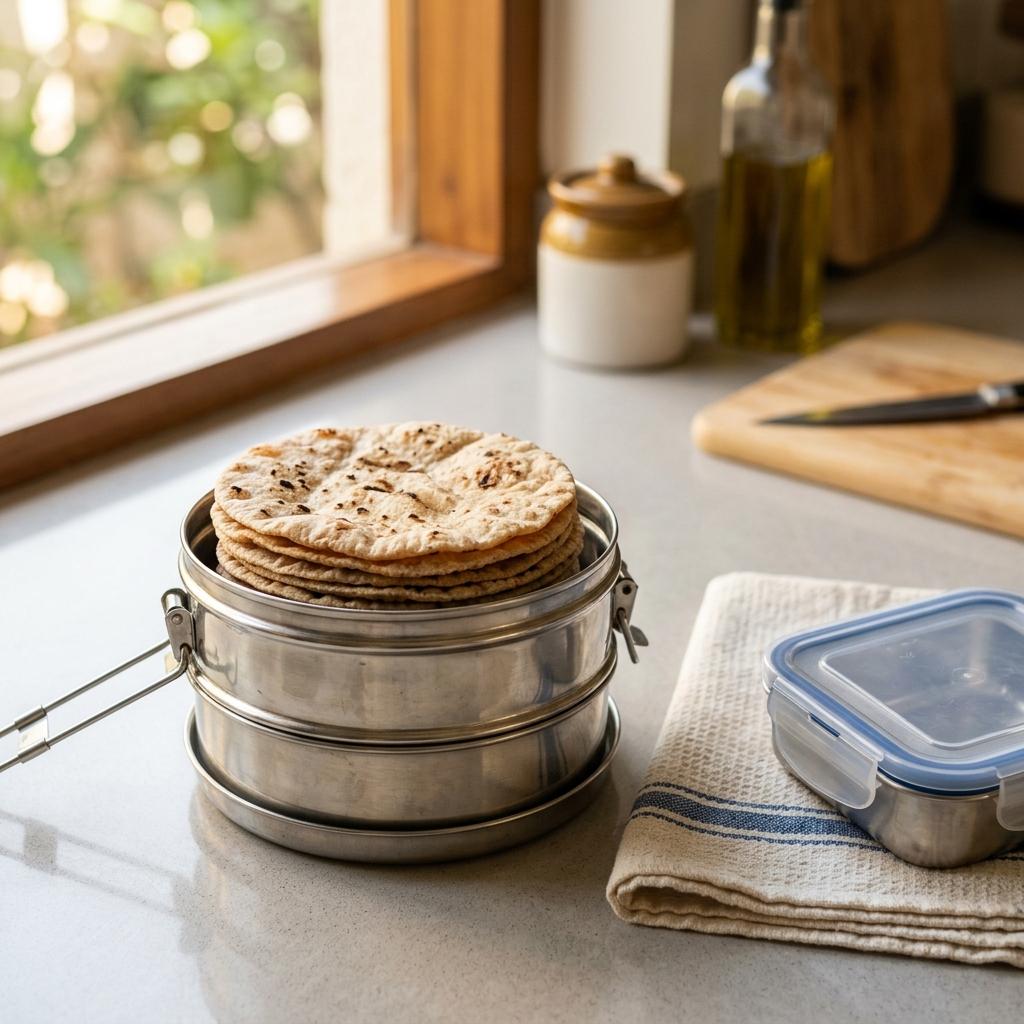
#For most office and school lunches, the target should be simple: cook in the morning, pack cleanly, and eat by lunch. That is usually a 3-5 hour window. Plain roti with dry sabzi is one of the better Indian lunchbox options for this.
To make it safer:
- use a clean, dry tiffin,
- avoid packing roti with wet curry in the same compartment,
- cool rotis briefly before closing the lid,
- keep curd, raita, paneer, and chutneys in separate small containers,
- avoid leaving the tiffin near sunlight, heaters, dashboards, or window seats,
- wash hands before eating.
If your office has a fridge, keep wet sides there and leave only the dry rotis in the bag. If there is no fridge, choose dry sabzi and skip dairy-heavy sides on extremely hot days.
For broader hot-weather lunch ideas, AllBlogs already has a useful guide to Indian office tiffin recipes for hot weather. If your lunch often sits out for hours, that article pairs well with this roti-specific guide.
Can you carry roti on train, bus, or road trips?
#Yes, roti is one of the more travel-friendly Indian staples, especially compared with creamy curries, curd rice, or loose gravies. The trick is choosing the right companion foods.
Better travel pairings:
- dry potato sabzi,
- sukhi bhindi,
- dry chana,
- roasted peanuts or chana,
- pickle in a separate leakproof container,
- whole fruit kept separately,
- dry thepla or methi roti for longer trips.
Riskier pairings:
- paneer gravy,
- curd or raita,
- coconut chutney,
- egg bhurji,
- mayo rolls,
- wet chole or rajma in the same container,
- reheated leftovers from the previous night.
If you are planning a train or bus journey in hot weather, you may also find AllBlogs’ guide to no-fridge travel food for Indian summers helpful.
How to tell if roti has gone bad
#Do not rely only on the clock. Use your senses too.
Throw away roti if you notice:
- sour, fermented, stale, or unusual smell,
- sticky, slimy, or wet surface,
- visible mold spots,
- strange discoloration,
- bitter or sour taste,
- roti stored with spoiled sabzi or leaking curry,
- roti kept in a very hot place for many hours.
Important: food can sometimes be unsafe without obvious smell or mold. That is why timing and temperature still matter. If the roti was packed with paneer, egg, chicken, dairy, or wet chutney and sat in heat for too long, do not “test taste” it.
How to pack roti so it stays soft and safer
#Soft roti and safe roti are not always the same. Many people trap steam to keep rotis soft, but too much moisture can make them spoil faster in summer.
Try this balanced method:
1. Cook fully, not half-done
#A half-cooked roti may stay softer, but it is not ideal for long holding. Cook both sides properly, then soften with a light cloth wrap if needed.
2. Cool briefly before packing
#Do not leave rotis out for an hour on the counter. Just give them a short steam-release period before closing the lid.
3. Use a dry divider
#A clean cotton cloth or food-grade paper can absorb excess steam. Avoid newspaper because ink is not meant for food contact.
4. Separate wet items
#Do not place pickle, chutney, curry, or onion salad directly on roti for long holding. Pack them separately and combine only when eating.
5. Keep the tiffin out of heat
#A bag kept under a desk is better than a bag in a parked car. A shaded train seat is better than a sunny window ledge.
Can you refrigerate cooked roti?
#Yes. If you made extra rotis and will not eat them soon, refrigerate them after cooling. Stack them in an airtight container or wrap them in a clean cloth inside a box. For best taste, eat within 1-2 days.
To reheat:
- sprinkle lightly with water only if dry,
- warm on a tawa for a short time,
- avoid repeated reheating,
- do not reheat roti that smells sour or has mold.
Freezing also works for batch cooking, but wrap in small portions so you do not thaw and refreeze the same stack.
Is last night’s roti safe the next morning?
#In cool, dry weather, many Indian homes leave plain rotis covered overnight and eat them in the morning. In peak summer or humid monsoon weather, this habit becomes riskier, especially if the kitchen stays warm.
If you want to use leftover rotis safely:
- refrigerate them after dinner once cooled,
- do not leave them beside the stove overnight,
- keep them away from wet sabzi, curry, or chutney,
- reheat thoroughly before eating,
- discard if there is sour smell, dampness, or mold.
If the roti was already used as a wrap with paneer, egg, cheese, or wet filling, do not keep it outside overnight.
What about roti dough?
#Roti dough has different rules from cooked roti. Dough has more moisture and can ferment or spoil faster in heat. If you are deciding whether kneaded atta can sit out, read AllBlogs’ separate guide: Can Roti Dough Be Left Out in Summer?
For this article, the focus is cooked roti. Do not apply cooked-roti timing to raw dough.
A simple decision rule
#When unsure, use this practical checklist:
- Plain, dry roti? Lower risk, but still keep it clean and cool.
- Wet filling or dairy? Treat it as perishable food.
- Hot car or summer travel? Shorten the safe window.
- Packed while steaming? Expect faster quality loss.
- Smells sour or feels slimy? Throw it away.
- For kids, elderly people, pregnant people, or anyone unwell? Be extra cautious.
Bottom line
#Cooked roti is one of the better Indian foods for summer tiffins and travel, but it is safest when kept plain, dry, clean, and away from heat. For plain rotis, think in terms of same-meal use and good packing. For roti rolls, stuffed parathas, dairy sides, paneer fillings, egg, meat, or wet chutneys, follow the stricter 2-hour rule, or 1 hour in very hot conditions.
A roti that looks fine after a few hours may still be okay if it was dry and handled well. A roti that smells sour, feels wet, or sat in a hot car with paneer filling is not worth the risk.