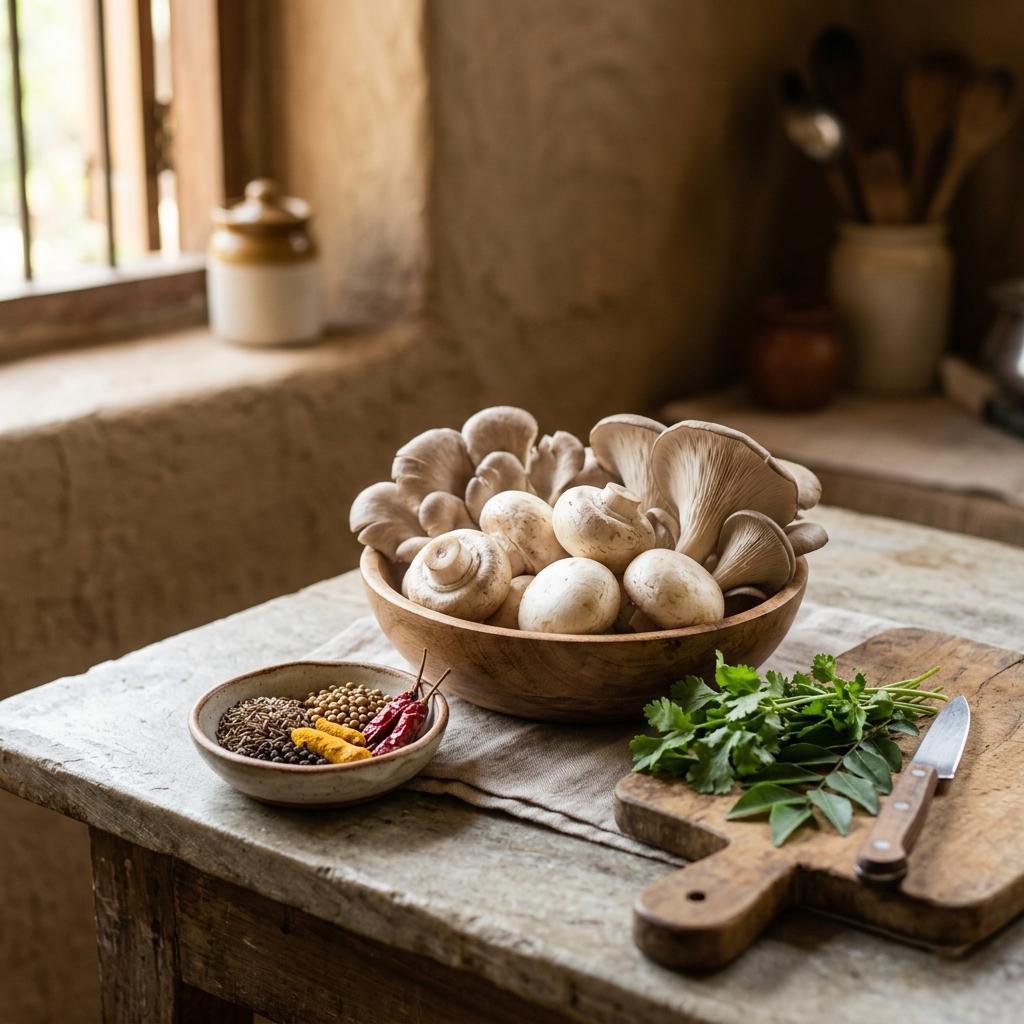
Mushroom is usually treated as vegetarian in everyday Indian food because it is not meat, fish, egg, or an animal-derived ingredient. Scientifically, mushrooms are fungi, not plants—but being “not a plant” does not automatically make them non-vegetarian. Some people, especially in Jain or strict family food traditions, may still avoid mushrooms for religious, cultural, or personal reasons.
Quick answer
#If your question is practical—“Can a vegetarian eat mushroom?”—the answer is generally yes, if your version of vegetarianism allows fungi. If your question is religious or family-specific, the answer depends on your household rules. Mushrooms sit in a slightly unusual space: vegetarian for many people, avoided by some, and often misunderstood because they look and taste different from common vegetables.
In simple words: mushroom is veg for most Indian vegetarian menus, not Jain-friendly for many Jain households, and often avoided in strict sattvik meals.
Why this question confuses so many Indian eaters
#In India, food labels are emotional as much as scientific. The words “veg” and “non-veg” are not just diet categories; they can connect to religion, family kitchens, temple food, hostel mess rules, wedding menus, and even what gets cooked in which pan.
Mushroom creates confusion because it does not behave like a regular vegetable. It is soft, earthy, sometimes meaty in texture, and it grows differently from plants. Many people first meet mushrooms in restaurant gravies, pizza toppings, Chinese-style starters, or creamy soups—foods that already feel a little “outside” home cooking for some families.
Then someone says, “Mushroom is not a plant.” That sentence is true. But the next jump—“so it must be non-veg”—is where the confusion begins.
Mushroom is a fungus, not a vegetable
#Biologically, mushrooms belong to the kingdom Fungi. They are not vegetables in the strict botanical sense. They do not grow like spinach, bottle gourd, tomato, or potato. They do not make food through photosynthesis the way plants do.
A mushroom is the visible fruiting body of a fungus. The larger fungal network may be hidden in soil, wood, compost, or another growing medium. This is why mushrooms feel mysterious compared with familiar sabzi ingredients.
But food categories are not always the same as biology categories. Tomato is botanically a fruit, yet we use it like a vegetable in dal, sabzi, chutney, and curry. Similarly, mushroom is biologically a fungus, but in cooking it is usually grouped with vegetarian foods because it is not animal flesh.
Does “fungus” mean non-vegetarian?
#No. “Fungus” does not mean non-vegetarian by itself.
A non-vegetarian food normally means food that comes from animals: meat, fish, poultry, seafood, and in many Indian contexts, eggs. Mushrooms do not come from animals. They do not contain meat. They are not fish. They are not eggs.
So, for most everyday Indian menus, a mushroom curry, mushroom masala, mushroom pulao, or mushroom soup is treated as vegetarian as long as the other ingredients are vegetarian too.
The important part is the full dish. Mushroom cooked in butter, cream, onions, tomatoes, and spices may be vegetarian for many people. Mushroom cooked in chicken stock, fish sauce, oyster sauce, meat gravy, or the same wok used for meat may not be acceptable to strict vegetarians.
Why many vegetarians eat mushrooms
#Most vegetarians define their diet by avoiding animal flesh. By that standard, mushrooms fit easily.
They are also useful in vegetarian cooking because they bring umami—the deep savory taste people often associate with slow-cooked or roasted foods. That is why mushrooms appear in vegetarian burgers, gravies, noodles, stir-fries, pasta, soups, and even kebab-style snacks.
For people trying to reduce meat, mushrooms can make a dish feel fuller without using meat. This does not make them “non-veg”; it only means their texture and flavor are satisfying.
In Indian kitchens, mushrooms often work like paneer’s earthier cousin. Paneer feels creamy and rich; mushroom feels savory and slightly chewy. Both can sit in a vegetarian restaurant menu, but both need ingredient checks if you are strict about onion, garlic, stock, sauces, or shared utensils.
Why some families avoid mushrooms anyway
#This is where the answer becomes more personal.
Some vegetarian families do not eat mushrooms because of tradition, religious interpretation, purity rules, or long-standing kitchen habits. Jain households, for example, commonly avoid mushrooms along with many root vegetables and fermented or microorganism-heavy foods, depending on the level of observance.
The reason is not simply “mushroom is non-veg.” It is more about ahimsa, ideas of purity, how the food grows, and the desire to avoid harming small life forms. Different families follow these rules with different levels of strictness.
Some Hindu families also avoid mushrooms during fasting, puja days, or sattvik meals. Again, that does not mean mushrooms are meat. It means mushrooms may not fit a specific religious or household food code.
So the most respectful answer is: mushroom is generally vegetarian, but not universally accepted in every vegetarian tradition.
Is mushroom sattvik?
#Many people who ask whether mushroom is veg or non-veg are actually asking a different question: “Is mushroom sattvik?”
Sattvik food rules vary across families and traditions, but mushrooms are often avoided in strict sattvik eating. Some people group them with foods like onion and garlic—not because they are meat, but because they are considered unsuitable for that style of eating.
If you are cooking for a puja, temple-style meal, vrata, or someone who follows strict sattvik food, do not assume mushroom is acceptable. Ask first, or choose a safer dish like simple dal, rice, roti, seasonal sabzi, fruit, or plain curd if dairy is allowed.
Is mushroom Jain food?
#In many Jain homes, mushrooms are avoided. The reasons can include how mushrooms grow, their association with decay or microorganisms, and the broader Jain focus on minimizing harm.
This is why a restaurant dish marked “veg” may still not be Jain-friendly. A mushroom pizza can be vegetarian but not Jain. A mushroom starter can be eggless and meat-free but still not suitable for someone following Jain food rules.
If you are ordering for Jain guests, avoid mushroom unless they clearly say they eat it. Also check onion, garlic, potato, carrot, beetroot, and stock-based sauces, depending on their practice.
What about the green dot on food labels?
#In India, packaged food commonly uses a green vegetarian symbol and a brown non-vegetarian symbol. For fresh loose mushrooms, you may not always see a label. For packaged mushroom products, the label depends on the complete product—not just the mushroom.
Plain mushrooms or dried mushrooms are generally treated as vegetarian. But mushroom soup powder, instant noodles, sauces, frozen snacks, or ready-to-eat gravies may include milk solids, egg, chicken flavoring, fish sauce, gelatin, or other additives.
So do not decide only by the word “mushroom” on the front. Turn the packet around and read the ingredient list, allergen note, and veg/non-veg symbol.
Restaurant ordering: what vegetarians should check
#Mushroom dishes are common in restaurants, but strict vegetarians should still ask a few simple questions.
First, ask whether the dish uses chicken stock or meat stock. This matters in soups, gravies, risottos, ramen-style bowls, sauces, and Indo-Chinese dishes.
Second, ask about oyster sauce or fish sauce. Mushroom stir-fries, noodles, and Asian-style gravies can sometimes use these for flavor.
Third, ask whether the dish contains egg. Some mushroom fried rice, battered starters, or cutlets may use egg for coating or binding.
Fourth, if you avoid onion and garlic, say that clearly. “Vegetarian” does not automatically mean “without onion and garlic.”
A simple line works well: “Is this mushroom dish fully vegetarian, without egg, meat stock, fish sauce, or oyster sauce?” If needed, add: “No onion and garlic, please.”
Home cooking: how to keep mushroom dishes clearly vegetarian
#At home, mushrooms are easy to keep vegetarian if the rest of the ingredients are clear.
Use fresh mushrooms, wash or wipe them properly, and cook them soon after buying. Pair them with onion, tomato, capsicum, peas, corn, spinach, paneer, rice, noodles, or simple spices depending on what your family eats.
If someone at home is uncomfortable with mushrooms, do not force the biology lesson at the dinner table. Food comfort matters. Make a second sabzi or keep mushrooms as an optional topping.
For mixed families—where some eat mushrooms and some avoid them—use separate utensils, serving spoons, and storage boxes. That small step prevents unnecessary arguments.
Mushroom vs plant-based meat: not the same thing
#One more modern confusion: mushrooms are sometimes used in plant-based burgers or mock-meat dishes. That does not make mushrooms meat.
A mushroom burger patty may be vegetarian if the ingredients are vegetarian. A plant-based meat product may also be vegetarian or vegan, but only if its ingredient list confirms that. Some products use egg, dairy, or flavoring agents that strict eaters may avoid.
So the rule is simple: mushroom itself is usually vegetarian; processed mushroom-based products need a label check.
Is mushroom vegan?
#Plain mushrooms are generally suitable for vegans because they are not animal-derived. But mushroom dishes are not automatically vegan.
A creamy mushroom soup may contain milk, butter, cream, cheese, or ghee. Mushroom pizza may include cheese. Mushroom masala may use cream. Mushroom fried rice may contain egg. Mushroom momos may be brushed with butter or served with mayonnaise.
If you are vegan, ask about dairy, egg, honey, and stock. If you are cooking at home, use oil instead of ghee or butter, coconut milk or cashew paste instead of cream, and vegetable stock instead of meat stock.
Is mushroom healthy?
#Mushrooms can be part of a balanced diet for many people, but avoid exaggerated health claims. They add flavor, texture, and variety. They are often used in lighter meals because they can make a dish feel filling without being very heavy.
That said, mushrooms are not magic medicine. They do not “cure” deficiencies, weight gain, diabetes, or any health condition. If you have allergies, digestive sensitivity, kidney disease, immune concerns, or a doctor-advised diet restriction, treat mushrooms like any other ingredient and ask a qualified professional when needed.
Also, do not eat unknown wild mushrooms. Some wild mushrooms can be poisonous. Buy edible mushrooms from reliable vendors unless you are trained in safe identification.
What to say if someone asks at a family meal
#A calm answer is better than a debate.
You can say: “Mushroom is a fungus, not a plant, but it is generally considered vegetarian because it is not animal food. Some families avoid it for religious or personal reasons, so let’s check before serving.”
That one sentence usually solves the argument.
It respects science, everyday Indian food practice, and household traditions—all at once.
Simple decision guide
#Choose mushroom if:
- You eat vegetarian food that avoids animal flesh but allows fungi.
- The dish has no egg, meat stock, fish sauce, oyster sauce, or animal-based additives.
- Your family or guests are comfortable with mushrooms.
- You are buying from a reliable source and cooking edible varieties.
Avoid mushroom if:
- You follow Jain food rules that exclude mushrooms.
- You are cooking a strict sattvik, puja, or fasting meal where mushrooms are not allowed.
- The dish may contain non-veg stock, egg, or fish-based sauces.
- You cannot confirm whether a wild mushroom is safe to eat.
- The person eating it simply does not accept mushrooms in their food tradition.
Bottom line
#For most Indian vegetarian eaters, mushroom is vegetarian. It is not a plant, but it is also not an animal. It belongs to fungi, which makes it a separate biological category.
The best practical answer is this: mushroom is veg for many people, not Jain-friendly for many Jain households, often avoided in strict sattvik meals, and always worth checking in restaurant or packaged foods.
Food is not only taxonomy. It is also trust, tradition, and comfort. If you are cooking for yourself, decide based on your diet. If you are cooking for someone else, ask once and respect the answer.