You arrive in Guwahati tired, hungry, and ready for a proper meal. The menu has the familiar comfort foods: butter chicken, fried rice, paneer, noodles. All perfectly fine.
But if you want to taste Assam, even in a small way, look for Masor Tenga.
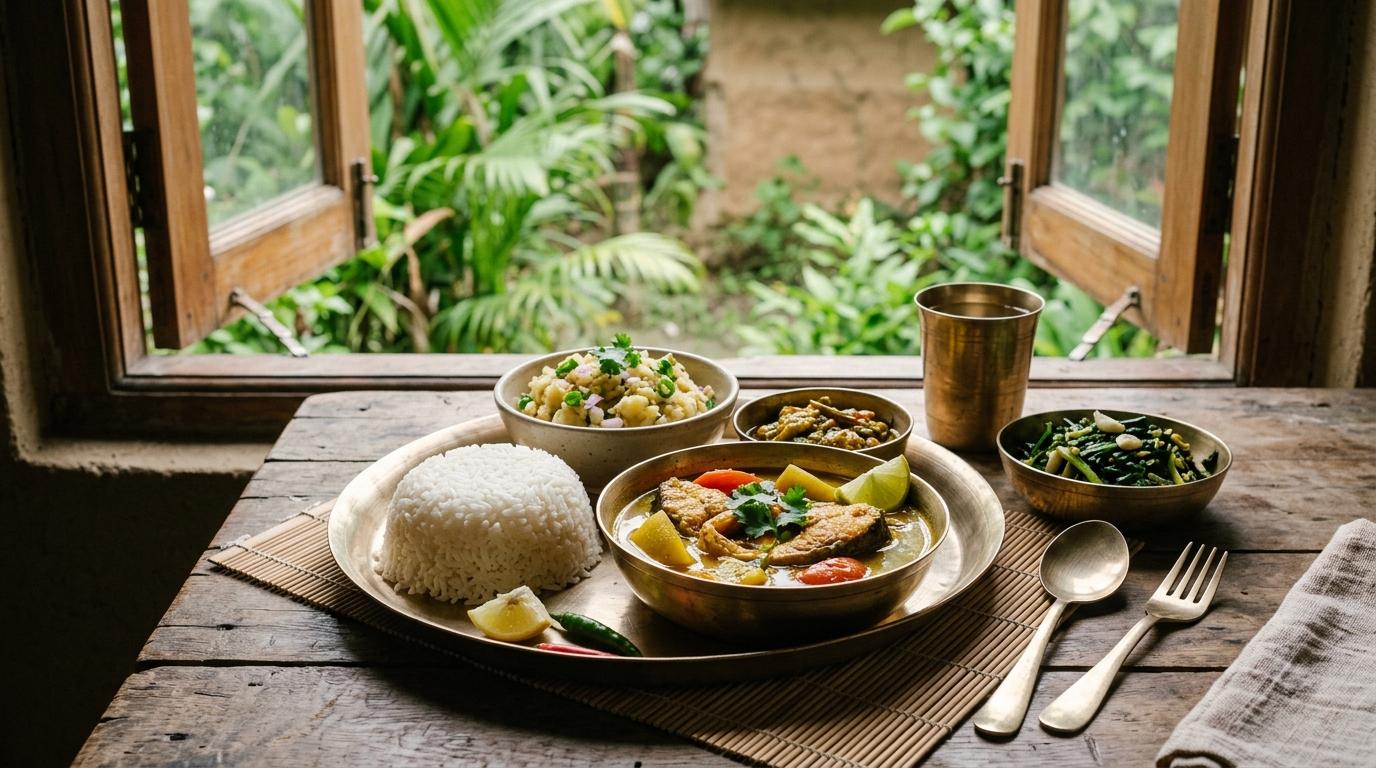
In simple terms, Masor Tenga is an Assamese sour fish curry. It is light, tangy, usually cooked in a thin broth, and almost always eaten with rice. You will often find it in an Assamese thali, alongside simple sides like pitika, khar, dal, and local greens.
It is not the kind of fish curry that comes in a thick, oily, spice-heavy gravy. Masor Tenga is gentler than that. It is fresh, sour, clean-tasting, and surprisingly refreshing, especially if you are used to richer Indian curries.
This guide is not a recipe. It is for travelers who want to know what Masor Tenga tastes like, where to find it, how to order it, what to eat with it, and how to make sensible choices when eating fish while traveling in Assam.
What Masor Tenga tastes like
#Masor Tenga tastes light, sour, and fresh.
The curry is usually thin, almost like a broth. The fish sits in this tangy liquid rather than being coated in a heavy gravy. The sourness is the main flavor, but it should not taste harsh or vinegary. A good Masor Tenga feels bright and balanced. You should still be able to taste the fish clearly.
Compared with many Indian curries, Masor Tenga is usually:
- Less oily
- Less spicy
- Less creamy
- More broth-like
- More sour and refreshing
- Built around rice, fish, and simple flavors
The souring ingredient can change depending on the home, restaurant, season, or region. In many Assamese kitchens, the sourness may come from thekera, a dried sour fruit used in local cooking. Other versions may use tomato, lemon, or ou tenga, also known as elephant apple.
So if you are expecting a deep red, fiery fish curry, Masor Tenga may catch you off guard. It is not trying to impress you with heat. It is more about balance. You may taste mustard oil or green chilli, but the main note is sourness, not spice.
Where to find Masor Tenga in Assam
#The easiest place to find Masor Tenga is anywhere serving traditional Assamese meals. Sometimes it appears clearly on the menu. Other times, you may need to ask for Assamese fish curry or sour fish curry.
Here are the most likely places to try it.
Assamese thali restaurants in Guwahati
#For many travelers, Guwahati is the first stop in Assam. It is also one of the easiest places to try Masor Tenga without much effort.
Look for restaurants serving Assamese thalis or local fish meals. A thali is a good choice because you get the curry with rice and small sides, so the dish makes sense as part of a full Assamese meal.
Local restaurants and hotel dining rooms
#Some hotels and local dining rooms serve Assamese dishes, even if the main menu also has North Indian, Chinese, or general Indian food.
If you do not see Masor Tenga written on the menu, ask:
“Do you have Assamese fish curry?”
Or:
“Do you serve sour fish curry?”
Many places will understand what you mean.
Homestays
#A homestay meal is one of the nicest ways to eat Masor Tenga. The dish often feels most natural in a home-style setting: plain rice, fish curry, pitika, greens, maybe khar, and a few seasonal sides.
It may not look fancy, but it can be one of the most memorable meals of your trip.
Heritage lodges, eco-stays, and tea garden stays
#If you are traveling around tea gardens, river areas, wildlife regions, or the wider Eastern Himalayan belt, you may find Masor Tenga served at lodges and eco-stays that offer local meals.
Guests often ask for “authentic Assamese food,” and Masor Tenga is one of the dishes that represents the region well.
How to order Masor Tenga with rice and pitika
#If you are unsure what to say, keep it simple.
You can ask:
“Do you have Assamese fish thali with Masor Tenga?”
Or:
“Can I get Masor Tenga with rice and aloo pitika?”
Or, if you are looking at an English menu:
“Do you serve sour fish curry, Assamese style?”
A good first order would be:
- Steamed rice
- Masor Tenga
- Aloo pitika
- Khar, if available
- Dal or local greens
- Safe drinking water, especially on hot days
Why rice matters
#Masor Tenga is meant to be eaten with rice.
The broth is thin, so the rice soaks it up beautifully. This is not a curry you usually scoop up with naan or roti. Rice is the natural base, and the dish makes much more sense with it.
Why pitika is a great side
#Pitika is a mashed side dish. The easiest version for travelers to recognize is aloo pitika, which is mashed potato, often mixed with mustard oil, onion, salt, and green chilli.
It is simple, but it works perfectly with Masor Tenga. The sour curry wakes up your palate, while the pitika brings in comfort and softness. A bite of rice with tenga, followed by a little pitika, feels complete.
Where khar fits in
#Many Assamese meals include khar, an alkaline dish often made with vegetables such as raw papaya. Traditionally, khar is eaten earlier in the meal, while tenga, the sour part, comes later.
As a traveler, you do not need to worry too much about getting every rule right. If you are served a thali, watch how others eat, or simply ask the server. Assamese meals have a quiet rhythm, and even following it loosely makes the experience more enjoyable.
What fresh Masor Tenga should look and smell like
#Fish curry is worth paying attention to when you are traveling. Not in a fearful way, just in a sensible way.
Fresh Masor Tenga should usually have:
- A clean, mild fish smell
- A fresh, tangy broth aroma
- Fish that looks properly cooked
- Flesh that holds together
- No strong stale or rotten smell
- No slimy texture
- No odd sourness that feels spoiled rather than naturally tangy
Masor Tenga is often made with freshwater fish, and the fish may be cooked on the bone. This is normal. Eat slowly, especially if you are used to boneless fillets.
If the fish smells too strong, looks mushy, or the place feels careless with food handling, skip it. There will always be another meal.
Quick hygiene checks before ordering fish curry
#You do not need to eat only in fancy restaurants. Many simple local places serve excellent Assamese food. But when ordering fish, especially while traveling, a quick check helps.
Look for:
- A place with steady customers, so food is moving
- Hot food served hot, not lukewarm from a counter
- Clean plates, glasses, and serving spoons
- Staff using utensils for ready-to-eat food
- Fish that does not smell stale when it arrives
- A kitchen or service area that looks reasonably clean
- Drinking water you trust, or bottled/filtered water if needed
The goal is not perfection. The goal is freshness, decent turnover, and basic care.
When to eat Masor Tenga on travel days
#Masor Tenga is lighter than many rich curries, so it can be a lovely lunch. It gives you a proper rice meal without leaving you as heavy or sleepy as a creamy curry might.
Still, think about your travel plans.
Good times to eat it
#Masor Tenga is a good choice when:
- You have time to sit and eat slowly
- You are not rushing for a bus, train, or flight
- You want a local lunch with rice
- You are staying nearby after the meal
- You are comfortable eating fish with bones
Times to be more careful
#You may want to avoid a large serving right before:
- A long road journey
- A winding hill drive
- A tight travel connection
- A day when your stomach already feels unsettled
- A route where clean rest stops may be limited
The curry is sour, and some versions may include green chilli or mustard oil. If your stomach is sensitive to tangy or spicy food, start with a smaller portion.
Who should be cautious with Masor Tenga
#Masor Tenga is usually light, but it still may not suit everyone.
Be careful if you:
- Have a fish or seafood allergy
- Are sensitive to sour foods
- Often get acid reflux after tangy meals
- Do not tolerate green chilli or mustard oil well
- Are recovering from a stomach upset
- Are about to travel for several hours without easy breaks
If you have a fish allergy, be very clear when ordering. Do not rely only on saying “no fish,” especially if there is a language gap. Ask whether the curry, broth, oil, or side dishes contain fish. In kitchens that cook fish often, cross-contact can also happen.
If you are not allergic but simply unsure whether you will like it, share one portion with rice instead of ordering a full meal for yourself.
Vegetarian and non-fish alternatives
#If you do not eat fish, you can still enjoy Assamese food. The cuisine has many simple, plant-forward dishes, and sour flavors are not limited to fish.
Here are a few things to ask for.
Vegetarian tenga
#Some places may make a sour curry without fish, using vegetables such as bottle gourd, ridge gourd, tomato, or other local ingredients.
Ask:
“Do you have vegetarian tenga?”
Or:
“Can I get sour curry without fish?”
Availability depends on the kitchen, so ask politely.
Khar
#Khar is one of the most distinctive Assamese dishes to try if you are vegetarian. It is usually mild, simple, and very different from the sour flavor of tenga.
Pitika
#Aloo pitika is the easiest version to ask for, but there may be other kinds depending on the meal. Pitika is comforting, filling, and goes well with rice and dal.
Rice, dal, and local greens
#A basic Assamese vegetarian meal can be deeply satisfying. Rice, dal, khar, pitika, greens, and seasonal vegetables are more than enough for a good local meal.
You do not need to force yourself to eat fish to experience Assamese cuisine. Masor Tenga is important, yes, but it is only one part of a much wider table.
How to eat Masor Tenga without feeling awkward
#If Assamese food is new to you, start slowly.
Take a little rice first. Try the dal or khar if it is served. Taste the pitika on its own, then mix a small amount with rice. When you get to the Masor Tenga, spoon some broth over the rice and take small bites of fish.
If the fish is on the bone, slow down. Use your fingers if that feels natural and fits the setting. Many local fish dishes are actually easier to eat that way. If you prefer a spoon and fork, that is fine too. Just be careful with small bones.
Do not pour the whole bowl over your rice at once if you are unsure about the sourness. Add a little, taste it, and then add more if you like it.
Useful questions to ask before ordering
#A few simple questions can make the meal easier.
Ask:
- “Is it very sour?”
- “Is it spicy?”
- “What fish is used?”
- “Does it have bones?”
- “Can I get it with rice?”
- “Do you have aloo pitika?”
- “Is there a vegetarian tenga?”
If you are sensitive to chilli, ask if they can make it less spicy. If the curry is already prepared, they may not be able to change it, but they can still tell you what to expect.
A simple first Masor Tenga order
#If it is your first time, order like this:
“One Assamese fish thali with Masor Tenga, rice, and aloo pitika, please. Not too spicy, if possible.”
That one sentence usually gets you the right kind of meal. You are not just ordering a random bowl of curry. You are getting Masor Tenga in the setting where it belongs.
If you are eating with another traveler, order one thali first and maybe add extra rice or one extra side. Taste before ordering more. Assamese food can be subtle, and it is best enjoyed slowly.
Final thoughts for travelers
#Masor Tenga is one of the best introductions to Assamese food because it says so much in such a quiet way. It is rice-based, fish-centered, sour, light, and seasonal in spirit. It does not shout with spice or richness. It wins you over slowly.
If you are wondering what to eat in Assam, this is a dish worth looking for. Order it with rice. Add pitika if you can. Check that the fish smells fresh and the place feels clean enough. Eat slowly, especially if the fish has bones.
And if sour fish curry is not for you, that is fine too. Try khar, pitika, dal, greens, or a vegetarian tenga instead.
You do not need to know every rule of Assamese dining. You only need curiosity, a little caution, and a good plate of rice.