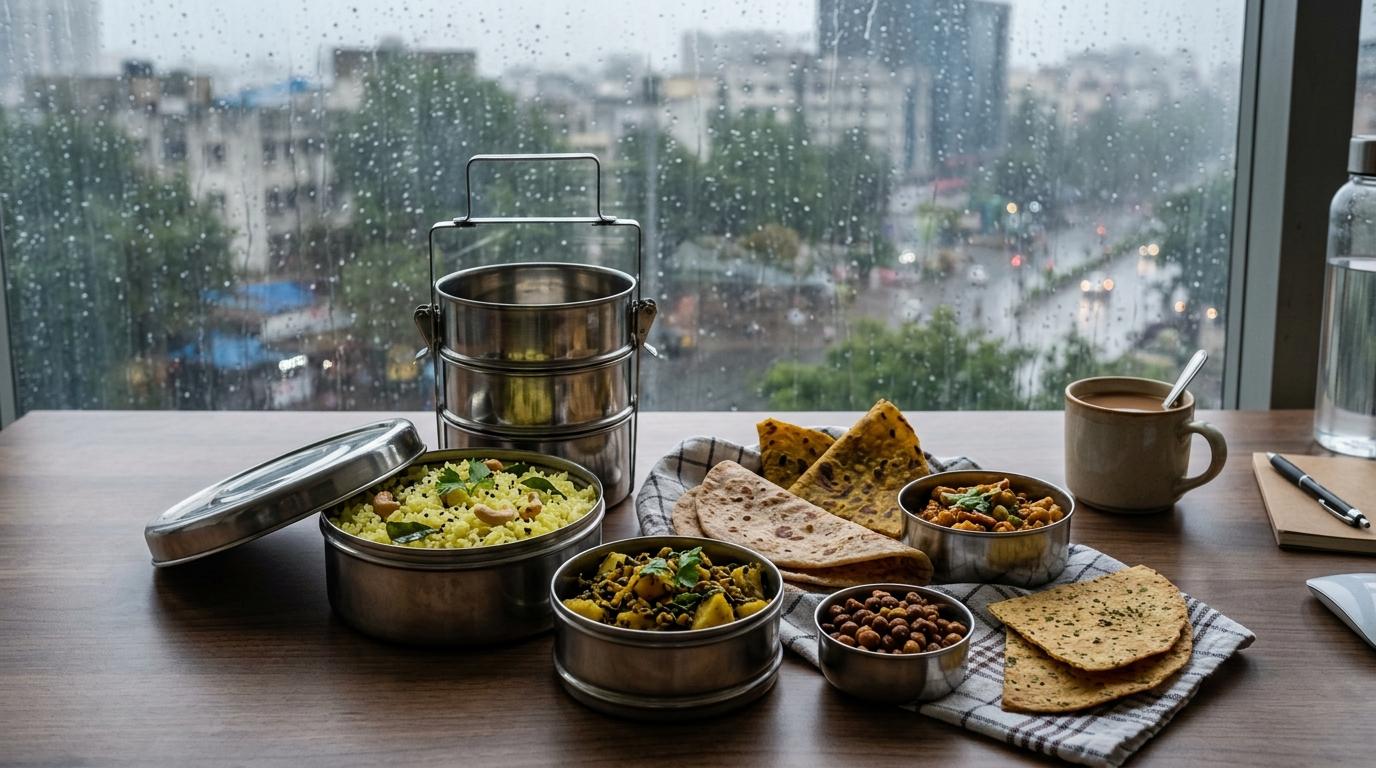
You know that moment when you open your tiffin at lunch and, instead of the smell of home food, you get that slight sour, “something is off” smell?
Monsoon does that to lunch more often than we like to admit.
It’s not just the heat. It’s the humidity, the trapped steam, the damp lunch bag, the wet umbrella kept nearby, the long commute, and sometimes an office fridge that is either packed, smelly, or not available at all.
A sabzi that looked completely fine at 8 am can feel sticky by 1 pm. Rice can start smelling a little fermented. Rotis can turn soft and sweaty if they were packed too hot.
So if you’re carrying a monsoon office lunch without fridge access, the goal is simple: keep food dry, let it cool before packing, and avoid foods that spoil quickly in warm, humid weather.
This guide is for office-goers, students, and parents packing Indian tiffins during the rainy season, especially when there’s no fridge at work or school.
Quick answer
#For a safer monsoon office lunch without fridge, choose dry, freshly cooked Indian food. Avoid wet, dairy-heavy, raw, coconut-based, or gravy-heavy items.
Better choices include:
- Plain parathas
- Theplas
- Dry sabzis
- Lemon rice
- Tamarind rice
- Sattu paratha
- Roasted chana
- Murmura
- Dry poha
- Khakhra
- Roasted makhana
Riskier choices include:
- Curd
- Raita
- Curd rice
- Raw salads
- Cut fruits
- Coconut chutney
- Watery dal
- Thin gravies
- Food packed hot and closed immediately
Let food cool before shutting the lid. Use clean, completely dry boxes. Eat lunch as early as you reasonably can.
And if something smells sour, looks bubbly, feels slimy, or tastes strange, don’t eat it. It’s not worth the stomach trouble.
Why monsoon makes tiffin safety trickier
#Most of us are careful with lunch in peak summer. We know food can spoil in the heat.
But monsoon is sneaky.
The weather may feel cooler than May or June, but the humidity is high. That extra moisture changes everything. Steam gets trapped in the dabba. Lunch bags stay damp. Kitchen cloths don’t dry properly. Even a few drops of water inside a box can make food turn soggy faster.
The biggest mistake is packing hot food and closing the lid immediately.
When hot rice, sabzi, dal, or paratha goes into a closed box, the steam has nowhere to go. It collects on the lid, turns into water, and drips back into the food. Then the tiffin sits in a warm bag for hours.
By lunchtime, the food may smell sour, feel sticky, or just seem “not right.”
That’s why rainy season tiffin safety is mostly about controlling moisture. Dry food usually travels better. Wet food needs more care, and sometimes it’s better not to carry it at all.
Some foods are especially risky in monsoon:
- Dairy, such as curd, raita, paneer gravies, and cream-based dishes
- Raw cut vegetables and fruits
- Coconut chutney and fresh coconut items
- Watery dal, kadhi, rasam, sambar, and thin curries
- Very soft or mushy rice that stays warm and damp for hours
This doesn’t mean every wet food becomes unsafe the second you pack it. But without refrigeration, wet and perishable foods carry more risk, especially if lunch is sitting for 4 to 5 hours.
A good rule is: cook fresh, cool properly, pack dry, and don’t push your luck.
Safer lunch ideas for monsoon
#Good monsoon tiffin ideas don’t have to be fancy. Honestly, the simple, slightly boring lunches are often the ones that survive best.
Think: dry, cooked, fresh, and not too watery.
1. Dry parathas and theplas
#Parathas are one of the most dependable options for a safe Indian office lunch, as long as the filling is not wet or undercooked.
Good options include:
- Plain paratha with dry sabzi
- Sattu paratha
- Methi thepla
- Ajwain paratha
- Dry aloo paratha, with well-cooked filling
- Besan paratha
- Dal paratha, cooked properly
Let parathas cool before packing. If you stack them hot and shut the box, they’ll sweat and become soggy. A clean cotton cloth inside a steel dabba can help absorb extra moisture.
Avoid packing parathas with:
- Leaky pickle
- Curd on the side
- Watery paneer stuffing
- Very moist vegetable fillings
2. Dry sabzis
#Dry sabzi is one of the best lunchbox formats for monsoon. It has less water, travels well, and works with roti, paratha, poori, or rice.
Good options include:
- Jeera aloo
- Dry bhindi
- Dry beans sabzi
- Cabbage sabzi cooked until moisture reduces
- Gajar-beans sabzi
- Dry arbi
- Lauki or tori, only if cooked dry
- Dry soya chunks
- Dry paneer bhurji, if eaten early and packed carefully
Cook the sabzi properly and let extra water evaporate. Don’t pack it while it’s still steaming.
Also, go easy on raw garnish. Raw onion, raw tomato, and lots of fresh coriander may look nice in the morning, but they can release moisture by lunchtime.
3. Lemon rice, tamarind rice, and other dry rice dishes
#Rice needs care in any lunchbox, especially in humid weather. But some dry rice dishes are still much better than curd rice or dal rice for a no-fridge lunch.
Better choices are:
- Lemon rice
- Tamarind rice
- Tomato rice, cooked dry
- Methi rice
- Peanut rice
- Dry vegetable pulao with less moisture
With rice, texture matters a lot.
Avoid very soft, wet, clumpy rice for a no-fridge tiffin. Cook it fresh, spread it out for a short while so the steam escapes, and pack only after it cools.
If rice smells sour, feels unusually sticky, looks strangely wet, or tastes fermented, throw it away.
This is especially important for anyone worried about cooked rice/khichdi/tiffin safety, because rice can become risky when it stays warm and moist for too long.
4. Dry poha, upma-style dishes, and chilla
#Some breakfast foods work well for lunch too, as long as they’re cooked dry and cooled before packing.
You can try:
- Dry poha with peanuts
- Vegetable upma cooked firm, not wet
- Besan chilla, packed after cooling
- Moong dal chilla, cooked thoroughly
- Handvo or dhokla, only if not too moist and eaten early
Be careful with coconut garnish, wet chutney, and curd-based sides. A dry chilla is much safer for monsoon than a chilla packed with coconut chutney in the same bag.
5. Roasted snacks as backup
#This is a very practical monsoon habit: carry a dry backup snack.
It helps on days when lunch smells doubtful, or when a meeting runs late and you don’t want to take a chance.
Good backup foods include:
- Roasted chana
- Murmura
- Roasted makhana
- Khakhra
- Dry sev-murmura mix
- Peanuts, if they suit you
- Plain mathri
- Baked dry snacks
Keep these in a separate airtight container.
Don’t mix them with chopped onions, tomatoes, lemon juice, or chutney in the morning. If you want bhel, assemble it fresh at lunchtime.
6. Simple lunch combinations that work
#If you want easy no-fridge lunch India ideas, don’t overthink it.
Try these combinations:
- Methi thepla with dry aloo sabzi
- Sattu paratha with roasted chana
- Lemon rice with dry beans sabzi
- Plain paratha with dry bhindi
- Tamarind rice with roasted peanuts
- Dry poha with makhana
- Ajwain paratha with dry gajar-beans sabzi
- Khakhra with dry peanut chutney powder
None of these are spoil-proof. No packed food is.
But they’re usually better choices for humid, no-fridge conditions than curd rice, raita, salad bowls, watery dal, or gravy-heavy meals.
Foods to avoid in a monsoon tiffin
#This is where a lot of monsoon lunch mistakes happen.
Some foods are healthy and perfectly fine at home, but they’re not great when they sit inside a closed tiffin for hours.
1. Curd, raita, chaas, and dairy sides
#Curd and raita feel cooling, especially during humid weather, but they’re not ideal if you don’t have a fridge or ice pack.
In warm, damp conditions, dairy can sour faster and separate.
Avoid packing:
- Plain curd
- Raita
- Curd rice
- Chaas in a regular bottle
- Dahi-based dips
- Creamy paneer gravies
- Milk-based sweets
If you really need to carry dairy, use an insulated bag with an ice pack and eat it early. Otherwise, it’s better to skip it.
2. Raw salads and cut fruits
#Raw cucumber, tomato, onion, carrot sticks, sprouts, and cut fruits feel fresh and healthy. But for a no-fridge monsoon tiffin, they’re not the safest option.
They release water as they sit. That moisture collects inside the box, and the food becomes warmer, wetter, and easier to spoil. Cut fruits can also turn mushy and start smelling odd.
Avoid packing:
- Cut cucumber
- Sliced tomato
- Onion salad
- Sprouts salad
- Cut melon
- Cut papaya
- Chopped apple or banana packed hours before eating
- Salad mixed with salt in the morning
If you want vegetables, cooked dry sabzi is a better choice.
For children too, monsoon school tiffin safety follows the same logic. Cooked, dry, easy-to-eat foods are usually safer than wet raw salads sitting until recess.
3. Coconut chutney and wet chutneys
#Fresh coconut chutney can spoil quickly in a warm lunchbox. Sometimes it’s the one thing that ruins an otherwise fine meal.
Be careful with:
- Coconut chutney
- Peanut-coconut chutney
- Wet coriander chutney
- Mint chutney with water added
- Loose tomato chutney
- Any watery chutney packed in the morning
Dry chutney powders are better for monsoon tiffins.
You can use:
- Peanut chutney powder
- Podi
- Dry garlic chutney
- Sesame chutney powder
- Dry flaxseed chutney
They add flavour without adding much moisture.
4. Watery dal, kadhi, and thin gravies
#Dal chawal is comfort food, no doubt. But watery dal in a monsoon tiffin without refrigeration can be risky. It can leak, ferment, smell sour, and make rice soggy.
Avoid packing:
- Thin dal
- Kadhi
- Rasam
- Sambar
- Watery chole
- Wet rajma
- Thin paneer gravy
- Gravy-heavy mixed vegetables
If you want to carry dal, make it thick and eat it early. Even then, keep it separate from rice or roti until lunchtime.
5. Fried foods packed hot
#Fried food looks dry, but it can trap steam if packed hot. In monsoon, that trapped steam turns into sogginess very quickly.
Avoid packing these while hot:
- Pakoras
- Pooris
- Vadas
- Cutlets
- Bread rolls
- Fried patties
If you pack them occasionally, cool them properly first. Keep chutney separate. Still, fried foods are usually better eaten fresh than carried around for long hours.
6. Leftovers from the previous night
#Leftovers are convenient. But monsoon is not the best time to take chances, especially when there’s no fridge at work.
Be careful with:
- Last night’s dal
- Reheated rice
- Leftover gravy
- Paneer curry
- Cooked meat or egg dishes
- Old khichdi
- Food that was left outside before being refrigerated
If food has already sat at room temperature, then gets refrigerated, reheated, packed, and kept warm again in a bag, the risk goes up.
Fresh morning food is usually the safer choice.
Monsoon tiffin packing checklist
#Even a good lunch can spoil if it’s packed badly. Use this simple checklist for better rainy season tiffin safety.
Cool food before closing the lid
#This is the most important step.
Don’t close the tiffin while the food is still steaming.
Do this instead:
- Spread rice on a clean plate for a short while
- Keep sabzi uncovered until the steam reduces
- Let rotis and parathas rest before stacking
- Pack only when the food is warm to room temperature, not piping hot
Food should not sit out for too long while cooling, but it also shouldn’t go into the box steaming hot.
Use clean, dry containers
#Your lunchbox should be completely dry before food goes in.
Check:
- Corners
- Lids
- Rubber seals
- Small compartments
Even a few drops of leftover water can make rotis soggy or chutney spoil faster.
Steel dabbas are easy to clean and dry. Glass is also good if it suits your commute. If you use plastic, make sure it’s clean, odour-free, and not stained with old food.
Keep wet and dry foods separate
#Don’t let sabzi soak into roti by 10 am.
Pack these separately when possible:
- Roti or paratha
- Sabzi
- Pickle
- Chutney powder
- Snacks
- Rice
If you’re carrying a slightly moist dish, use a leak-proof box. Mix only when you’re ready to eat.
Avoid overfilling the box
#Overfilled boxes trap heat and moisture. They also leak more easily, especially during a rainy commute.
Leave a little space in the container. Food stays in better shape, and your bag is less likely to smell like sabzi by afternoon.
Use a clean spoon
#This sounds basic, but it matters.
During monsoon, your hands touch wet umbrellas, phones, bags, train handles, lift buttons, office doors, and who knows what else.
Carry a clean spoon if needed, and wash your hands before eating. Tiffin safety is not only about the food. It’s also about everything that touches the food before you eat it.
Keep the lunch bag dry
#A wet lunch bag can become musty and make everything inside feel damp.
Try to:
- Keep the tiffin away from wet umbrellas and raincoats
- Use a separate lunch pouch
- Dry the bag after use
- Avoid keeping lunch near windows where rain may splash
- Don’t leave food inside a closed, damp backpack longer than needed
Eat earlier when possible
#If there’s no fridge, don’t save lunch for late afternoon.
Try to eat within a normal lunchtime window. If you packed lunch at 8 am and it’s already much later than usual, check the food carefully before eating.
Dry foods usually hold better, but they’re not magic.
When to throw food away
#Don’t try to “adjust” if food seems spoiled. Monsoon is not the time to test your stomach.
Throw the food away if you notice:
- Sour or fermented smell
- Bubbles or froth in dal, rice, or gravy
- Slimy texture
- Unusual stickiness
- Mold
- Gas or pressure when opening the box
- Bitter, sour, or strange taste
- Leaking, swollen, or foul-smelling container
If you’re unsure, throw it out.
One missed lunch is better than getting sick from food that has clearly changed.