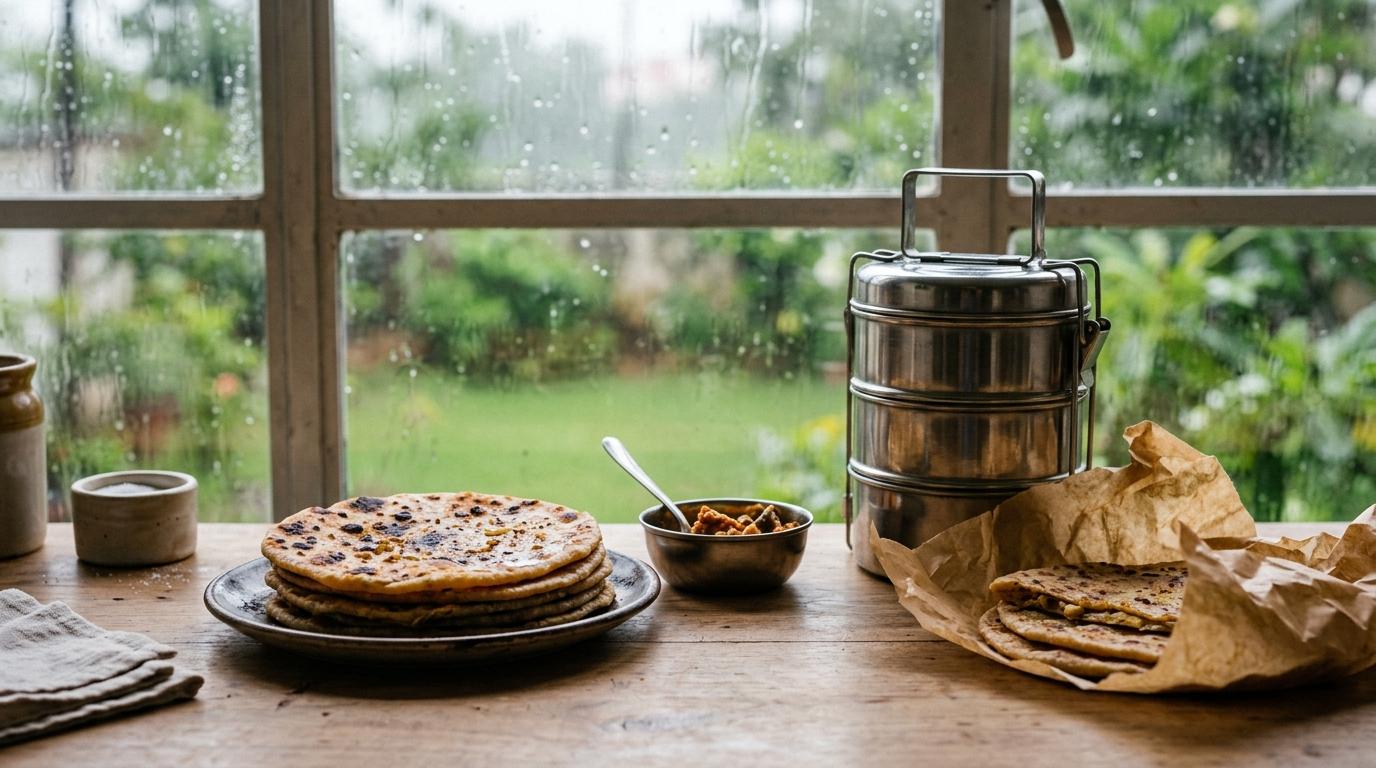
A stuffed paratha in a tiffin feels like the perfect Indian lunch. It is filling, easy to carry, not too messy, and almost everyone is happy to eat it at school, office, coaching class, on a train, in a bus, or during a long wait somewhere.
But monsoon changes things.
The same aloo paratha that feels perfectly fine in winter can turn sweaty, sour-smelling, or just “not right” by lunchtime in humid weather. A paneer paratha packed fresh in the morning may not be the best idea if it sits for hours inside a school bag, office drawer, warm bus, or train compartment.
This guide is about stuffed paratha tiffin safety in real-life monsoon conditions. Not panic. Not complicated food rules. Just practical advice you can actually use.
We will cover how long paratha can stay outside, which fillings spoil faster, how to pack tiffins better, and when it is safer to throw the food away.
If you also pack rotis regularly, you may find this useful too: how long can roti stay out in summer.
Quick answer
#Stuffed paratha is a perishable food, especially in monsoon.
As a cautious food safety rule, perishable foods should not sit at room temperature for more than about 2 hours. In hot, humid rainy weather, it is better to be even more careful because warmth and moisture help food spoil faster.
So, can paratha stay outside in monsoon?
A plain, dry paratha or thepla usually holds up better than a stuffed paratha because it has less moisture inside. Stuffed parathas need more caution, especially if they contain:
- Potato
- Paneer
- Cheese
- Onion
- Leafy greens
- Leftover sabzi
- Curd
- Wet chutney
For school tiffins, office lunch, or short travel:
- Cool the paratha completely before packing.
- Keep the filling dry.
- Avoid curd, raita, and wet chutneys for long hours unless they stay chilled.
- Use an insulated lunch bag and ice pack if the food will sit for many hours.
- Eat the paratha as early as possible.
- Throw it away if it smells sour, feels slimy or sticky, looks moldy, or tastes strange.
There is no perfect fixed timing for every tiffin. Weather, filling, container, packing style, and where the lunchbox is kept all matter.
When in doubt, do not eat it.
Why monsoon makes parathas spoil faster
#Monsoon is not always cool and pleasant. In many parts of India, it is humid, sticky, and unpredictable.
Your kitchen may feel fine in the morning, but the lunchbox may later sit inside a damp school bag, a warm office corner, a crowded bus, or a non-AC train compartment.
Food spoils faster when three things come together:
- Warmth
- Moisture
- Food that bacteria can grow on
A stuffed paratha often has all three.
The outside may look nicely roasted and dry, but the filling inside is usually moist. Potato mash, grated paneer, onion, gobi, methi, spinach, and leftover sabzi all hold water.
And if you pack a hot paratha straight into a closed dabba, steam gets trapped. It collects on the lid, turns into water, and drips back onto the paratha.
That is when the paratha becomes soft, sweaty, and damp.
In dry weather, this may only affect the texture. In monsoon, it can become a food safety issue.
That is why stuffed paratha lunchbox safety is not only about how fresh the paratha looked at home. It is also about what happens inside the closed box for the next few hours.
A paratha packed hot at 7 am, carried in a warm school bus, and left in a bag until noon is very different from a paratha that was cooled properly, wrapped well, and kept in an insulated lunch bag.
The biggest difference is moisture control.
Monsoon also makes leftovers more risky. If you use last night’s sabzi as stuffing, or pack paratha with curd and chutney, you are adding more moisture and more chances for spoilage.
Reheating may make food hot again, but it does not always make spoiled food safe. If food already smells sour, feels slimy, or looks spoiled, do not try to “fix” it on a tawa or in a microwave.
For more lunchbox safety tips, you can also read: office lunch food safety.
Plain paratha vs stuffed paratha
#This is where many people get confused. We often treat plain paratha, roti, thepla, aloo paratha, paneer paratha, and leftover sabzi paratha as if they behave the same in a tiffin.
They do not.
Plain paratha
#A plain paratha has less moisture once it is cooked well. It is made from dough, roasted on a hot tawa, and often finished with ghee or oil.
If you cool it properly before packing, it usually keeps better than a stuffed paratha.
Thepla and dry masala parathas also travel better, especially when they are not packed with wet sides. Many families prefer them for journeys, and honestly, it makes sense.
This does not mean plain paratha can be forgotten in a bag all day. If packed hot, kept in a damp cloth, or left outside overnight during monsoon, even plain paratha can become unsafe or unpleasant.
But compared with stuffed paratha, it is usually less risky.
Stuffed paratha
#Stuffed paratha has a moist center. That is the main issue.
The filling may be potato, paneer, gobi, methi, onion, cheese, dal, or leftover sabzi. The outer dough cooks directly on the tawa, but the stuffing mostly steams inside.
That makes it soft and tasty, but it also means the inside stays moist.
This matters a lot for aloo paratha tiffin safety, because aloo paratha is one of the most common school and office lunches.
Potato is filling and easy to cook, but mashed potato holds moisture. If you add raw onion, fresh coriander, green chilli, or leftover masala and then pack the paratha while it is still hot, it can start smelling sour by lunchtime in humid weather.
Stuffed paratha is not automatically unsafe. It just needs better filling choices, proper cooling, and sensible packing.
Filling risk by type
#Not every stuffed paratha is equally risky. Some fillings are dry and travel better. Others are better eaten fresh at home, especially during the rains.
Use this as a practical guide, not a guarantee.
Higher-risk fillings in monsoon
#These fillings need the most caution, especially if the tiffin will sit outside for more than a couple of hours.
Paneer
#Paneer is moist and dairy-based. It can turn sour quickly in warm, humid weather.
A paneer paratha may be fine if eaten soon, but it is not the best choice for a long school day, office commute, or delayed train journey unless you can keep it cool.
If you still pack it, cool it completely, use an insulated bag, and try to eat it early.
Cheese
#Cheese parathas are popular with kids, but they are not ideal for long monsoon tiffins.
Cheese can become greasy, sweaty, and unpleasant when it sits warm for hours. With a moist stuffing, it can spoil faster.
For rainy-season school tiffins, cheese parathas are better only when the gap before eating is short.
Raw onion
#Raw onion releases water after chopping, especially when mixed with salt.
In a stuffed paratha, it can make the filling wet and strong-smelling. Pyaaz paratha tastes lovely hot from the tawa, but it is not a great monsoon lunchbox option for long hours.
If you want to use onion, cook it properly and keep the stuffing dry. Even then, eat the paratha early.
Leafy greens
#Spinach, fresh methi, coriander-heavy fillings, and other greens can carry a lot of moisture.
If they are not sautéed well before stuffing, they can make the paratha damp from inside.
Fresh greens can also change smell quickly when packed warm. For tiffins, use them only if they are cooked down well and cooled properly.
Leftover wet sabzi
#Using leftover sabzi in paratha is common and useful, but monsoon calls for extra caution.
Wet aloo curry, matar paneer, mixed veg gravy, or any leftover sabzi with moisture is not ideal as lunchbox stuffing.
Leftovers have already been cooked, cooled, stored, and then reused. If they sit again inside a warm paratha for hours, the risk goes up.
Avoid leftover wet sabzi parathas for school, office, and travel during monsoon.
Curd-based sides
#Curd, raita, chaas, and dahi dips are not usually fillings, but they often travel with paratha.
They can sour in humid heat. If you cannot keep them chilled, avoid packing them for long hours.
Medium-risk fillings
#These can work if prepared carefully and eaten within a sensible time.
Aloo
#Aloo paratha is the big one. For many homes, tiffin means aloo paratha.
For better aloo paratha tiffin safety, keep these points in mind:
- Do not make the potato mixture watery.
- Avoid raw onion in the mash.
- Cook the masala if it feels moist.
- Do not add too much fresh coriander if lunch is late.
- Roast the paratha well.
- Cool it fully before packing.
- Avoid curd or wet chutney for long hours.
If an aloo paratha smells sour, feels sticky, or tastes strange, throw it away. Do not reheat and eat it.
Gobi
#Gobi can be tricky because it releases water after salting.
If you grate cauliflower and directly stuff it, the paratha may become wet inside.
A better method is to squeeze out extra water and cook the filling until dry before stuffing. Gobi paratha can be okay, but in monsoon it still needs careful packing.
Methi or spinach, cooked dry
#Fresh greens are more risky when wet, but if chopped greens are sautéed properly and the filling is dry, they can be used with caution.
The important thing is simple: do not pack them steaming hot or damp.
Lower-risk fillings
#These are generally better for monsoon tiffins and travel because they are drier.
Sattu
#Sattu is a good choice for monsoon tiffins.
It is roasted, dry, and absorbs moisture instead of adding too much of it. Sattu paratha is common in Bihar, eastern UP, and nearby regions, and it usually travels better than many wet vegetable fillings.
Still, do not pack it hot. Cool it and wrap it properly.
Roasted besan
#A dry roasted besan stuffing with spices can also work well.
It has less moisture than potato, paneer, or onion fillings. It is filling too, which makes it useful for school or office lunch.
Dry dal filling
#A dry dal filling, such as roasted or well-cooked dal that has been dried down properly, can be safer than wet sabzi fillings.
The key word is dry.
If the dal stuffing is soft, pasty, and moist, treat it with more caution.
Dry masala paratha
#A paratha with dry spices, ajwain, jeera, or a little pickle masala is usually easier to carry than a stuffed paratha with a moist filling.
It may not feel as heavy as aloo or paneer paratha, but in humid weather it is often more practical.
How long can stuffed paratha stay outside in monsoon?
#There is no exact answer that works for every home, city, school bag, train, or office.
But a cautious rule is this:
If the stuffed paratha has a moist filling and is not kept cool, try not to leave it outside for more than about 2 hours.
This is especially important for fillings like:
- Aloo
- Paneer
- Cheese
- Onion
- Leafy greens
- Leftover sabzi
If the paratha is dry, cooled properly, packed well, and kept in a cool place, it may hold better. But “may” is the important word.
Food safety is not guaranteed just by looking at the clock.
Ask yourself:
- Was the paratha packed hot?
- Is the filling wet?
- Does it contain paneer, cheese, onion, curd, or greens?
- Is the tiffin in a warm school bag, office drawer, bus, or train?
- Is the weather humid?
- Has the dabba been opened and closed many times?
- Does the food smell or feel different?
If several answers are worrying, do not stretch the timing.
For children, elderly people, pregnant people, and anyone with a sensitive stomach, be extra careful.
Monsoon packing rules for paratha tiffins
#Good packing cannot make risky food safe forever. But it can reduce avoidable spoilage.
1. Cool the paratha completely
#This is the most important step.
Do not put a hot paratha straight into the tiffin. Steam gets trapped, turns into water, and makes the paratha damp.
Place the paratha on a plate, wire rack, or clean surface where air can move around it. Let it cool until it is no longer steaming.
Do not stack hot parathas immediately. The middle ones will stay wet.
For school mornings, this means making the paratha a little earlier. It is annoying, yes, but it helps.
2. Keep the filling dry
#A wet filling is a tiffin problem.
For aloo, cook the masala until extra moisture evaporates. For gobi, squeeze and dry it. For greens, sauté them properly. For paneer, avoid adding watery vegetables or wet chutneys into the stuffing.
If the stuffing looks shiny, watery, or loose, it is not ideal for a monsoon lunchbox.
3. Avoid raw onion for long tiffins
#Raw onion in stuffing may taste good, but it releases water and smell.
During monsoon, this can make the paratha unpleasant quite fast.
If onion is needed, cook it first and keep the filling dry. For school and travel, it is often better to skip it.
4. Wrap smartly
#Avoid sealing a warm paratha tightly in plastic wrap. It traps moisture.
Food-grade butter paper, parchment paper, or a clean dry cloth can help manage surface moisture better.
If using cloth, make sure it is fully dry. A slightly damp cloth in monsoon will only make things worse.
Once wrapped, place the paratha in a clean steel or glass container if possible.
5. Use clean, dry containers
#Monsoon makes hygiene even more important.
Wash tiffin boxes properly, dry them fully, and check corners, lids, seals, and clips.
Old plastic boxes with scratches can hold smells and food residue. Steel dabbas are easier to clean and dry, which is helpful in humid weather.
6. Use an insulated lunch bag when needed
#If the paratha will sit for several hours, especially with aloo, paneer, or cheese, use an insulated lunch bag.
Add a small ice pack if possible.
This helps for office lunches, school tiffins, coaching classes, and short journeys where refrigeration is not available.
If your office has a fridge, keep the tiffin there when you arrive. Reheat only if the food still smells and looks normal.
Reheating is not a fix for spoiled food.
7. Pack smaller portions
#A large stuffed paratha stays warm longer and has a thicker moist center.
Two smaller parathas may cool faster and be easier to finish early.
For children, smaller portions also reduce the chance of half-eaten food sitting in the box until evening.
What to pack with paratha in monsoon
#The side dish can make or break the lunchbox.
A dry paratha packed with wet chutney leaking beside it is not dry anymore. A good aloo paratha with warm curd in a small plastic dabba may become a risky meal by lunch.
Better sides
#These are usually more practical for monsoon tiffins:
- Dry pickle, like mango or lemon achaar
- Dry chutney powder
- Roasted peanut chutney powder
- Dry garlic chutney
- A small sealed sachet of commercial sauce, if you use it
- Dry sabzi, packed separately and cooled properly
Pickle works well because it is salty, oily, and spicy, but pack only a little. Too much oil can leak and make the tiffin messy.
Sides to avoid for long hours
#Be careful with:
- Curd
- Raita
- Wet green chutney
- Coconut chutney
- Watery tomato chutney
- Cut cucumber and tomato
- Raw salad
- Leftover gravy sabzi
These are not bad foods. They are just not ideal for sitting in a warm tiffin for hours during humid monsoon weather.
If you want to carry curd or chutney, keep it chilled in an insulated bag and eat it early.
School tiffin tips for parents
#Children may not notice smell, texture, or spoilage the way adults do. They also eat quickly during short breaks and may not check the food properly.
For school tiffins in monsoon:
- Prefer dry paratha, thepla, sattu paratha, or dry besan filling.
- Avoid paneer and cheese parathas for long school days.
- Be careful with aloo paratha if lunch break is late.
- Do not pack curd or wet chutney unless the tiffin can stay cool.
- Use a clean, dry lunchbox every day.
- Tell children not to eat food that smells sour or feels sticky.
- Ask them to bring back uneaten food instead of eating it much later.
Also, do not overpack.
A small fresh tiffin eaten on time is better than a heavy lunch that sits half-finished until evening.
Office lunchbox tips
#Office-goers often pack breakfast and lunch together, travel for an hour or more, and then keep the dabba on a desk until lunchtime.
In monsoon, that can be risky for stuffed parathas.
If you carry stuffed paratha to work:
- Cool it completely before leaving home.
- Use an insulated lunch bag.
- Refrigerate it at work if possible.
- Avoid paneer, cheese, and wet fillings for long gaps.
- Do not leave the lunchbox in a parked car or near a sunny window.
- Reheat only if the food still smells and looks normal.
If your office does not have a fridge, choose drier tiffin options during monsoon.
Plain paratha with dry sabzi, thepla with pickle, or sattu paratha will usually be more practical than paneer paratha with curd.
Train and bus travel tips
#Travel adds uncertainty.
Delays happen. Compartments get warm. Bags sit on racks, seats, and floors. Food may be opened and closed again and again.
For short train or bus journeys, stuffed paratha can work if you pack it carefully and eat it early.
For longer journeys, be stricter.
Good travel choices:
- Plain paratha
- Thepla
- Sattu paratha
- Dry masala paratha
- Dry pickle
- Dry chutney powder
Riskier travel choices:
- Paneer paratha
- Cheese paratha
- Aloo paratha with raw onion
- Gobi paratha packed hot
- Paratha with curd
- Paratha with wet chutney
- Leftover sabzi paratha
If a train is delayed and the paratha has been sitting for many hours in humid weather, do not force yourself to eat it just because it was homemade.
Homemade food can spoil too.
When to discard stuffed paratha
#This is the most important part of stuffed paratha tiffin safety.
Do not depend only on time. Check the food too.
Throw the paratha away if you notice:
- Sour smell
- Yeasty or fermented smell
- Slimy surface
- Sticky or stringy texture
- Wet patches that were not there before
- Fuzzy spots or mold
- Unusual discoloration
- Fizzy, sour, bitter, or strange taste
Ideally, do not taste food just to check if it is spoiled. Smell and texture are enough warning signs.
If you accidentally taste it and it feels off, spit it out and discard the rest.
Do not reheat a sour-smelling paratha and assume it is safe. Heating may make it hot, but it cannot reliably undo spoilage.
Food waste feels bad, especially when someone got up early to cook. But eating doubtful food is not worth the risk.
Simple monsoon tiffin checklist
#Before closing the lunchbox, ask yourself:
- Is the paratha fully cooled?
- Is the filling dry?
- Did I avoid raw onion, paneer, cheese, curd, and wet chutney for long hours?
- Is the box clean and dry?
- Is the paratha wrapped in a way that does not trap steam?
- Will it be eaten soon?
- If not, is there an insulated bag or ice pack?
- Does the person eating it know to throw it away if it smells or feels off?
If the answer to many of these is no, choose a safer tiffin.
Conclusion
#Stuffed paratha is not the enemy of monsoon tiffins. It just needs more care than we usually give it.
The safest approach is simple:
Keep fillings dry, cool the paratha fully, avoid risky sides, use an insulated bag when needed, and do not stretch leftovers or long holding times.
For humid weather, plain paratha, thepla, sattu paratha, roasted besan filling, and dry masala parathas are usually better choices than paneer, cheese, onion-heavy, or wet leftover sabzi parathas.
And the final rule is the most important one.
If the paratha smells sour, feels slimy, looks moldy, or tastes off, discard it.
In monsoon, caution is not overthinking. It is just good tiffin sense.