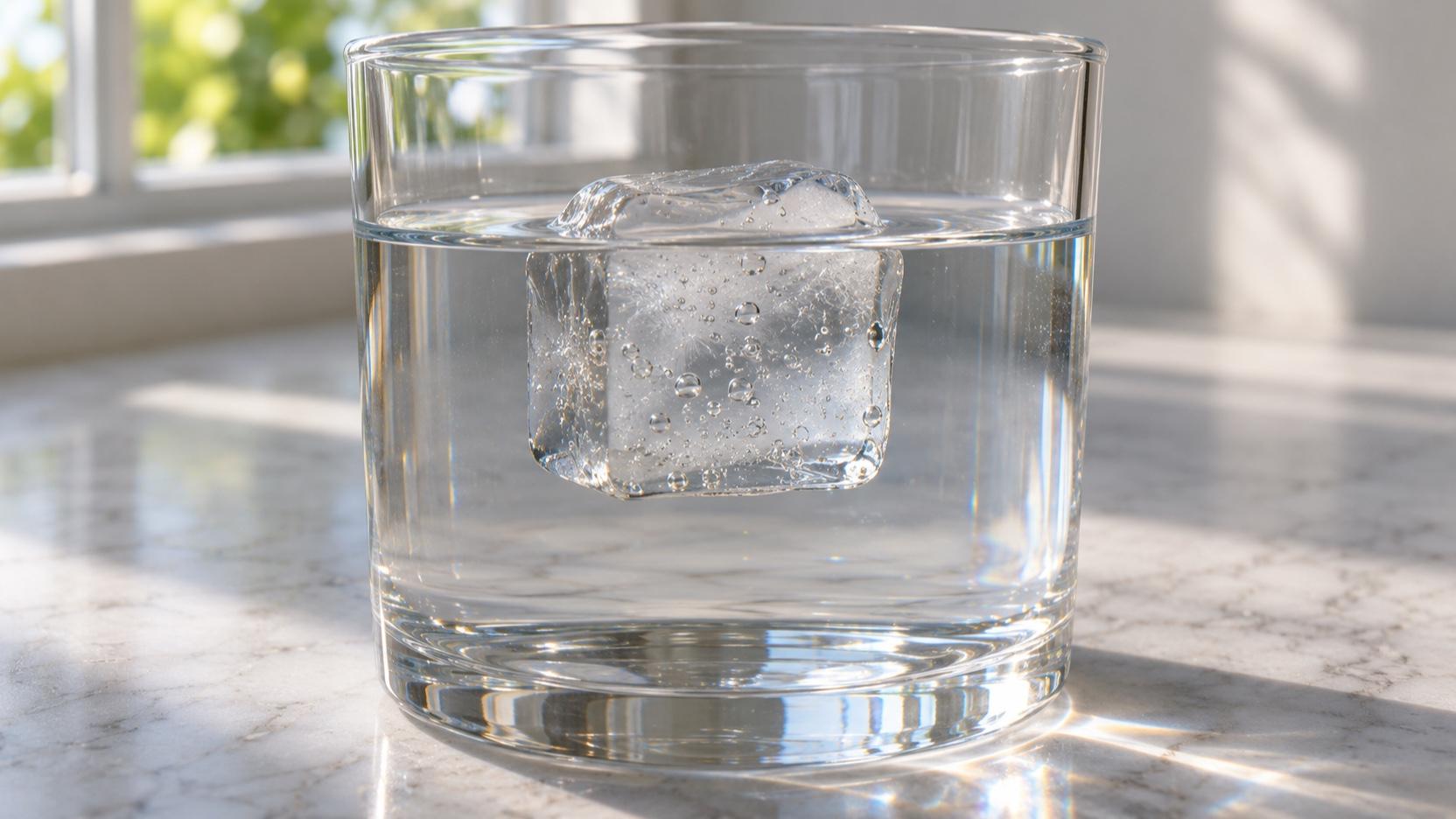
Drop an ice cube into a glass of warm water, and it immediately bobs to the surface, clinking against the glass as it floats effortlessly. Stand on the edge of a subarctic lake in mid-January, and you will look out across miles of solid, gleaming ice capable of supporting trucks and timber sleds, while beneath that rigid white ceiling, liquid water flows silently and fish glide through the calm dark.
To human beings, floating ice is so familiar that we rarely stop to consider how fundamentally bizarre it is. In the physical sciences, floating ice is an outrageous defiance of the basic laws of thermal physics. 
Nearly every substance in the known universe follows a strict, predictable thermodynamic script. As a gas cools into a liquid, its molecules slow down and draw closer together. As that liquid cools further toward its freezing point, thermal kinetic energy plummets, intermolecular attraction pulls the atoms even tighter, and the substance solidifies into a compact, densely packed crystal or amorphous solid. Consequently, almost every solid in existence is heavier and denser than its liquid counterpart. If you melt solid lead and drop a chunk of solid lead into the cauldron, it sinks like a stone. Solid gold sinks in liquid gold; solid paraffin wax sinks in melted candle wax; solid olive oil sinks in liquid oil.
Water, however, is a planetary rebel. When liquid water freezes into solid ice, it does not shrink, compress, or sink. Instead, it does the exact opposite: it expands violently by roughly nine percent, becoming lighter, more buoyant, and dramatically less dense than the fluid from which it was born. 
This singular thermodynamic quirk—often termed the density anomaly of water—is not merely an interesting laboratory curiosity. It is one of the foundational biophysical pillars that makes complex life on planet Earth possible. To understand why ice floats, one must journey into the sub-nanometer architecture of the water molecule, explore the dynamic choreography of hydrogen bonds, and examine the profound ecological consequences that occur when an entire lake freezes from the top down.
The Molecular Blueprint: Electronegativity, Polar Dipoles, and Bent Geometry
#The secret behind water anomalous behavior begins with its simple chemical formula: H2O. A single water molecule consists of one central oxygen atom covalently bonded to two hydrogen atoms. Yet the spatial distribution of electrical charge within this trio is radically asymmetric.
Oxygen is one of the most electronegative elements on the periodic table, meaning it possesses a fierce, greedy affinity for electrons. Hydrogen, conversely, possesses low electronegativity. In each covalent O-H bond, the oxygen atom pulls the shared pair of negatively charged electrons tightly toward its own atomic nucleus, keeping them far away from the tiny hydrogen protons:
- The Polar Dipole: This unequal sharing generates a permanent electric dipole. The oxygen atom acquires a strong partial negative charge, while each hydrogen atom is left with a bare, exposed proton, creating a strong partial positive charge.
- The Bent V-Shape Geometry: Water is not a straight, linear molecule like carbon dioxide. Because oxygen possesses two unbonded pairs of valence electrons (lone pairs) in addition to its two bonding pairs, the four electron pairs repel each other, organizing into a roughly tetrahedral arrangement. This geometry forces the two hydrogen atoms into a bent V-shape with an internal bond angle of approximately 104.5 degrees.
| Molecular Parameter | Numerical Value | Physical Significance | Impact on Macroscopic Properties |
|---|---|---|---|
| O-H Covalent Bond Length | 0.096 nanometers | Extremely short, highly stable chemical bond | High dissociation energy, chemical resilience |
| H-O-H Internal Bond Angle | 104.5 degrees | Bent V-shape geometry | Creates asymmetrical charge distribution |
| Oxygen Electronegativity | 3.44 on Pauling scale | Strong pull on shared electron pairs | Creates strong partial negative charge on oxygen |
| Hydrogen Electronegativity | 2.20 on Pauling scale | Weak pull on shared electron pairs | Leaves exposed partial positive charge on hydrogen |
| Molecular Dipole Moment | 1.85 Debye | Exceptional electrical polarity | High dielectric constant, supreme solvent capability |
Because of this intense electrical polarity, water molecules do not behave like inert, neutral spheres. They behave like microscopic, highly reactive magnets. The partially positive hydrogen atom of one water molecule is electrostatically attracted to the partially negative oxygen atom of an adjacent water molecule. This intermolecular attraction is known as a hydrogen bond.
The Liquid Dance: Transient Hydrogen Bonds in Flowing Water
#To understand why ice expands, one must first look at what happens in warm, flowing liquid water. Liquid water is not a static lattice; it is a chaotic, hyperactive molecular mosh pit.
At room temperature (around 20 to 25 degrees Celsius), thermal energy keeps water molecules moving, tumbling, and rotating at astonishing speeds:
- The Lifespan of a Picosecond: A single hydrogen bond in liquid water lasts for only a fraction of a second—typically between 1 and 20 picoseconds (a picosecond is one-trillionth of a second).
- Continuous Breaking and Reforming: Millions of times each second, hydrogen bonds snap, the molecules slide past each other, collide, tumble into tiny gaps, and immediately form new, fleeting bonds with neighboring molecules.
- Fluid Packing Density: Because thermal agitation constantly knocks molecules out of rigid alignment, the molecules in liquid water can crowd very close together. Liquid water contains a dynamic mixture of transient, fleeting clusters intermingled with chaotic, unbonded molecules that slip into empty spaces between clusters.
As liquid water cools from a warm boiling state down toward room temperature and further down toward 10 degrees Celsius, its molecules lose kinetic energy. They slow down, vibrate less violently, and pack closer together—behaving exactly like a normal, well-behaved liquid. Its volume shrinks, and its density steadily increases.
However, as the temperature continues to drop past 4 degrees Celsius toward the freezing point, an extraordinary thermodynamic revolution takes place.
The Hexagonal Cage: How Freezing Locks Water into an Open Lattice (Ice Ih)
#When liquid water reaches 0 degrees Celsius (32 degrees Fahrenheit), thermal kinetic energy drops to the point where it can no longer overpower the electrostatic strength of hydrogen bonds. The molecules can no longer tumble past each other or squeeze into microscopic gaps.
Instead, every single water molecule is forced to surrender to the geometric demands of hydrogen bonding:
- Maximum Hydrogen Bonding: In the liquid state, each water molecule forms an average of roughly 3.4 to 3.6 transient hydrogen bonds at any given instant. But as water freezes into standard terrestrial ice (known crystallographically as Ice Ih), every single molecule is locked into a rigid, permanent coordination network with four neighboring molecules.
- Tetrahedral Coordination: Each central oxygen atom acts as a hydrogen bond donor to two neighbors and a hydrogen bond acceptor to two others, creating a symmetrical tetrahedral coordination geometry.
- The Open Hexagonal Cage: To maintain this strict 104.5-degree bond geometry and accommodate four permanent tetrahedral bonds, the molecules cannot pack densely. They are physically forced to arrange themselves into a vast, three-dimensional array of repeating, open, hexagonal rings—resembling microscopic honeycombs or six-sided cages.
| State of Matter | Average Hydrogen Bonds per Molecule | Primary Molecular Structure | Physical Density at Phase Boundary |
|---|---|---|---|
| Liquid Water at 20 C | 3.2 to 3.4 transient bonds | Dynamic, tumbling clusters with high packing | 0.9982 grams per cubic centimeter |
| Liquid Water at 4 C | 3.6 transient bonds | Maximum crowding; optimized packing geometry | 1.0000 grams per cubic centimeter |
| Liquid Water at 0 C | 3.7 transient bonds | Incipient ice-like clusters forming in liquid | 0.9998 grams per cubic centimeter |
| Solid Ice Ih at 0 C | 4.0 permanent bonds | Rigid, open hexagonal crystalline lattice | 0.9167 grams per cubic centimeter |
The physical consequence of this rigid hexagonal cage is staggering: the crystalline lattice contains vast amounts of empty space. The molecules in solid ice are actually held farther apart by their permanent hydrogen bonds than they were in the chaotic, tumbling liquid state.
Because the same mass of water molecules now occupies roughly nine percent more volume, its density plummets from approximately 1.000 grams per cubic centimeter down to 0.9167 grams per cubic centimeter. According to Archimedes' Principle, any solid whose density is lower than the surrounding liquid will experience an upward buoyant force greater than its own weight. Ice floats because its crystalline structure is literally an open, airy scaffold constructed from frozen chemical bonds.
The 4 C Density Inversion: The Bizarre Thermodynamics of Cold Water
#The unusual behavior of water does not begin abruptly at the freezing point. It manifests several degrees earlier, during a peculiar thermal transition known as the density inversion of water.
In virtually all pure liquids, cooling continuously increases density until the substance solidifies. If you graph density against temperature for liquid ethanol, mercury, or benzene, the line slopes steadily upward right up to the moment of freezing.
For water, the graph does something unprecedented:
- The Peak at 3.98 C: As water cools from room temperature, its density increases normally until it reaches exactly 3.98 degrees Celsius (roughly 4 degrees Celsius or 39.2 degrees Fahrenheit). At this exact temperature, liquid water reaches its absolute maximum density of 1.0000 grams per cubic centimeter.
- The Expansion of Cold Water: As water cools further from 3.98 degrees Celsius down to 0 degrees Celsius, it unexpectedly reverses direction: it begins to expand and become lighter. Water at 2 degrees Celsius is lighter than water at 4 degrees Celsius; water at 0 degrees Celsius is lighter still.
Why does this happen? Around 4 degrees Celsius, two competing physical forces wage war within the liquid:
- Force 1 (Normal Thermal Contraction): Slower molecular motion allows molecules to pack closer together, which tends to increase density.
- Force 2 (Incipient Ice Clustering): Slower motion allows hydrogen bonds to start locking molecules into rigid, open, low-density hexagonal clusters, which tends to decrease density.
Above 4 degrees Celsius, normal thermal contraction wins the battle, and the water shrinks as it cools. But below 3.98 degrees Celsius, the formation of open, voluminous hydrogen-bonded clusters overpowers thermal contraction. The water begins to expand while still in a completely liquid state.
Why Lakes Freeze from the Top: Thermal Stratification and Winter Survival
#This 4-degree density maximum is not an abstract laboratory footnote. It is the direct engine that governs the physical limnology and seasonal life cycles of every freshwater lake, pond, and river in the temperate and polar regions of the world.
Consider what happens to a large freshwater lake as autumn gives way to freezing winter:
- Autumn Cooling and Lake Turnover: Cold autumn winds chill the surface water from 15 degrees Celsius down toward 10 degrees, then 6 degrees, and finally 4 degrees Celsius. Because water becomes denser as it cools toward 4 degrees, this chilled surface water becomes heavy and sinks to the bottom, pushing warmer, lighter water up to the surface to be chilled in turn. This vertical circulation, known as the autumn turnover, thoroughly mixes the lake and distributes dissolved oxygen to the deep benthic zones.
- The 4 C Bottom Sanctuary: Eventually, the entire body of water reaches uniform maximum density at 4 degrees Celsius. Now, as freezing winter winds continue to blow, the surface water cools below 4 degrees—dropping to 3 degrees, 2 degrees, 1 degree, and finally 0 degrees Celsius.
- Inverse Thermal Stratification: Because water colder than 4 degrees is lighter and less dense, it no longer sinks. It remains trapped at the surface, floating like a buoyant thermal blanket over the heavier 4-degree water below.
- Surface Freezing: When the surface water reaches 0 degrees Celsius, it freezes into a rigid layer of ice. Because ice is nine percent lighter than water, it stays at the top, forming an expanding floating lid across the lake.
| Lake Zone | Winter Temperature Range | Water State and Density | Ecological Function During Freezing Months |
|---|---|---|---|
| Surface Ice Sheet | 0 C to sub-zero ambient | Solid Ice Ih; lowest density | Reflects solar radiation; insulates water below from wind |
| Sub-Ice Water Layer | 0.0 C to 1.5 C | Buoyant liquid; near-freezing | Cold buffer zone; minimal currents |
| Mid-Water Epilimnion | 1.5 C to 3.5 C | Transition liquid density | Allows vertical nutrient diffusion |
| Deep Benthic Lakebed | Exactly 3.98 C (roughly 4 C) | Heaviest liquid water; maximum density | Unfreezing biological sanctuary for fish, turtles, and flora |
This surface ice sheet serves as a phenomenal insulating lid. Ice possesses very low thermal conductivity, meaning it transfers heat very poorly. Once a layer of surface ice forms, it physically shields the underlying water from freezing sub-zero winds, trapping the Earth natural geothermal heat within the lakebed. 
Beneath the ice, the water at the very bottom remains a stable, liquid 4 degrees Celsius throughout the coldest winter storms. In this unfreezing benthic sanctuary, fish, frogs, turtles, and aquatic insects survive in a semi-dormant, low-metabolic state, completely insulated from the lethal arctic conditions above.
Understanding these thermodynamic phase boundaries reflects how our broader understanding of molecular chemistry and volatile biochemical reaction principles consistently demonstrates that subtle sub-nanometer molecular geometries dictate macroscopic environmental survival.
The Catastrophic Counterfactual: What Would Happen if Ice Sank?
#To fully appreciate the ecological miracle of floating ice, one need only imagine an alternate Earth where water behaved like a normal liquid—where solid ice was denser than liquid water.
In such a world, planetary biology would face swift and irreversible collapse:
- Bottom-Up Freezing: In winter, as surface water chilled to 0 degrees Celsius and froze, the newly formed ice crystals would immediately sink to the deepest trenches of lakes, rivers, and oceans.
- The Ice Accumulation Engine: New surface water would continuously contact freezing winds, freeze, and sink, piling solid ice higher and higher from the ocean floor upward.
- The Failure of Summer Thaw: In spring and summer, solar radiation heats only the top few meters of open water. Because water is an exceptionally poor conductor of heat downward, and because warm water floats, summer sunlight would warm only a thin surface skin of meltwater. The colossal mountains of ice accumulated on the ocean and lake floors would never receive sufficient heat to melt.
- Complete Glaciation: Year after year, more water would freeze and sink, locking planetary water into permanent benthic glaciers. Within centuries, virtually every lake, river, and temperate ocean basin on Earth would freeze solid from the bottom up, leaving only a shallow, lifeless puddle of slush on top during high summer. Aquatic ecosystems would be eradicated, global oceanic circulation (the thermohaline conveyor belt) would shut down, and Earth would become an arid, hyper-arid ice planet.
The fact that Earth boasts vibrant marine biodiversity, flowing rivers, and a stable, temperate global climate is entirely owed to the fact that water molecules lock into an open hexagonal ring rather than a compact cube.
Everyday Physics: Bursting Pipes, Glacial Creep, and Drink Cooling Efficiency
#The expansive physics of freezing water produces dramatic everyday consequences across domestic plumbing, geology, and daily life:
- The Tremendous Force of Pipe Bursting: When water freezes inside household plumbing, its nine percent volume expansion exerts staggering hydrostatic pressures. If the ice forms between a closed faucet and a frozen blockage, the trapped liquid water is compressed to immense levels exceeding 200 megapascals (nearly 30,000 pounds per square inch)—far higher than the yield strength of copper, PVC, or cast iron, causing the pipe wall to rupture cleanly.
- Geological Frost Wedging: In nature, liquid rainwater seeps into microscopic fractures and fissures in towering granite cliffs. When winter freezes arrive, the expanding ice acts as a powerful hydraulic wedge, prying the rock faces apart. Over centuries, this process of frost wedging shatters mountains, carves dramatic alpine valleys, and generates fertile mineral soil.
- The Cooling Power of Melting Ice: Why do we put floating ice cubes in drinks rather than simply chilling the drink in a refrigerator? To melt one gram of solid ice into liquid water at 0 degrees Celsius requires a colossal input of thermal energy—known as the latent heat of fusion (334 joules per gram). As floating ice bobs in your glass, it continuously extracts massive amounts of heat directly from the surrounding liquid, chilling the drink far faster and more effectively than an equivalent volume of cold water ever could.
The next time you watch an ice cube float in your glass, remember that you are looking at one of the rarest, most consequential physical anomalies in nature: an open molecular cage that defies the universe tendency to contract, quietly preserving the delicate conditions that allow life to flourish on Earth.