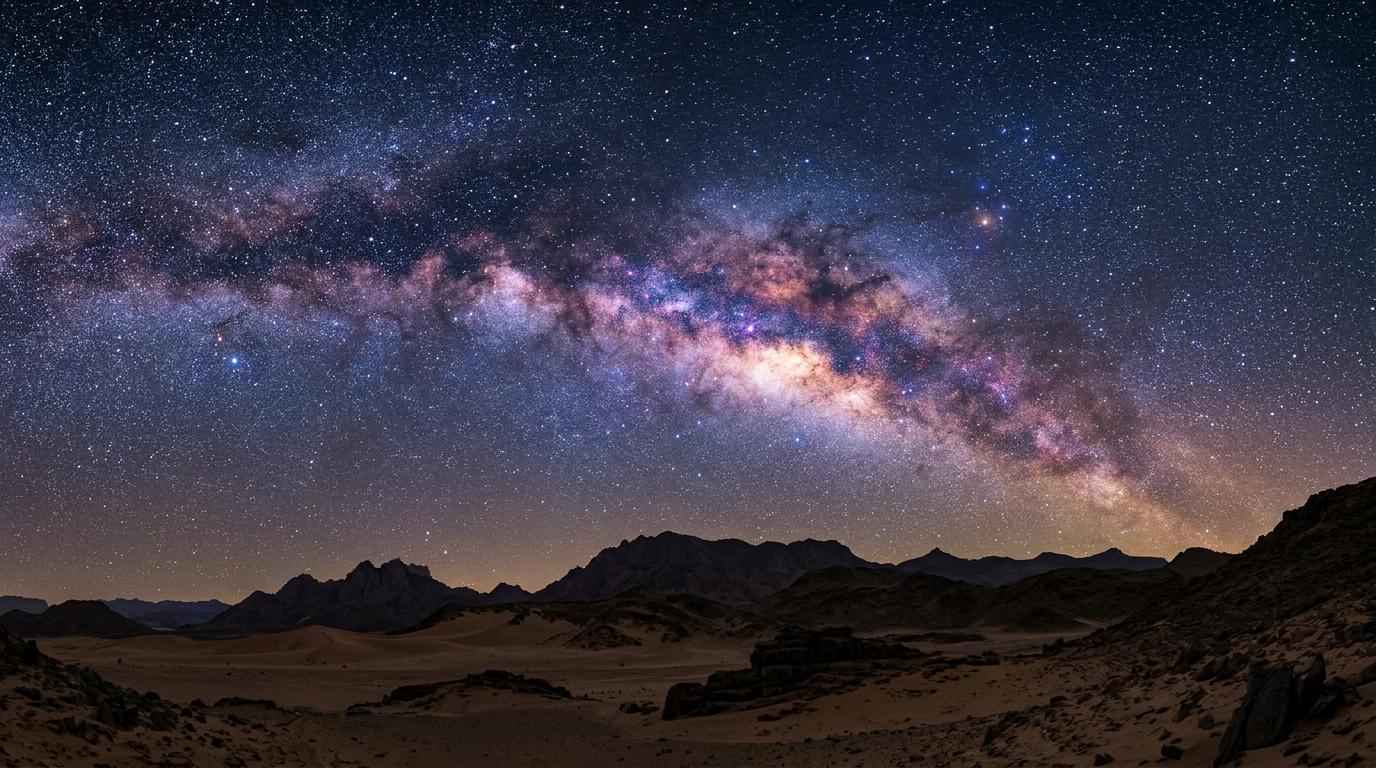
On a clear night far from city lights, looking up into the dark sky reveals a glittering field of stars that flash, shimmer, and dance in brightness. Yet if you spot a bright planet like Jupiter, Venus, or Mars, you will notice something completely different: planets shine with a steady, unblinking glare. They do not flicker. They do not twinkle.
The short answer comes down to optical physics and distance: stars do not actually twinkle in space. They twinkle only because Earth's turbulent atmosphere bends their pinprick of light like a funhouse mirror. Planets do not twinkle because they are close enough to form a wide disk of light that smooths out the flickering.
If you were an astronaut floating outside the International Space Station, every star in the cosmos would shine completely still, without a hint of flickering. The twinkling happens entirely within the thin blanket of air wrapped around our planet.
How Earth's Turbulent Atmosphere Bends Light
#To understand why stars twinkle, look at the air between your eyes and deep space. 
Earth is surrounded by an atmosphere roughly 100 kilometers thick. This ocean of air is never still. Daytime heat rising from the ground, cold nighttime air sinking, and high-altitude winds create constant atmospheric turbulence. 
That churning air is divided into millions of shifting pockets of warm and cold air:
- Warm air is less dense and bends light gently.
- Cold air is denser and bends light more sharply.
Whenever a beam of light passes between pockets of air with different temperatures and densities, it bends slightly. Because the air above you is constantly moving and swirling hundreds of times every second, light traveling through it gets bent in random directions in fractions of a millisecond.
Scientists call this rapid bending of light astronomical scintillation.
Stars: True Optical Point Sources
#Why does this shifting air make stars flash violently while leaving planets steady? The difference lies in their distance and apparent size in the sky.
Stars are gigantic balls of burning gas, often millions of kilometers wide and much larger than our Sun. But stars are situated at unimaginable interstellar distances. The closest star system to Earth, Alpha Centauri, is more than 40 trillion kilometers away. Other familiar stars like Betelgeuse lie hundreds of light-years in the distance.
Because stars are so staggeringly far away, their light arrives at Earth as an infinitesimal point source—a single beam of light narrower than a human hair.
Because a star's light is a single hair-thin ray:
- As that beam travels through shifting pockets of warm and cold air, a single parcel of turbulent air can bend the entire ray away from your pupil for a millisecond.
- In that instant, the star appears to dim or vanish completely.
- A millisecond later, the air shifts again, bending the ray straight back into your eye so the star flashes bright.
- Happening dozens of times per second, your brain perceives this rapid bending and flashing as twinkling.
Because cool air bends blue light slightly more than red light, bright stars like Sirius often appear to sparkle with vivid flashes of red, white, and blue on cold, clear nights.
Planets: Wide Disks of Light
#Planets in our solar system do not twinkle because they are our cosmic next-door neighbors.
Even though planets like Mars or Venus are physically thousands of times smaller than stars, they are millions of times closer to us. While stars lie light-years away, planets are only millions of kilometers from Earth:
- Mars can be as close as 55 million kilometers during close approaches.
- Jupiter is usually around 600 to 900 million kilometers away.
- Venus orbits within 40 to 260 million kilometers of Earth.
Because planets are so much closer, their light does not reach your eye as a single pinprick ray. Instead, a planet forms a wide circular disk of light composed of millions of individual light rays side by side.
Even though your naked eye cannot resolve that tiny disk without binoculars or a telescope, the physics still holds:
- When an air pocket bends light coming from the left edge of Jupiter's disk away from your eye, light from the right edge bends straight toward your eye.
- The millions of rays across the planet's disk cancel out each other's flickering.
- The overall brightness of the planet remains rock-steady.
| Characteristic | Interstellar Stars | Solar System Planets |
|---|---|---|
| Physical Distance | Trillions of kilometers (light-years away) | Millions of kilometers (within our solar system) |
| Light Structure | Infinitesimal point source (single hair-thin beam) | Extended two-dimensional disk of millions of rays |
| Atmospheric Impact | Entire light beam is deflected away and back | Different parts of the disk cancel out deflections |
| Naked-Eye View | Flashes, flickers, and changes color rapidly | Shines with a steady, unblinking glare |
| View from Space | Completely still and rock-steady | Completely still and rock-steady |
Can Planets Ever Twinkle?
#Under unusual weather conditions, planets can occasionally appear to twinkle.
If you spot Venus or Mercury sitting very low on the horizon right after sunset, you are looking through a much thicker layer of dense, ground-level air than when looking straight up. That thick column of air can be turbulent enough to distort even a wide planetary disk, making the planet shimmer gently. 
Similarly, on nights with severe atmospheric turbulence or approaching storm fronts, planets may exhibit a subtle flicker. But high in the open night sky, planets almost always maintain their calm, steady light.
Why Astronomers Build Telescopes on Mountain Peaks
#For backyard stargazers, twinkling stars are charming. For professional astronomers trying to take sharp pictures of distant galaxies, twinkling is an absolute nuisance.
Because atmospheric turbulence blurs celestial objects, major astronomical observatories are built on high, dry mountain peaks (like Mauna Kea in Hawaii or the Atacama Desert in Chile), well above the densest, most turbulent layers of the atmosphere. 
To overcome the remaining shimmer, modern ground observatories use adaptive optics: flexible mirrors that deform hundreds of times per second to cancel out atmospheric distortion in real time. And the ultimate solution remains space telescopes like Hubble and James Webb, which orbit entirely outside Earth's atmosphere to capture perfectly steady, unblinking views of the universe.
The next time you step outside on a clear night, you can use twinkling as an easy stargazing tool: if a bright celestial light shimmers and changes colors, you are looking at a distant star. If it shines with a solid, piercing beam, you are looking at a planet.