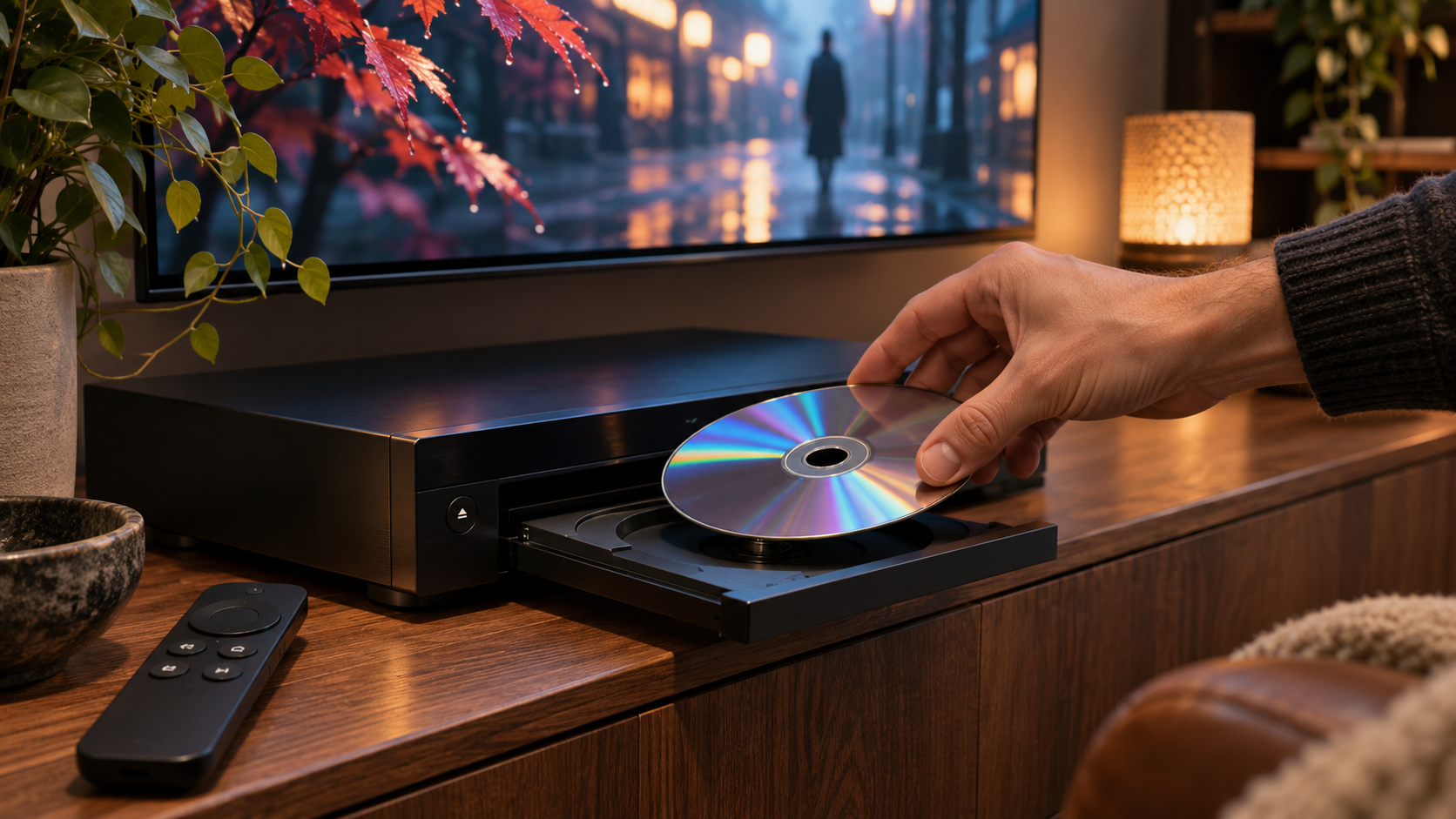
A decade ago, the tech industry declared optical discs dead. Streaming services promised an effortless future: every film, television series, and documentary ever produced would be instantly accessible from the cloud for the price of a monthly sandwich. Giant physical video stores closed, DVD bargain bins vanished from grocery aisles, and laptop manufacturers stripped optical drives from every new computer chassis.
Yet in 2026, an unmistakable counter-movement is taking hold. Physical media—specifically 4K Ultra HD Blu-ray and vinyl records—is experiencing a remarkable cultural and commercial revival. Cinephiles, home theater builders, and everyday entertainment fans are returning to spinning physical discs in record numbers. Specialty boutique labels are expanding, major retailers are selling out of premium steelbook editions within hours, and film directors routinely urge their audiences to buy physical copies of their work.
This is not simple hipster nostalgia for plastic cases. It is a calculated consumer rebellion driven by two cold realities: the severe visual and acoustic compromises of internet streaming, and the vanishing legal illusion of digital ownership.
The Streaming Mirage: When 4K Doesn't Mean 4K
#When you click play on a "4K UHD" title on Netflix, Disney+, or Amazon Prime Video, your television screen illuminates with 3,840 horizontal pixels and 2,160 vertical pixels. By definition, that is four times the pixel count of a traditional 1080p high-definition television. 
However, resolution is only the container; bitrate is what actually fills it.
Resolution measures how many dots are on your screen. Bitrate measures how much data the video file actually delivers to those dots every second. A streaming service can broadcast an image containing 8.3 million pixels, but if it only sends a trickle of data to describe what color those pixels should be, the picture will look muddy, noisy, and flat.
To deliver smooth video across millions of home Wi-Fi networks simultaneously without constant buffering, streaming platforms compress video files aggressively. They run raw film scans through encoding algorithms designed to throw away as much data as humanly possible while keeping the image barely acceptable to casual viewers watching on small screens or smartphones.
| Video / Audio Feature | Typical 4K Streaming (Netflix, Prime, Disney+) | 4K Ultra HD Blu-ray Disc | What Your Senses Actually Experience |
|---|---|---|---|
| Average Video Bitrate | 15 to 25 Mbps (often dips below 12 Mbps) | 50 to 100 Mbps (peaks up to 128 Mbps) | 4x to 6x more image data per second on physical discs |
| Video Compression | Aggressive variable bitrate HEVC/AV1 | Unconstrained high-bitrate HEVC | No macroblocking, pixelation, or banding in dark scenes |
| Audio Format | Compressed Dolby Digital Plus (E-AC-3) | Uncompressed Dolby TrueHD / DTS-HD Master Audio | Studio-master lossless sound versus lossy web streaming |
| Audio Bitrate | Capped at 448 to 768 kbps | 3,000 to 6,000+ kbps | Massive dynamic range: quiet whispers and thunderous bass |
| Internet Dependency | 100% dependent on broadband and Wi-Fi | Completely offline; zero bandwidth usage | No buffering, no throttling, and immune to ISP data caps |
| Ownership Status | Revocable access license (can vanish anytime) | Permanent personal property | The movie is yours forever; cannot be altered or removed |
| Bonus Material | Minimal or absent; trailers only | Audio commentaries, making-of documentaries, deleted scenes | Archival film history preserved directly on the disc |
The Bitrate Divide: 15 Mbps vs 100 Mbps
#The mathematical difference between streaming and physical media is staggering. 
The average 4K stream on a mainstream platform operates at a video bitrate between 15 and 25 megabits per second (Mbps). Under peak network congestion or throttled home connections, that number frequently drops as low as 10 to 12 Mbps without warning.
In contrast, a triple-layer 100-gigabyte 4K Ultra HD Blu-ray disc reads data locally from an optical laser at steady speeds ranging between 50 and 100 Mbps, with peak action sequences bursting up to 128 Mbps. 
A 4K Blu-ray delivers roughly four to six times more visual data every single second than the highest-quality mainstream stream. The disc drive does not care if your neighborhood is downloading a massive software update or if your teenager is gaming in the next room. The optical laser transfers uncompressed, bit-for-bit picture information directly to your television panel without network bottlenecks.
Compression Artifacts: Why Dark Scenes Fall Apart on Streaming
#The practical result of this bitrate divide is most visible whenever a film gets challenging to render. Streaming compression algorithms work by identifying areas of the frame that look similar from one second to the next and grouping them together to save bandwidth. 
Bright, brightly lit daylight scenes—like a soccer match or an animated children's movie—compress relatively cleanly. But the moment a director introduces darkness, smoke, fog, water, or chaotic movement, streaming video breaks down completely.
You have almost certainly experienced these common streaming artifacts:
- Macroblocking in dark scenes: Instead of smooth, velvety shadows in a nighttime thriller or outer space movie, dark backgrounds dissolve into shimmering mosaic squares and muddy grey blocks. This occurs because the streaming encoder does not have enough bitrate to calculate subtle gradations of shadow, so it flattens them into chunky digital tiles.
- Color banding across gradients: In shots featuring a sunset, a single lamp in a dark room, or light filtering through water, you often see distinct, stepped rings of color instead of a seamless gradient.
- Smearing in fast motion: When an explosion occurs, confetti falls, or waves crash against rocks, the thousands of individual particles overwhelm low-bitrate encoders, turning sharp action into a smeared, watery blur.
On a 4K Blu-ray disc, these artifacts disappear. Shadows remain deep, inky, and stable. Subtle film grain—which streaming encoders ruthlessly scrub away because fine grain is computationally expensive to compress—remains intact, giving classic movies their organic, theatrical texture.
The Audio Gap: Lossy Dolby Digital Plus vs Lossless Dolby TrueHD
#While the visual upgrade on physical media is dramatic, the audio gap is where the difference becomes undeniable.
Streaming platforms promote "Dolby Atmos" prominently in their user interfaces. However, what streaming services deliver is lossy Dolby Atmos packed inside a compressed Dolby Digital Plus stream. Because streaming bandwidth is strictly rationed, streaming audio bitrates are hard-capped at approximately 448 to 768 kilobits per second (kbps) across all channels combined.
To squeeze a full surround sound or spatial audio mix into that narrow straw, audio engineers must compress the audio file aggressively. The highest frequencies are shaved off, the lowest sub-bass rumbles are rolled back, and the overall dynamic range is compressed so that whispers and explosions exist at roughly the same volume.
A 4K Blu-ray disc features lossless audio codecs like Dolby TrueHD (with Dolby Atmos) or DTS-HD Master Audio (with DTS:X). These tracks operate at bitrates between 3,000 and 6,000+ kbps—nearly eight to ten times the bandwidth of streaming sound.
Lossless audio delivers bit-for-bit mathematical replication of the studio master recorded on the mixing stage. The practical benefits are immediately obvious even on a modest soundbar, and revelatory on a multi-speaker surround setup:
- Uncompressed dynamic range: In a streaming film, you frequently have to ride the remote control, turning the volume up to hear muddled dialogue and turning it down when an explosion shakes the room. On a 4K disc, dialogue is razor-sharp and articulate, while cinematic impacts hit with full acoustic weight without distortion.
- Precise spatial steering: Overhead and surround effects move with pinpoint accuracy around your living room. The sound of rain falling, leaves rustling behind you, or a bullet ricocheting across the ceiling has physical presence rather than sounding like diffuse background noise.
The Ownership Illusion: You Don't Actually Own Your Digital Movies
#Beyond picture and sound fidelity, the physical media revival is fueled by a growing realization among consumers: you do not actually own digital movies purchased on the internet.
When you click "Buy" on Apple TV, Amazon Prime, Google Play, or digital storefronts, you are not purchasing an asset. You are purchasing a non-exclusive, revocable personal license to view that file for as long as the platform maintains the legal distribution rights.
Buried deep in every digital storefront's terms of service is language establishing that if a movie studio terminates its licensing agreement with the platform, the platform reserves the right to remove that title from your library without a refund.
This is not a hypothetical risk. It happens regularly:
- In 2023, Sony announced it would delete hundreds of previously purchased Discovery television shows from PlayStation user accounts due to expiring content licensing arrangements with Warner Bros. Discovery (a decision walked back only after massive public backlash).
- Streaming platforms have quietly altered films years after their release, swapping out copyrighted songs from classic soundtracks, smoothing out controversial dialogue, or cropping aspect ratios without user consent.
- Entire streaming services have shut down, stranding customers who spent thousands of dollars building digital video libraries.
When you hold a 4K Blu-ray disc in your hand, you own private property. No corporate studio can push a firmware update to erase the movie from your living room shelf. You can lend it to a friend, resell it on an aftermarket exchange, play it completely offline during an internet outage, and pass it down to your children. 
The Disappearing Library: Studio Tax Write-offs and Licensing Purges
#The streaming landscape has entered a phase of aggressive corporate cost-cutting. In an effort to reduce residual payments to actors and write off corporate losses against tax liabilities, major media conglomerates have begun executing digital purges.
Films and television shows developed exclusively for streaming services—such as completed projects, critically acclaimed miniseries, and independent festival acquisitions—have been permanently pulled from server farms, deleted from digital storefronts, and made completely unwatchable anywhere on earth.
If a movie only exists as a digital file on a streaming server and the corporate owner decides to delete it, that work of art ceases to exist. 
This cultural vandalism has transformed physical media into an essential preservation tool. Film directors, cinematographers, and film preservationists recognize that physical discs are the only reliable safeguard against corporate accounting decisions erasing cinematic history.
The Boutique Revival: Criterion, Arrow and Collector Culture
#While big-box department stores like Best Buy phased out physical media racks to sell more home appliances, specialized boutique publishers are thriving.
Companies like The Criterion Collection, Arrow Video, Kino Lorber, Vinegar Syndrome, and Shout! Factory treat physical media the same way vinyl record labels treat music: as luxury, collectible art objects.
These boutique labels do not simply stamp digital files onto plastic. They track down original camera negatives, perform painstaking 4K chemical restorations, commission original cover artwork from independent illustrators, publish bound essays written by film historians, and press discs with maximum possible bitrates.
The collector community that has coalesced around physical media mirrors the vinyl resurgence of the past decade. Younger demographics who grew up in an entirely digital ecosystem are discovering the tactile joy of physical media: holding a heavy steelbook case, browsing physical spine artwork on a curated shelf, reading printed production booklets, and experiencing a movie as a deliberate, uninterrupted event rather than passive background content.
How to Build a Modern Physical Media Collection
#If you want to experience your home theater setup at its full potential and protect your favorite films from corporate deletion, transitioning to physical media is straightforward.
- Start with your reference titles: You do not need to buy every movie you watch on physical disc. Use streaming services for casual viewing, reality television, and background noise. Reserve physical 4K disc purchases for your top 20 favorite films, cinematic masterworks (like 2001: A Space Odyssey, Dune, or Blade Runner 2049), and movies you know you will rewatch for decades.
- Choose the right player: If you already own a standard PlayStation 5 or Xbox Series X, you already own a competent 4K UHD Blu-ray player. If you want reference-grade performance, dedicated standalone players like the Panasonic DP-UB820 feature specialized HDR tone-mapping chips and Dolby Vision output that extract every ounce of dynamic range from discs onto high-end OLED screens.
- Hunt the secondary market: Because mainstream consumers transitioned to streaming, secondhand record stores, thrift shops, and online enthusiast forums are flooded with pristine physical discs at steep discounts compared to streaming rental prices.
The Bottom Line
#Streaming won the war of convenience. It provides instant gratification, infinite scrolling, and acceptable quality for passive entertainment. 
However, for anyone who truly cares about the art of cinema, the visceral power of uncompressed sound, and the permanence of personal ownership, 4K Ultra HD Blu-ray is not obsolete technology. It is the gold standard that internet streaming simply cannot touch.