
The Short Answer I Wish Someone Had Told Me Earlier
#If your bathroom turns into a foggy rainforest after every shower, the thing that “works” best is usually an exhaust fan. Not a cute little bathroom dehumidifier sitting in the corner. An exhaust fan removes the wet air at the source and throws it outside, which is exactly what you want when hot shower steam is hitting mirrors, paint, grout, towels, the ceiling, everything. But — and this is where people get annoyed with me — a dehumidifier can still be really useful in some bathrooms. Especially if you rent, don’t have a proper vent, live somewhere humid, or your exhaust fan is basically just making a sad humming noise while doing nothing.
I learned this the annoying way. Our old bathroom fan sounded like a tiny airplane but somehow the mirror still stayed wet for 25 minutes. I kept thinking, “well it’s loud, so it must be working.” Nope. Loud is not the same as moving air. Then I bought a small dehumidifier, felt very clever for about three days, and then realized it was helping after the shower, not during the shower. Different job. Different tool. Basically, exhaust fan = steam removal. Dehumidifier = leftover humidity control. They overlap a bit, but they’re not twins.
Why Bathroom Moisture Is Such a Sneaky Little Problem
#Bathroom moisture doesn’t always look dramatic. Sometimes it’s just a mirror that stays cloudy, towels that never properly dry, a little black spotting around silicone, paint bubbling near the ceiling, or that wet-sock smell when you open the door in the morning. And honestly, that smell is what gets me. I can ignore a lot of house stuff, probably too much, but musty bathroom air feels like the room is personally judging me.
The real issue is that warm air holds more moisture, and showers dump a shocking amount of water vapor into a tiny space. If that vapor doesn’t leave fast enough, it condenses on cooler surfaces. Mirrors first, then windows, then tile, then inside cracks and corners you don’t even see. Over time, that can mean mildew, mold staining, swollen wood trim, rusty fixtures, peeling paint, and that gross dampness in bath mats. If you’ve ever dealt with musty AC smells while traveling, it’s the same general family of problem: moisture plus poor airflow equals funk. I wrote about that kind of damp odor troubleshooting here too: Hotel Room AC Smells Musty? What to Do Before Sleep. Different room, same nose-wrinkling drama.
There’s also a health-ish side, but I’m not trying to scare anyone
#I’m careful with mold talk because the internet loves to go full disaster movie. Not every black speck is the end of civilization. But indoor dampness is genuinely not something to shrug off forever. Mold and mildew like moisture, and bathrooms give them food, warmth, and terrible ventilation if we let them. People with allergies, asthma, or sensitive noses may notice it faster. Even if nobody in your house reacts, damp rooms just age badly. Grout gets ugly. Caulk fails sooner. Cabinets smell weird. And then one random Sunday you’re on your knees with bleach, a toothbrush, and regret. Ask me how I know.
So What Does an Exhaust Fan Actually Do?
#An exhaust fan pulls humid bathroom air out and sends it outdoors through ducting. That last part matters. Outdoors. Not into the attic, not above a false ceiling, not into a random wall cavity where it can quietly create a damp science project. A proper fan is supposed to exchange moist air for drier air from the rest of the home, which comes in under the door or through a grille. If the bathroom door is sealed tight like a submarine, even a decent fan can struggle because it has no replacement air to pull in.
Most bathrooms are sized using airflow, usually listed as CFM, which means cubic feet per minute. A common rule of thumb you’ll see from ventilation people is around 1 CFM per square foot for bathrooms up to about 100 square feet, with many basic bathrooms using a 50 CFM fan as the minimum-ish starting point. Larger bathrooms, long duct runs, multiple showers, jetted tubs, and super steamy households may need more. But don’t get obsessed with buying the biggest fan on the shelf either. Too much fan can be noisy, waste conditioned air, and in some homes it may pull air from places you don’t want. Like, moderation exists, apparently.
- If the fan is noisy but weak, check the grille first. Dust can choke it badly.
- If it vents into the attic, fix that. Seriously. That’s not ventilation, that’s relocating the problem.
- If the duct is crushed, too long, full of bends, or missing a backdraft damper, the fan may test fine on paper and still do a terrible job in real life.
- If nobody runs it long enough, even a great fan won’t save the room. I am personally guilty of this one.
And What Does a Bathroom Dehumidifier Do?
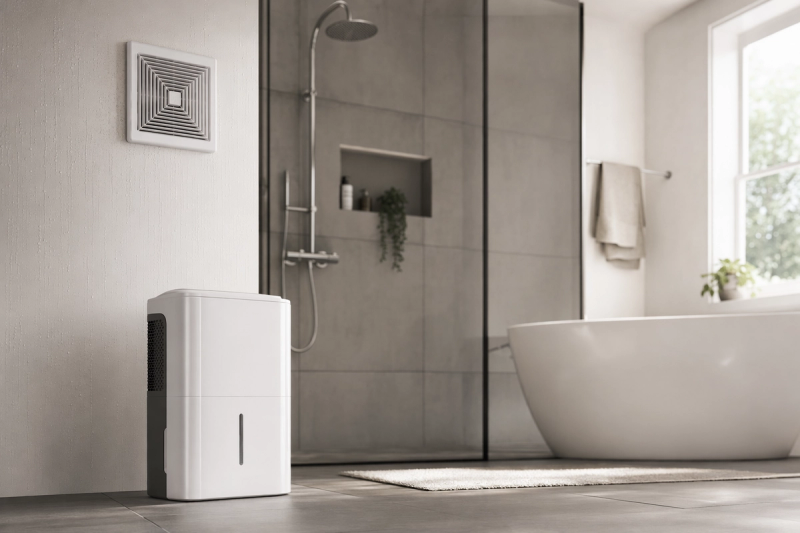
#A dehumidifier doesn’t vent air outside. It pulls humid air over cold coils, condenses water out of it, collects that water in a tank or sends it through a drain hose, and blows drier air back into the same room. Because of how the machine works, the air it blows out is often slightly warm. That’s normal. It’s not broken. It’s also why a dehumidifier can make a bathroom feel less clammy but not necessarily “fresh” in the way outdoor ventilation does.
Small bathroom dehumidifiers are usually best for after-shower moisture, damp towels, humid climates, windowless bathrooms, basements, laundry-bathroom combos, or rental flats where installing a real exhaust duct is impossible. But they are not magic boxes. If you take a long hot shower and steam is rolling across the ceiling, a little 500 ml mini dehumidifier is not going to heroically swallow all that moisture in real time. It’ll sit there blinking politely while your mirror cries.
The annoying truth about tiny dehumidifiers
#Those very small Peltier-style dehumidifiers are quiet and cheap-ish, and I don’t hate them. They can help in cupboards, small powder rooms, or mildly damp bathrooms. But they remove water slowly compared with compressor dehumidifiers. A compressor unit removes more moisture, but it’s bigger, heavier, usually louder, and it needs a safe electrical spot. Bathrooms are wet spaces, so placement matters. Keep any plug-in appliance away from splash zones, use proper grounded/GFCI-protected outlets where required, and don’t run extension cords like you’re setting up a concert stage next to the bathtub. I know that sounds obvious, but people do stuff.
Exhaust Fan vs Dehumidifier: The Real-World Comparison
#| Thing you care about | Exhaust fan | Bathroom dehumidifier |
|---|---|---|
| Best at | Removing shower steam quickly, if ducted outside | Lowering lingering humidity after the steam event |
| Needs installation? | Usually yes, unless already fitted | Usually no, just plug in safely |
| Removes odors? | Yes, because air leaves the room | Not really. It dries air but doesn’t replace stale air |
| Running cost | Usually low per use, depends on wattage and run time | Higher if used for hours daily, especially compressor models |
| Noise | Can be very quiet if you buy a low-sone model, or awful if old | Small units are quiet, compressor units hum like a mini fridge |
| Maintenance | Clean grille, check duct, replace bad damper sometimes | Empty tank, clean filter, clean reservoir, prevent slime |
| Best for renters | Only if fan already exists or landlord helps | Often easier, since it’s portable |
| Big weakness | Bad ducting makes it useless | Doesn’t remove polluted/stale air outside |
If I had to choose one for a normal full bathroom with a shower, I’d choose a properly installed exhaust fan first. No hesitation. It deals with the moisture where and when it happens. A dehumidifier is more like the backup singer. Important, helpful, sometimes the thing that makes the whole song work, but not usually the lead.
The “Works” Part Depends on Your Bathroom, Not Just the Gadget
#This is where the internet arguments get silly. Someone says, “dehumidifiers are useless in bathrooms,” and someone else says, “my dehumidifier saved my moldy rental,” and both of them might be right. The bathroom layout matters. Climate matters. Shower habits matter. Whether you keep the door open after bathing matters. Whether four people shower back-to-back every morning matters a LOT. Also, whether your fan is actually connected to a duct and not just vibrating for emotional support.
In a dry climate, a decent exhaust fan and an open door might be plenty. In a coastal city, monsoon season, or a ground-floor apartment with poor cross-ventilation, the room may stay humid even after the fan runs. In that case, a dehumidifier can help pull the room down to a more comfortable level. Many home comfort guidelines talk about keeping indoor relative humidity roughly around 30% to 50%, though bathrooms spike higher during showers. I don’t panic if it hits 80% during a hot shower. I care how fast it comes back down.
My cheap little humidity meter changed my mind
#I bought a tiny hygrometer because I was tired of guessing. Best boring purchase ever. Before that, I’d go by vibes: mirror wet = bad, mirror dry = good. Very scientific. But the meter showed our bathroom stayed above 70% humidity long after showers, especially when it rained outside. Running the fan for five minutes barely did anything. Running it for 20 to 30 minutes with the door cracked helped a lot. Adding a small dehumidifier on very damp days helped even more. Not glamorous. Just data, in a tiny plastic box.
- Take a shower like normal, don’t change your habits for the test.
- Check humidity right after, then again at 15, 30, and 60 minutes.
- If it’s still sitting high an hour later, you’ve got a ventilation or drying problem.
- Try the same test with the fan running longer, door cracked, and towels spread out. You might be suprised how much those basic things matter.
When an Exhaust Fan Is the Clear Winner
#An exhaust fan wins when your problem is shower steam, odors, and stale air. If you’re remodeling, building, or already have a fan that can be upgraded, do that before buying another appliance. Look for a fan with enough airflow for the bathroom, a reasonable noise rating, and ideally a timer or humidity sensor. The timer is underrated. People turn fans off too soon because the noise annoys them or because they forget. A timer switch lets the fan run after you leave, which is exactly what the room needs.
Humidity-sensing fans can be great too, though they’re not perfect. Some turn on late, some stay on forever in humid weather, and some people hate when appliances make decisions. I get it. Still, for families or shared bathrooms, automation helps because not everyone is going to stand there thinking about relative humidity before work. Me included.
Signs your exhaust fan isn’t actually working well
#Here’s my non-fancy checklist. Hold a tissue near the fan grille while it’s on. It should pull the tissue up firmly. Not violently, just clearly. If the tissue barely moves, clean the cover and try again. If it still barely moves, the fan may be weak, the duct may be blocked, or the backdraft flap might be stuck. Also go outside and find the vent outlet while the fan runs. You should feel air coming out. If you can’t find an outlet, that’s... not ideal. Older homes sometimes have weird setups, and some apartments have shared shafts, so it’s not always simple, but you want to know where that wet air is going.
- Mirror still wet after 20 minutes? Could be undersized fan or not enough run time.
- Ceiling paint peeling near the shower? Steam is hanging around too long.
- Fan sounds like a blender full of screws? Replacement may be kinder to your ears and your bathroom.
- Cold draft coming through the fan when it’s off? Check the damper and exterior vent hood.
When a Bathroom Dehumidifier Makes More Sense
#A dehumidifier makes sense when installing or fixing an exhaust fan is not possible right now, or when your exhaust fan works but the bathroom still stays damp because the whole home is humid. This happens a lot in rainy seasons and in apartments where air doesn’t move well. It also happens when towels dry inside the bathroom, laundry hangs nearby, or there’s no window. A dehumidifier is portable, renter-friendly, and it gives you visible proof because the tank fills with water. There’s something weirdly satisfying about pouring that water out, like “ha, got you.”
But please think about running cost. A fan might use relatively little power because it runs for short periods. A dehumidifier may run for hours, and compressor models can draw noticeably more electricity. If you’re in India or any humid climate where monsoon use becomes a daily thing, the electricity math is worth doing before you buy a big unit. This guide on Dehumidifier Electricity Cost in India: Watts, Units and Smart Monsoon Use is useful if you want the watts-to-units side explained without going cross-eyed.
What size dehumidifier for a bathroom?
#For a small bathroom, don’t automatically buy the smallest unit just because the room is small. Shower moisture is intense. A mini unit can help with mild dampness, but if you expect it to dry a family bathroom after multiple hot showers, you’ll probably be disappointed. Look at the water removal rating, tank size, noise, auto shutoff, washable filter, drain option, and whether it can restart after power cuts if that matters where you live. Also check the operating temperature range, because some compressor dehumidifiers don’t perform well in colder rooms.
One more thing: a dehumidifier needs air circulation. Don’t shove it behind the toilet under a pile of towels and expect miracles. Give it breathing room. Empty the tank before it shuts off. Clean it, because wet tanks can get gross. I once ignored a tank for too long and the smell was so bad I briefly considered moving house. Slight exaggeration. Only slight.
The Best Setup Is Often Both, But Not Always at the Same Time
#If you have the option, the dream setup is a quiet exhaust fan on a timer plus a dehumidifier used only when needed. Fan runs during the shower and for 20-ish minutes after. Door stays cracked once privacy is no longer an issue. Wet towels get spread out, not balled on hooks. Dehumidifier kicks in during humid weather or after back-to-back showers. That’s the boring adult answer and unfortunately it works.
I don’t run my dehumidifier during the actual shower unless the bathroom is safe and it’s placed far from water, and even then I don’t see much point. The exhaust fan is better during the steam blast. Afterward, once the room is less steamy but still damp, the dehumidifier can finish the job. This combo is especially nice in apartments where the AC also affects indoor humidity. If you’re trying to understand how AC dry mode, fan mode, and temperature settings play into apartment humidity, this piece on AC Temperature Setting Guide for Indian Apartments: 24°C, Fan Mode, Dry Mode, and Humidity fits right into that bigger picture.
Little Habits That Matter More Than People Want to Admit
#I love gadgets, but bathroom moisture control is annoyingly habit-based. You can buy the best fan and still lose if everyone shuts the door tight, turns the fan off instantly, and leaves wet towels in a heap. I say this with love because I have lived with people. People are chaos. Bathrooms are small. Moisture is patient.
- Run the exhaust fan during the shower, not only after. Start early.
- Let it keep running 20 to 30 minutes after, longer if the room is still wet.
- Crack the bathroom door after bathing if you can. Makeup air matters.
- Squeegee shower glass or tile if you’re that kind of person. I am sometimes that person for three days, then I forget.
- Spread towels out. A towel folded on a hook is basically a damp burrito.
- Fix leaks quickly. A dripping valve or toilet condensation can make you blame the fan when the water is coming from somewhere else.
What I’d Buy or Fix First, If It Was My Bathroom
#If I walked into a damp bathroom today, I’d start with the fan. Is there one? Does it pull tissue? Does air leave the building? Is it too noisy, so nobody uses it? Is there a gap under the door? I’d fix those basics before spending money on a dehumidifier. A quiet, correctly ducted fan with a timer is honestly one of those upgrades that feels boring until you have it, then you wonder why you suffered for years.
If I rented and couldn’t change the fan, I’d get a hygrometer first, then maybe a dehumidifier based on the readings. Not the fanciest one necessarily. Just something sized honestly for the moisture load, with auto shutoff and easy cleaning. If the humidity drops quickly with the door open and fan running, I might skip the dehumidifier. If the bathroom stays damp all day, I’d use one. Simple enough, except we all like buying gadgets before measuring things. Me too.
My rough decision tree
#- No exhaust fan and no window? Use a dehumidifier for now, but plan for ventilation if you own the place.
- Fan exists but mirror stays wet forever? Clean it, test airflow, check ducting, then consider replacing it.
- Fan works but humidity stays high in rainy season? Add a dehumidifier or use whole-home humidity control.
- Musty smell plus visible mold spots? Drying helps, but also clean properly and look for leaks or hidden damp areas.
- Bathroom smells bad but isn’t humid? That may be drain, toilet seal, or ventilation odor, not a dehumidifier problem.
Common Mistakes I Keep Seeing
#The biggest mistake is treating a dehumidifier like a replacement for ventilation. It isn’t. It won’t remove shampoo smells, toilet odors, cleaning fumes, or stale indoor air. It removes water from air. That’s valuable, but it’s not the whole job. The second mistake is installing a fan that vents into an attic or ceiling space. I know I already said this, but it deserves repeating because it’s such a classic “looks fine from inside” problem. The bathroom looks better for a while, meanwhile the roof space is getting damp. Terrible trade.
Another mistake is ignoring noise. People buy a cheap loud fan, then nobody uses it because it sounds like punishment. Look at sone ratings if you’re shopping. Lower sones mean quieter operation. And clean the fan. Dust buildup reduces airflow and makes the motor work harder. It’s not a moral failing if yours is filthy. Most are. Bathroom fans are one of those things you don’t notice until you’re standing on a stool with a vacuum attachment thinking, “wow, that’s disgusting.”
My personal rule now: if the bathroom still feels damp an hour after a shower, something needs changing. Maybe the fan, maybe the habits, maybe the humidity in the whole home. But “just live with it” is not a strategy.
So... Bathroom Dehumidifier vs Exhaust Fan: What Works?
#For shower moisture, an exhaust fan works best when it’s properly sized, ducted outside, and run long enough. That’s the main answer. A bathroom dehumidifier works best as support, especially for lingering humidity, rentals, windowless rooms, monsoon climates, and bathrooms where the fan can’t keep up. If you can only choose one for a bathroom with a shower and you’re allowed to install it properly, choose the exhaust fan. If you can’t install anything, or your whole home is humid, a dehumidifier can absolutely help, just don’t expect it to replace fresh air.
Honestly, the most effective setup is not sexy: good exhaust, enough run time, cracked door, dry towels, clean grout, maybe a dehumidifier when weather gets sticky. No miracle. No fancy hack. Just moisture leaving the room before it settles in and starts acting like it owns the place.
And if you’re currently staring at a fogged mirror thinking, “ugh, fine, I’ll check the fan,” same. That’s where I started too. Test it, measure humidity if you can, and don’t buy three gadgets before you know what’s failing. Though if you do, no judgement, I’ve definately done worse with home stuff. For more practical, slightly obsessive home comfort rabbit holes, I’d casually poke around AllBlogs.in sometime.