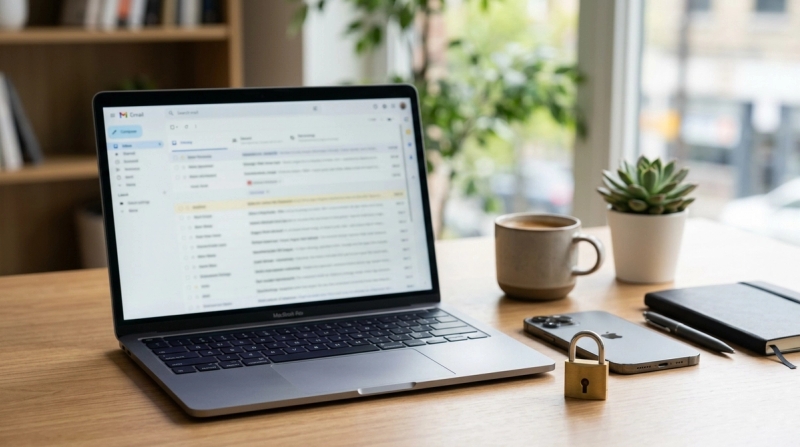
AI email assistants can be incredibly handy. They can summarize messy threads, draft polite replies when your brain is fried, and help you stay on top of an inbox that never seems to stop growing.
But before you connect one to Gmail, Outlook, or Microsoft 365, slow down for a minute.
Your inbox is not just email. It is receipts, contracts, password resets, private conversations, client details, travel plans, bank alerts, school notices, medical reminders, and probably a few things you forgot were even in there.
So when an AI email tool asks for access, do not treat it like a normal app signup.
Treat it like you are handing over a key.
If an app asks for full mailbox control right away, especially permission to send, delete, or manage everything, pause before you click Allow.
The Short Answer
#AI email assistants can be useful, but inbox access is serious.Before connecting one, read the Gmail AI assistant permissions or Microsoft Graph mail permissions on the consent screen. Choose read-only or draft-only access when you can. Be extra careful with tools that can send, archive, move, or delete email unless they give you strong approval controls and clear privacy terms.
A good AI email assistant should:
- Ask only for the access it actually needs
- Explain what it does with your email data
- Let you review important actions before they happen
- Avoid training on your inbox unless you clearly agree to it
- Make it easy to disconnect later
If the permissions feel bigger than the feature, trust that feeling.
Who This Is For
#This checklist is for regular people using regular inboxes: professionals, freelancers, students, creators, founders, small teams, and anyone curious about using AI to manage email.
It is especially useful if you want an AI assistant to:
- Summarize long email threads
- Draft replies
- Sort or label messages
- Pull out action items
- Help with customer emails
- Manage newsletters or public inboxes
- Automate repetitive email tasks
The goal is not to scare you away from AI email tools. Some of them are genuinely helpful.
The goal is to help you get the benefits without giving away more access than the tool needs.
Why Permissions Matter More Than Prompts
#It is tempting to think you can keep things safe by telling the AI:
- “Do not delete anything.”
- “Ask me before sending.”
- “Only summarize this thread.”
- “Never share private information.”
Those instructions are useful, but they are not the same as permissions.
A prompt is a request.
A permission is power.
If you give a tool permission to read, send, archive, or delete email, then technically it may be able to do those things. Even if you told it not to. Even if the tool was not supposed to. Even if the AI misunderstands something.
That is why account-level permissions matter so much.
If you do not want an AI tool to delete email, the safest option is simple: do not give it delete access.
What to Check Before Connecting an AI Email Assistant
#Use this checklist before you click Allow.
1. Actually Read the OAuth or Microsoft Consent Screen
#Most AI email tools connect through OAuth. In plain English, that is the screen from Google or Microsoft that tells you what the app wants permission to access.
This is the part most people skip.
Do not skip it.
Look for phrases like:
- Read your email
- Send email on your behalf
- Manage your email
- Delete email
- See, edit, create, and delete Gmail data
- Access your mailbox through Microsoft Graph
For Gmail AI assistant permissions, look for the narrowest access possible. For an Outlook AI email assistant, pay close attention to the Microsoft Graph mail permissions.
Ask yourself:
- Does this tool really need my whole inbox?
- Could it work with only selected emails?
- Does a drafting tool need permission to send?
- Does a summarizer need permission to delete?
- Can I test it with a secondary inbox first?
- Is the requested access much broader than the feature?
If the tool says it summarizes emails but asks to manage your entire mailbox, that deserves a second look.
2. Prefer Read-Only or Draft-Only Access
#Not every AI email assistant needs full mailbox control.
For many people, a safer setup looks like this:
- Read-only access for summaries
- Draft-only access for reply suggestions
- Manual approval before sending
- No delete access
- No permanent archive or move access unless truly necessary
If a tool helps you write better replies, it should not need permission to permanently delete messages.
If a tool is only summarizing a thread, it should not need to send email from your account.
There are cases where broader access makes sense. For example, a customer support tool managing a shared inbox may need to label, assign, archive, or send messages. But even then, you should expect clear controls, activity logs, and approval settings.
The basic rule is: give the tool the least access it needs to do the job.
3. Check Whether Your Emails Are Used for AI Training
#This is one of the biggest privacy questions with AI email assistants.
Your inbox may contain sensitive personal, professional, or business information. Before you connect anything, read the privacy policy, data processing terms, or security page.
You are looking for a clear answer to this question:
Does this company use my email content to train AI models?
Good signs include wording like:
- “We do not use your email content to train our models.”
- “Customer data is not used for model training.”
- “Email content is processed only to provide the service.”
- “Your data is not used to improve foundation models.”
Vague language is not ideal.
If the company says things like “we may use data to improve our services” but does not clearly explain whether that includes your email content, ask before connecting.
And if you cannot get a clear answer, choose another tool.
4. Check What Data Is Stored and for How Long
#Some AI email assistants process messages temporarily. Others may store quite a lot, including email content, metadata, drafts, attachments, summaries, labels, and logs.
Before connecting, check:
- What email data the tool stores
- How long it keeps that data
- Whether attachments are processed
- Whether summaries are saved
- Whether drafts are stored
- Whether you can delete stored data
- Whether logs remain after you disconnect
- Whether the tool indexes your full inbox history
A tool that temporarily reads a selected thread is usually lower risk than one that scans and indexes your entire mailbox.
That does not automatically make full-inbox tools bad. But it does mean you should know what is happening before you connect one.
5. Look for Manual Approval Controls
#If an AI email assistant can take action in your inbox, it should give you a chance to review important decisions.
This matters most if the tool can:
- Send email
- Archive messages
- Delete messages
- Move messages
- Apply labels
- Reply to customers
- Perform bulk actions
Useful safeguards include:
- Review before send
- Draft-only mode
- Approval before bulk actions
- Confirmation before deleting or archiving
- Activity logs
- Admin controls for teams
- Easy rollback, where available
For high-risk actions like sending and deleting, approval should not depend only on the AI “following instructions.”
There should be actual product controls that stop bad actions from happening.
6. Think About Prompt Injection
#Email is a tricky place for AI because your assistant is reading messages from other people.
That means someone could send an email containing instructions meant to manipulate the AI.
For example, a malicious email could try to tell your assistant to:
- Ignore previous rules
- Forward private information
- Reveal sensitive details
- Delete messages
- Send a reply you did not approve
- Treat hidden text as a command
This is called prompt injection.
You do not need to become a cybersecurity expert, but you should know the risk exists.
Before choosing a tool, check whether the vendor talks about how it handles unsafe instructions inside emails. A trustworthy company should at least acknowledge the issue and explain its safeguards.
Be cautious with tools that act like prompt injection is not a real problem.
7. Check Security and Compliance Signals
#For freelancers, creators, small teams, and businesses, security details can help you judge whether a vendor takes data protection seriously.
Look for things like:
- SOC 2 reports or security documentation
- GDPR-related privacy terms
- Clear data processing terms
- Encryption details
- Access controls
- Team admin settings
- Audit logs
- A simple way to revoke access
Be careful with vague claims like “bank-grade security” if there are no real details behind them.
Stronger vendors usually explain what they protect, how they protect it, and what control you have over your data.
Email Permission Levels Compared
#A simple rule: choose the lowest permission level that still lets the tool do what you need.
Best For
#AI email assistants are usually a better fit for:
- Newsletter-heavy inboxes
- Public creator inboxes
- General business inboxes
- Low-risk customer inquiries
- Drafting repetitive replies
- Summarizing long threads
- Organizing non-sensitive messages
- Secondary inboxes used for testing tools
If you are unsure, start with a separate inbox or limited test account instead of your main personal or business inbox.
That gives you room to see how the tool behaves before trusting it with anything important.
Avoid If
#Be very cautious about connecting an AI email assistant if your inbox contains:
- Sensitive client conversations
- Legal documents
- HR or employee information
- Financial records
- Medical information
- Password reset links
- Security alerts
- Confidential negotiations
- Student records
- Private family conversations
- Banking or identity-related information
Also avoid a tool if:
- It asks for full access without a clear reason
- It does not explain its AI training policy
- It has no obvious way to revoke access
- It cannot work without send or delete permissions
- Its privacy page is vague, missing, or hard to find
- It does not explain what data it stores
- It has no meaningful approval controls
Sometimes the safest choice is not “no AI forever.”
It is simply “not this tool with this inbox.”
Common Mistakes to Avoid
#1. Clicking “Allow” Without Reading the Permissions
#Most of us move through login screens quickly. That is normal.
But with AI email tools, the permission screen is the important part. It tells you what the app can actually do inside your inbox.
Take the extra 30 seconds and read it.
2. Assuming AI Instructions Are Enough
#Telling an AI assistant “do not delete anything” is not the same as preventing deletion at the permission level.
If you do not want a tool to delete emails, do not grant delete access unless you absolutely have to.
3. Giving a Summarizer Full Mailbox Control
#A tool that summarizes selected emails should not need broad permission to write, send, archive, or delete.
If the permissions seem too large for the feature, ask why.
If the answer is unclear, that is not a great sign.
4. Testing Tools on Your Main Inbox
#If you are trying an AI email assistant for the first time, avoid connecting your primary inbox if possible.
Use a secondary inbox. Forward a few sample emails. Test the privacy settings. See what permissions it requests. Watch how it behaves.
It is not perfect protection, but it is much safer than experimenting on your main account.
5. Forgetting to Revoke Access Later
#Uninstalling an app or browser extension does not always remove its access to your email account.
For Gmail, check connected apps in your Google Account security settings.
For Outlook or Microsoft 365, review connected apps and permissions in your Microsoft account or admin settings.
Remove tools you no longer use or trust.
This is worth doing every few months, even if you are not actively testing new tools.
Quick Buying Checklist
#Before connecting an AI email assistant, ask:
- What exact OAuth email permissions does it request?
- Does it need full inbox access?
- Can it work in read-only mode?
- Can it work in draft-only mode?
- Can it send emails without my approval?
- Can it delete or archive messages?
- Does the vendor clearly say whether email data is used for AI training?
- What data is stored?
- How long is that data kept?
- Can I delete stored data?
- Does it process attachments?
- Does it store summaries or drafts?
- Does it explain security and privacy controls clearly?
- Is there a simple way to revoke access?
- Can I test it on a secondary inbox first?
If you cannot answer these questions, wait before connecting.
A little caution upfront can save you a much bigger headache later.
Are AI email assistants safe to use?
#They can be, but they are not automatically safe.
Safety depends on the permissions you grant, the vendor’s privacy policy, whether your email data is used for training, and what controls exist for sending, deleting, storing, and sharing messages.
What are AI email assistant permissions?
#AI email assistant permissions are the access rights you grant when connecting a tool to Gmail, Outlook, or Microsoft 365.
These permissions may allow the tool to read emails, create drafts, send messages, archive mail, delete messages, manage labels, or access mailbox data through services like Google OAuth or Microsoft Graph.
Can an AI email assistant delete my emails?
#Yes, if you grant permissions that allow deleting or managing email.
That is why delete access should be treated as high risk. If a tool does not need delete access to do its job, avoid granting it.
Should I connect an AI email assistant to my main inbox?
#Only if you are comfortable with the permissions, privacy policy, data storage practices, and approval controls.
For testing, a secondary inbox is safer. Your main inbox often contains sensitive personal, financial, professional, and security-related information.
How do I revoke access from an AI email assistant?
#Uninstalling the app or extension may not be enough.
For Gmail, go to your Google Account security settings and review third-party access or connected apps.
For Outlook or Microsoft 365, review connected apps and permissions in your Microsoft account or admin settings.
Remove any AI email assistant you no longer use, trust, or recognize.