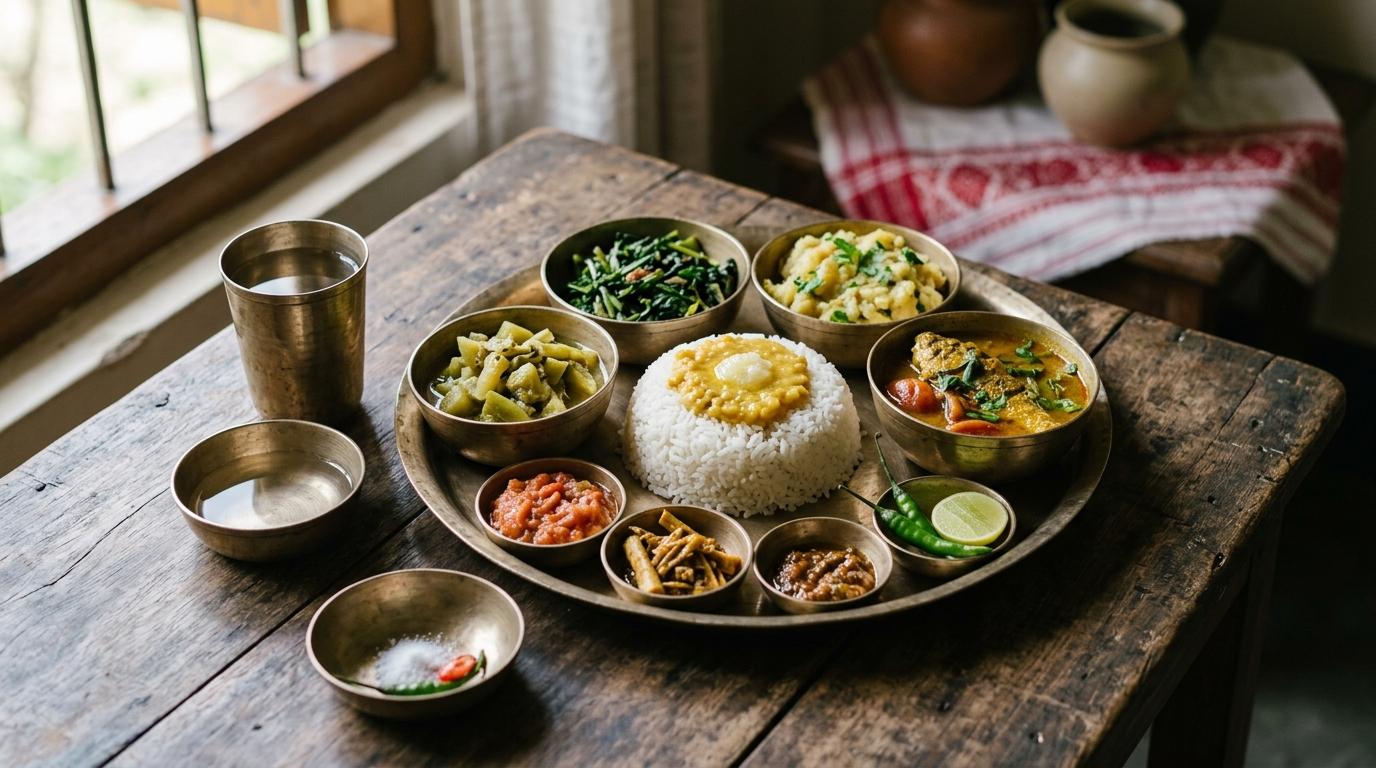
If you’re visiting Assam for the first time, start with an Assamese thali.
It’s the easiest, most relaxed way to understand the food. You don’t have to study the whole menu or know every dish name. A thali brings the meal to you in small portions: rice, dal, greens, mashed vegetables, sour curry, pickles, maybe fish or meat, and a few flavours that feel very specific to Assam.
The big ones to know are khar, tenga, and pitika.
Assamese food can feel gentle at first. It usually isn’t built around heavy gravies, cream, or big spice mixes. It’s more about rice, mustard oil, seasonal greens, sourness, bitterness, herbs, fermented flavours, and clean broths.
So if your idea of an Indian thali is butter chicken, paneer, naan, thick dal, and a sweet lassi, an Assamese thali may feel quieter. But give it time. Eat slowly. Taste one thing at a time. The flavours begin to open up.
That’s the charm of it.
Quick answer: what comes in a full Assamese thali?
#A full Assamese thali usually includes some version of:
- Rice, usually plain steamed rice, and sometimes fragrant Joha rice.
- Khar, an alkaline dish traditionally made with filtered banana peel ash, cooked with raw papaya, pulses, vegetables, or sometimes fish.
- Dal, usually thinner and lighter than many North Indian dals.
- Xaak, seasonal leafy greens cooked simply.
- Pitika, a mashed dish such as potato or roasted eggplant, often mixed with raw mustard oil, onion, green chilli, and salt.
- Tenga, a sour curry or broth, often made with fish in non-vegetarian thalis.
- Pickles, chutneys, or fermented sides, usually served in small amounts.
- Something sweet, sometimes payokh or another rice-based sweet, depending on the place.
If you remember only one thing, remember the order:
Start with khar, then dal, xaak, pitika, fish or meat if included, and finish the savoury part with tenga.
Try not to mix the whole plate together immediately. Take a little rice, add one dish, taste it properly, then move to the next. Assamese thali makes much more sense that way.
Why an Assamese thali feels different
#An Assamese thali doesn’t shout. It sits quietly in front of you and lets the flavours build.
You may taste bitter greens, sharp mustard oil, smoky mashed vegetables, sour tenga, earthy khar, soft rice, mild dal, and sometimes the strong flavour of fermented bamboo shoot or mustard paste.
The cooking is often simple: boiling, steaming, roasting, light frying, and gentle tempering. You won’t usually find everything covered in thick, oily gravy.
That’s why some first-time travellers need a few bites to adjust. At first, the food may seem plain. But it isn’t plain. It’s subtle.
The meal is less about one dramatic curry and more about balance.
What an Assamese thali usually includes
#No two Assamese thalis are exactly alike.
A thali in Guwahati may feel more polished and restaurant-style. A meal in Majuli may be simpler, more seasonal, and often vegetarian. In Upper Assam, the food may feel earthier, especially if it includes pork, bamboo shoot, or local fish.
Still, most Assamese thalis are built around a few important dishes.
1. Rice, the centre of the meal
#Rice is the heart of Assamese food. Almost everything on the thali is meant to be eaten with rice.
You may get plain steamed rice, local rice, or sometimes Joha rice, which is loved for its fragrance. Don’t assume Joha rice will always be served, though. If you’re curious, ask.
The best way to eat it is simple: take a small amount of rice, mix it with one item, eat, and then move to the next dish. This keeps the flavours clear.
2. Khar, the Assamese beginning
#Khar is one of the most distinctive parts of Assamese cuisine.
Traditionally, khar is made by filtering water through the ash of sun-dried banana peel. It is often associated with bhim kol, a local banana variety. That alkaline liquid is then used in cooking.
Khar may be made with raw papaya, pulses, vegetables, or sometimes fish head. The flavour is mild, earthy, and unusual if you’ve never tasted anything alkaline before.
In a traditional Assamese meal, khar is usually eaten at the beginning. Many locals also connect it with digestion, though it’s best to understand that as food culture rather than a medical claim.
What should you expect?
Something soft, gentle, and slightly earthy, with a clean feeling in the mouth. It may not be love at first bite, but it’s one of the dishes that makes Assamese food Assamese.
3. Dal, simple and comforting
#Assamese dal is usually light.
It’s often thinner, less oily, and more gently seasoned than the dals you may know from North Indian restaurants. It gives the thali a familiar, comforting middle.
If khar feels new and pitika feels sharp, dal brings everything back down.
Eat it with rice after the khar. Try it on its own first, then have it with a little xaak or pitika if you like.
4. Xaak, the seasonal greens
#Xaak means leafy greens, and it is a regular part of Assamese meals.
The greens change with the season and the region. They may be cooked with garlic or kept very simple with minimal seasoning. The point is not to hide the flavour of the leaves.
Xaak can be slightly bitter, grassy, earthy, or tender. It may not be the loudest item on the plate, but it tells you a lot about Assamese food: local plants, seasonal eating, and simple cooking matter here.
5. Pitika, the mashed comfort dish
#If you want an easy place to start, try pitika.
Pitika is a mash. Common versions include:
- Aloo pitika, made with mashed potato.
- Bengena pitika, made with roasted eggplant.
- Fish pitika or other vegetable pitikas, depending on the place.
The usual flavour comes from raw mustard oil, chopped onion, green chilli, and salt. Sometimes the vegetable is roasted first, which gives the pitika a smoky warmth.
The mustard oil is important. It can taste sharp, peppery, and a little strong if you’re not used to it. Start with a small bite. If it works for you, pitika may become the thing you keep returning to throughout the meal.
6. Tenga, the tangy finish
#Tenga means sour.
In an Assamese thali, it usually refers to a light sour curry or broth. The most famous version is masor tenga, a sour fish curry.
The sourness may come from tomato, lemon, elephant apple, known locally as ou tenga, or other local souring ingredients. The broth is usually thin and refreshing, not thick or very spicy.
Tenga is often eaten toward the end of the savoury meal. After dal, greens, pitika, and fish or meat, it feels bright and clean.
If you eat fish, masor tenga is one of the best dishes to try in Assam.
Khar, tenga, pitika: the trio to understand first
#If the whole thali feels like too much, focus on these three dishes: khar, tenga, and pitika.
They explain a lot about Assamese flavour.
Khar gives you alkaline earthiness.Pitika gives you smoke, mustard oil, chilli, and texture.Tenga gives you sourness and freshness.
Together, they show why Assamese food feels so different from many other Indian regional cuisines. It isn’t bland. It’s subtle, sour, sharp, earthy, herbal, and closely tied to local ingredients.
Vegetarian Assamese thali vs fish and meat thali
#Assamese food is deeply connected to fish, river produce, greens, herbs, and seasonal vegetables. But vegetarian travellers can eat well too.
In many places, you can ask for a vegetarian Assamese thali, often called niramish. You can also order fish or meat thalis where available.
If you eat fish
#A fish thali is one of the best first orders in Assam.
Look for:
- Masor tenga, sour fish curry.
- Fish cooked with light spices and local sour ingredients.
- Rice, dal, xaak, pitika, khar, and small sides.
The fish may be lightly fried before it goes into the curry. The final dish is usually not a heavy fish masala. It’s cleaner, lighter, and more broth-like.
If you eat meat
#Some Assamese and wider Northeast Indian meals include pork, often cooked with bamboo shoot. This is especially common in some local and tribal-influenced food traditions.
If you’re curious but new to the flavour, start small. Bamboo shoot can be earthy, funky, and intense, especially when fermented. It can be delicious, but it may be a lot for a first bite.
If you are vegetarian
#A vegetarian Assamese thali can be very satisfying.
You may find:
- Rice.
- Khar made with vegetables or pulses.
- Dal.
- Xaak.
- Aloo pitika or bengena pitika.
- Seasonal vegetable dishes.
- Banana flower preparations in some meals.
- Pickles, chutneys, or fermented sides.
In places with Vaishnavite influence, especially around Majuli’s satras, vegetarian food can be especially important. Some meals may also avoid onion and garlic, depending on the tradition.
If you are strictly vegetarian, ask clearly whether the khar, pitika, dal, or sides contain fish, fish head, or any meat-based ingredient. Don’t assume everything that looks vegetarian actually is.
How to order your first Assamese thali
#You don’t need to know the whole menu before you sit down. A few simple questions are enough.
You can ask:
- “Do you have a full Assamese thali?”
- “Is there a fish thali?”
- “Do you have vegetarian or niramish thali?”
- “Does the thali include khar?”
- “Is there masor tenga?”
- “Are any sides fermented or very spicy?”
- “Can I get less chilli?”
If you’re eating alone, a thali is perfect because you get variety without ordering too much. If you’re with friends, order one vegetarian thali and one fish or meat thali if possible, then compare.
And don’t rush. This is the kind of meal that rewards slow eating.
What to try first on the plate
#Here’s a simple first-timer sequence.
Step 1: Start with rice and khar
#Take a little rice, add a small spoon of khar, and taste it. Don’t judge the entire meal by this first bite. Khar is subtle and unusual, and it may take time to understand.
Step 2: Move to dal
#Dal brings warmth and comfort. It also helps settle the palate after khar.
Step 3: Add xaak
#Try the greens with rice. Notice whether they are bitter, earthy, grassy, or very simple. If they taste plain, that may be exactly the point.
Step 4: Taste pitika
#Take a small amount first, especially if the mustard oil smells strong. Mix it with rice. If you enjoy the sharpness, take more.
Step 5: Eat the fish or meat, if included
#If you have fish curry, try it with plain rice before mixing it with other sides. If you have pork or bamboo shoot, go slowly because the flavours can be stronger.
Step 6: Finish the savoury meal with tenga
#Tenga works beautifully at the end. Its sourness refreshes the mouth and keeps the meal from feeling heavy.
Step 7: End with something sweet, if served
#Some thalis may include payokh or another sweet. Not every thali has dessert, so treat it as a bonus.
Ordering tips in Guwahati, Majuli, and Jorhat
#Guwahati
#Guwahati is a good place for your first Assamese thali because it has more restaurant options. Menus are often easier for travellers to understand, and thalis may be more structured.
What to order:
- Full Assamese thali.
- Fish thali with masor tenga.
- Vegetarian thali if you want to focus on greens, khar, dal, and pitika without fish or meat.
A useful question to ask:
“Is this a traditional Assamese thali, and what items are included?”
Don’t assume every “Assamese thali” has the same dishes. If khar or tenga matters to you, ask before ordering.
Majuli
#Majuli is strongly associated with satras, the Neo-Vaishnavite monastic institutions of Assam. Around this setting, vegetarian meals can be especially meaningful.
What to look for:
- Simple vegetarian thalis.
- Rice, dal, greens, vegetable dishes, and pitika.
- Meals with less onion and garlic in some traditional places.
A useful question to ask:
“Is the meal niramish?”
If you also avoid onion and garlic, ask that separately.
Majuli is also a place to slow down. The food may not always feel polished like a city restaurant meal, and that is part of its charm.
Jorhat and Upper Assam
#Jorhat is a useful base for exploring Upper Assam’s food culture. Thalis here can feel earthy and direct, with rice, greens, fish, and local preparations playing a strong role.
What to order:
- Assamese fish thali.
- Masor tenga, if available.
- Pork with bamboo shoot, if you eat pork and want a stronger local flavour.
- Vegetarian thali with xaak and pitika, if you prefer a lighter meal.
A useful question to ask:
“Is the bamboo shoot fermented?”
If you’re new to bamboo shoot, start with a small portion.
Hygiene and stomach-comfort tips for travellers
#Assamese food is often lighter than many rich restaurant meals, but your stomach may still need time to adjust. New oils, fermented foods, raw garnishes, local water, and unfamiliar greens can all affect you.
Use normal travel food sense.
Start gently with fermented sides
#Fermented mustard paste, bamboo shoot, and pickled items can be delicious, but they are strong. Try a small bite first, especially on your first day in Assam.
If your stomach is sensitive, don’t make fermented sides the main event right away.
Go slow with raw mustard oil
#Pitika often contains raw mustard oil. Many travellers end up loving its sharp aroma, but it can feel intense at first.
Taste a little. If it feels fine, continue.
Be careful with raw onion, chilli, and garnishes
#Pitika may contain raw onion and green chilli. Some chutneys or sides may also include raw ingredients.
If you’re unsure about hygiene at a small roadside place, choose fully cooked dishes first. Hot rice, cooked dal, cooked greens, cooked fish curry, and cooked tenga are safer choices. Be more careful with raw garnishes and chutneys.
Drink safe water
#Stick to sealed bottled water or water you know has been safely filtered. Avoid ice if you are not sure about the water source.
Eat where food is moving
#A busy place with high turnover is usually a better bet than a quiet place where cooked food may have been sitting too long. Look for hot food served fresh.
Don’t overdo khar
#Khar is culturally associated with digestion, but it is alkaline and may be unfamiliar to your stomach. Eat the portion served in the thali. There’s no need to order extra on your first try.
How Assamese thali differs from a typical North Indian thali
#This is one of the biggest surprises for travellers.
A typical North Indian thali may include roti or naan, paneer, rich dal, thick gravies, raita, pickle, rice, and sweets. It often uses more ghee, cream, dry spice mixes, and heavier frying.
An Assamese thali is usually more rice-centred and lighter. It leans on:
- Rice instead of bread as the main base.
- Khar instead of a heavy starter.
- Tenga instead of a rich curry.
- Xaak and seasonal greens.
- Pitika with raw mustard oil.
- Fermented, sour, bitter, and herbal notes.
- Fish and river-based food traditions in many non-vegetarian meals.
One is not better than the other. They simply come from different landscapes, ingredients, and ways of eating.
A simple first Assamese thali order
#If you’re unsure what to order, start here.
For fish eaters
#Order: Full Assamese fish thali with masor tenga, khar, xaak, dal, and pitika.
Ask: “Is khar included?” and “Is the fish curry tenga?”
For vegetarians
#Order: Niramish Assamese thali with khar, dal, xaak, pitika, and seasonal vegetables.
Ask: “Is everything vegetarian?” and “Does the khar contain fish or fish head?”
For adventurous eaters
#Order: Assamese thali plus a small portion of bamboo shoot or pork with bamboo shoot, if available.
Ask: “Is it fermented?” and “Is it very spicy?”
Is an Assamese thali very spicy?
#Usually, no. Assamese food is often milder than people expect. Heat may come from fresh green chilli or chilli served on the side.
Very hot chillies, including bhut jolokia, may appear in some meals or condiments, so taste carefully.
What are khar, tenga, and pitika?
#Khar is an alkaline Assamese dish traditionally linked to filtered banana peel ash.
Tenga is a sour curry or broth, often made with fish.
Pitika is a mashed dish, commonly made with potato or roasted eggplant, usually mixed with mustard oil, onion, green chilli, and salt.
Can I eat Assamese thali if I am vegetarian?
#Yes. Ask for a niramish Assamese thali.
It may include rice, dal, xaak, vegetable khar, pitika, and seasonal vegetable dishes. If you are strictly vegetarian, confirm that khar and sides do not contain fish or fish head.
How should I eat an Assamese thali?
#Eat it with rice, one item at a time.
Start with khar, then dal, xaak, pitika, fish or meat if included, and finish the savoury part with tenga. You can eat with your hand if you’re comfortable, or use a spoon if you prefer.
What should I try first in Assam?
#For a first meal, try a full Assamese thali.
If you eat fish, choose one with masor tenga. If you are vegetarian, choose a niramish thali with khar, xaak, dal, and pitika.
Final bite
#An Assamese thali is not a meal to rush.
It is a plate of quiet contrasts: earthy khar, sour tenga, smoky pitika, soft rice, bitter greens, light dal, and small sharp sides.
For first-time travellers, that makes it one of the best introductions to Assamese food. Order simply, ask what is included, taste one dish at a time, and let the meal build slowly.
That is where the beauty of a full Assamese thali really shows.