The night my old fan made me weirdly angry
#So this whole BLDC fan thing started for me at 2:40 AM during one of those classic Indian summer nights where the air feels like hot soup and the inverter is doing its sad little beep-beep drama from the corner. Our old ceiling fan was spinning, technically, but it was eating battery like a hungry buffalo. The lights were dim, Wi-Fi was dead, and I was lying there thinking, why is a FAN taking so much power in 2024-ish life? Like we have phones with ridiculous processors and tiny chargers, but my bedroom fan still behaves like it was designed when Doordarshan was the main entertainment system.
That’s when I properly fell into the BLDC rabbit hole. I had seen the ads before: 28W, remote control, inverter friendly, save electricity, blah blah. I thought it was mostly marketing. But then I started checking wattages, BEE labels, bills, and actual backup time. And honestly, for Indian homes, especially where fans run basically all day for 7-9 months, BLDC fans are not some fancy tech toy. They’re boring household tech, yes, but the good kind. The kind that quietly saves money while you forget it exists.
Normal fan vs BLDC fan: what’s actually different?
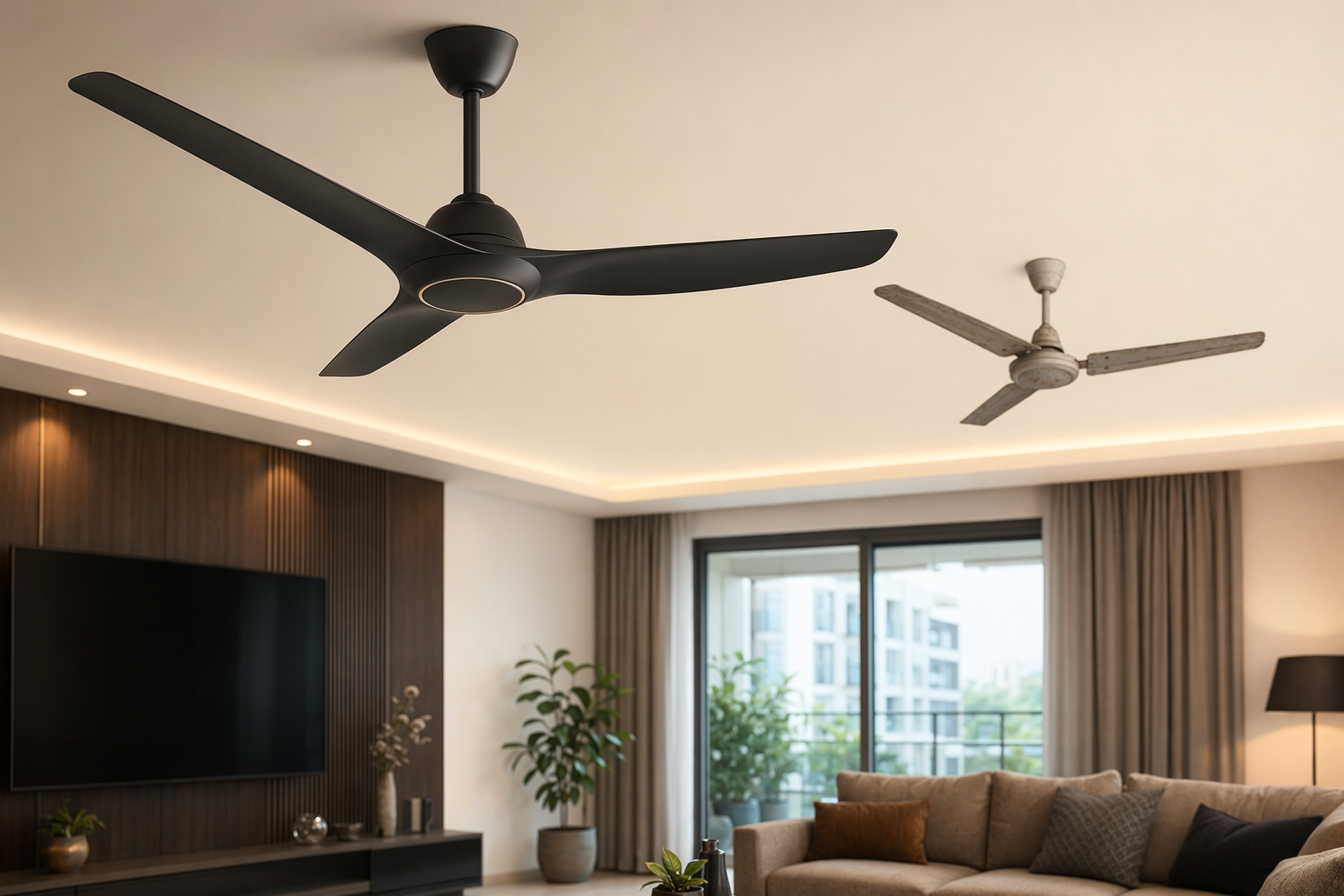
#A normal ceiling fan in India usually means an AC induction motor fan. Old-school, tough, cheap, easy to repair, and available in every electrical shop from Delhi to Dindigul. Most of these fans consume somewhere around 70W to 80W at full speed, though newer BEE-rated induction fans can be lower. If you use an old resistor regulator, you can waste even more power as heat. Electronic regulators are better, but still, the fan motor itself is not exactly a power-saving champion.
A BLDC fan, full form Brushless DC, uses permanent magnets and an electronic controller inside the fan. The motor is more efficient, and the speed control is handled electronically. That’s why many BLDC ceiling fans in India are rated around 25W to 35W at full speed. Some advertise 28W, some 32W, some go a bit higher depending on blade size and air delivery. The important thing is not the sticker alone. Check the BEE star label, wattage, air delivery, and service value if it’s available. Since BEE star labelling became a serious shopping filter for ceiling fans in India in recent years, it’s easier now to compare fans without just trusting the shop uncle’s confidence.
| Feature | Normal induction fan | BLDC fan |
|---|---|---|
| Typical full-speed power | Around 70W-80W for many older/common models | Around 25W-35W for many common models |
| Speed control | Wall regulator, capacitor based motor | Remote or electronic control, sometimes wall switch modes |
| Inverter backup | Higher load, drains battery faster | Lower load, noticeably longer backup |
| Upfront price | Usually cheaper | Usually costlier by ₹1,000-₹2,500 or more |
| Repair comfort | Local electricians understand it well | Needs brand service or PCB replacement sometimes |
| Best for | Low budget, rentals, rough use | Long daily usage, inverter homes, high electricity bills |
The savings maths, but without making it painful
#Let’s do the part everyone asks about first: kitna bachega? I’ll use a simple example because exact savings depend on your electricity tariff, number of hours, and fan speed. Say your current fan uses 75W at full speed and a BLDC fan uses 28W. Difference is 47W. If that fan runs 10 hours daily, you save 0.47 units? Wait, not 0.47, it’s 47W x 10 hours = 470Wh, which is 0.47 kWh per day. Over a year, that’s about 171 kWh. If your effective electricity cost is ₹8 per unit, that is roughly ₹1,370 per year for one fan.
| Usage per fan | Approx yearly units saved | Saving at ₹6/unit | Saving at ₹8/unit | Saving at ₹10/unit |
|---|---|---|---|---|
| 5 hours/day | 86 kWh | ₹516 | ₹688 | ₹860 |
| 10 hours/day | 172 kWh | ₹1,032 | ₹1,376 | ₹1,720 |
| 16 hours/day | 274 kWh | ₹1,644 | ₹2,192 | ₹2,740 |
| 2 fans at 10 hours/day | 344 kWh | ₹2,064 | ₹2,752 | ₹3,440 |
Now, before anyone starts shouting in the comments, yes, this is simplified. Fans don’t always run at full speed, some normal fans are already efficient, some BLDC fans consume more at boost mode, and electricity slabs in India can be confusing. Your bill may have fixed charges, fuel adjustment, taxes, subsidies, and all that lovely paperwork that makes you question life. But as a practical thumb rule, if a fan runs daily for long hours, a BLDC fan can pay back its extra cost in maybe 1 to 3 years. In a bedroom or hall where the fan is running all night and most of the day, payback can be surprisingly fast.
The inverter backup difference is where BLDC really feels magical
#Electricity savings are nice, but inverter backup is where I personally became a fanboy, no pun intended but okay, pun accepted. When you’re on battery, every watt matters. A normal fan at 75W plus one LED bulb and maybe your router can easily cross 95W to 110W. A BLDC fan at 28W with the same LED and router might sit around 50W. That doesn’t sound huge on paper, but when the power cut stretches from “10 minute issue” to “sir transformer problem hai”, you will feel the difference in your bones.
| Load during power cut | Approx load | With ~1,000Wh usable battery energy |
|---|---|---|
| 1 normal fan + 1 LED bulb | 85W-95W | Around 9-11 hours |
| 1 BLDC fan + 1 LED bulb | 38W-45W | Around 20-26 hours |
| 2 normal fans + 2 LED bulbs | 170W-190W | Around 5-6 hours |
| 2 BLDC fans + 2 LED bulbs | 75W-90W | Around 11-13 hours |
I used 1,000Wh usable energy here just to keep the calculation sane. A 150Ah, 12V battery is 1,800Wh on paper, but lead-acid batteries don’t like being fully drained, and inverter efficiency also eats some power. Real life is messy. Battery age matters, water level matters, inverter quality matters, and sometimes the battery just behaves moody because it’s 46 degrees outside. Still, the direction is very clear: BLDC fans stretch backup. If your home has frequent power cuts, BLDC is not only about electricity bill savings. It’s about not waking up sweaty and irritated at 3 AM.
But are BLDC fans as fast as normal fans?
#This is the question my dad asked first. Not price. Not warranty. Bas hawa deta hai ki nahi? And fair question, because some early energy-saving fans felt weak. A fan is not a showpiece. It needs to move air. Modern BLDC fans are much better, but you should still check air delivery, usually listed in CMM or cubic meters per minute. Don’t buy only because it says 28W in giant font. A 1200mm fan with poor blade design can feel underwhelming even if the motor is efficient.
My experience has been mixed but mostly positive. In a normal bedroom, a decent BLDC fan at speed 4 or 5 feels totally fine. In a large hall with high ceiling, you may want a model that has strong air delivery or maybe a larger sweep size if suitable. Some BLDC fans have a “boost” mode that uses more watts but gives stronger air. That’s okay. I’d rather have the option. Just don’t expect a tiny low-power fan to perform miracles in a hot top-floor room with no insulation. Physics is rude like that.
The hidden stuff nobody tells you in the showroom
#The sales pitch is usually simple: “Sir 28 watt, remote, 5 star, very good.” Nice. But living with a BLDC fan has some small quirks. Most use remote controls, which is great until the remote disappears under the sofa or your kid treats it like a spaceship controller. Some models remember the last speed after power returns, some don’t. Some work with the wall switch in step modes, like switch off-on to change speed, but this varies by brand. And please, don’t blindly use your old wall regulator with a BLDC fan unless the manual says it supports it. Many BLDC fans want direct supply, with the regulator kept at full or bypassed.
- Check whether the fan works properly on inverter power, especially if your inverter output is not pure sine wave.
- Ask about PCB warranty, not just motor warranty, because the electronics are the heart of a BLDC fan.
- Look for service presence in your city. A great fan with no service nearby is just future headache with blades.
- If you hate remotes, choose a model with wall-switch speed control or smart compatibility, but verify before buying.
BEE star ratings, wattage stickers, and my slightly nerdy buying method
#When I compare fans now, I don’t start with brand name. I start with three boring things: wattage, air delivery, and warranty. The BEE star label is useful because it forces a more standard comparison, but still read the actual numbers. A 5-star fan that saves power but gives weak airflow may annoy you every night. A slightly higher wattage BLDC fan with better air delivery might be the better buy. This is where Indian appliance buying becomes less “best fan under ₹3000” and more “best fan for my room and my usage.” Not very glamorous, but it works.
Also, prices keep changing like crazy during online sales. Normal fans can be around ₹1,200 to ₹2,500 depending on brand and design. BLDC fans often sit somewhere around ₹2,500 to ₹5,000, with premium or smart models going higher. I’m not giving exact live prices because tomorrow some sale will make me look like a fool. But the pattern is consistent: BLDC costs more upfront. The question is whether your daily usage is high enough to recover it. For a guest room fan used twice a month, maybe don’t bother. For bedroom, study room, shop, clinic, small office, hostel room, or any place where the fan runs forever, it makes sense.
A quick payback example from a very normal Indian home
#Imagine a 2BHK with four ceiling fans: two bedrooms, hall, and kitchen/dining. Let’s say only two fans run heavily, around 10-12 hours daily, and the other two run 3-5 hours. If you replace the heavy-use fans first, the savings are obvious. Two fans saving around ₹1,300 each per year at ₹8 per unit is ₹2,600 yearly. If each BLDC fan costs ₹1,500 extra over a normal fan, you recover that extra cost in a bit more than a year. After that, it’s just savings. Small savings, yes, not “buy a car” savings, but household money leaks are usually small leaks. Fix enough of them and the bill starts behaving.
I like doing upgrades like this in phases. Don’t replace every fan just because the internet said BLDC is cool. Start with the fan that runs longest. Usually bedroom. Then hall. Then maybe kitchen if it’s used often. The store room fan? Leave it alone unless it dies. Same logic applies to a lot of Indian home appliances actually. I wrote notes while comparing humidity and comfort gadgets too, and this buying mindset is very similar to something like Air Purifier vs Dehumidifier for Indian Monsoon Homes, where the “best” product is not always best for your exact room and climate.
Where normal fans still win, because they do
#I know this post sounds like I’m campaigning for BLDC fans, but normal fans are not useless. They’re cheap, rugged, and any electrician can fix them. If the capacitor goes, it’s a small repair. If the regulator fails, easy. In rental flats where you may shift in 8 months, spending extra on BLDC may not be worth it unless you can take the fan with you. Also, in rough environments like dusty workshops or places with voltage issues, a simple induction fan can sometimes be the stress-free option.
There is also the repair anxiety. A BLDC fan has electronics. If the PCB fails outside warranty, repair cost may hurt more than a capacitor replacement. Good brands have improved a lot, and many offer long motor warranties, but still, check what’s actually covered. Motor warranty and electronics warranty may be different. I once ignored warranty terms while buying a “smart” appliance and later learnt the hard way that smart features are only smart until the board dies. Then it becomes an expensive dumb object.
What about noise, heating, and speed control?
#Good BLDC fans are usually quiet, especially motor noise. But fan noise is not only motor noise. Blade design, mounting, bearing quality, canopy fitting, and even a slightly bent blade can create sound. If your fan makes tik-tik-tik noise, don’t blame BLDC immediately. Installation matters. Also make sure the downrod is properly tightened. I have seen one fan wobble like it was trying to leave the ceiling, and the issue was just bad installation.
Heat is another interesting bit. Normal regulators, especially old resistor types, waste power as heat. That’s why those old regulator plates sometimes feel warm. BLDC fans don’t need that style of speed control, so there’s less wasted energy. But the BLDC driver circuit itself can get warm, which is normal within limits. If there’s burning smell, flickering, random stopping, or the fan resets on speed change, call service. Don’t do jugaad with electronics unless you actually know what you’re doing. And no, YouTube confidence is not always engineering knowledge, I say this as someone who has opened things and then quietly regretted it.
My practical buying checklist for India
#- Pick the rooms first. Replace fans that run 8+ hours daily before touching low-use rooms.
- Check wattage at full speed. Around 25W-35W is common for BLDC, but compare with air delivery.
- Look at BEE star label and service value, not only the giant “5 star” sticker on the box.
- Confirm warranty for motor and PCB separately. Ask what happens after warranty also.
- If you have an inverter, ask if the fan works well on inverter supply. Pure sine wave is generally safer for electronics.
- Avoid using old regulators unless the brand specifically supports it. Keep the regulator full or bypass it as per manual.
- Don’t overbuy smart features. Remote is useful, app control is optional, voice control is fun for two days and then nobody cares.
So, should you buy a BLDC fan or normal fan?
#My honest answer: if the fan runs daily for long hours, buy BLDC. If you have inverter backup and power cuts, buy BLDC even faster. If electricity tariff in your area is high, again BLDC. For bedrooms, halls, small offices, shops, clinics, and homes where fans are basically part of the family, it’s a very sensible upgrade. Not exciting like a new phone, maybe, but more useful than half the gadgets we buy during sale season because the discount banner shouted at us.
But if you need the cheapest possible fan today, or you’re buying for a rarely used room, or you don’t want any electronics-related repair risk, a normal induction fan is still fine. I’d rather people make a boring correct purchase than a trendy wrong one. Technology should reduce headache, not add another remote to your life that you’ll lose behind cushions.
The real win with BLDC fans in India is not just lower wattage. It’s lower wattage multiplied by long usage, hot weather, rising bills, and inverter backup anxiety. That combination is where the savings become real.
Final fan-nerd thoughts
#I genuinely think BLDC fans are one of those underrated Indian home upgrades. Not flashy. Not Instagram material. But practical, measurable, and very satisfying once you see the inverter lasting longer or the electricity bill being a little less scary. Start with one room, do the maths with your own bill, and don’t blindly chase the lowest wattage if airflow is poor. A good fan should save power and still make you feel like a human being in May.
And yeah, I’m still weirdly excited about fan motors now, which is not something younger me would’ve predicted. But that’s adult tech life, I guess. One day you’re comparing phones, next day you’re calculating watts, battery backup, and air delivery like it’s a cricket scorecard. If you like these practical tech breakdowns for Indian homes, I keep finding useful reads and ideas on AllBlogs.in, so maybe go poke around there too.