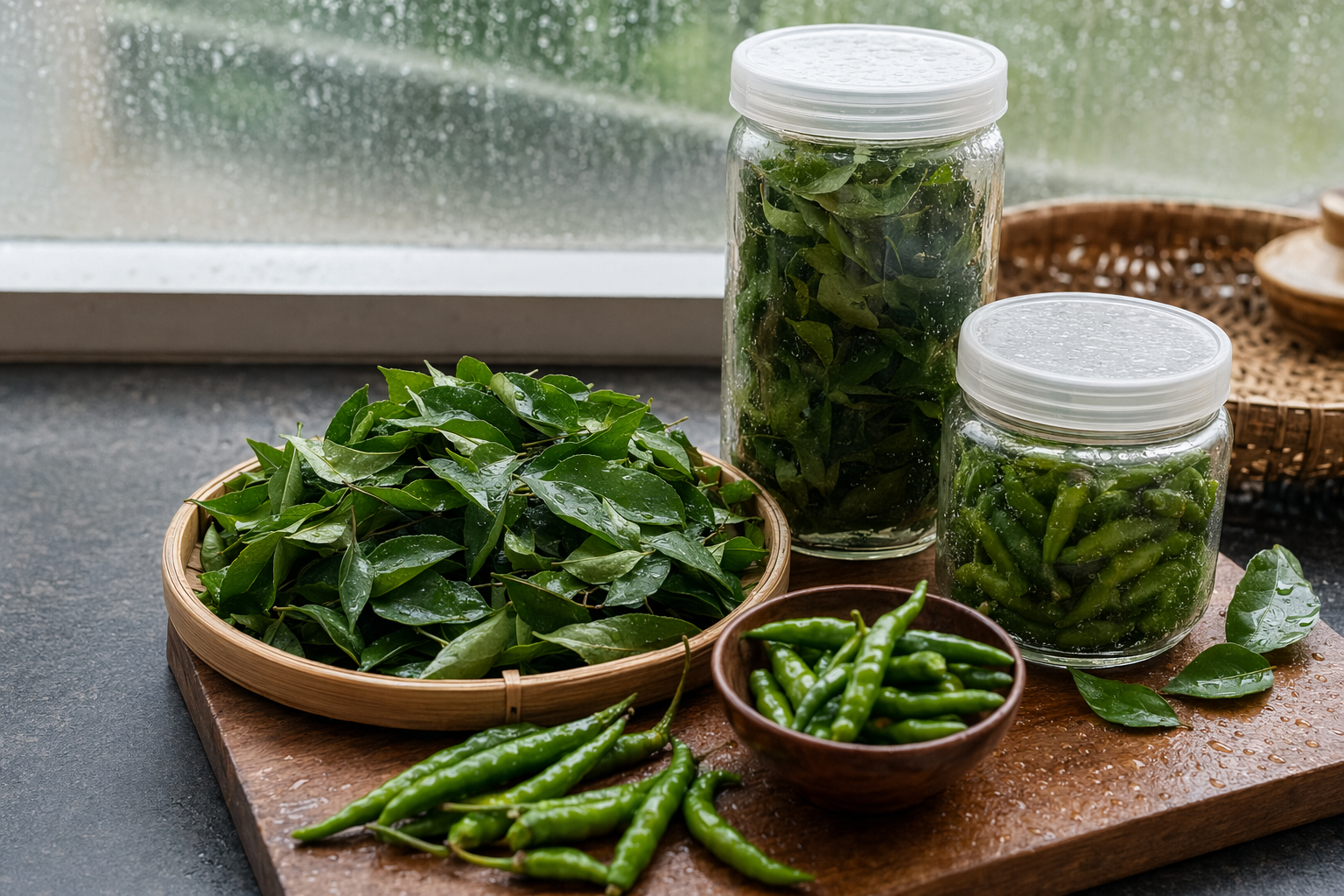
The rainy-season drama in my masala dabba corner
#Every monsoon, my kitchen starts behaving like it has a mood. The salt clumps, papad goes soft, onions get that suspicious smell, and my beautiful curry leaves turn black like they personally gave up on life. Green chillies are worse sometimes. One day they’re shiny and brave, next morning one chilli has gone mushy and taken the whole packet down with it. If you cook Indian food even a little bit, you know this heartbreak. Curry leaves and green chilli are tiny things, but without them the food feels... unfinished. Like sambar without the first crackle of kadi patta, poha without that green chilli bite, dal tadka that tastes polite but not exciting. So this is not just storage talk for me. This is survival. Monsoon kitchen survival.
I learnt most of my curry leaves and green chilli storage tricks not from some fancy chef, but from my mother, my neighbour aunty, one cranky vegetable vendor, and honestly from ruining a lot of produce. Like, a lot. I used to come home with a fat bunch of curry leaves because the sabziwala would tuck it in for free, all generous, and I’d feel rich for exactly two days. Then the leaves would become slimy in the plastic bag. Same with chillies. I once kept a whole quarter kilo of green chillies in the fridge door, still damp from the market, and they grew this fuzzy white mould that looked like it belonged in a science lab. I was newly married then and trying to be the kind of person who always has fresh chutney ready. Lol. The chutney did not happen.
Why monsoon is so rude to curry leaves and green chillies
#The basic villain is moisture. Monsoon air is heavy, sticky, and full of dampness, and fresh herbs hate being trapped wet. Curry leaves have delicate leaves that bruise and blacken fast when they sit with water droplets. Green chillies have smooth skin, but the stem area and tiny cracks can hold moisture, and then one soft chilli becomes the gossip aunty of the box, spreading spoilage everywhere. Warmth also matters. If your kitchen stays humid and not exactly cool, things rot faster. This is why the same bunch of curry leaves that lasted four days in January starts dying by Tuesday in July.
And washing is tricky. I know, I know, we all want to wash everything the second it comes home because market dust, muddy hands, rainwater splashes, all of that. But washing and then storing while damp is almost the worst thing you can do. It’s not that washing is bad. Wet storage is bad. There’s a difference, and I only understood it after my third or fourth sad curry leaf funeral. If you’re fighting kitchen dampness in general, this piece on AC Dry Mode vs Dehumidifier for Monsoon Humidity: What Should You Use at Home? is actually useful because a less humid home kitchen genuinely makes drying herbs less annoying.
My first proper lesson came from a dosa place, obviously
#There was this small dosa place near my old office, not Instagram-pretty or anything, just steel tables, wet umbrellas leaning near the entrance, and that loud tawa sound that makes you hungry even if you already ate. Their chutney had this ridiculous fresh curry leaf flavour. Not overpowering, not bitter, just warm and green and nutty. I asked the owner once, because I am that person who bothers people about food, and he laughed and said, “Madam, leaf ko hawa chahiye, swimming pool nahi.” The leaf needs air, not a swimming pool. I still remember that line. He had curry leaves spread on a clean cloth near a fan, not in a plastic bag, not suffocating. That one sentence changed how I store them.
His green chillies were also never wrinkled. He kept them wiped, sorted, and refrigerated in small batches. Not one big overstuffed dabba. That’s something home cooks ignore because we buy once for the week and dump everything together. Restaurants, at least the good practical ones, think in batches. They sort daily because one rotten thing can spoil the taste and the cost. At home we should steal that idea shamelessly. I do.
The curry leaf routine that actually works in my monsoon kitchen
#First thing, I do not leave curry leaves in the vendor’s plastic bag. Not even for “just one hour” because one hour becomes dinner time, dinner time becomes sleepy time, and then morning brings black leaves. I open the bunch, remove rubber bands or thread, and shake it out gently. Then I pick out any yellow, black, or wet-sticky leaves. Be ruthless here. Sentiment is expensive in monsoon. One bad sprig can make the whole bunch smell stale.
If the leaves are very dirty, I wash them in a big bowl of water, swish gently, and then comes the important part: drying like I actually mean it. I spread them on a cotton kitchen towel, pat with another towel, and leave them under a fan for at least an hour. Sometimes two. If the day is extra damp, I turn the leaves once like I’m babysitting papad. Are they perfectly bone dry every time? No. I am not running a hotel. But they should not feel wet to touch. That’s the line.
- For 3 to 5 days: I wrap the dry curry leaves loosely in a paper towel and keep them in a small airtight box in the fridge.
- For a week or slightly more: I layer paper towel at the bottom, leaves in the middle, another bit of paper towel on top, then close the box. I check after two days because monsoon has trust issues.
- For longer storage: I freeze curry leaves after drying them very well. They darken a little sometimes, but in tadka they still sing.
The fridge temperature matters too, and this is one of those boring food-safety things that became interesting only after my fridge started acting weird last summer. Food safety guidance commonly recommends keeping the fridge cold, around 5°C or below, because warmer fridges make fresh ingredients spoil quicker. If your milk sours too fast and herbs keep dying, don’t just blame the weather. Check the fridge. I found this comparison handy: Fridge Thermometer vs Smart Temperature Sensor: What Should You Buy for Food Safety?. Not glamorous, but neither is throwing away half your coriander and curry leaves every week.
Freezing curry leaves without turning them into sad green dust
#Freezing curry leaves is my lazy-person insurance. I still love fresh leaves most, especially for coconut chutney or lemon rice, but frozen curry leaves are totally fine for tadka, rasam, upma, dal, poha, and that quick aloo fry I make when I’m pretending it’s a side dish but really it’s dinner. The trick is to freeze them dry and loose. If you freeze a damp clump, you get one icy block and then you’ll hack at it with a spoon like an angry archaeologist.
What I do: wash only if needed, dry properly, pluck leaves from thick stems, spread them on a plate for 20 to 30 minutes in the freezer, then shift to a freezer-safe bag or small steel box. This quick pre-freeze step is not mandatory, but it keeps the leaves seperate. I label nothing because I am chaotic, but if you are a better person than me, label the month. Use directly from the freezer into hot oil. Don’t thaw them first. Thawed curry leaves become limp and slightly dramatic.
Drying curry leaves: old-school, useful, but not my everyday favorite
#My grandmother used to dry curry leaves in shade, then crush them into powder with a little roasted cumin and salt sometimes. She’d sprinkle it on curd rice, and my god, that taste. Proper rainy evening comfort. Drying is great if you got a huge bunch and you know you won’t use it fresh. But don’t dry in harsh sunlight for too long if you want decent aroma. Shade drying with airflow is better, or a very low oven if you know your oven behaves. Mine does not. Mine goes from gentle warmth to biscuit-burning rage, so I mostly avoid.
Dry curry leaves are not a perfect replacement for fresh ones. Let’s not lie. Fresh curry leaves in hot coconut oil have that crackling perfume that dried leaves can’t fully give. But dried leaves are still useful in podi, masala powders, quick sabzi, and emergency tadkas when rain is pouring sideways and you are not stepping out just for kadi patta. I keep a tiny jar, not a giant one, because dried herbs also lose aroma with time. Small batches, always.
Green chillies: the tiny green troublemakers
#Green chilli storage is where families fight. Some people remove stems immediately. Some say never remove stems because it opens the chilli and makes it spoil. Some wrap in newspaper, some in tissue, some just throw them in the fridge drawer and hope for blessings. I have tried all these methods, and my answer is annoying but honest: it depends how wet the chillies are, how fresh they were when bought, and how soon you’ll use them. Monsoon chillies often come damp, sometimes even with rainwater sitting near the stem. That water is the enemy.
When I get chillies home, I spread them on a plate and inspect them like a jeweller. Soft ones go first for chutney or tadka that same day. Any chilli with black spots, split skin, or a weird smell goes out. I don’t try to rescue it because I’ve done that and regretted it. If the chillies are clean, I don’t wash before storing. I wipe them with a dry cloth if needed. If they are muddy, I wash, then dry really really well under the fan. Again, the fan is the unsung hero of monsoon cooking.
Stems on or stems off? My slightly confused but practical answer
#For very fresh chillies that I’ll use within a few days, I keep stems on until they are dry. The stem protects the top a bit. But if the stems are already wet, brown, or rotting, I remove them after drying and use those chillies quickly. For weekly storage, I often remove stems from fully dry chillies, then keep them in a paper towel lined box. Does this contradict the “don’t remove stems” advice? A little. But cooking is like that. Rules meet real vegetables and then everyone compromises.
- Never store green chillies in a sealed plastic bag when they are even slightly wet. They sweat and spoil.
- Use paper towel or a clean cotton cloth inside the box to absorb extra moisture.
- Don’t overfill the container. Chillies need a bit of breathing room, not a Mumbai local train situation.
- Check the box every two or three days in monsoon. Remove soft chillies immediately.
My fridge-box method for green chillies
#This is the method I use most often. I take a small airtight box, line it with paper towel, add dry green chillies in a single-ish layer, then put another paper towel on top. If I have too many chillies, I split into two boxes. The box goes in the fridge, not the door if I can avoid it, because the door temperature keeps changing when people open it every ten minutes looking for “something nice.” In my house that person is usually me.
The chillies usually stay good for a week, sometimes ten days if they were fresh and I behaved properly. Thin spicy chillies wrinkle faster in my experience, while thicker bhavnagri-style ones last a bit longer but can become soft if wet near the top. Also, don’t mix green chillies with wet coriander or mint in the same box. I did this once because I was in a hurry, and it became a little compost project. Not cute.
Freezing green chillies for chutneys, tadka, and lazy days
#Freezing green chillies is brilliant if you cook often but can’t keep buying small amounts. Wash if needed, dry completely, remove stems if you like, and freeze whole. I sometimes slit a few before freezing and keep them in a seperate small bag for dal and sabzi, but be careful because slit chillies release more aroma and can get icy if not packed well. Whole frozen chillies can go straight into tadka, grinding jars, or pressure cooker dal. They won’t be crisp after thawing, so don’t expect to use them as fresh garnish. But for cooking? Perfectly good.
One small warning from my own dumb mistake: don’t grab frozen chillies with wet hands and then put the bag back. Ice builds up, chillies stick together, and then you start hating your past self. Use a dry spoon or shake out what you need. If I’m making green chilli thecha or chutney, frozen chillies work fine, though fresh chillies have a brighter punch. For sandwiches or raw kachumber, I still prefer fresh. There’s no shame in having both.
The smell test, the touch test, and when to stop being brave
#Food bloggers sometimes romanticize using every last bit, and I get it, waste feels terrible. But monsoon spoilage is not the place to be heroic. Curry leaves that are black, slimy, or smell sour should go. Green chillies that are mushy, mouldy, leaking, or smell fermented should go. Cutting off one bad part may be okay for a firm vegetable sometimes, but with small wet chillies and herbs, spoilage spreads fast and it’s just not worth it. Especially if you are cooking for kids, older people, or anyone with a sensitive stomach.
Rainy-season food safety is a whole topic by itself. Fish, leafy greens, herbs, cut fruit, leftovers... everything needs more attention when the air is damp and power cuts happen. If you’re also confused about non-veg during rains, this practical guide on Can You Eat Fish in Rainy Season? A Practical Guide to Buying, Cooking, and Storing It Safely sits in the same mental folder for me: buy carefully, store cold, cook properly, don’t gamble with smell.
Little kitchen habits that save more money than you think
#I used to think storage hacks were fussy. Like, who has time to dry every chilli and wrap leaves like babies? But then I noticed how much I was throwing away. A ten-rupee bunch here, a twenty-rupee chilli packet there, coriander, mint, ginger, all slowly dying in the fridge. It adds up. More than money, it kills cooking mood. You open the fridge wanting to make rasam, see rotten curry leaves, and suddenly dinner becomes toast.
- Sort the same day you buy. Not tomorrow. Tomorrow is where vegetables go to suffer.
- Dry before storing, especially in monsoon. If you remember nothing else, remember this.
- Use smaller containers. Big boxes trap more air and encourage you to ignore the bottom layer.
- Keep a freezer backup of curry leaves and green chillies. Future you will feel very smug.
- Do a two-minute fridge check before making chai in the evening. Remove anything soft or suspicious.
What I cook when my curry leaves and chillies are behaving nicely
#This is the fun part. Fresh curry leaves and green chillies make monsoon food taste alive. My favourite rainy breakfast is upma with extra curry leaves fried till crisp, green chilli chopped unevenly because I’m always rushing, and a squeeze of lime. Or poha with peanuts, mustard seeds, curry leaves, turmeric, and those little green chilli pieces that surprise you. On proper stormy evenings, I make rasam with frozen curry leaves if fresh are over, and honestly nobody complains. Hot rasam, rice, potato fry, rain hitting the balcony grill. That is luxury. Not five-star luxury, but better.
There’s also a tiny coastal place I love where they put curry leaves in fish curry so beautifully that I once tried to count how many leaves were in my bowl. My friend told me to stop being weird. But I swear, the flavour was layered, not just dumped. Restaurants that understand curry leaves don’t treat them as decoration. They bloom them in oil, they let the aroma travel. Same with green chilli. It’s not only heat. It’s grassy, sharp, fresh, sometimes fruity. Bad storage dulls all that. A limp chilli still burns, sure, but it doesn’t sparkle.
In my kitchen, curry leaves are not optional garnish and green chillies are not just “spice.” They are the opening music of the meal.
My no-fuss monsoon tadka paste-ish thing
#On weeks when I know I’ll be busy, I make a rough green mix. Not exactly paste, not exactly chutney. I grind green chillies, a handful of curry leaves, ginger, a little salt, and a few drops of oil. Sometimes garlic, sometimes not. I keep it in a small clean jar in the fridge and use it within two or three days for dal, omelette, sabzi, fried rice, even pakora batter. It saves me when everything is wet and I don’t want to chop. But don’t make a huge jar and expect it to last forever. Fresh green mixtures spoil fast, especially in monsoon, and every spoon going in should be clean and dry.
If I want longer storage, I freeze this mix in tiny portions. Ice cube tray works, though mine always smells faintly of chilli after, so maybe use a dedicated tray unless you enjoy spicy iced coffee. Once frozen, pop the cubes into a freezer bag. One cube in hot oil with mustard seeds and hing, and suddenly plain dal becomes respectable. Is it as good as fresh tadka? Not always. Is it better than skipping curry leaves and chilli because they rotted again? Absolutely.
A small buying guide, because storage starts at the market
#No storage method can save bad produce. I say this with pain because I love bargain piles. For curry leaves, choose sprigs that smell strong when you rub one leaf lightly. Leaves should be green, not yellowing, not black at the edges, and not wet-slimy. A little mud is okay. Sliminess is not. For green chillies, look for firm skin, bright colour, and fresh-looking stems. Avoid packets with water droplets inside. Those supermarket plastic packs with condensation are suspicious in monsoon, unless you plan to use them quickly.
Also, don’t buy giant quantities just because the vendor gives a discount. I still do it sometimes, so this is me scolding both of us. Buy what matches your actual cooking. If you make tadka daily, yes, stock up and freeze. If you cook twice a week, small bunches are better. The freshest storage hack is simply not overbuying. Very boring advice. Very true.
Final rainy-day kitchen thoughts
#Monsoon cooking has its own rhythm. You need patience for drying, a little suspicion for damp boxes, and a backup plan in the freezer. Curry leaves and green chillies look small, but they decide whether your food tastes flat or full of life. I’ve ruined enough bunches to respect them now. Dry them, sort them, wrap them, chill them, freeze some, and don’t feel guilty about throwing away the ones that have clearly crossed over to the dark side.
And then cook something loud and comforting. A peppery rasam. Chilli poha. Coconut chutney with that curry leaf crackle. Rain outside, hot food inside, fridge behaving for once. That’s the dream, no? If you like these slightly obsessive kitchen notes and food stories, wander through AllBlogs.in sometime. I keep finding the kind of practical food reads there that make you want to go check your fridge immediately.