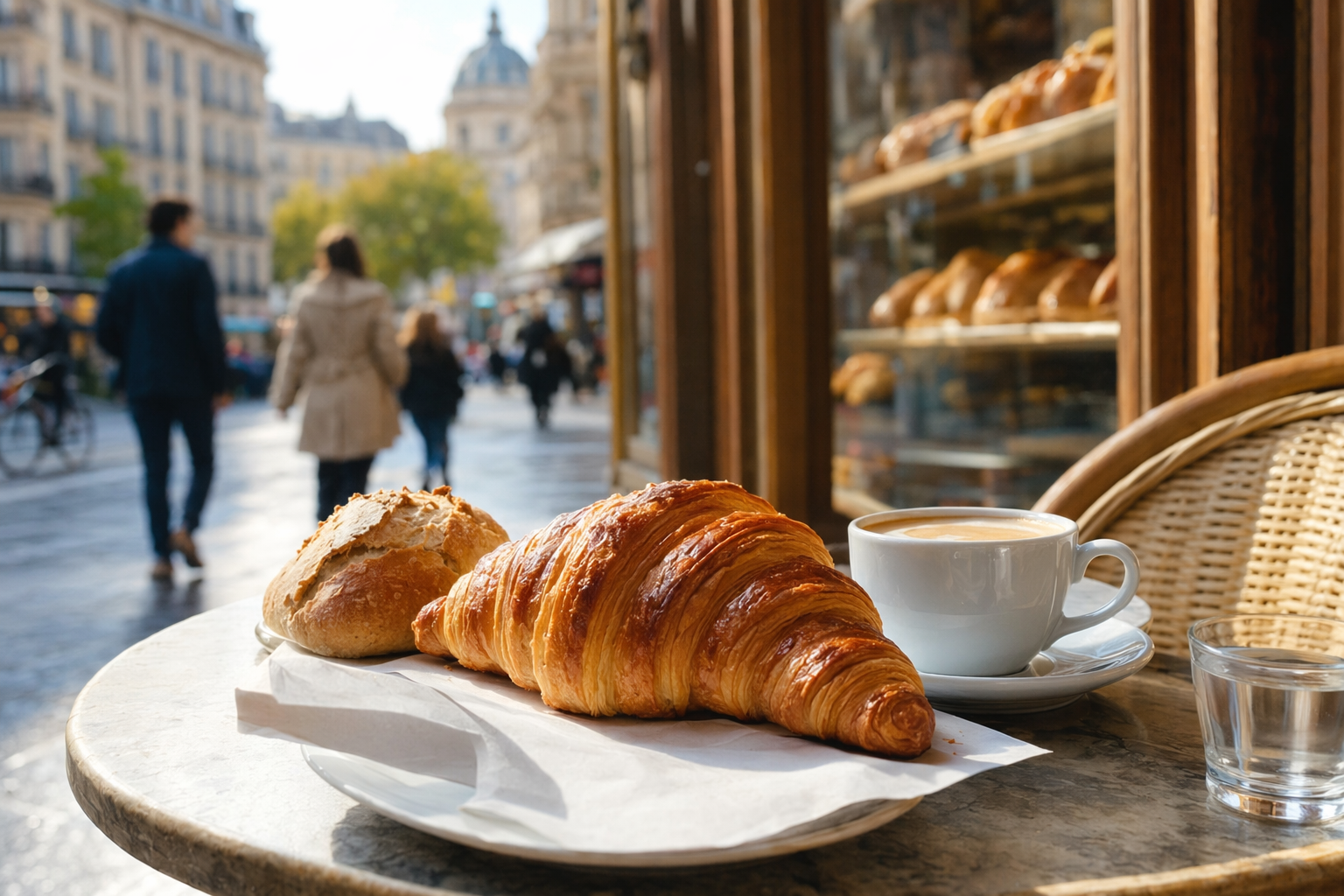
There is a very specific kind of happiness that happens when you wake up in a cheap hostel bed, slightly confused about what country you’re in, and then remember there’s a bakery downstairs. Not a hotel breakfast buffet with sweaty cheese slices and cereal in little plastic tubs. I mean a real bakery. Flour on the counter, someone yelling in a language you only half understand, trays of bread coming out hot, butter basically doing emotional damage. That kind of morning.
I’ve traveled around Europe on a budget for years now, sometimes with a backpack that was definitely too heavy, sometimes with a carry-on and way too much confidence, and my biggest money-saving trick has never been an app or a secret flight hack. It’s breakfast from bakeries. Honestly. A 2 to 6 euro bakery breakfast can carry you through half a day if you do it right, and it also gives you this tiny window into local life that you don’t really get from sitting in a tourist cafe paying 14 euros for avocado toast. Which, no shame, I like avocado toast too, but not when I’m trying to afford a train ticket to the next city.
So this is my bakery breakfast guide for budget travelers in Europe, based on a bunch of mornings spent standing on sidewalks with crumbs on my coat, drinking coffee from tiny cups, and pretending I knew what I ordered. Prices and opening hours change all the time, especially now that bakeries are dealing with higher ingredient costs, staff shortages, and the whole food-travel boom that just keeps getting bigger in 2026. So check before you go. But the habits, the dishes, the little ordering tricks? Those are pretty reliable.
Why Bakeries Are the Best Budget Breakfast in Europe Right Now
#Food travel has changed a bit lately. People aren’t just hunting for fancy tasting menus anymore, though of course those still exist and Instagram still loves them. The more interesting trend I’ve noticed across Europe is what I’d call “small luxury travel.” Travelers are spending less on hotels or skipping expensive restaurants, but they’ll happily pay for one really good pastry, a perfect coffee, a regional bread they can’t get at home. Bakeries fit that mood perfectly. They feel special but they don’t destroy your budget.
Another big 2026-ish food travel thing is early-morning local eating. I see more travelers planning their day around bakeries, farmers markets, sourdough shops, coffee windows, even hotel alternatives where people just book a room without breakfast and go exploring instead. Makes sense. Breakfast is cheaper than dinner, queues are shorter than brunch, and if you’re in a city like Paris, Lisbon, Vienna, Copenhagen, Kraków, or Naples, the morning bakery scene is almost a sightseeing activity by itself.
- Bakeries are usually cheaper than sit-down cafes, especially if you take away and eat in a park or by the train station like a dramatic budget poet.
- They open early, which is perfect if you’re catching trains, budget flights, buses, or doing that thing where you swear you’ll beat the museum crowds.
- You get local specialities without needing a reservation, a dress code, or the courage to read a 9-page dinner menu.
- A bread roll, pastry, yogurt from a grocery store, and coffee can become a full breakfast for under 7 euros in a lot of cities, sometimes under 4 if you’re lucky.
My Basic Bakery Breakfast Formula, Learned the Crumby Way
#My usual formula is simple: one local pastry, one savory thing if I’m walking a lot that day, and coffee. If I’m really watching money, I skip the fancy coffee and buy fruit or yogurt from a supermarket. The mistake I made early on was buying only sweet pastries and then wondering why I was hungry and cranky by 11:30. A croissant is beautiful, but it is not a personality, and it will not fuel your 22,000-step museum day alone.
Also, learn the local bakery rhythm. In France, you’ll find people buying baguettes early and again later in the day. In Portugal, pastelarias are an all-day thing but mornings are magic. In Germany and Austria, bakeries can be very efficient, almost emotionally intimidating if you don’t know what you want. In Scandinavia, the bakeries are gorgeous and expensive, so you need to choose carefully unless you want your breakfast budget to become your dinner budget. And in Eastern Europe, which I love deeply, you can still find seriously filling bakery breakfasts for prices that feel merciful.
- Look at what locals are ordering, not what’s displayed biggest in the window.
- If there’s a queue of office workers, you’re probably in the right place.
- Ask for “to go” or learn the local phrase, because sitting down can sometimes cost more.
- Carry napkins. I say this as someone who once ate a custard tart on a tram in Lisbon and looked like a toddler afterwards.
Paris: Croissants, Baguettes, and the Danger of Spending Your Whole Budget on Butter
#Paris is the obvious bakery breakfast city, and yes, it’s famous for a reason. But it can also be sneaky expensive if you drift into the prettiest cafe on the corner and order without looking. My budget move in Paris is to go to a boulangerie, buy one excellent viennoiserie, maybe a baguette tradition if I’m staying somewhere with a fridge and cheese, then eat near a canal or little square. It feels romantic even when your hostel towel smells weird.
A classic croissant in Paris is still one of the great travel breakfasts. But don’t sleep on pain aux raisins, chausson aux pommes, or a simple baguette with salted butter. If you want famous places, Du Pain et des Idées near Canal Saint-Martin has that old-school painted ceiling and beautiful pastries, though it’s not exactly secret anymore. Stohrer, one of the city’s historic pastry shops, is gorgeous for a treat. Mamiche and Boulangerie Utopie are also names that come up a lot among pastry people, and for good reason. Just remember, hyped bakeries can mean queues and prices that don’t feel very backpacker.
My favorite Paris breakfast wasn’t at a famous place though. It was a tiny bakery near Belleville where I bought a still-warm croissant and a coffee from another shop, then sat on a bench watching delivery drivers argue cheerfully. The croissant shattered everywhere. Like, everywhere. On my jeans, in my scarf, probably in my passport. Worth it.
Budget tip for Paris: skip the full cafe breakfast and build your own. One pastry, one piece of fruit from a market, and coffee standing at the counter can save you enough for a proper lunch later.
Lisbon: Pastéis de Nata Before the Tour Groups Wake Up
#Lisbon is dangerous because pastelarias are everywhere and the city seems designed to make you say, “Okay just one more.” The pastel de nata is the obvious breakfast move, and I know people debate whether it’s dessert, breakfast, snack, or spiritual practice. I vote all of the above. If it’s warm and the custard is slightly blistered on top, I don’t care what time it is.
Pastéis de Belém is the historic big name and it’s worth going once, especially early before the crowds get silly. Manteigaria is my personal repeat stop because the quality is consistent and you can watch the tarts being made, which is basically free theater. In 2026, Lisbon is still very much on the food travel map, but budget travelers should be aware that central neighborhoods have gotten pricier. The trick is to go one or two streets away from the main tourist flow. You’ll find local pastelarias with good coffee, bread rolls, cheese, ham, and pastries for less.
One morning in Lisbon, I had two natas and an espresso while standing at the counter next to an older man reading the paper. He didn’t look at his phone once. I remember thinking, this is the breakfast lifestyle I want. Then I walked up a hill and immediately regretted the second nata, but emotionally? No regrets.
Vienna: Fancy Bakery Energy Without Always Paying Fancy Prices
#Vienna can feel grand even when you’re broke. The coffee houses are beautiful, but a proper sit-down breakfast in a famous cafe can be expensive, and sometimes the service has that special old European chill where you’re not sure if you’re welcome or being judged for existing. Bakeries are easier. Grab-and-go, quick, and still very Viennese.
Look for kipferl, poppy seed pastries, nut pastries, and good dark breads. Austria does bread seriously. Joseph Brot and Öfferl are high-quality modern bakery names people talk about, though they’re more treat-yourself than rock-bottom budget. For cheaper everyday options, chains and neighborhood bakeries can still do the job, especially for rolls, pretzels, and sweet pastries. A simple semmel with butter or cheese can be oddly satisfying when you’re heading to Schönbrunn or catching a train.
My Vienna bakery memory is from a cold morning near a tram stop. I bought a poppy seed pastry that looked too plain to be exciting, then bit into it and just stood there, stunned. It was dense, nutty, not too sweet, and the filling stuck in my teeth for approximately three hours. Not glamorous. Very good.
Berlin: Cheap, Filling, and Better Than People Give It Credit For
#Berlin doesn’t always get praised like Paris or Copenhagen for bakery travel, but if you’re on a budget, Berlin is your friend. The city has everything from old-school German bakeries to Turkish bakeries, sourdough spots, vegan pastry places, and coffee shops that look like someone designed them for laptop people in black clothes. Breakfast can be very cheap if you avoid the trendy brunch trap.
For German bakery basics, try a belegtes Brötchen, which is basically a filled roll, often with cheese, egg, salami, ham, or veggies. It’s practical and filling. Pretzels are everywhere. Franzbrötchen, more associated with Hamburg but found in Berlin too, is a cinnamon-sugar buttery spiral situation that deserves more international fame. Turkish bakeries are also brilliant for budget mornings, with simit, börek, sesame breads, and strong tea. Honestly, a spinach and cheese börek in Berlin has saved me from many bad decisions.
Zeit für Brot is famous for cinnamon buns and has several locations, and yes, it’s good. But don’t ignore the corner bakeries near U-Bahn stations. I once got a cheese roll, coffee, and apple pastry for less than what a single “artisan” cappuccino cost in another neighborhood. Was it the best pastry of my life? No. Did it power me through the East Side Gallery and a flea market? Absolutely.
Copenhagen: Beautiful Bakeries, Brutal Prices, and How to Survive Them
#Copenhagen is one of Europe’s most exciting bakery cities right now, but let’s be honest, it is not naturally kind to budget travelers. The new Nordic baking scene has made cardamom buns, sourdough loaves, laminated pastries, and seasonal fruit tarts into actual destinations. Places like Juno the Bakery, Hart Bageri, Andersen & Maillard, and Lille Bakery have all had serious food-traveler attention. And they are fantastic. They are also not where you go if you want breakfast for 2 euros.
My Copenhagen strategy is one great pastry, no extras. Not a pastry plus sandwich plus juice plus coffee unless I’m ready to financially recover later. A cardamom bun and filter coffee can still be a worthwhile splurge, especially because the quality is often ridiculously high. The texture, the spice, the butter, the way the bun tears apart in soft ropes... sorry, I get emotional.
If you’re really tight on money, mix bakery culture with supermarket tactics. Buy one signature pastry from a great bakery, then grab skyr, fruit, or a boiled egg from a grocery store. Sit by the harbor and enjoy your budget breakfast with a view. Copenhagen makes even frugal eating feel stylish somehow, which is annoying but nice.
Prague, Kraków, and Budapest: My Favorite Budget Bakery Triangle
#Central Europe is where bakery breakfast becomes a proper budget traveler superpower. Prague, Kraków, and Budapest all have strong bread and pastry traditions, plus enough modern bakery energy to keep things interesting. You can eat well in the morning without instantly panicking about your bank balance.
In Prague, look for koláče, buchty, chlebíčky if you want savory open-faced sandwiches, and good rye breads. Eska in Karlín is a well-known bakery-restaurant and not the cheapest, but it’s a cool stop if you care about modern Czech baking. More casual bakeries and markets are better for daily budgeting. In Kraków, obwarzanek krakowski is the classic street bread ring, sold from little blue carts around the city. It’s chewy, cheap, and perfect when you’re walking through the old town half awake. Pair it with coffee and you’re set.
Budapest might be my favorite of the three for bakery breakfast. There’s kakaós csiga, a chocolate spiral pastry that looks humble and then suddenly becomes addictive. Pogácsa, those savory little scones often made with cheese or potato, are great for train snacks. Artizán Bakery is a respected sourdough spot, and Arán Bakery has become popular for very good pastries and bread. But again, for budget mornings, the everyday bakeries and market halls are where you win.
I once ate a warm kakaós csiga on a bench near the Danube after arriving on a night bus, and I swear it fixed my personality for at least 40 minutes. Travel fatigue is real, and sometimes the cure is chocolate dough and a view of old buildings glowing in morning light.
Naples and Rome: Cornetti, Sfogliatelle, and Standing Coffee Culture
#Italy is slightly different because the bakery breakfast often blends with bar culture. A typical Italian breakfast is quick and sweet: cornetto and coffee, usually standing at the counter. Sitting outside in a tourist area can cost way more, so if you’re budgeting, do what locals do and stand. It’s faster, cheaper, and honestly more fun once you get over feeling awkward.
In Rome, a cornetto semplice or cornetto con crema with a cappuccino is the classic. In Naples, please chase sfogliatella at least once. It comes in two main styles: riccia, with crisp layered pastry, and frolla, with a smoother shortcrust shell. Both are filled with sweet ricotta and semolina, often with citrus. I prefer riccia because I like pastries that fight back a little.
Naples is also one of those cities where breakfast feels alive. Scooters, shouting, espresso cups clinking, bakery windows packed with things that look too beautiful to be legal. I had a sfogliatella one morning near the historic center and burned my mouth because patience is not my gift. Still one of my best breakfasts in Italy.
Where the Real Savings Happen: Markets, Train Stations, and Neighborhood Bakeries
#A lot of people think the best bakery has to be the famous one. Sometimes yes. Often no. For budget travelers, the best bakery is usually the place close to where regular people commute. Train station bakeries in Europe are mixed, I won’t lie. Some are sad. Some are weirdly excellent. Neighborhood bakeries near schools, office areas, and residential streets are often more useful than the viral pastry shop with a 45-minute queue.
Markets are also your friend. Not every market is cheap anymore, especially the pretty central ones that now sell truffle everything and 9-euro juices, but morning markets still give you options. Bread, fruit, cheese, yogurt, cured meats, and local pastries can become a picnic breakfast. In places like Barcelona’s neighborhood markets, Vienna’s smaller food markets, Budapest’s market halls, or Riga’s Central Market, you can build a breakfast that feels more local and less expensive than a cafe meal.
One trend I actually love is the return of bread as a travel souvenir. Not always practical, obviously. Please don’t bring a giant sourdough on a budget airline if you’re already fighting the baggage rules. But bakeries selling regional grains, heritage wheat loaves, rye breads, seeded rolls, and naturally fermented dough are becoming part of the food travel conversation. It’s not just pastries anymore. Bread people are intense, and I say that lovingly.
What to Order in Different Countries If You’re Hungry and Confused
#Sometimes you walk into a bakery and freeze. There are labels you don’t understand, locals behind you who definitely know what they’re doing, and a staff member waiting with tongs. I’ve been there. Many times. Here are some easy bakery breakfast wins I keep coming back to.
- France: croissant, pain au chocolat, pain aux raisins, baguette tradition with butter or cheese from a shop nearby.
- Portugal: pastel de nata, pão de Deus, simple ham and cheese rolls, strong espresso that makes you question your life choices.
- Austria: kipferl, poppy seed pastries, nut rolls, semmel with cheese, pretzels if you need something sturdy.
- Germany: belegtes Brötchen, pretzels, Franzbrötchen, seeded rolls, and Turkish börek if you’re in a city with good Turkish bakeries.
- Denmark and Sweden: cardamom buns, cinnamon buns, rye bread sandwiches, seasonal pastries if your wallet allows.
- Czech Republic, Poland, Hungary: koláče, obwarzanek, kakaós csiga, pogácsa, poppy seed and walnut pastries.
- Italy: cornetto, maritozzo in Rome if you want cream-filled chaos, sfogliatella in Naples, and coffee at the counter.
My Budget Rules That Actually Work
#I’m not a perfect budget traveler. I have absolutely spent too much money because a pastry looked shiny. But these rules help me keep bakery breakfasts affordable without making travel feel miserable.
- Choose one star item. If you’re at a famous bakery, buy the thing they’re known for and skip the add-ons.
- Don’t buy bottled water from bakeries in expensive cities. Carry a refillable bottle where tap water is safe.
- Eat standing or take away in countries where table service adds cost.
- Use supermarkets for protein. Yogurt, cheese, eggs, fruit, and nuts make pastry breakfasts less sugary and more filling.
- Go early. The best stuff is fresh, and some bakeries sell out of popular items by late morning.
- Check closing days. Small bakeries can close Sundays, Mondays, or random holiday weeks, and it will break your heart if you planned your whole morning around them.
The best budget breakfast I ever built was probably in Kraków: obwarzanek from a street cart, banana from a corner shop, cheap coffee, and later a small pastry I couldn’t pronounce. It cost hardly anything and felt like an actual travel memory, not just fuel. That’s the thing. Budget food doesn’t have to feel like settling. Sometimes it’s more connected to the place than the expensive meal.
A Few Food Travel Changes I’m Seeing in 2026
#The European bakery scene is moving in a few interesting directions. Sourdough is still everywhere, but now there’s more focus on regional grains, low-waste baking, and smaller menus done really well. I’ve seen bakeries using yesterday’s bread in puddings, croutons, kvass-style drinks, or savory bakes. More places are offering vegan pastries that don’t taste like punishment, which is a huge improvement from a few years ago. Gluten-free options are better in big cities, though still uneven, especially in traditional bakeries where wheat is basically the main character.
Another thing: bakeries are becoming travel destinations in their own right. People plan city breaks around bread now. Copenhagen, Paris, Lisbon, London, Berlin, Vienna, and Amsterdam all have bakery scenes that attract food travelers, and smaller cities are getting attention too. But with that comes higher prices and viral queues. My advice is to do one famous bakery if you really care, then spend the rest of your mornings eating like a local commuter.
And yes, mobile ordering, digital maps, and food apps make finding bakeries easier, but wandering still wins. Some of my favorite breakfasts happened because I turned down the wrong street or followed the smell of bread like a cartoon character. Not every meal needs to be optimized. Actually, please don’t optimize all your meals. Leave room for accidents.
Final Crumbs: Why Bakery Breakfasts Make Europe Feel More Personal
#If you’re traveling Europe on a budget, bakery breakfasts are one of the easiest ways to eat well, save money, and feel like you’re actually inside the daily rhythm of a place. You learn what people grab before work, what flavors show up again and again, how cities wake up. You also learn practical things, like never wear black while eating a flaky pastry, and don’t assume the innocent-looking poppy seed roll won’t leave evidence in your teeth.
My perfect European morning is not complicated. A bakery bag warm in my hand, coffee somewhere nearby, a street I haven’t walked yet, and no rush except maybe a train later. That’s enough. More than enough, honestly. Whether it’s a Paris croissant, Lisbon nata, Vienna poppy seed pastry, Berlin börek, Copenhagen cardamom bun, Kraków obwarzanek, or Naples sfogliatella, breakfast can become the best part of the day without costing much.
So skip the overpriced hotel buffet once in awhile. Follow the office workers. Point at the pastry you can’t pronounce. Eat on a bench. Save your coins for the next city. And if you’re hungry for more casual food-and-travel ramblings like this, I’d definitely poke around AllBlogs.in, because there’s always another dish, another bakery, and another morning worth planning a trip around.