If you’re booking a hotel in Stockholm, Gothenburg, Malmö, or almost anywhere else in Sweden, you may see the word frukostbuffé on the hotel page. On some older booking sites, or sites that don’t handle Swedish accents well, it may also appear as frukost buffe.
The short answer: frukostbuffé means breakfast buffet.
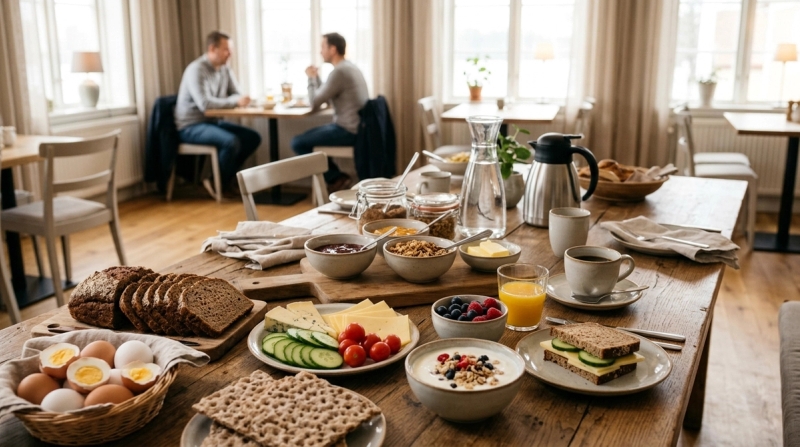
But if you’re picturing only coffee and a croissant, Swedish hotel breakfasts are often a little more generous than that. In many hotels, breakfast is a proper spread: bread, crispbread, cheese, eggs, cold cuts, vegetables, yogurt or filmjölk, cereal, fruit, coffee, juice, and sometimes fish or warm dishes too.
That said, there’s no single standard. Some hotel breakfasts are simple and practical. Others are big, beautiful, and full of local products. Breakfast may be included in your room rate, or it may cost extra. Opening hours, takeaway rules, non-guest access, and allergy information also vary from hotel to hotel.
So if breakfast matters to your trip, check your booking confirmation or ask the hotel directly.
Quick answer
#The frukostbuffé meaning is “breakfast buffet” in Swedish.
- Frukost means breakfast.
- Buffé means buffet.
For travelers, a frukostbuffé usually means a self-service breakfast at a hotel, guesthouse, or sometimes a café. At a Swedish hotel breakfast, you can often expect a Scandinavian-style spread with bread, crispbread, cheese, eggs, cold cuts, vegetables, yogurt or fermented milk, cereals or muesli, coffee, tea, and juice.
Some hotels also offer smoked fish, pickled herring, porridge, warm dishes, or plant-based options. Not every buffet will have all of these, though, so don’t assume it will be huge unless the hotel says so or shows it in photos.
For many travelers, it’s a convenient and filling way to start the day before sightseeing, meetings, train journeys, ferry trips, or a long walk around a Swedish city.
What frukostbuffé means
#The literal frukostbuffé meaning is simple: breakfast buffet. In practice, though, the phrase can suggest something more substantial than a basic continental breakfast.
A continental breakfast might mean coffee, juice, bread, butter, jam, and maybe a pastry. A Swedish hotel breakfast is often built around variety and balance. You can keep it light with yogurt, fruit, and coffee. You can make it more filling with eggs, bread, cheese, porridge, and cold cuts. Or you can lean into the Scandinavian breakfast buffet experience with crispbread, dairy, vegetables, open-faced sandwiches, and fish if it’s available.
You may see a few related Swedish phrases when booking:
- Frukostbuffé: breakfast buffet.
- Frukost ingår: breakfast is included.
- Frukost tillgänglig: breakfast is available, but not necessarily included.
- Frukost serveras: breakfast is served.
- Bufféfrukost: buffet breakfast, another way of saying breakfast buffet.
If you see frukost buffe without the accent or as two words, it usually just means frukostbuffé. The spelling is simplified, but the meaning is the same.
For travelers, the translation is only part of the story. The more useful questions are: Is breakfast included? What time is it served? Will it work with your diet? And does it fit your plans for the day?
What you usually find
#A Sweden breakfast buffet can be simple or surprisingly elaborate. A budget hotel may keep things practical. A boutique or higher-end hotel may add local cheeses, fresh-baked bread, better coffee, homemade jams, smoked fish, or a larger hot food section.
Still, many Swedish hotel breakfasts follow a familiar pattern.
Breads and crispbread
#Bread is often the base of breakfast. You may find:
- Fresh rolls
- Sliced bread
- Rye bread
- Sourdough
- Crispbread, called knäckebröd
- Butter, spreads, and jams
If you’re new to Sweden, try the crispbread. It’s dry, crunchy, and sturdy, which makes it perfect for open-faced breakfast toppings. On its own it may look plain, but with cheese, egg, cucumber, tomato, or a spread, it starts to make sense very quickly.
Cheese, cold cuts, and sandwich toppings
#A Swedish breakfast buffet usually makes it easy to build simple open-faced sandwiches. Look for:
- Sliced cheese
- Ham or other cold cuts
- Turkey or salami, depending on the hotel
- Cucumber slices
- Tomato
- Bell pepper
- Lettuce or greens, depending on the spread
The vegetables are not just decoration. They’re a normal part of breakfast in Sweden, and they make the meal feel fresher and lighter than a plate made only of bread and cheese.
Eggs and warm items
#Eggs are common, but the style varies. You may see:
- Boiled eggs
- Soft-boiled eggs
- Scrambled eggs
- Other warm breakfast items, depending on the hotel
Some hotels have a full hot section. Others keep breakfast mostly cold, with just a few warm basics. If you’re expecting a full cooked breakfast, check the hotel photos or breakfast description first.
Dairy, yogurt, and filmjölk
#Dairy is a big part of many Swedish breakfasts. You may find:
- Yogurt
- Filmjölk, a tart fermented milk product
- Milk
- Muesli or granola
- Cereal
- Berries or fruit toppings, depending on the hotel
Filmjölk can be a surprise the first time you try it. It’s not exactly yogurt and not exactly milk. It’s pourable, tangy, and very common at Swedish breakfasts. If you like plain yogurt, kefir, or buttermilk, it’s worth trying a small bowl.
If you avoid dairy, check labels or ask staff. Many hotels now offer oat milk or other plant-based alternatives, but it isn’t guaranteed everywhere. For more practical tips, see our guide to traveling with lactose intolerance.
Fish and Scandinavian breakfast items
#At some hotels, especially more generous ones, you may see fish options such as:
- Smoked salmon
- Pickled herring, called sill
- Cod roe spread, sometimes served from a tube
These are not guaranteed at every hotel, so think of them as a nice bonus. But if you’re curious about a more traditional Scandinavian breakfast buffet, items like fish, crispbread, cheese, eggs, and fresh vegetables are all part of the experience.
Porridge, grains, and lighter options
#If you prefer a simple breakfast before a busy day, you may find:
- Oatmeal or porridge
- Cereal
- Muesli
- Fruit
- Yogurt
- Seeds or toppings
This kind of breakfast is useful if you have an early start, a long museum day, or a few hours on a train and don’t want anything too heavy.
Coffee, tea, and juice
#Coffee is a normal part of Swedish hotel breakfast. You’ll usually find filter coffee or a coffee machine, plus tea and juice.
The setup depends on the hotel. Some places have self-service coffee stations. Others serve certain drinks from a counter or bar. If you’re not sure what to do, just pause for a moment and watch how other guests use the setup. You’ll figure it out quickly.
How to build a good plate
#The best way to enjoy a frukostbuffé is to take a quick look around before filling your plate. See what’s available, then choose what actually suits your morning.
Here are a few easy approaches.
The classic Swedish-style plate
#Start with bread or crispbread. Add butter, cheese, or a spread. Then add something like ham, egg, cucumber, tomato, or bell pepper.
A simple plate might be:
- One slice of rye bread with cheese and cucumber
- One crispbread with egg
- A small bowl of yogurt or filmjölk with muesli
- Coffee or tea
It gives you a good mix of protein, carbs, fat, and freshness without feeling too heavy.
The light sightseeing plate
#If you’re walking around a city, visiting museums, or planning to stop later for coffee and a cinnamon bun, you may want something steady but not too rich.
Try:
- Yogurt or filmjölk with cereal or muesli
- Fruit
- One slice of bread or crispbread
- Coffee or tea
This is enough to get you going without making you feel like you need a nap before noon.
The hearty travel-day plate
#For a train day, ferry day, airport transfer, or long drive, a more filling breakfast can be helpful.
Consider:
- Eggs
- Bread with cheese or cold cuts
- Porridge, if available
- Vegetables
- Coffee, tea, or juice
If you’re eating more because you have a long day ahead, it’s still better to take food in smaller rounds. It keeps the table neater and helps avoid waste.
The curious traveler plate
#If it’s your first time in Sweden, the buffet is a low-pressure way to try local breakfast habits.
Take small portions of:
- Crispbread
- Filmjölk
- Pickled herring, if available
- A Swedish-style open sandwich
- Cheese with cucumber or tomato
Small tastes are your friend. It’s much better to try a little and go back for more than to load up your plate with unfamiliar foods and discover you don’t like them.
Etiquette
#A Swedish hotel breakfast room is usually calm, casual, and practical. You don’t need to be overly formal, but a bit of awareness goes a long way.
Queue properly
#If there’s a line for the coffee machine, toaster, eggs, or hot food, join it and wait your turn. Cutting in, reaching across people, or crowding someone at the buffet can feel rude.
Take what you can eat
#It’s fine to go back for seconds. In fact, that’s better than piling your plate high and leaving half of it behind. Start with a modest plate, see what you enjoy, and return if you want more.
For a broader guide, read our hotel breakfast etiquette tips here: hotel breakfast buffet etiquette for travelers.
Use the serving utensils
#Use the tongs, spoons, and ladles provided. Don’t use your own fork or your hands to take shared food.
If you go back to the buffet, many hotels prefer that you take a fresh plate, especially for hot food, sauces, or shared items. It’s cleaner for everyone.
You can also read our safety-focused guide: hotel breakfast buffet safety for travelers.
Don’t pack lunch unless it’s allowed
#A frukostbuffé is usually meant to be eaten in the breakfast room. Taking a piece of fruit may be tolerated in some places, but filling a bag for later is usually not okay unless the hotel clearly allows it.
If you have an early checkout, a tight train connection, or a tour before breakfast opens, ask the front desk in advance. Some hotels can arrange a takeaway breakfast or an early option, but policies vary. Don’t assume.
Keep the pace comfortable
#Breakfast rooms can get busy, especially close to closing time. If you want a slow breakfast, go earlier if you can. If you arrive near the end, take what you need without lingering too long at the buffet stations.
Also check the posted breakfast hours. Weekday and weekend times may be different.
Useful checks before you book or walk in
#A frukostbuffé can be excellent value, but only if it fits your booking, schedule, appetite, and dietary needs. Before relying on it, check a few details.
Is breakfast included?
#Look for frukost ingår in your booking. If breakfast is not included in the room rate, the hotel may offer it as a paid add-on.
Booking platforms don’t always display breakfast information clearly. If you’re unsure, check your confirmation email and the hotel’s own website, or contact the property directly.
What time does it open?
#Opening hours matter if you have an early train, flight, meeting, or tour. Some hotels start breakfast early. Others open later on weekends or holidays.
If timing is important, ask the hotel directly, especially if you need to leave before 7 or 8 in the morning.
Can non-guests eat there?
#Some hotels allow outside guests to pay for breakfast. Others limit the buffet to overnight guests, especially during busy periods.
If you’re not staying at the hotel but want to try its Swedish hotel breakfast, contact the property first.
Are allergens labeled?
#Allergen labeling and dietary support vary by hotel. If you have a serious allergy, don’t rely only on buffet signs. Contact the hotel before arrival, then confirm with staff at breakfast.
Useful questions to ask include:
- Is there gluten-free bread?
- Are dairy-free milks available?
- Are vegan options available?
- Are fish, egg, nut, or dairy items handled separately?
- Can staff explain which items contain allergens?
Is it worth paying extra?
#It depends on your plans. A large breakfast buffet may be worth it if you enjoy a proper morning meal, have a long travel day, or want to try several Swedish breakfast foods in one place.
If you only want coffee and a pastry, a bakery or café may be a better fit. For budget-friendly ideas outside the hotel, see European bakery breakfast tips for travelers.
There’s no single right answer. The best choice is the one that fits your appetite, schedule, and room rate.