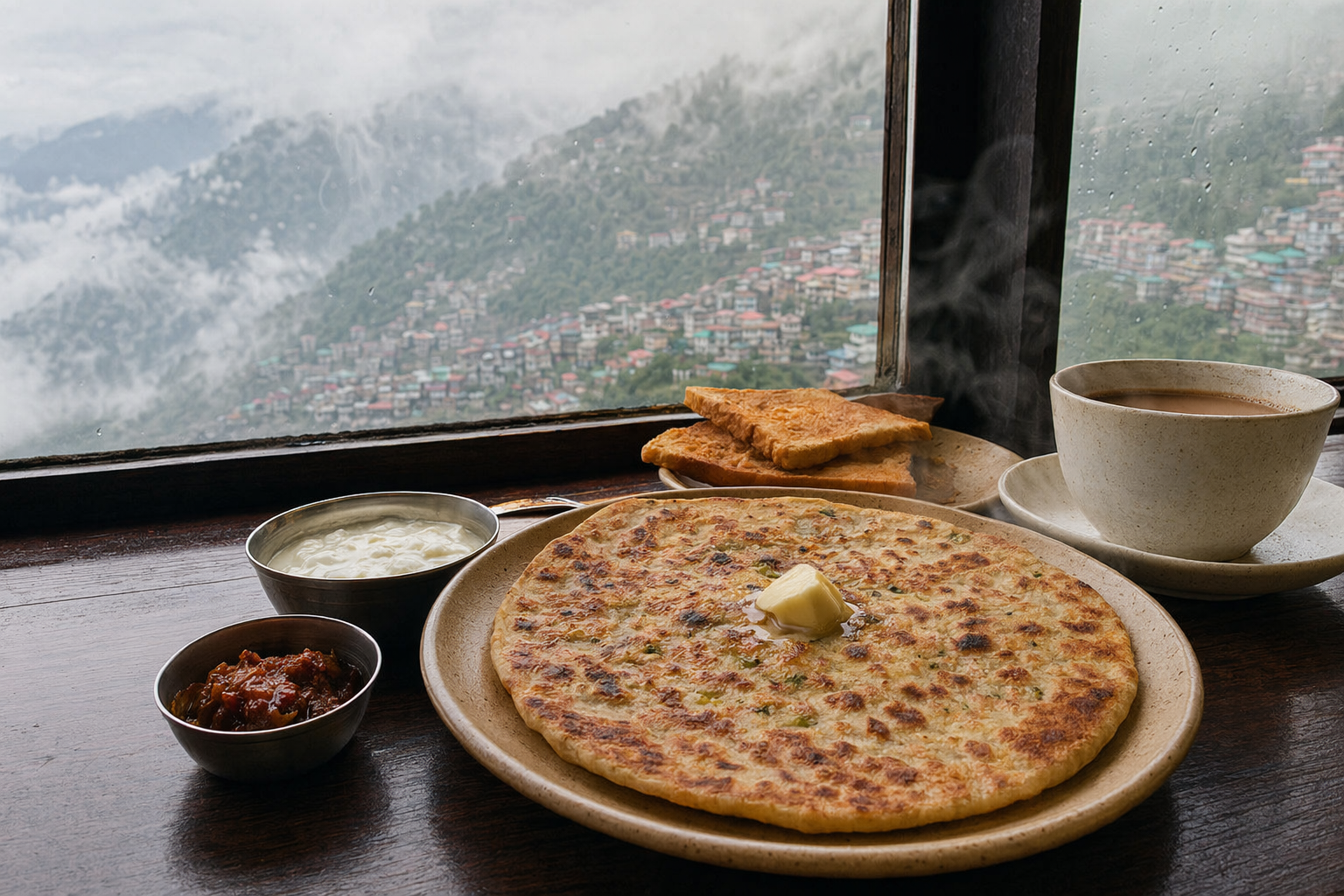
There is a very specific kind of hunger that happens in an Indian hill-station during monsoon. Not normal breakfast hunger. I mean the damp-socks, hair-smelling-like-rain, stomach-growling-after-a-5-am-bus-ride kind. You wake up to fog pressing against the window, the road outside is half road and half stream, and somewhere nearby someone is frying something in oil that has clearly understood its life purpose. That smell. Pakora, paratha, fresh bread, pepper, ginger, maybe wet pine needles too. Honestly, it makes fancy hotel buffets look a bit silly.
I’ve chased breakfasts through quite a few hill towns now, usually with bad planning and too much confidence. Darjeeling in sideways rain. Landour when the clouds sat so low I could barely see the tea in my cup. Munnar with leeches waiting in the grass like tiny villains. Coorg where coffee is not a beverage, it’s basically a religion. And one soggy morning in Shillong where I ate jadoh before 9 am and then walked around feeling like I had unlocked some secret level of travel. Monsoon breakfasts in the hills are messy and moody and not always convenient, but that’s exactly why they stay with you.
Why Breakfast Hits Different When the Hills Are Soaked
#In the plains, breakfast is often functional. Quick dosa, poha, bread omelette, whatever gets you through the morning. In the hills during monsoon, breakfast becomes an event because the weather forces you to slow down. Roads get delayed. Viewpoints disappear behind fog. Treks get cancelled because, well, landslides are not cute. So you sit. You order another chai. You watch steam curl out of a bowl of thukpa or upma or puttu with kadala curry, and suddenly the whole trip is not about checking places off anymore. It’s about being warm.
Also, and I will die on this tiny wet hill, monsoon makes food smell better. Ginger tea smells sharper. Butter on toast smells richer. Fermented things like idli batter, appam, siddu, or local breads feel alive somehow. Even a basic aloo paratha at a roadside dhaba above Rishikesh tastes like it has been blessed by mountain gods when your fingers are cold and your jacket is slightly useless.
The food travel scene has changed a lot too. By 2026, the thing I kept seeing across hill destinations was not just “tourist café with fairy lights” anymore, though those are still everywhere and I do like them, no shame. It’s more hyperlocal now. Homestays doing millet breakfasts. Small cafés listing single-origin coffee from local estates. QR menus with seasonal specials. Breakfast walks. Women-led kitchens serving recipes that were never really on restaurant menus before. Even big travel platforms and boutique stays are pushing low-waste, farm-to-table, and regional breakfast experiences because travelers are finally asking for more than pancakes and hash browns in every hill town. Thank god.
Darjeeling: Toast, Sausages, Momos, and Tea That Makes You Shut Up for a Minute
#My first proper monsoon breakfast memory is Darjeeling. I had arrived after one of those shared jeep rides where everyone pretends they are fine but nobody is fine. Rain was hitting the windshield like thrown rice. By the time I reached near Chowrasta, my jeans were wet till the knees and my stomach was making public complaints.
Darjeeling breakfast can go two ways. You can do the old-school colonial bakery thing, or you can follow the steam and eat Tibetan-Nepali comfort food. I did both because I have no self-control on trips. Glenary’s is still that classic stop for bread, cakes, eggs, and the whole “I’m in a hill station and I deserve a window seat” feeling. Keventer’s, with its rooftop if weather allows, has that legendary breakfast plate reputation, especially for people who love sausages and old Darjeeling nostalgia. But honestly, the breakfast that fixed me was a bowl of thukpa and momos from a small place tucked away from the main tourist drag. Not glamorous. Plastic tablecloth. Condensation on the wall. Perfect.
And tea, obviously. Darjeeling tea in monsoon is strange because the skies are grey and the plantations look almost too green, like someone over-edited the world. I visited Happy Valley Tea Estate once on a misty day and drank tea so light it felt like a whisper, which sounds dramatic but it’s true. Breakfast there doesn’t need to be heavy. Buttered toast, eggs, maybe wai-wai tossed with chillies, and a pot of second flush if you can get it. Simple. Sharp. Rain outside doing its thing.
Landour and Mussoorie: Bun Omelette, Cinnamon Rolls, and Foggy Little Greed
#Landour is the kind of place where breakfast becomes a moral test. You say you’ll eat light because you want to walk. Then you reach Char Dukan and suddenly there are pancakes, parathas, waffles, Maggi, bun omelette, ginger lemon honey tea, and you become weak. I became very weak. Anil’s Café at Char Dukan is one of those names everyone mentions, and it is touristy, yes, but sometimes touristy places are popular for a reason. A hot bun omelette after walking through wet deodar lanes is not something I’m going to act superior about.
Down in Mussoorie, Lovely Omelette Centre is still one of those places people squeeze into for cheesy omelettes, and nearby bakeries keep doing the sweet-carb thing that hill stations do so well. Landour Bakehouse has that polished heritage vibe, with good breads and cakes, and I know some people call it overhyped. Maybe it is a little. But I sat there once while clouds moved over the windows like slow ghosts, drinking coffee and eating a cinnamon roll, and I was not interested in being critical. I was interested in being dry.
The new thing I noticed around Uttarakhand hill cafés, especially in 2026 travel chatter, is how many menus are bringing in mandua, jhangora, and local grains. Ragi or mandua pancakes, millet porridge, pahadi ghee, rhododendron squash, local jams. Some of it is genuinely rooted, some of it is branding, and sometimes both at the same time. But when it works, it works beautifully. A mandua roti with white butter and a cup of strong chai on a rainy morning? Better than half the expensive brunches I’ve had in cities, no kidding.
Munnar: Appam, Stew, Puttu, and Tea Gardens Smelling Like Wet Earth
#Munnar in monsoon is ridiculously pretty and slightly impractical. The tea gardens look cinematic, but your shoes may never forgive you. Breakfast there is where Kerala quietly wins. I don’t know how many people go to Munnar and waste mornings on toast, but please don’t. Eat appam with vegetable stew. Eat puttu with kadala curry. Eat idiyappam with coconut milk. Eat pazham pori if someone is frying it, because banana fritters in rain are basically emotional support.
One morning I stayed at a small homestay outside town, and the aunty there served puttu that came out in warm cylinders, soft and crumbly, with black chickpea curry that was dark, peppery, coconut-rich and not trying to impress anyone. It just was. There was also red banana, homemade pickle, and tea from nearby estates. I remember being embarrassingly quiet while eating. Usually I talk too much at breakfast, ask questions, take photos, fiddle with my phone. That morning I just ate. The rain was hitting the tin roof so loudly that conversation would’ve been work anyway.
For travelers who want restaurant names, Saravana Bhavan in Munnar has long been a reliable vegetarian stop for South Indian breakfast, especially dosa and filter coffee, and Rapsy Restaurant is one of those casual places many backpackers know for Kerala meals and quick bites. But the better move, in my opinion, is booking a homestay that actually serves local breakfast, not a generic “continental plus Indian” spread. In 2026, homestay-led food travel is huge in the Western Ghats, and for once the trend makes sense. You don’t need foam or edible flowers. You need coconut, curry leaves, steam, and someone’s grandmother-level confidence.
Coorg: Coffee First, Everything Else Later
#Coorg in monsoon smells like coffee, pepper vines, damp wood, and occasionally, your own wet backpack which is less romantic. Breakfast here begins with coffee even if you pretend it doesn’t. The good stuff is often estate-grown, freshly brewed, and stronger than what most city cafés are pouring at twice the price. A lot of stays now do coffee tastings or estate walks, and by 2026 the “bean-to-cup travel” thing has become proper mainstream. People want to see where the coffee grows, meet growers, buy small-batch roasts, and post a photo of a misty mug with their fingers looking artfully cold. I mock it but I do it too.
Food-wise, Coorg breakfast can be simple or wildly indulgent depending on where you land. Akki rotti, nool puttu, kadambuttu, coconut chutneys, spicy curries, and if you eat meat, pandi curry tends to dominate Coorg food conversations, though it’s not exactly what everyone has at breakfast. At a homestay near Madikeri, I had akki rotti with a green chutney so sharp it woke up parts of my brain I wasn’t using. There was also homemade orange marmalade, because Coorg loves mixing local produce into breakfast without making a big fuss about it.
In Madikeri, Coorg Cuisine is known for Kodava food, though I’d check current timings before planning breakfast around it. A lot of the best morning meals here happen at estates and homestays rather than restaurants. That’s a broader hill-station truth actually. If you want the real breakfast, sleep where someone cooks.
Shillong and the Northeast: Breakfast With Smoke, Rice, and Rain That Doesn’t Apologise
#Shillong rain is not gentle background music. It has opinions. I went there during a wet spell and the city looked freshly washed all day, with pine, traffic, music cafés, and the kind of clouds that make you forget what time it is. Breakfast here can be café-style, especially around Laitumkhrah, or it can be local and rice-heavy in the best way.
Khasi food in the morning is not always what mainstream Indian travelers expect because it doesn’t follow the dosa-paratha-poha template. You might find jadoh, the rice and meat dish that is usually eaten through the day, or putharo, a steamed rice cake, with dohneiiong or other pork preparations depending where you go. There is red tea, smoked meat, local greens, tungrymbai made with fermented soybean, and flavours that are earthy, smoky, funky, and very alive. I know fermented soybean at breakfast may scare some people. It scared me a little too. Then I tasted it and immediately wanted more rice.
Shillong also has a strong modern café culture. Dylan’s Café is well-known, ML 05 Café has its motorcycle-road-trip vibe, and there are many small bakeries and coffee places that keep popping up. The 2026 food travel mood in the Northeast is exciting because people are finally going beyond “scenic trip” content and talking about indigenous ingredients, smoked foods, wild herbs, black sesame, bamboo shoot, local citrus, and community-run food experiences. It feels overdue. Very overdue.
Ooty, Kodaikanal, and the Nilgiris: Filter Coffee, Varkey, and Rain on Eucalyptus Leaves
#The Nilgiris are breakfast heaven if you like old bakeries, Tamil tiffin, and cold-weather snacking. Ooty has its varkey, that flaky biscuit-ish bakery thing that is best with tea and worst when you try to explain it to someone who hasn’t eaten it. There are classic spots like Ooty Coffee House for dosas and filter coffee, and old hotel restaurants where you still get that slightly faded hill-station charm. Earl’s Secret at King’s Cliff is more of a sit-down colonial bungalow experience, lovely for a slower meal if you’re not rushing to catch the toy train or escape a traffic jam.
Kodaikanal breakfast, for me, is about bakeries and eggs and too much coffee. Pastry Corner is one of those beloved old stops, and the town has plenty of cafés catering to walkers, cyclists, remote workers, and people who came for two days and stayed a week, which is very Kodai behaviour. In 2026, the workation crowd is still shaping hill food in a big way. You see sourdough next to idli, kombucha next to chai, millet bowls next to cheese toast. Sometimes it feels annoying, like every hill town is becoming the same café with a different view. But then someone serves a proper local chutney with a crisp dosa and I calm down.
Mahabaleshwar and Panchgani: Strawberries, Misal, and the Monsoon Drama of the Ghats
#Western Maharashtra hill breakfasts deserve more love. Everyone talks about strawberries in Mahabaleshwar, and yes, strawberry cream is not exactly breakfast but I have eaten it before noon and I refuse to apologise. During monsoon, the ghats turn wild green, the roads get dramatic, and the hunger after a foggy drive is serious. Misal pav, kanda poha, sabudana khichdi, batata vada, cutting chai, corn roasted with chilli and lime, this whole belt knows how to feed wet travelers.
Mapro Garden near Panchgani remains a popular stop for strawberry products, sandwiches, pizzas, shakes, and the very tourist-friendly strawberry cream scene. It gets crowded, obviously. But I still like stopping there because travel doesn’t always need to be hidden gems and whispered local secrets. Sometimes the obvious place is fun. For a more local breakfast, smaller Maharashtrian eateries around Panchgani and Mahabaleshwar do poha and misal that taste much better than anything you’ll get at a resort buffet pretending to be “regional.”
The 2026 Breakfast Trends I Kept Seeing in Hill Stations
#- Millets are everywhere now, and not just as health-food punishment. Mandua rotis, ragi pancakes, jowar upma, millet idlis, even millet waffles in some boutique cafés. Some are great, some taste like cardboard wearing honey.
- Homestay breakfasts have become the new luxury. Not chandeliers, not seven types of cereal. Just local grains, eggs from the backyard, estate coffee, homemade pickle, and somebody telling you which road is blocked today.
- Speciality coffee has moved uphill in a big way, especially Coorg, Nilgiris, parts of Himachal and Uttarakhand café circuits. Pour-overs in misty cafés are no longer rare, though I still want my steel tumbler filter coffee too.
- Food walks are starting earlier. Breakfast walks in Darjeeling, Shillong, Shimla, and old hill bazaars are getting popular because travelers want markets before the crowds and rain arrive.
- Low-waste and local sourcing is finally more visible. Banana leaves, refill water stations, seasonal menus, composting at eco-stays, and less plastic packed breakfasts for treks. Still a long way to go, but better.
What to Actually Order When It’s Pouring
#If you’re the sort who panics at menus, here’s my very biased wet-weather breakfast list. In Darjeeling or Sikkim-side hill towns, get thukpa, momos, tingmo if available, butter tea if you’re curious, and local tea always. In Uttarakhand or Himachal, go for aloo paratha, siddu where you find it, bun omelette, pahadi chai, mandua roti, and anything with white butter. In Kerala’s hills, appam-stew, puttu-kadala, idiyappam, dosa, and pazham pori. In Coorg, akki rotti, nool puttu, strong coffee, chutneys, and whatever the homestay cook is proud of. In Meghalaya, be brave with rice breakfasts, smoked meats, putharo, red tea, and fermented flavours. In Maharashtra’s ghats, misal, poha, vada pav, sabudana khichdi, and roasted bhutta because rain demands corn.
Also, please don’t underestimate plain Maggi. I know it’s cliché. I know every viewpoint stall sells it. But there is a reason monsoon Maggi survives all food snobbery. It is hot, salty, soupy, and ready before your fingers stop shivering. Add egg and extra green chilli and suddenly it’s poetry. Bad poetry maybe, but still.
A Few Monsoon Food Travel Rules I Learnt the Damp Way
#- Eat where there is turnover. Rainy weather and empty food stalls are not a romance novel, they are a stomach risk.
- Ask your homestay host about road conditions before chasing breakfast across town. A “15 minute drive” in monsoon can become one hour and one small landslide.
- Carry cash even if UPI works almost everywhere now. Hill networks get moody, especially when you are hungry and overconfident.
- Don’t demand out-of-season food. If a place says local greens today, eat local greens. If strawberries are not at their best, don’t be that person.
- Pack a light rain poncho and one dry pair of socks in your day bag. This sounds unrelated to breakfast until you try enjoying appam with swamp feet.
The best hill-station breakfast is not always the famous one. Sometimes it’s the meal you eat while waiting for rain to stop, with no view, no plan, and a cup of tea that somehow fixes your whole mood.
My Favourite Kind of Morning, If I Had to Pick
#If I could design the perfect monsoon hill breakfast, it would start too early. Grey light, not sunrise exactly, because monsoon doesn’t do clean sunrise on command. I’d walk through a bazaar where shutters are half-open and dogs are sleeping under awnings. There would be a tea stall with benches still wet from the night, a man frying pakoras even though it is absolutely breakfast time and nobody should question him. I’d have ginger chai first because decisions should not be made uncaffeinated.
Then something local and hot. Maybe puttu-kadala in Munnar, thukpa in Darjeeling, akki rotti in Coorg, misal in Panchgani, or putharo in Shillong. I don’t need linen napkins. I need steam fogging my glasses. I need that small burn on the tongue because I was too impatient. I need the cook looking slightly amused because tourists like me always arrive drenched and dramatic.
And then, the best part, doing nothing for a while. This is what monsoon teaches if you let it. You can’t control the weather, the road, the visibility, or whether your shoes dry by tomorrow. But you can sit with breakfast and let the hills exist around you. That sounds cheesy, I know. Still true.
Final Thoughts From a Person Who Plans Trips Around Breakfast
#Hill-station breakfasts in the Indian monsoon are not just about food. They’re about surrendering to weather, to local kitchens, to plans falling apart in delicious ways. The rain makes you less efficient and more hungry, which is maybe the ideal travel state. You notice the cook grinding chutney. You hear tea being poured from height into steel tumblers. You smell wet soil and frying onions. You talk to strangers because everyone is stuck under the same roof anyway.
So if you’re planning a hill trip this monsoon, don’t only search for viewpoints. Search for breakfast. Stay in places that cook local. Wake up before the Instagram crowd. Carry dry socks. Say yes to the dish you don’t fully understand. And if a roadside stall has steam pouring out into the rain, go stand there. That’s probably where the morning is happening. For more food-travel rambles, practical guides, and the kind of trip ideas that make you hungry before you’ve booked anything, I’d casually point you toward AllBlogs.in.