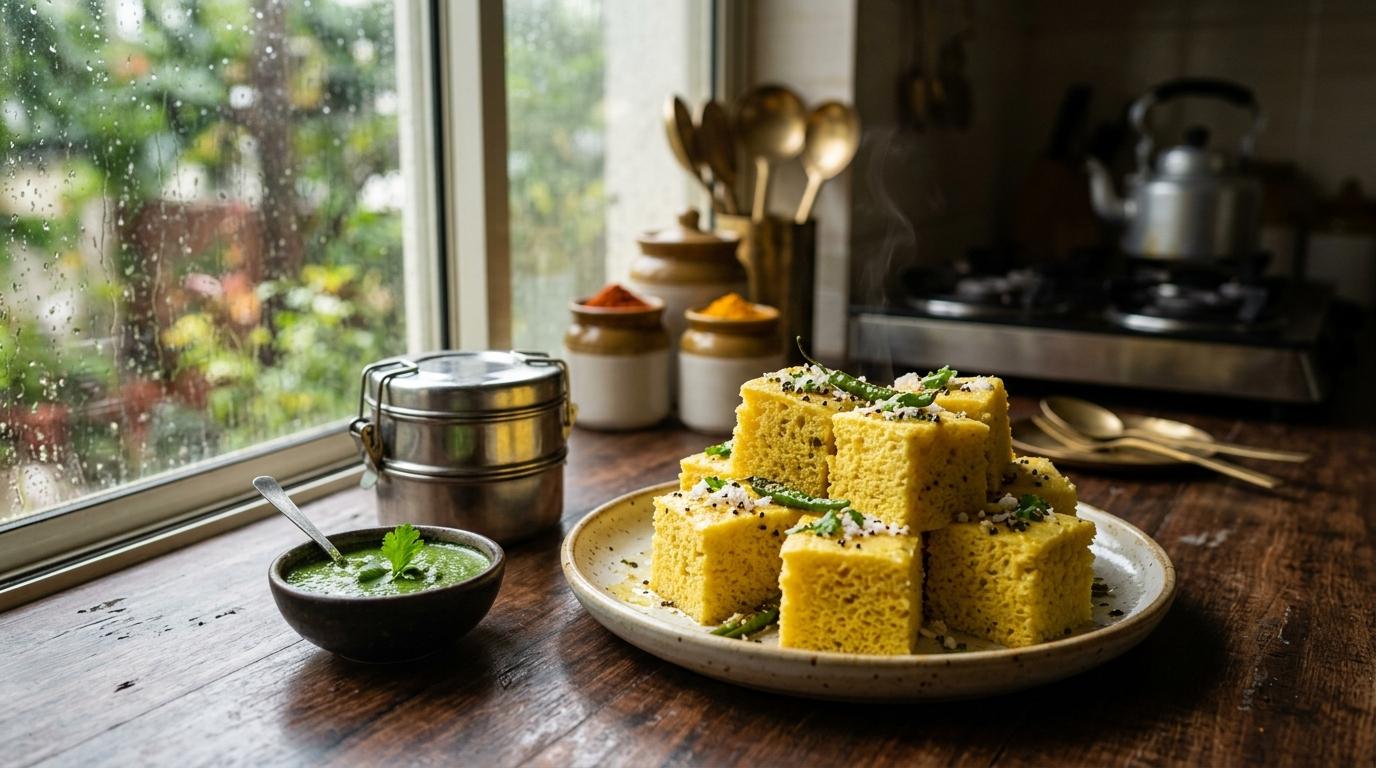
Dhokla and rainy weather feel like a perfect match. Soft khaman, a cup of chai, maybe some green chutney on the side — it is exactly the kind of snack many of us reach for during monsoon.
It also feels like a “safe” tiffin food because we usually eat dhokla at room temperature. But monsoon changes things. The weather is warm, the air is damp, and food stays moist for longer. If your dhokla has watery tadka, sugar-lemon syrup, fresh coconut, coriander, or chutney, it can spoil faster than you think.
And if you pack it while it is still warm and close the tiffin lid? That trapped steam can make it soggy and risky by lunchtime.
Quick answer
#Yes, dhokla can stay outside in monsoon, but only for a few hours.
If it is regular soft dhokla with water-based tadka, sugar-lemon syrup, coconut, coriander, or chutney, try to eat it within 3 to 4 hours in humid rainy weather.
If it is a dry tiffin-style dhokla with only oil tempering and no wet garnish, it can usually stay okay for 6 to 8 hours, provided it was cooled properly before packing and kept away from heat.
Do not leave dhokla outside overnight during monsoon. If it smells odd, feels slimy, looks discoloured, becomes stringy, or seems unusually wet, throw it away.
For homemade dhokla, cool it properly, store it in a clean airtight container, and refrigerate it within about 2 hours. Refrigerated dhokla is best eaten within 2 to 3 days.
Why dhokla spoils faster in monsoon
#Dhokla is light and spongy. That is what makes it so lovely to eat, but it also means it holds moisture very easily.
Think of a regular plate of dhokla. It may have:
- A soft steamed base
- Sweet-sour water tadka
- Lemon juice or sugar syrup
- Fresh coriander
- Fresh grated coconut
- Green chutney or sweet chutney on the side
All of this adds moisture. In dry weather, that may not be a big problem for a short time. But in monsoon, the air itself is already humid. Food does not dry out as quickly, and a closed tiffin can trap even more moisture inside.
The biggest mistake is packing dhokla while it is still warm. The steam hits the lid, turns into water droplets, and falls back onto the dhokla. By the time you open the box, it may be extra soft, wet, sour-smelling, or sticky.
So the issue is not dhokla alone. It is the combination of moisture, warmth, and time.
If you are careful with poha, khichdi, cooked rice, chutney, and other wet foods during monsoon, treat dhokla with the same caution. For more lunchbox planning during rainy weather, you can also read AllBlogs’ guide on Indian monsoon lunchbox safety for train and bus delays.
How long does dhokla last outside in monsoon?
#It depends on how wet the dhokla is, how it was packed, and where the tiffin is kept. A lunchbox sitting in an air-conditioned office is very different from one kept in a warm school bag, car, bus, or train.
Still, these are useful practical limits.
These timings are not a guarantee. They are safe, practical limits for everyday use.
If the dhokla was packed warm, kept in a hot bag, mixed with wet chutney, or already smelled too sour before packing, reduce the time.
1. Wet dhokla: eat within 3 to 4 hours
#This is the regular dhokla most of us love — soft pieces soaked with sweet-sour tadka, topped with coriander and sometimes fresh coconut.
It tastes best fresh, but it is also the most delicate version for tiffin.
In monsoon, wet dhokla should not sit outside all day. If you pack it at 8 AM and eat it at 1 or 2 PM, it may already be close to the limit, especially if the box has been sitting inside a warm bag.
For wet dhokla:
- Eat it within 3 to 4 hours.
- Refrigerate it if you plan to serve it later.
- Avoid carrying it for long travel.
- Do not leave it on the counter overnight.
- Be extra careful if it has fresh coconut.
Fresh coconut and coriander make dhokla taste fresh and festive, but they also add moisture. That makes the dhokla less suitable for long tiffin hours in rainy weather.
2. Dry tiffin-style dhokla: better for 6 to 8 hours
#If you want to pack dhokla for school, office, train, or bus travel, make it drier than usual.
That means:
- Steam the dhokla as usual.
- Let it cool completely.
- Use only oil-based tempering.
- Avoid watery tadka, sugar syrup, or lemon water.
- Skip fresh coconut and lots of coriander.
- Pack chutney separately, or carry a dry chutney instead.
Dry dhokla does not mean tasteless dhokla. You can still use oil, mustard seeds, curry leaves, hing, sesame seeds, and green chillies. Just avoid adding extra water before packing.
This version works much better when you do not have access to a fridge. Even then, try to finish it within 6 to 8 hours. If the weather is very warm, the bag has been sitting in a hot place, or the dhokla smells odd when opened, do not take a chance.
3. Refrigerated dhokla: best within 2 to 3 days
#If you have made a big batch or want to prepare dhokla in the morning for evening snacks, refrigeration is the safest option.
Here is the simple way to store it:
- Let the dhokla cool to room temperature.
- Do not leave it sitting out for too long after cooling.
- Transfer it to a clean, dry, airtight container.
- Refrigerate it within about 2 hours of cooking.
- Eat it within 2 to 3 days.
Dhokla may become slightly firm in the fridge. That is normal. You can warm it gently before eating. If it feels too dry, sprinkle a few drops of water while reheating.
Avoid taking the same container in and out of the fridge again and again. Remove only the portion you need and keep the rest chilled.
Tiffin packing tips for dhokla in rainy season
#With monsoon tiffins, small habits matter. A safer dhokla box is usually a drier dhokla box.
Cool the dhokla completely before packing
#This is the most important rule.
Do not pack hot or warm dhokla and close the lid immediately. The steam will get trapped inside the box, turn into water droplets, and make the dhokla soggy. By lunchtime, it may smell sour or feel sticky.
Spread the dhokla on a plate and let it cool first. Once it is at room temperature, cut and pack it.
If mornings are rushed, make the dhokla the previous evening, refrigerate it, and pack it chilled or after letting it sit out briefly. It is better than packing it hot in a hurry.
Keep chutney separate
#Watery chutney can spoil a good tiffin quickly. Mint-coriander chutney, coconut chutney, and thin sweet chutneys can leak into the dhokla and make it wetter.
Better options:
- Pack chutney in a small separate container.
- Use thicker chutney instead of watery chutney.
- Carry dry garlic-peanut chutney for travel.
- Do not pour chutney over dhokla before packing.
For short office commutes, separate chutney is usually fine. For long train or bus travel during monsoon, dry chutneys are safer.
Skip fresh coconut for packed dhokla
#Fresh coconut tastes wonderful on dhokla, but it is not the best idea for monsoon tiffins.
If you are serving dhokla at home and eating it soon, garnish it fresh. But if it is going into a lunchbox, especially for children or travel, skip the coconut.
The same goes for too much chopped coriander. A little may seem harmless, but fresh garnish adds moisture and wilts quickly inside a closed box.
Do not pack dhokla with wet foods
#Avoid placing dhokla in the same compartment as:
- Wet chutney
- Raita
- Curd-based dips
- Juicy salad
- Watery sabzi
- Cut fruits that release water
Dhokla absorbs moisture easily. If it sits next to wet foods, its safe outside time becomes shorter.
Use separate compartments or separate containers whenever possible.
Use a clean, dry tiffin box
#A damp lunchbox is a bad start, especially in monsoon.
Before packing, make sure the container is fully dry. Check the corners, lid, and silicone seal too. Water often hides there.
For short trips, you can wrap cooled dry dhokla in food-safe paper or a clean cloth before placing it in the box. This helps reduce surface moisture. For longer travel, use a clean, dry, airtight container and eat within the safer time limit.
Pack smaller portions
#Big blocks of dhokla hold more moisture and take longer to cool. Let the dhokla cool first, then cut it into smaller pieces before packing.
Small pieces are easier to finish quickly too. This is useful during travel, when half-eaten food may sit around for hours after the box has been opened.
Dhokla for office, school, and travel
#Different situations need different levels of caution.
For office tiffin
#If you leave home around 8 or 9 AM and eat by lunchtime, dry dhokla is the better choice. Keep the tiffin away from direct sunlight, and do not leave it inside a parked vehicle.
If your office has a fridge, use it. Refrigerate the tiffin when you arrive, especially if the dhokla has wet tadka.
You may also find this related AllBlogs guide useful: Office lunch in Indian heat, safe foods and tiffin rules.
For children’s tiffin
#For school, keep dhokla simple and dry. Children may not notice early signs of spoilage, and lunchboxes often stay closed for many hours.
A safer school tiffin version would be:
- Dry dhokla
- No fresh coconut
- No watery chutney in the same box
- Small pieces
- Clean, dry tiffin
- Packed only after cooling
If the school day is long or your child eats lunch late, choose dry dhokla over wet dhokla.
For train or bus travel
#During monsoon travel, always assume delays. A snack that is fine for 3 hours may not be ideal for a 7-hour journey.
If you are carrying dhokla:
- Choose dry dhokla only.
- Avoid watery tadka.
- Avoid fresh coconut and heavy garnish.
- Pack chutney separately, preferably dry.
- Eat it early in the journey.
- Do not keep leftovers for the next day.
For long trips without refrigeration, dry snacks are usually easier and safer than soft, wet foods.
Signs dhokla has spoiled
#Dhokla can be slightly sour even when it is fresh, so smell alone can sometimes confuse people. But there are some signs you should never ignore.
Throw dhokla away if you notice any of these.
1. Slimy or sticky surface
#Fresh dhokla can be moist, but it should not feel slimy. If the surface feels slippery, sticky, or unusually tacky, do not eat it.
2. Stringy texture
#Break a piece and check it. If thin strings pull between the pieces, discard it. This can happen when moist cooked foods start spoiling.
3. Sharp or unpleasant smell
#A mild fermented smell can be normal. But a strong rotten, alcohol-like, overly sour, or unpleasant smell is not normal.
If you open the tiffin and immediately feel something is wrong, trust that instinct.
4. Discolouration
#Do not eat dhokla if you see grey, pinkish, greenish, or black spots. Also discard it if the surface looks patchy in a way it did not before.
5. Unusual wetness, fizzing, or bubbling
#If the dhokla has released liquid, become mushy, or looks bubbly after storage, throw it away.
6. It was left out overnight
#Even if it looks okay, do not eat dhokla that has been left outside overnight during monsoon. The risk is not worth it.
Food safety is not about proving the food has spoiled. It is about avoiding doubtful food before it causes trouble.
What if there is a power cut?
#Power cuts are common during the rainy season, and they can affect refrigerated leftovers.
If dhokla is in the fridge during a power cut, keep the fridge door closed as much as possible. If the power is restored quickly and the fridge has stayed cold, the dhokla is likely fine.
But if the power cut is long and the fridge becomes warm inside, be more careful. Once dhokla has warmed up for hours, do not assume it still has the full 2 to 3 days of refrigerated life.
If it smells odd, feels slimy, looks wet, or has been sitting warm for too long, discard it.
For general fridge and leftover handling during rainy season, see AllBlogs’ guide on monsoon power cut food safety and leftovers.
Practical do’s and don’ts for monsoon dhokla
#Do
#- Eat wet dhokla within 3 to 4 hours if kept outside.
- Make dry dhokla for tiffins and travel.
- Cool dhokla completely before packing.
- Refrigerate leftovers within about 2 hours.
- Use clean, dry containers.
- Pack chutney separately.
- Discard dhokla if the smell, colour, or texture seems wrong.
Don’t
#- Do not leave dhokla outside overnight.
- Do not pack warm dhokla in a closed tiffin.
- Do not add watery tadka if it is for long travel.
- Do not garnish travel dhokla with fresh coconut.
- Do not mix wet chutney into the same box.
- Do not taste spoiled-looking dhokla just to “check.”
- Do not reuse a damp or unwashed tiffin box.