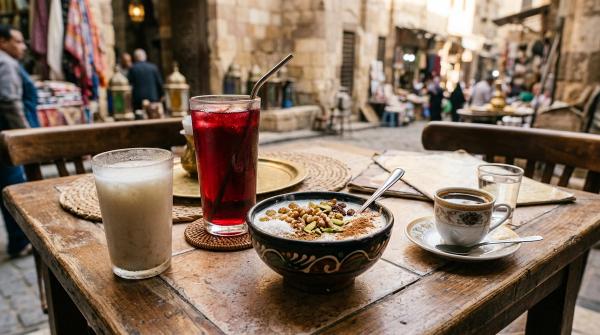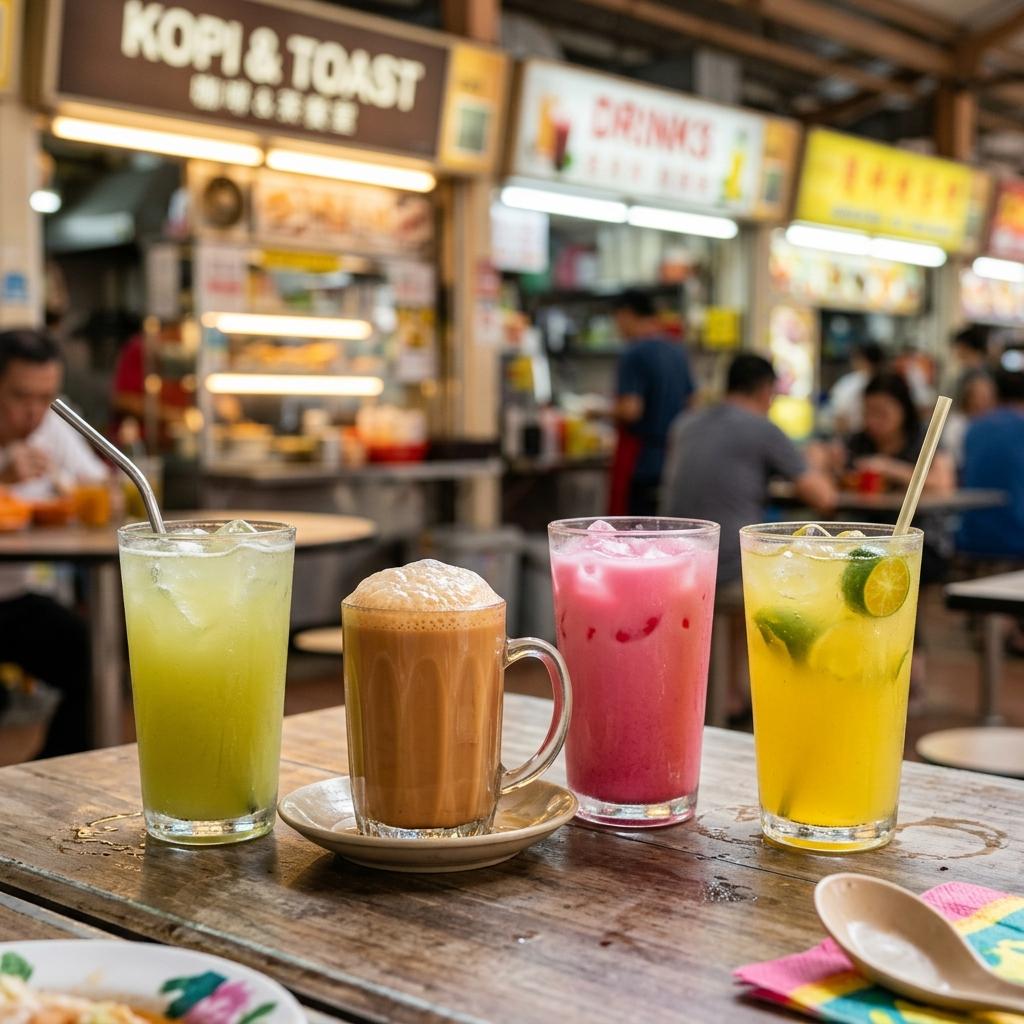
Singapore’s hawker centres are not just places to eat cheap, filling meals. They are also one of the easiest places to understand the city through drinks: strong kopi, pulled teh, fresh sugarcane juice, lime juice, barley water, bandung, soya bean milk, and the very Singapore habit of customising sweetness until the stall uncle or aunty knows exactly what you mean.
If you are visiting from India, the food may feel familiar in some ways—rice meals, spice, tea, busy counters, fast service—but the drink menu can still be confusing. You may see words like kopi o, teh c, kosong, siew dai, peng, and gao, while the queue behind you keeps moving.
Here is the simple version: start with one easy drink, learn two or three ordering words, and do not feel pressured to decode the whole kopi universe on day one.
Quick answer: what should you drink first?
#For a first Singapore hawker centre visit, Indian travelers can safely begin with kopi or teh if they want a local coffee-or-tea order, fresh sugarcane juice or lime juice for hot afternoons, and barley water, soya bean milk, bandung, or Milo-style drinks when they want something filling or sweet.
If you prefer less sugar, learn two words early: siew dai means less sweet, and kosong means no added sugar. If your stomach is sensitive, start with hot drinks, bottled water, or a busy stall with clear turnover before moving to fresh juices.
Why hawker drinks matter in Singapore
#A hawker centre drink is practical first. Singapore is warm, walking-heavy, and very easy to explore by MRT, so you may find yourself needing a cold lime juice at 2 PM more than another full meal.
But the drinks also carry a lot of everyday culture. Kopi and teh are not just caffeine. They are breakfast, office break, market pause, late-night comfort, and a way to sit with the city for ten minutes instead of rushing through it.
Singapore’s hawker culture is formally recognised as part of the country’s living food heritage, and hawker centres work as shared dining rooms where people from different communities eat and drink side by side. That is exactly why a drink stall is a good place to begin: low cost, low commitment, and plenty to observe.
Kopi basics: Singapore coffee without panic
#Singapore kopi is usually stronger, darker, and sweeter than the average café latte. It is often brewed through a cloth filter and commonly served with condensed milk unless you specify otherwise.
The default can feel sweet for Indian travelers who are used to cutting sugar in tea or coffee at home. So do not be shy about asking for less sugar.
Useful kopi orders
#- Kopi: coffee with condensed milk and sugar
- Kopi o: black coffee with sugar
- Kopi o kosong: black coffee without added sugar
- Kopi c: coffee with evaporated milk and sugar
- Kopi c kosong: coffee with evaporated milk, no added sugar
- Kopi siew dai: coffee with less sugar
- Kopi peng: iced coffee
- Kopi gao: stronger coffee
If you are unsure, order kopi c siew dai. It is still local, but less heavy than condensed-milk kopi and not as plain as black coffee.
Teh basics: tea, but not exactly Indian chai
#Do not expect masala chai. Singapore teh is usually tea with condensed milk or evaporated milk, often sweet and smooth, without the ginger-cardamom-clove profile many Indian travelers associate with chai.
That is not a bad thing. It is just a different comfort drink.
Useful teh orders
#- Teh: tea with condensed milk and sugar
- Teh o: tea without milk, usually with sugar
- Teh o kosong: plain tea without milk or added sugar
- Teh c: tea with evaporated milk and sugar
- Teh c siew dai: tea with evaporated milk and less sugar
- Teh peng: iced milk tea
- Teh halia: ginger tea, closer to an Indian comfort zone
If you miss Indian chai, teh halia is probably the easiest bridge. It is not the same as home chai, but the ginger gives it warmth and familiarity.
Cold drinks for Singapore heat
#Singapore’s heat can sneak up on you because you may spend half the day moving between air-conditioned MRT stations and humid streets. A heavy sweet drink every time will not always help. Sometimes you need refreshing, not just cold.
Sugarcane juice
#Fresh sugarcane juice is one of the most satisfying hawker drinks on a hot day. It tastes grassy, clean, and sweet without feeling like a packaged soft drink. Many stalls add lemon or calamansi for brightness.
Choose a stall where the sugarcane looks fresh, the machine area is reasonably clean, and cups are moving quickly. Drink it soon after buying. It is best treated as a fresh drink, not something to carry around for hours.
Lime juice and calamansi drinks
#If you like nimbu pani, Singapore lime or calamansi drinks will feel easy. They are tangy, cold, and good with fried or spicy meals.
Ask for less sugar if you do not like syrupy drinks. A simple lime juice can be more useful than a fancy drink when you are walking around Bugis, Chinatown, Little India, or Tiong Bahru in the afternoon.
Barley water
#Barley water is mild, lightly sweet, and gentle. It may not feel exciting on the first sip, but it works well when you want something cooling and less sharp than lime.
It is a good pick with oily hawker foods because it does not fight the meal. If you are eating something rich, like fried noodles or a heavy rice plate, barley water can feel calmer than a creamy drink.
Soya bean milk
#Soya bean milk is another easy option, especially for vegetarian travelers. It can be cold, lightly sweet, and filling without being as heavy as a milkshake.
Check whether it is sweetened. If you are managing sugar intake, ask before ordering or choose a smaller cup.
Sweet local drinks: fun, but pace them
#Some Singapore hawker drinks are basically dessert in a cup. Enjoy them, but do not build your whole day around sweet drinks unless that is genuinely what you want.
Bandung
#Bandung is a rose-flavoured milk drink, usually pink, sweet, and nostalgic for many people in Singapore and Malaysia. Indian travelers who like rose milk or Rooh Afza-style flavours may enjoy it.
It is not a hydration drink. Treat it like a sweet treat after a meal.
Milo drinks
#Milo is everywhere in Southeast Asia, and Singapore hawker stalls may serve it hot, iced, or in richer versions. Milo dinosaur usually means iced Milo with extra Milo powder on top.
It is fun once, especially if you are traveling with kids or you like chocolate-malt drinks. But it is filling and sweet, so pair it with a lighter meal.
Grass jelly and chin chow drinks
#Grass jelly drinks can be refreshing if you like herbal, slightly bitter flavours. The texture may surprise you at first. If you enjoy falooda-style textures or basil seed drinks in India, you may be more open to it.
Again, check sweetness. Many drinks that look light can still be quite sweet.
What to drink with common hawker meals
#Drink pairing is not formal in hawker centres. You order what you like. Still, a few combinations make travel days easier.
With vegetarian meals
#If you are eating veg rice, dosa-style South Indian food in Little India, tofu dishes, or a simple noodle meal, try lime juice, barley water, or teh c siew dai. These do not overpower the meal.
For more vegetarian help, AllBlogs already has a practical Singapore vegetarian guide: https://allblogs.in/post/singapore-vegetarian-food-guide-for-indian-travelers
With spicy food
#For spicy laksa-style meals, sambal-heavy plates, or chilli-loaded snacks, avoid ordering the sweetest drink automatically. Sweet milk drinks can help briefly, but they can also feel heavy in humidity.
Try iced barley, lime juice with less sugar, or soya bean milk depending on your comfort.
With breakfast
#Kopi or teh makes the most sense at breakfast. If you are heading out for a long sightseeing day, keep it simple: one drink, one light meal, and water in your bag.
With fried snacks
#For fried snacks, fresh lime juice or calamansi is the easiest choice. The sourness cuts through oil better than a creamy drink.
Ice, water, and hygiene: what Indian travelers should know
#Singapore generally has strong food-safety systems, and hawker centres are far more organised than many first-time visitors expect. Singapore’s national water agency also says the country’s tap water is suitable for drinking directly from the tap without further filtration.
Still, travel stomachs are personal. A drink can be technically fine and still feel unfamiliar because of dairy, sugar, ice, or your overall food load that day.
Use the same common-sense checks you would use anywhere:
- Choose busy stalls with fast turnover.
- Avoid stalls where cups, ice, or fruit are handled carelessly.
- Prefer hot kopi or teh if you are tired, jet-lagged, or already bloated.
- Drink fresh juices soon after buying.
- Do not leave milk-based drinks in a warm bag.
- Keep plain water separate from sweet drinks; they do different jobs.
If you want a broader safety checklist for busy food spaces, this AllBlogs guide may help: https://allblogs.in/post/food-market-hygiene-checklist-travelers-safe-stalls
Ordering without holding up the queue
#Hawker centres move fast during breakfast, lunch, and dinner peaks. You do not need to be perfect, but it helps to know your order before you reach the counter.
A simple method:
- Decide hot or cold.
- Decide coffee, tea, juice, or sweet drink.
- Decide sugar level.
- Say the order clearly.
- Pay and move aside.
For example:
- “Kopi c siew dai.”
- “Teh o kosong, hot.”
- “Sugarcane with lemon.”
- “Lime juice, less sweet.”
If the stallholder asks a follow-up and you do not understand, smile and say, “Less sugar, please” or “cold, please.” Most tourist-area hawker centres are used to visitors.
For general hawker centre behaviour, including seats and payment, read: https://allblogs.in/post/singapore-hawker-centre-etiququette-tourists-ordering-seats-payments
Tray return and table manners
#In Singapore, returning trays and clearing table litter is not just polite; it is part of the expected hawker centre routine. After you finish your drink or meal, take the tray, cup, tissues, and leftovers to the tray return area.
This is different from many Indian casual dining setups where someone may clear the table for you. In Singapore, assume you should clear your space unless a sign or staff member indicates otherwise.
Also avoid spreading bags across seats during peak hours. If you are traveling as a family, let one person hold the table while others order, but keep it reasonable.
Best areas to try hawker drinks
#You do not need to chase one famous stall for drinks. The better strategy is to try local drinks where you are already eating.
Good areas for first-timers include:
- Maxwell Food Centre near Chinatown
- Tiong Bahru Market for a calmer morning feel
- Tekka Centre in Little India for Indian-friendly food surroundings
- Lau Pa Sat for a central, tourist-friendly start
- Old Airport Road Food Centre if you want a more local food-centre experience
- Chinatown Complex Food Centre for variety and scale
Do not over-plan this. The best drink may simply be the cold lime juice you buy after walking too much.
What to avoid if you have a sensitive stomach
#You do not need to avoid hawker drinks, but be selective on day one.
Be careful with:
- Very creamy drinks after a heavy meal
- Extra-sweet drinks in the afternoon heat
- Fresh juice from a stall with poor turnover
- Drinks left open on a table too long
- Too much caffeine before a long walking day
- Multiple dairy-based drinks if you are not used to them
If your stomach is already unsettled, choose hot tea, hot coffee, bottled water, or plain food first. Save adventurous drinks for when you feel normal again.
A simple one-day hawker drink plan
#If you want to experience Singapore drinks without overdoing sugar, try this:
Morning
#Order kopi c siew dai or teh halia with breakfast. This gives you the local feel without jumping straight into a very sweet iced drink.
Afternoon
#Choose fresh lime juice, calamansi, or sugarcane with lemon after walking. Ask for less sugar if possible.
Evening
#Try barley water, soya bean milk, or a small bandung if you want something different after dinner.
That is enough for one day. Singapore has many drinks, but your body still has to process all the food you are excited to try.
Final sip
#Singapore hawker drinks are easy to enjoy once you stop treating the menu like an exam. Learn kopi, teh, kosong, and siew dai. Choose fresh drinks from busy stalls. Pace the sweet ones. Return your tray. Keep plain water in your day plan.
Do that, and hawker centres become less confusing and much more fun—one cup at a time.