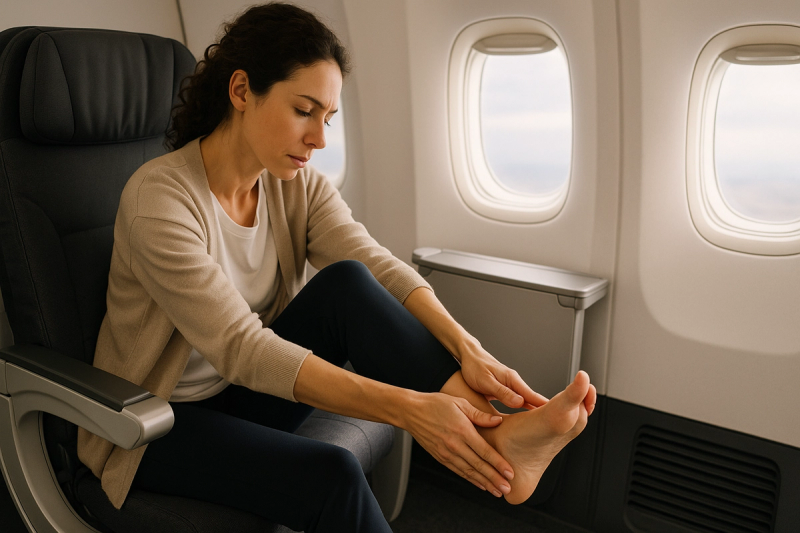
I used to think swollen feet after flying was just one of those annoying travel things, like dry airplane skin or that weird gross coffee. No big deal. Then I took a long-haul flight a couple years back, stood up after landing, and my shoes felt like they'd shrunk two sizes. My ankles were puffy, my feet looked shiny, and for a second I kinda panicked. Since then I've gotten a bit obsessive about preventing it, not in a scary way, just in a practical health-nerd way. So if you've ever landed and felt like your feet belonged to somebody else... yeah, me too.
Quick thing though: mild swelling on flights is common, mostly because sitting still for hours slows blood flow in the legs and fluid pools down in the feet thanks to gravity. Cabin pressure, dehydration, salty snacks, and cramped seats don't exactly help. But one swollen leg, major pain, redness, warmth, chest pain, or shortness of breath? That's not a "walk it off" situation. That needs urgent medical attention because it can sometimes point to a blood clot, like deep vein thrombosis, and that's serious. I know that's not the fun part to mention, but it's important.
Why feet puff up on planes in the first place
#Basically, when you're wedged in a seat for 6, 10, 14 hours, your calf muscles aren't doing their usual job of helping push blood and fluid back up toward the heart. Your lower legs become kind of a traffic jam. Add lower cabin pressure and dry air, and your body can get a little weird about fluid balance. Recent travel health guidance still says the biggest issue for most healthy travelers is dependent edema, which is a fancy way of saying gravity-related swelling in the lower legs. It looks dramatic sometimes but usually settles within hours to a day or so after you move around and rehydrate.
What surprised me when I started reading more current travel-medicine advice is that prevention hasn't changed in some magical biohacker way in 2026. There are trends, sure, and I'll get to those. But the boring basics still matter most: movement, hydration, sensible compression socks, and not ignoring your own risk factors. Honestly, that's both reassuring and a little annoying because I wanted some genius hack. Turns out your calves are the hack.
The stuff I do before the flight now
#I start the day before, not when I'm already buckled in and regretting my life choices. First, I don't wear tight shoes. This sounds embarrassingly obvious, but I once flew overnight in cute ankle boots and absolutely did not make a good decision there. Now I wear breathable sneakers or slip-ons with room in the toe box. Compression socks too, usually knee-high, especially for flights over 4 hours. Most up-to-date medical advice still supports graduated compression socks for many travelers because they help reduce leg swelling and may lower the risk of symptomless clot formation on long trips. They need to fit right though. Too tight in the wrong places is not helpful.
- I put compression socks on before I leave for the airport, not halfway through the flight when my legs already feel heavy
- I avoid really salty meals the night before and at the airport, because sodium makes me retain water like crazy
- I fill a water bottle after security and actually drink from it instead of pretending I will
- If I know my period is due, I plan extra carefully because I personally swell more then... not everyone does, but wow my body does
And if you have specific health conditions, this part matters even more. People who are pregnant, recently had surgery, have a history of blood clots, cancer, heart failure, kidney disease, liver disease, severe varicose veins, or are taking estrogen-containing meds may have higher risk and should ask a clinician before a long trip. Some folks need a more tailored plan, and occasionally that includes medical-grade compression or other preventive treatment. Not everybody, obviously. But some do.
What I do during the flight, even when I don't feel like it
#Okay so here's the thing. The best anti-swelling strategy on a plane is movement, and movement is exactly what you don't wanna do when you've finally arranged your blanket, earbuds, neck pillow, charger, snacks, emotional support hoodie, all of it. I get it. But every hour or two, I make myself do something. Not a full workout. Just enough to wake up the calf muscles and get blood moving again.
- Ankle circles for 20 to 30 seconds each way
- Heel raises and toe lifts while seated
- A few knee lifts if there's space and I don't smack the tray table
- A walk to the bathroom or galley every 1 to 2 hours when it's safe
- A couple standing calf raises while I'm waiting around awkwardly
That simple stuff really does help. And yes, I know, some flights are turbulent forever and sometimes the seatbelt sign is on for ages. In that case I do the seated movements more often. Current travel medicine recommendations still focus on frequent calf activation for exactly this reason. It sounds low-tech because it is low-tech.
Hydration... but not in a weird wellness-influencer way
#I'm very pro hydration and also very tired of hydration being treated like a personality. For flights, I just aim to drink water regularly through the trip. The air in cabins is super dry, and while dehydration isn't the sole cause of swollen feet, being underhydrated can make you feel worse overall and may contribute to that heavy, crampy, blah feeling in your legs. I usually alternate water with whatever else I'm having. If I drink coffee, I add extra water. If I have wine, same thing. Some clinicians still say moderate caffeine is probably fine for most people, and the evidence doesn't really support dramatic fearmongering over one coffee. But alcohol can dehydrate you and make swelling feel worse, so I keep it light now.
The older I get, the less interested I am in landing from an overnight flight feeling like a salted raisin with cankles.
One 2026-ish wellness trend I do actually like is people paying more attention to electrolyte balance without going overboard. If you're sweating a lot, traveling in heat on both ends of the trip, or prone to headaches and fatigue, a low-sugar electrolyte drink can be useful. But for most average travelers, plain water plus normal meals is enough. You do not need neon powder from a celebrity brand to survive seat 34B. Probably.
Compression socks: worth it, with a couple caveats
#I was weirdly resistant to compression socks because I thought they were only for older people, runners, or ultra-organized travelers who own packing cubes in matching colors. Turns out they are excellent, and me being wrong is a recurring theme in my wellness life. Research over the years has consistently found that graduated compression stockings can reduce symptomless DVT in airline passengers on longer flights and definitely reduce swelling and discomfort in many people. In plain English, your legs often feel better with them.
What I use is mild to moderate graduated compression, often around 15 to 20 mmHg for travel, unless a doctor suggests something else. If you have peripheral artery disease, certain circulation problems, severe neuropathy, or a leg condition that makes compression unsafe, check before using them. Fit matters a lot. If the top band is digging in like a ham tied with string, that's not right. I learned that one in a very humbling airport bathroom.
The seat, the clothes, the weird little details that matter more than you'd think
#Aisle seat if you can get it. I know, this is not groundbreaking journalism. But if you're trying to prevent swollen feet, easy access to standing up is huge. I also avoid crossing my legs for long stretches because it seems to make that heavy, pins-and-needles feeling worse. Loose pants help. Tight waistbands, super-snug leggings, or anything that leaves deep marks on your skin by hour three? Hard pass for me now.
I also stash my personal item in a way that leaves me some foot room. Back when me and my husband flew to Tokyo, I crammed a giant tote under the seat and basically trapped my own legs for 13 hours. Very smart. Very wellness. Never again. Having at least a bit of space to flex your ankles and reposition your feet is honestly underrated.
A few things people try that I'm not sold on
#So there are a bunch of travel-wellness trends floating around in 2026. Some are fine. Some are just expensive ways to feel prepared. Mini massage guns at the gate, lymphatic drainage gadgets, anti-bloat patches, oxygen cans, magnesium leg sprays, all that stuff. Look, if something harmless makes you more comfortable, cool. But from everything I've seen, none of that replaces movement and compression. Not even close.
Same with those detox claims after flying. Your feet are swollen because of fluid pooling and inactivity, not because your body is full of airplane toxins or whatever nonsense TikTok is on this week. Gentle walking after landing, drinking water, maybe putting your legs up later at the hotel, that makes sense. A three-day cleanse? Nah. I'm not saying every wellness trend is fake, just that travel edema is one of those topics where the old-school advice still wins.
When swelling might mean more than just "plane feet"
#This part matters a lot, especially if you're someone who tends to brush things off. Mild swelling in both feet after a long flight can be normal. But if one leg is much more swollen than the other, or you have calf pain, tenderness, warmth, redness, sudden shortness of breath, chest pain, coughing up blood, dizziness, or you just feel deeply not-right, get medical help fast. Please don't wait to see if it settles after a nap. Recent public health messaging around travel-related blood clots still emphasizes that symptoms can show up during travel or even days after. Not to be dramatic, but this is one of those better-safe-than-sorry situations.
Also, if your feet or legs swell a lot every single time you travel, or the swelling lasts more than a couple days, bring it up with a clinician. Persistent edema can have other causes too, like venous insufficiency, medication side effects, heart or kidney issues, thyroid stuff, lymphedema... the list goes on a bit. Most of the time it's something less scary than your brain invents at 2 a.m., but it still deserves a proper look.
My personal post-flight routine that helps a ton
#When I land, I do not go straight from seat to taxi to hotel bed anymore if I can help it. I walk through the terminal on purpose, even if I'm tired and mildly grumpy. Once I get where I'm going, I drink water, take off my shoes, and if possible I elevate my legs for 15 to 20 minutes. Nothing fancy, just pillows under my calves so my feet are above heart level a bit. Sometimes I do a warm-not-hot shower and a few calf stretches. That usually gets me back to normal pretty quick.
- Walk after landing instead of hunting for the nearest chair immediately
- Elevate legs for a short while when you get to your destination
- Skip super salty fast food right away if you're already puffy
- Check your feet and calves if something feels off, don't just ignore it
And yeah, I know, after red-eyes I don't always do this perfectly. Sometimes I inhale airport fries and collapse horizontally. Life happens. But even then, a little movement goes a long way.
The 2026 health angle: what feels current right now
#A thing I appreciate in newer wellness conversations is that people are finally talking more realistically about circulation health, especially for women, older adults, plus-size travelers, and people with chronic illness. There used to be this vibe of "just drink water and stop complaining," which... not helpful. More travel clinics and primary care practices now seem to be giving individualized advice based on clot risk, medications, mobility, and prior history rather than tossing the same generic handout to everybody. That's a good shift.
There's also more emphasis now on comfort as prevention. Not vanity, not optimization, just reducing strain on the body. Better compression materials, more breathable travel socks, app reminders to move, and even smartwatches nudging you to stand can genuinely help some people stick with the basics. I use my watch for this and it's annoyingly effective. Every time it buzzes, I'm like wow okay fine, bossy little rectangle, I'll move.
If I had to boil it down to the simplest possible advice
#Here's the no-nonsense version. For most people, preventing swollen feet on long flights comes down to: wear comfortable shoes, use properly fitted compression socks for longer flights if appropriate, move your ankles and calves often, get up when you can, drink water regularly, go easy on alcohol and super salty foods, and know your own medical risks. That's it. Not glamorous, but it works better than most travel hacks on the internet.
I wish someone had told me this in exactly this plain way years ago, because I spent a lot of time overcomplicating it. Sometimes wellness is green smoothies and sunrise stretching and whatever. And sometimes wellness is just remembering to wiggle your ankles in economy class before your feet turn into bread loaves.
Final thoughts, from one puffy-footed traveler to another
#If swollen feet on flights freak you out, I get it. Bodies do weird stuff when we ask them to sit still in the sky for half a day. But in a lot of cases, there are simple things you can do to make a real difference, and usually you don't need a suitcase full of wellness gadgets to do it. Start with the basics, pay attention to warning signs, and if you have any health condition that raises your risk, ask for actual medical advice before you fly. That part's worth doing properly.
Anyway, that's my very unglamorous system and it has saved me from that awful shiny-ankle feeling more than once. Hope it helps you too, or at least makes your next long flight a bit less miserable. If you're into practical health stuff like this without too much fluff, I've also stumbled across some useful reads on AllBlogs.in.