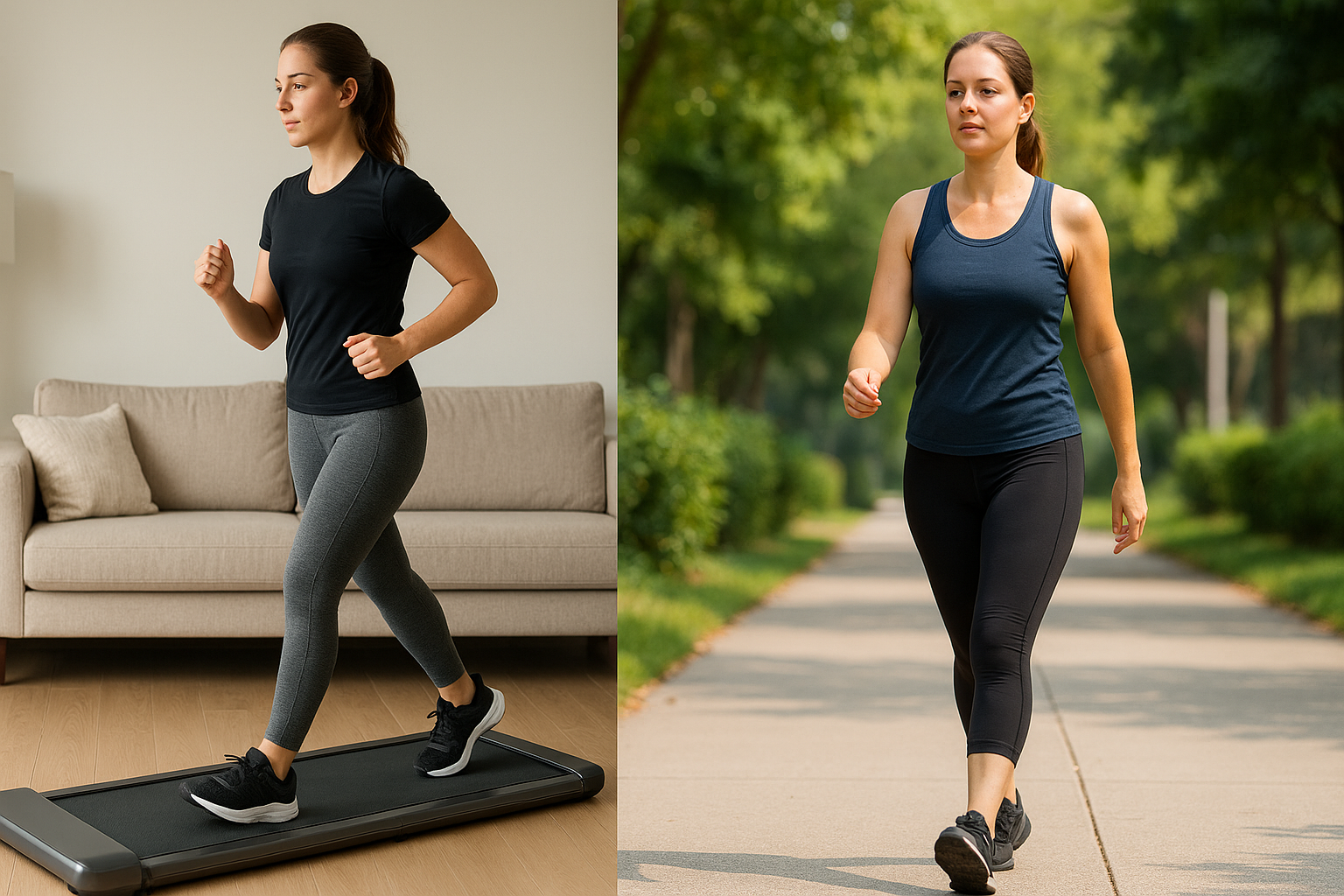
I didn't think I'd ever have strong feelings about walking. Like... walking is just walking, right? You put one foot in front of the other, maybe listen to a podcast, maybe stare into the void a little, and somehow it's supposed to help with your health. But over the last couple years, especially heading into 2026 when everybody seems obsessed with "cozy cardio," step goals, glucose hacks, and those under-desk treadmill setups all over social media, I've actually tested both pretty seriously: walking outside and using a walking pad indoors. And the question I keep getting from friends is the same one I asked myself: which one is better for weight loss?
Short answer? Um, both can work. Annoying answer, I know. But if we're being real, the best one for weight loss is the one you'll actually keep doing when it's freezing, when you're tired, when work is chaos, when your motivation is in the trash, and when life gets weird. Still, there are some legit differences, and they matter more than I first realized.
Quick thing before I get too far into this, I'm not your doctor and this isn't medical advice. But I do care about getting the health info right, so I've been reading current exercise guidance and recent research pretty obsessively. The big public-health recommendations haven't changed much because, honestly, they were solid to begin with: most adults should aim for at least 150 minutes of moderate-intensity aerobic activity a week, plus muscle-strengthening work at least twice weekly. Walking absolutely counts toward that. And newer research keeps backing up that regular walking improves body weight, blood sugar, heart health, mood, sleep, and all that good stuff. So yeah, this isn't fluff wellness. It's basic, boring, powerful health stuff.
Why I Even Started Comparing Them in the First Place
#I bought a walking pad after one of those winters where I basically turned into a blanket burrito. It gets dark early where I live, sidewalks get gross, and I started skipping my usual evening walks. I told myself I'd just do YouTube workouts instead. Reader, I did not. I sat. A lot. My energy was weird, my appetite got all over the place, and I started doing that thing where your jeans fit but also don't fit? You know what I mean.
So I got one of those foldable walking pads everyone was talking about. Mine isn't fancy. It hums a little, and I swear sometimes it sounds like it's judging me. But it made movement stupidly easy. Ten minutes while checking emails. Fifteen after dinner. Twenty while watching some dramatic crime show. It was less romantic than outdoor walking, sure, but way more practical. Then spring came around, I started walking outside more again, and I noticed they did not feel the same in my body or my brain.
If weight loss is the goal, the calories matter some. But consistency matters more than almost everything, and enjoyment decides consistency more than people wanna admit.
What the Science Says About Walking and Weight Loss in 2026
#Let's get the non-sexy truth out of the way. Walking can help with weight loss, but by itself it's usually not a dramatic fat-melting machine. I wish it was. Weight loss still comes down to a sustained calorie deficit over time, and physical activity supports that by increasing energy expenditure, helping preserve lean mass when paired with enough protein and some resistance training, and making a lot of people feel more regulated around food and stress. Walking is especially good because it's low impact and easier to recover from than high-intensity workouts, which means people actually stick with it.
Recent research keeps pointing in a similar direction: more daily movement, including walking, is linked with lower body fat, better insulin sensitivity, lower blood pressure, and reduced cardiovascular risk. A lot of the newer conversation in 2025 and 2026 has shifted away from perfection and toward total daily movement volume. Not just one workout, but how much you move across the day. That's partly why walking pads got so popular in work-from-home culture. They help reduce long stretches of sitting, and even light activity breaks can improve post-meal blood sugar and overall metabolic health. That's not the same as saying a walking pad magically causes weight loss, but it does support the kind of lifestyle that makes weight management easier.
Also, the old 10,000-steps thing? It's not a magic number. It was never some sacred law. Current evidence suggests health benefits happen well below that for many people, and more steps generally help up to a point. For some adults, even moving from 3,000 or 4,000 steps a day to 6,000 or 7,000 is a huge meaningful shift. I actually find that kind of reassuring because otherwise wellness culture gets very all-or-nothing and kinda exhausting.
Walking Pad: Why It's Weirdly Good for Weight Loss
#Honestly, the walking pad's biggest advantage is friction. Or, I guess, the lack of friction. No weather. No commute to a gym. No changing clothes if you don't want to. No worrying about whether it's dark or raining or if your neighborhood sidewalks are trying to kill your ankles. You just step on and go. For me, that made a massive difference on work days when I was mentally fried.
- It's easier to stack movement into normal life, like 10 minutes before breakfast, 20 during calls, 15 after dinner
- It helps break up sitting time, which a lot of metabolic health experts keep emphasizing now
- It can be less intimidating if you're deconditioned, heavier-bodied, recovering your fitness, or just shy
- The consistency can be really, really good. And that adds up more than people think
And weight loss is often about what you can repeat for six months, not what feels heroic for six days. A walking pad wins there for a lot of people. I had weeks where outdoor walking was maybe two sessions total, but my walking pad still got me 120 to 180 minutes of easy movement spread through the week. That steadied my appetite in a way I wasn't expecting. I snack less mindlessly when I've moved during the day. Not because I'm virtuous lol, just because my body feels less chaotic.
One more thing nobody told me enough: indoor walking can be easier to control. Pace is steady. Surface is flat. Distractions are lower. If you're trying to stay in a moderate zone for 30 or 40 minutes, that's actually pretty useful. Some people pair it with heart-rate tracking, though personally I think we can over-tech everything these days. Still, if numbers motivate you, cool.
But Walking Pads Have Some Downsides Too
#I love mine, but I don't worship it. Walking pads can get boring. Like deeply, soulfully boring. You are often staring at a wall or screen, doing repetitive movement in place. If your attention span is already held together by caffeine and vibes, this can be rough. Also, many walking pads aren't built for incline, so the workout can be less challenging than a hilly outdoor route unless you intentionally increase time or pace.
Calorie burn can also be overestimated by apps and smart devices, which is true outdoors too, but I think people get especially tricked indoors because the numbers make it feel more productive than it maybe is. And posture matters. I had a phase where I used mine while hunched over my laptop like a little goblin. My neck hated me for it. If you're using one, set your screen higher, relax your shoulders, and don't grip a desk for dear life the whole time.
There's also cost. Outdoor walking is basically free-ish assuming you have shoes. Walking pads can be a decent investment, and the cheaper ones aren't always durable. Some are noisy, some feel short if you have a longer stride, and some frankly look cuter online than they perform in real life.
Outdoor Walking: Why It Still Feels Like the Gold Standard Sometimes
#Okay so now let me gush about outdoor walking, because wow, when it's good it's GOOD. There is just something about actually going somewhere. The changing scenery, the weather on your face, sunlight in the morning, hearing birds or traffic or neighborhood chaos, whatever. It wakes me up in a way the walking pad never does. And from a weight-loss perspective, I do think outdoor walking often gets people moving longer without noticing it as much. A 20-minute indoor walk can feel like a task. A 45-minute outdoor walk can somehow feel like a little adventure.
There are some practical advantages too. Natural terrain changes your effort more. Wind resistance, hills, uneven ground, turns, curbs, all of that can increase the overall challenge and recruit stabilizing muscles more than a flat indoor belt. Not wildly, not enough to turn a walk into boot camp, but enough that many people do feel they work a bit harder outside. Plus, exposure to daylight, especially earlier in the day, can support circadian rhythm, mood, and sleep. The mental health side of this is not tiny. When my stress is high, outdoor walks help me not spiral. And if stress eating is part of your weight struggle, that matters a lot.
Current wellness conversations in 2026 are also really leaning into what's sometimes called 'nature dosing' or green exercise. Basically, being active outdoors seems to have extra mood and stress benefits for a lot of people compared with indoor activity. I know that sounds slightly woo, but there is legit research showing outdoor movement can improve perceived energy and emotional wellbeing. I notice it every single time. Me and my grumpy brain go out, and we come back less dramatic.
Where Outdoor Walking Can Be Worse, Yep I Said It
#Still... outdoor walking is not automatically superior. Weather can wreck consistency. Heat waves are getting more intense in a lot of places, air quality can be bad, ice and rain increase fall risk, and if you live somewhere without safe sidewalks or decent lighting, the whole thing gets complicated fast. Safety isn't some minor detail, espescially for women walking alone, older adults, or anyone with balance issues.
And if you're trying to lose weight, consistency beats theory. The 'best' outdoor route in the world does nothing if you only manage it once every ten days. I had this very noble idea once that I would only do real walks outside because they felt more authentic. That lasted until a week of cold rain and deadlines. Then I did no walking at all. Which, uh, was not a genius strategy.
So Which Burns More Calories?
#This is where people usually want a clean winner, and sorry, but it depends on speed, incline, body size, fitness level, distance, and how long you're walking. In general, if your outdoor route includes hills, wind, or a naturally brisk pace, outdoor walking may burn a bit more than an easy flat walking-pad session. But if the walking pad helps you walk 45 minutes most days while outside you only manage 15 here and there, then the walking pad probably wins in real-world calorie burn over the week. That's the honest answer.
For weight loss, weekly total matters more than one perfect walk. So a person doing 30 to 60 minutes on a walking pad five days a week is likely in a better position than someone waiting around for ideal outdoor conditions. And if you can add occasional incline treadmill sessions, strength training, or simply increase pace over time, even better.
| Factor | Walking Pad | Outdoor Walking |
|---|---|---|
| Consistency | Usually easier | Depends on weather/safety/time |
| Calorie burn per session | Moderate, often steady | Can be a bit higher with hills/wind |
| Convenience | Very high | Medium |
| Mental health boost | Good, especially with music or shows | Often excellent because of daylight and nature |
| Cost | Equipment needed | Usually low cost |
| Best for beginners | Very good | Also good, but terrain may be tougher |
| Long-term adherence | Great if you like convenience | Great if you enjoy being outside |
What Actually Helped Me Lose Weight, a Little at a Time
#If I'm being super honest, it wasn't choosing one over the other. It was stopping the drama and using both. Walking pad on busy workdays. Outdoor walks on weekends, mornings, and whenever my brain needed sunlight. That combo got me moving more consistently than either one alone. And that consistency helped me slowly lose weight without feeling like I was constantly "on a plan."
- I started aiming for minutes walked per week first, not a perfect step count
- I added 2 short strength sessions because muscle matters for body composition, and every guideline worth reading still says don't skip this part
- I walked for 10 to 15 minutes after meals when I could, especially dinner, because it helped my blood sugar and weird evening cravings
- I stopped rewarding exercise with giant treats. Oof, that one stung a bit
- I focused on being slightly more active every day instead of trying to 'burn off' food
That post-meal walking thing is one of the more useful trends that has stayed popular for a reason. Even short walks after eating can help blunt blood sugar spikes, and for some people that means better energy and fewer snack attacks later. It's not magic, don't get me wrong, but it's practical. Very practical.
If Your Main Goal Is Weight Loss, Here's My Slightly Opinionated Verdict
#If you struggle with consistency, have a packed schedule, work from home, feel self-conscious exercising outside, or live somewhere with bad weather half the year... the walking pad might be better for your weight loss. Not because it's physiologically superior, but because it's available. And available wins.
If you love being outdoors, get energized by sunlight and scenery, can walk safely where you live, and tend to go longer or faster outside without forcing it, outdoor walking may be better for your weight loss. Again, not because it's morally better or more hardcore, just because you naturally do more of it.
And if you want my actual answer, not the neat headline version? The best setup for a lot of people is both. Walking pad for convenience. Outdoor walking for joy, mental health, and a little extra challenge. That's the combo I'd bet on for long-term results.
A Few Health and Safety Things I Don't Wanna Skip
#- If you're brand new to exercise, start small. Even 10-minute walks count
- Wear shoes that feel stable and comfortable. Blisters are such an unecessary reason to quit
- If you have joint pain, chest pain, dizziness, or a chronic condition, talk with a healthcare professional before ramping up
- In hot weather, walk earlier or later, bring water, and don't be stubborn about heat risk
- For actual weight loss, pair walking with nutrition habits you can maintain and some strength training if possible
Also, if you're in perimenopause, menopause, dealing with insulin resistance, recovering from burnout, or just not seeing the scale move fast, please don't assume walking is failing you. Bodies are complicated. Sometimes progress shows up first in energy, stamina, mood, blood pressure, resting heart rate, waist measurements, or just the fact that your afternoons no longer feel like a zombie movie. That's still progress. For real.
Final Thoughts From Someone Who Overthought This Way Too Much
#I used to think I needed to choose the perfect form of cardio and then commit to it like it was some big identity. Outdoor walker. Walking pad girl. Whatever. Turns out, that's silly. The body mostly responds to repeated effort over time. The mind responds to ease, pleasure, and routines that don't make you miserable. So now I try not to make it deeper than it is. I walk inside when life is chaotic. I walk outside when I want sunshine and perspective. Both count. Both are real exercise. Both can support weight loss.
If you're stuck deciding, ask a simpler question: which one are you most likely to do this week, and next week, and the week after that? Start there. You can always tweak later. That's pretty much how most sustainable health habits happen anyway, messy and imperfect and kind of unglamorous.
And yep, that's my rambling verdict. If you like this sort of practical wellness talk without the fake perfection, you might like poking around AllBlogs.in too. I've found some nice health reads there when I'm in my over-research era.