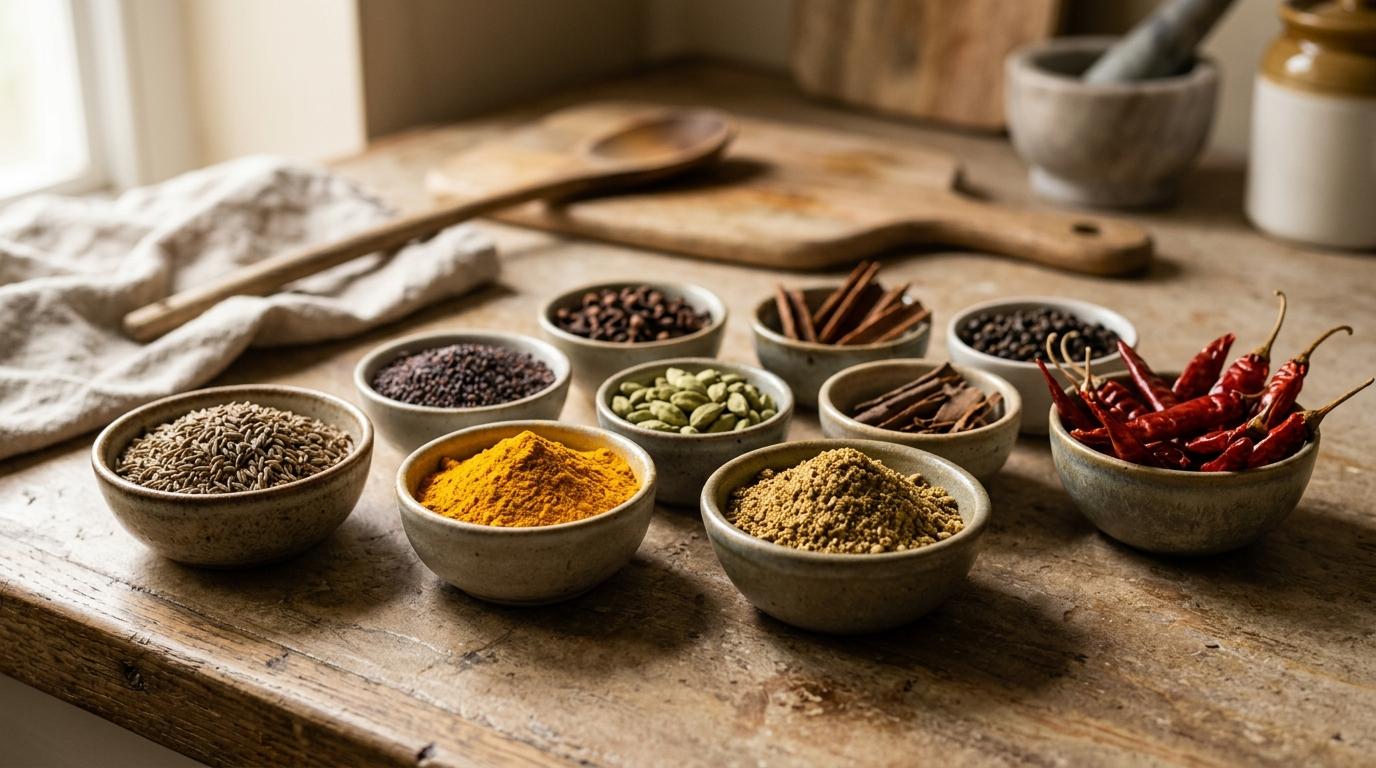
Spices are the heart of Indian cooking. Sometimes a dish needs nothing more than cumin seeds crackling in hot oil. Other times, it needs a whole masala coming together slowly: cloves, cinnamon, cardamom, coriander, chilli, turmeric, and a few quiet background players doing their work.
But honestly, the tricky part is not always the cooking. It is the names.
You may know exactly what jeera, haldi, rai, or elaichi looks like in your kitchen. Then you open an English recipe and see cumin, turmeric, mustard seeds, or cardamom, and for a moment you stop and think, “Wait, is this the same thing?”
This guide is for that exact moment.
Below, you’ll find common Indian spices in English, along with their names in Hindi, Gujarati, Marathi, Tamil, Telugu, and Malayalam wherever possible.
One small note before we begin: spellings can vary a lot. Cumin may be written as jeera, jira, jire, jeeragam, or jirakam. Different regions, families, shops, and brands use different spellings. So think of this as a practical kitchen guide, not a strict dictionary.
You may also find these related AllBlogs guides useful:
- Indian Fruits in English
- Indian Vegetables in English
- Vegetarian Food Labels Abroad
- 12 Hyperlocal Indian Pantry Ingredients to Try in 2026
Quick Answer
#Here are some of the most common Indian spices in English:
- Jeera = Cumin seeds
- Haldi = Turmeric
- Dhaniya = Coriander seeds or coriander powder
- Rai / Sarson = Mustard seeds
- Elaichi = Cardamom
- Laung = Cloves
- Dalchini = Cinnamon
- Kali mirch = Black pepper
- Methi dana = Fenugreek seeds
- Ajwain = Carom seeds
If you are reading an Indian recipe in English, making a grocery list, or setting up your first masala box, these are the Hindi spice names you will come across again and again.
Indian Spices Name Table
#Use this table as a quick glossary for common Indian spice names and regional spice names. Some names overlap across languages, and some have more than one spelling, especially on shop labels.
A small shopping tip: English labels can be very specific. Whole dhaniya may be sold as “coriander seeds,” while ground dhaniya will be “coriander powder.” Whole jeera is “cumin seeds,” but ground jeera is “cumin powder.”
So before buying, check whether your recipe asks for seeds, powder, leaves, pods, or sticks. It sounds simple, but this is one of the easiest places to make a mistake.
Whole vs Ground Spices
#Knowing the English name is useful, but knowing the form is just as important.
In Indian cooking, the same spice can taste and behave quite differently depending on whether it is whole or ground.
Whole Spices
#Whole spices include cumin seeds, mustard seeds, cloves, cinnamon sticks, black peppercorns, bay leaves, and cardamom pods.
These are often added right at the beginning of cooking, usually into hot oil or ghee. This step is called tadka, chhonk, vagar, or phodni, depending on the region.
The idea is simple: hot fat wakes up the spices and carries their aroma through the whole dish.
Common examples include:
- Cumin seeds in dal, sabzi, or jeera rice
- Mustard seeds in South Indian tempering
- Whole garam masala spices in pulao or biryani
- Curry leaves with mustard seeds and dried red chillies
If the seeds start to crackle, that is usually a good sign. Just be careful not to burn them. Unless a recipe specifically asks for a very dark roast, blackened spices can make the whole dish taste bitter.
Ground Spices
#Ground spices include turmeric powder, red chilli powder, coriander powder, cumin powder, and garam masala.
These are usually added after there is some moisture in the pan, such as onions, tomatoes, ginger-garlic paste, cooked vegetables, or even a splash of water. Ground spices can burn quickly if they go straight into very hot oil and sit there for too long.
Common examples include:
- Turmeric powder for colour and earthy flavour
- Coriander powder for body and mild citrusy warmth
- Cumin powder for a roasted, nutty taste
- Garam masala near the end for aroma
If a recipe simply says “cumin,” read the instructions carefully. “Cumin seeds” and “cumin powder” are not always used in the same way.
How to Buy and Store Spices
#Good spices make everyday cooking much easier. You do not need a huge pantry, but it helps to buy the right things and store them well.
Buy Whole Spices When You Can
#Whole spices usually keep their aroma longer than powders.
If you cook Indian food often, these are useful basics to keep at home:
- Cumin seeds
- Coriander seeds
- Mustard seeds
- Black pepper
- Cloves
- Cinnamon
- Cardamom
- Bay leaves
You can roast and grind small amounts whenever needed, especially for homemade spice blends. Freshly ground masala has a fragrance that packaged powder does not always have.
Check the Label Carefully
#When shopping in English-language stores, look closely at the exact form:
- Seeds means whole, such as cumin seeds or mustard seeds
- Powder means ground, such as turmeric powder or coriander powder
- Pods often refers to cardamom
- Sticks often refers to cinnamon
- Leaves may refer to bay leaves or curry leaves
For masala names in English, remember that “masala” usually means a spice blend, not a single spice.
Store Spices Away from Heat and Moisture
#Spices lose their aroma faster when they are exposed to light, heat, air, or moisture. Keep them in airtight containers and store them in a cool, dry cabinet.
A traditional masala dabba is perfect for everyday cooking, but try not to keep it right next to the stove. Steam and heat can make spice powders lose their strength over time.
Smell Before You Use
#This is a small habit, but a very useful one.
If a spice smells flat, dusty, or almost like nothing, it probably will not add much flavour to your food. This is especially true for ground spices.
For whole spices, lightly crush or rub a small amount in your palm. If the aroma comes alive, it is still good to use.
Commonly Used Spice Blends
#Indian cooking uses many spice blends, and their names can feel confusing when written in English. Here are some common masala names in English and what they usually mean.
Garam Masala
#Garam masala is a warming spice blend. It often includes cinnamon, cardamom, cloves, cumin, black pepper, and sometimes other spices too.
It is usually added near the end of cooking so the aroma stays fresh and does not disappear into the gravy.
Sambar Powder
#Sambar powder is a South Indian spice blend used for sambar. It commonly includes coriander seeds, dried red chillies, cumin, fenugreek, and sometimes lentils.
It gives sambar its deep, savoury, spiced flavour.
Rasam Powder
#Rasam powder is used for rasam, a thin, tangy South Indian dish.
Compared with sambar powder, rasam powder is often stronger in black pepper and cumin.
Chaat Masala
#Chaat masala is a tangy spice blend used on snacks, fruits, salads, chaats, and street-style dishes.
Its flavour is usually salty, sour, spicy, and slightly funky because of ingredients like black salt.
Kitchen Masala or Curry Powder
#Some brands sell blends called kitchen masala, curry powder, sabzi masala, or vegetable masala. These are usually general-purpose spice mixes.
The ingredients vary a lot by brand, so check the label if you are trying to match a family recipe. One curry powder can taste completely different from another.
Commonly Confused Indian Spice Names
#Some Indian spice names sound similar, and some are used differently from home to home. These are worth double-checking before you buy or cook.
Rai vs Sarson
#Both are related to mustard.
In many recipes, rai means mustard seeds used for tempering. Sarson can also mean mustard, but depending on the dish, it may refer to mustard seeds, mustard oil, or mustard greens.
For example, sarson ka saag is made with mustard greens, not mustard seeds.
Dhaniya vs Kothmir
#Dhaniya often means coriander seeds or coriander powder in Hindi.
In some regions, fresh coriander leaves are called kothmir or kothimbir.
So if a recipe says dhaniya, check the context. Is it asking for whole seeds, powder, or fresh leaves sprinkled on top?
Methi vs Methi Dana
#Methi can mean fenugreek in general.
Methi dana specifically means fenugreek seeds.
Fresh fenugreek leaves are a different ingredient from the seeds, and they are used differently. Kasuri methi, which means dried fenugreek leaves, is different again.
Elaichi vs Badi Elaichi
#Elaichi usually means green cardamom.
Badi elaichi means black cardamom.
They are not direct substitutes in most dishes. Green cardamom is sweet, floral, and fragrant. Black cardamom is smoky, bold, and better suited to dals, rice dishes, and heavier curries.