The tiny plug problem that almost ruined my first Japan morning
#I know, a plug adapter sounds like the most boring thing in the entire travel universe. Like, who gets excited about plastic rectangles with metal pins? Me, apparently. Because the first time I went to Japan from India, I landed in Tokyo with a phone at 18%, a power bank that was also dying, and this smug confidence that my “universal adapter” from a random electronics shop would handle everything. It did not. It was universal in the same way some hotel Wi-Fi is “high speed”... technically written on the box, emotionally false.
So if you’re an Indian traveler going to Japan, please don’t treat the plug adapter as an afterthought. Japan uses Type A and Type B sockets, mostly the two-flat-pin Type A ones, while India mostly uses Type C, Type D, and Type M round-pin plugs. Also India runs on around 230V, 50Hz, and Japan runs on 100V, with 50Hz in eastern Japan and 60Hz in western Japan. That little voltage difference is where things get spicy. Your phone charger will probably be fine. Your hair dryer? Maybe not. Your laptop? Usually fine. Your old trimmer from home? Uh, read the label before it becomes a sad buzzing paperweight.
Japan sockets vs Indian plugs, in normal human language
#Okay, here’s the simple version. In India, we are used to round pins. The small two-pin plug, the chunky three-pin plug, that big round one that feels like it could power a washing machine and a spaceship. Japan is not like that. Japan’s common wall socket is two flat vertical slots, same family as the US Type A plug. Some places have Type B, which has two flat pins plus a round ground pin, but in hotels and older buildings you’ll often just see the two-slot Type A.
This means your Indian charger plug will not physically fit into most Japanese sockets. You need a plug adapter. Not a voltage converter necessarily, just a shape changer, if your device supports Japanese voltage. And that distinction is super important because people mix it up all the time. A plug adapter changes the pin shape. A voltage converter changes electricity from 100V to 230V or something close. Two very different jobs. One is like translating a charging cable’s accent, the other is doing actual electrical engineering magic and sometimes getting hot while doing it.
| Thing | India | Japan | What it means for you |
|---|---|---|---|
| Common plug types | Type C, D, M round pins | Type A, Type B flat pins | Indian plugs need an adapter |
| Voltage | Around 230V | 100V | Check your device label |
| Frequency | 50Hz | 50Hz east, 60Hz west | Mostly fine for chargers, can matter for motors/clocks |
| Best travel solution | Indian multi-plug or USB charger | Japan Type A socket | Carry a Type A adapter or USB-C charger with flat pins |
The label on your charger is the truth, not the Amazon listing
#Before any international trip now, I do this weird little ritual where I flip every charger and read the tiny grey text printed on it. Phone charger, laptop brick, camera battery charger, power bank charger, even my electric toothbrush charger if I’m carrying it. I’m looking for one magic line: “Input: 100-240V, 50/60Hz”. If it says that, you’re usually good for Japan. You only need a plug adapter so it fits into the wall.
Most modern phone chargers, laptop chargers, USB-C PD chargers, camera chargers, and Nintendo Switch-style adapters are dual voltage or wide voltage. Basically they’re designed for international use. My MacBook charger, my OnePlus charger, my camera charger, all of them have worked fine in Japan with a basic Type A adapter. No drama. Actually the only drama was me trying to find the socket behind a hotel bed while half asleep.
But if the label says only “220-240V” or “230V” then don’t assume it’ll work properly in Japan. On 100V, some devices will barely function. A 230V hair dryer may run weak, heat badly, or not work as expected. A straightener might heat slowly or unevenly. A trimmer may sound like it has lost the will to live. And no, forcing it with an adapter doesn’t fix that. The adapter is not a transformer. It is just pins. Dumb pins, honestly.
My quick charger-check method before packing
#- Read the charger label, not just the device label. The charger brick matters.
- Look for “100-240V” and “50/60Hz”. If both are there, I relax.
- If it says only 220V, 230V, or 240V, I either leave it home or plan a proper converter.
- For high-wattage heat things like hair dryers, I usually don’t carry them. Hotels, Don Quijote, Bic Camera, local options... Japan has solutions.
What plug adapter should Indians buy for Japan?
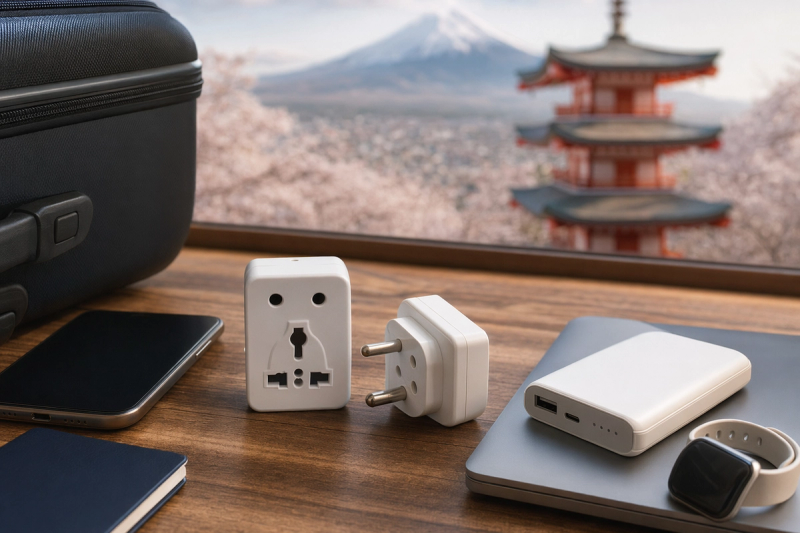
#For Japan, the safest simple answer is: buy a Type A plug adapter that accepts Indian plugs. That means the side facing the Japanese wall has two flat parallel pins, and the socket side accepts Indian Type C, Type D, maybe Type M if you need it. If you’re carrying a laptop charger with a big three-pin Indian plug, double-check the adapter actually accepts that chunky plug. Some cheap “world travel” adapters accept only small two-pin plugs and then you’re standing there in your hotel room, inventing new swear words.
I personally like carrying a compact universal travel adapter with Japan/US pins plus a separate USB-C GaN charger. The adapter is for laptop brick or camera charger. The USB-C charger handles phone, earbuds, power bank, sometimes laptop too. Less clutter, fewer cables, more happiness. I’m irrationally fond of GaN chargers, by the way. They’re small, they charge fast, and they make me feel like I’ve hacked travel even though I’m just plugging stuff into a wall.
But not every universal adapter is good. Some are loose in Japanese sockets. Some are too bulky and fall out if the wall socket is a bit old. Some claim “universal” but the Indian three-pin plug doesn’t go in properly. And some have USB ports that are painfully slow, like 5W slow, which in 2026 feels like waiting for a train that already left. If you’re buying one, check that it supports Type A output pins, accepts Indian plugs, has decent USB-C output if you need it, and has a proper rating printed on it.
- Good basic choice: Type A Japan/US adapter that accepts Indian two-pin and three-pin plugs.
- Better techy choice: universal adapter plus USB-C PD, ideally 30W, 45W, 65W, or higher depending on your laptop.
- Best minimalist setup: one 65W or 100W USB-C charger with foldable Type A pins, plus cables for everything.
- Avoid mystery adapters with no rating, no brand, no fuse info, and plastic that smells like it came from a tyre fire.
Voltage converters: do you actually need one?
#Most Indian travelers to Japan do not need a voltage converter for everyday tech. Phones, laptops, tablets, cameras, power banks, smartwatches, earbuds, all that stuff is generally fine if the charger says 100-240V. I’ve charged Android phones, iPhones, MacBooks, ThinkPads, camera batteries, GoPros, Kindle, random Bluetooth speakers... all without voltage converters. Just adapters.
Where converters enter the chat is with single-voltage Indian appliances. Especially anything that heats or has a motor. Hair dryer, hair straightener, electric kettle, iron, some shavers, some older toothbrush chargers, maybe a medical device if it’s not universal voltage. A step-up transformer can convert Japan’s 100V to something closer to Indian 230V, but high-wattage converters are bulky, heavy, and not always practical. Also cheap converters can get warm and make me nervous. I’m not saying they’re all bad, but I personally don’t like sleeping next to an angry hot brick.
For hair dryers, my honest advice is: don’t carry your Indian one unless it clearly supports 100-240V. Most hotels in Japan provide a dryer, even business hotels. If you need a straightener, consider buying a travel dual-voltage model before leaving India, or buy/borrow locally in Japan. Japan runs 100V, so Japanese hair tools are made for that. It’s cleaner. Less risky. Less suitcase weight. More room for snacks, which is the real electrical priority.
The airport panic checklist I wish I had earlier
#There’s this pre-flight moment where everything suddenly matters: passport, visa, web check-in, roaming pack, Suica setup, charger cable, adapter, headphones, power bank. I’ve done that 2 AM packing sprint and it is not cute. If you’re flying from India to Japan, make a small tech pouch and treat it like your passport’s cousin. Adapter, USB-C cable, Lightning cable if needed, power bank, SIM ejector tool, spare wired earphones maybe, and screenshots of hotel address because airport Wi-Fi likes to test our character.
Also, online check-in for international flights can be annoying because names, passport details, visa rules, airline systems... all those tiny mismatches become big at the worst time. I’ve had friends get stuck on check-in pages and then start blaming the browser, the airline, and Mercury retrograde. If that happens to you, this guide on International Flight Online Check-In Not Working? Passport, Visa & Name Fixes for Indian Travelers is a good one to keep open while you’re sorting the boring-but-important stuff. Do the document bits and the charging bits together. Future you at the airport will be grateful.
Power banks, batteries, and the “don’t put it in checked luggage” thing
#Quick side quest, because this catches people. Power banks and spare lithium batteries should go in cabin baggage, not checked baggage. Airlines usually follow the broad international rule where power banks under 100Wh are allowed in carry-on, and 100Wh to 160Wh may need airline approval. Most normal 10,000mAh and 20,000mAh power banks are under 100Wh, but check the printed Wh rating if you’re carrying a monster power bank. If it only lists mAh, the Wh calculation depends on voltage, and yeah, this is where travel becomes a math exam for no reason.
I carry a 10,000mAh or 20,000mAh power bank depending on the trip. For Japan, I’d strongly recommend one because you’ll use Google Maps, translation apps, camera, train apps, maybe eSIM QR codes, and your phone will get hammered. Tokyo alone can eat battery like crazy because you’re constantly checking platforms, exits, walking routes, restaurant reviews, and then taking 47 pictures of a vending machine because it looks cool. Or maybe that’s just me.
Hotel rooms in Japan: sockets are there, but not always where you want them
#Japanese hotels are generally very efficient, sometimes almost comically efficient. Everything has a place. The kettle has a place. The slippers have a place. Your suitcase, sadly, may not have a place unless it is spiritually compact. But sockets? They vary. Newer hotels often have outlets near the bed and USB ports. Older business hotels may have one outlet near the desk, one hidden behind the TV, and one in the bathroom that you’re not sure you should use.
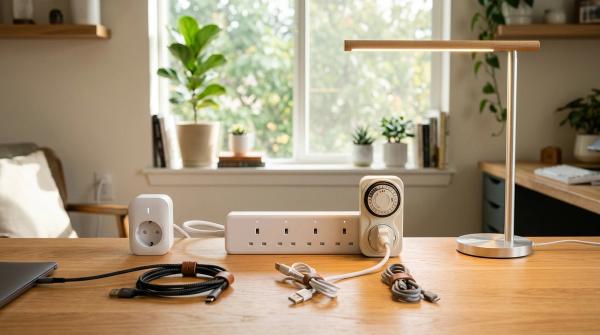
A small extension setup can help, but be sensible. I’ve used an Indian power strip connected through a Japan Type A adapter, but only for low-power dual-voltage chargers. Phone, laptop, camera battery, that kind of thing. I would not run a high-wattage appliance through that chain. Also, remember that grounding may not be available in many two-pin Japanese sockets, even if your Indian plug has earth. For normal chargers it’s usually not a big problem, but for certain equipment it matters.
My favorite setup now is one wall adapter plus a multi-port USB-C charger. One outlet becomes four charging ports. Phone, watch, earbuds, power bank. Clean. No cable jungle. If your laptop supports USB-C charging, even better. I’m slowly trying to move all my travel tech to USB-C, but then one random device always needs micro-USB and ruins the dream. There is always one.
Buying adapters after landing in Japan: possible, but don’t depend on it
#Can you buy plug adapters in Japan? Yes. Airports, electronics stores like Bic Camera or Yodobashi Camera, convenience stores sometimes, travel sections, hotel front desks sometimes have loaners. Japan is extremely good at solving small practical problems. But here’s the catch: many adapters sold there are for Japanese people traveling abroad, meaning Japan plug to foreign socket, not Indian plug to Japan socket. You need the opposite.
At airports, you might find what you need, but you’ll pay more and you’ll be tired. At electronics stores, staff are usually helpful, but explaining “Indian three round pin to Japanese flat pin” with jet lag is not my idea of fun. I once spent 20 minutes in an electronics aisle comparing adapters like I was choosing a life partner. It worked out, but still. Bring one from India. Bring two if you’re the anxious type. They’re small.
If you buy a charger in Japan, look for proper safety markings and reputable brands. Japan has its own electrical safety expectations, and known brand chargers are worth the extra money. Don’t buy ultra-cheap no-name fast chargers just because they look cute. Fast charging is not an area where I enjoy gambling.
My actual packing list for Japan charging gear
#This is what I’d pack for a 7 to 14 day Japan trip from India. Not perfect, not minimal influencer-style, just practical. I like redundancy because I’ve lost cables in hotel rooms, cafés, trains, once even inside my own backpack somehow. Don’t ask.
- One Type A adapter that accepts Indian plugs. Preferably compact and firm, not wobbly.
- One multi-port USB-C PD charger, 65W is a sweet spot for phone plus laptop for many people.
- Two USB-C cables, because one will disappear into the void.
- One Lightning cable if you use an older iPhone or AirPods case.
- One power bank, usually 10,000mAh or 20,000mAh, carried in cabin baggage.
- Optional: Indian power strip, only if you know what you’re doing and only for low-power dual-voltage chargers.
- Optional: short extension cord. Sometimes the wall socket is in the most inconvenient place known to mankind.
Common mistakes Indian travelers make with Japan plug adapters
#The biggest mistake is thinking “adapter” means “converter”. It doesn’t. I keep repeating this because it’s the one that can damage stuff or at least waste your time. Second mistake: buying an adapter that only accepts two-pin Indian plugs, then realizing your laptop has a three-pin plug. Third mistake: carrying a hair dryer from India without checking voltage. Fourth mistake: assuming the hotel will have USB ports everywhere. Some do, some don’t. And sometimes the USB port is so slow your phone charges 6% overnight and you wake up personally betrayed.
Another sneaky one is relying on one adapter for two people. Please don’t. If you’re traveling as a couple or family, everyone will want to charge phone, watch, camera, power bank, tablet, and then someone will say “can I just plug my straightener for five minutes?” and suddenly your entire charging plan collapses. Carry at least two adapters for a family trip. They weigh nothing.
A tiny rant about “universal” adapters
#Universal adapters are great, but the word universal is doing a lot of unpaid labour. Some are universal for countries but not for plug shapes. Some support many output pins but don’t accept India Type D properly. Some have a universal socket that feels loose, and loose electrical connections are just... no. I want my charger to sit firmly, like it has confidence. So if you’re ordering online, read user photos and reviews from Indian buyers specifically. Look for people saying it worked in Japan with Indian plugs. That one detail matters.
What about trains, airports, cafés, and Shinkansen charging?
#Japan is pretty good for charging on the go, but don’t count on it everywhere. Some airport seats have outlets or USB ports. Some cafés have charging seats. Newer Shinkansen trains and certain reserved seats may have outlets, but it depends on train type and seat. Long-distance buses may have outlets too. Still, the socket will be Japanese Type A or Type B, so your adapter or Japanese-pin USB charger comes into play again.
This is where a charger with foldable Type A pins becomes super useful. No adapter stack, no bulky thing hanging out of the wall, just plug and charge. I used to carry a big universal adapter everywhere, then I switched to a smaller USB-C charger with flat pins and honestly it felt like upgrading from a backpack full of bricks to a normal life. For laptop work sessions in cafés, though, I still keep the adapter in my pouch because laptop bricks can be weird.
A quick “will my device work?” cheat sheet
#| Device from India | Will it work in Japan? | What you need |
|---|---|---|
| Phone charger | Usually yes if 100-240V | Type A adapter or Japan-pin USB charger |
| Laptop charger | Usually yes if 100-240V | Adapter for Indian plug or USB-C PD charger |
| Camera battery charger | Usually yes, check label | Type A adapter |
| Power bank | Charging usually fine with proper charger | Carry power bank in cabin baggage |
| Hair dryer | Often no if only 220-240V | Use hotel dryer or dual-voltage travel dryer |
| Hair straightener | Depends, many are single voltage | Check label or use dual-voltage model |
| Electric kettle or iron | Don’t bother carrying usually | Use hotel appliance |
| Electric toothbrush | Depends on charger label | Check 100-240V before packing |
My final recommendation, if you don’t want to overthink it
#If you just want the practical answer: buy two Japan Type A plug adapters that accept Indian plugs, carry one good USB-C PD charger, check all charger labels for 100-240V, don’t carry Indian high-wattage appliances unless they are dual voltage, and put your power bank in cabin baggage. That’s the whole game. Not glamorous, but very effective.
If you’re a tech nerd like me, use the Japan trip as an excuse to clean up your charging ecosystem. Move to USB-C where possible. Get shorter cables. Label your cables if you’re traveling with family. Carry a tiny pouch. Test your adapter at home with your actual plugs before you leave. Don’t be that person discovering at midnight in Kyoto that the adapter accepts your phone charger but not your laptop plug. I have been that person. It builds character, but I don’t recommend it.
A plug adapter is one of those boring travel items that becomes extremely exciting the moment you don’t have it.
Wrapping up from one overprepared traveler to another
#Japan is one of the easiest countries to travel in once you get the basics right, and charging your tech is definitely one of those basics. The country is wonderfully organized, but it won’t magically reshape Indian round pins into Japanese flat slots. That part is on us. Carry the right adapter, respect the voltage difference, and your phone, laptop, camera, and power bank will stay alive while you chase ramen, temples, trains, anime stores, autumn leaves, or whatever your version of Japan happiness is.
And honestly, there’s something satisfying about getting the tiny tech details right. It makes the whole trip smoother. Less panic, more exploring. If you’re planning your Japan trip and want more practical travel-tech stuff without the boring textbook vibe, I’d poke around AllBlogs.in too. I keep finding useful bits there when I’m in my “wait, did I forget something?” pre-trip spiral.