Every police procedural drama features the same scene: a detective lifts a glass with a gloved hand, holds it to the light, and declares confidently that the fingerprints found at the scene will identify the suspect. The assumption embedded in that scene — that fingerprints are unique to each individual and permanent throughout their lifetime — is one that most people accept without question.
But very few people ever stop to wonder why fingerprints are unique. Not just different between strangers, but provably, mathematically different between identical twins who share every single base pair of their DNA. Not just between people, but between your own left index finger and your right index finger. The pattern on each fingertip is an individual event, generated once during fetal development and never repeated.
The reason lies in one of the most beautiful intersections of developmental biology, physics, and randomness in the natural world: a process called ridgeogenesis, governed by both genetic instructions and mechanical chaos during the third and fourth months of fetal life.
What Fingerprints Are: The Ridge System
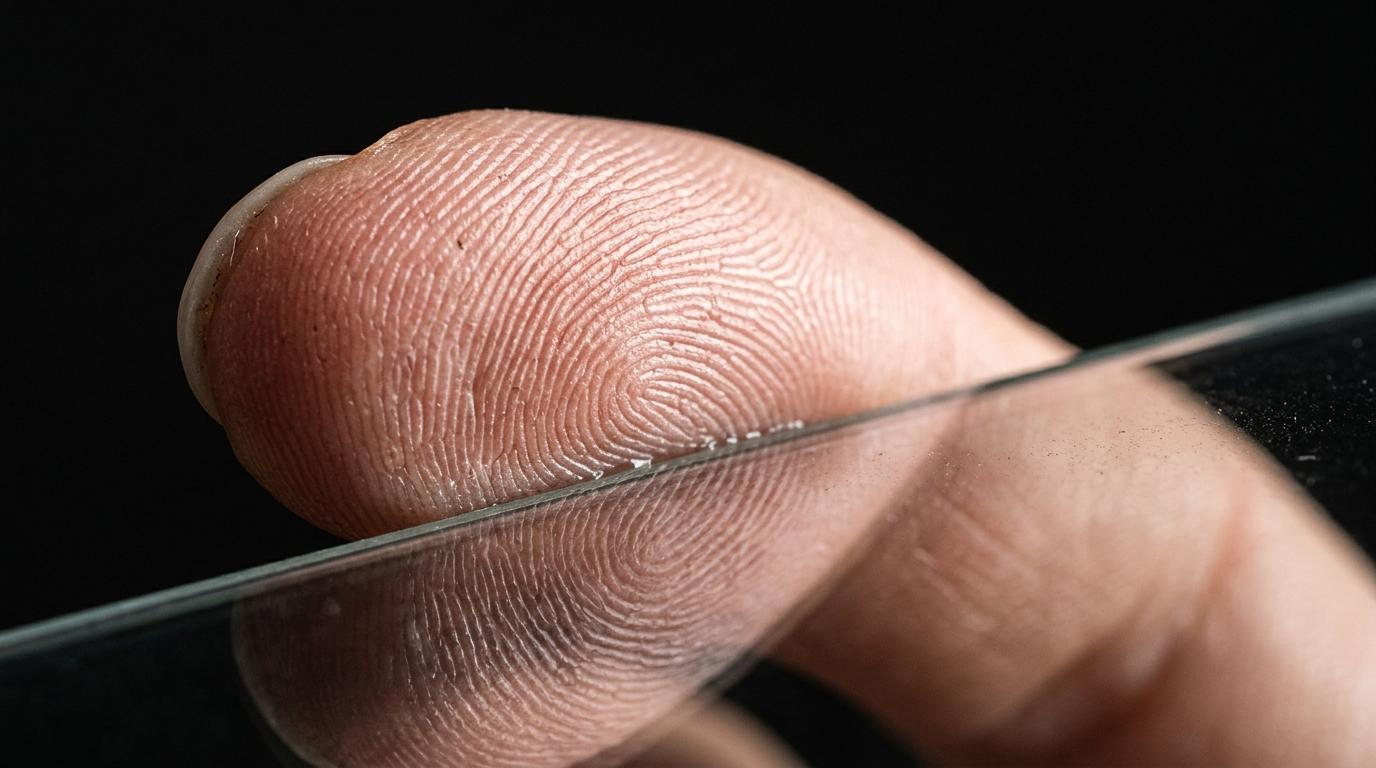
#The raised lines on your fingertips are called friction ridge skin — a specialised form of thick, heavily innervated skin found on the palmar surface of the hands, the plantar surface of the feet, and the finger and toe tips. These ridges serve several mechanical functions: they greatly increase friction between the skin surface and objects being gripped (allowing fine motor manipulation of tools and objects), they amplify the vibration signals received by pressure-sensitive Meissner's corpuscles and Merkel disk receptors in the dermis (dramatically improving tactile sensitivity), and they channel sweat from eccrine glands along the ridge surfaces to maintain optimal grip moisture.
The ridges are permanent structures embedded in the dermis — the deep layer of skin. While the outer epidermis is continuously shed and replaced (which is why you can sand the surface of your fingertips and the original pattern will grow back), the ridge pattern itself is determined by the architecture of the dermal papillae — the upward projections of the dermis that interlock with downward projections of the epidermis. This deeper architecture cannot be altered by normal wear, aging, or minor injuries.
The three basic fingerprint pattern types are:
- Loops: Ridges flow in and recurve back in a U shape. The most common pattern, occurring in approximately 60–65% of fingerprints globally.
- Whorls: Ridges spiral around a central point in concentric circles or double loops. Occur in approximately 30–35% of fingerprints.
- Arches: Ridges rise gently and flow smoothly across the finger without recurving. The rarest pattern, occurring in approximately 5% of fingerprints.
These broad categories classify the general topology of a print, but the forensic identification system relies on something far more granular: minutiae — the precise locations of ridge endings (where a ridge simply stops), bifurcations (where one ridge splits into two), and other micro-features that occur hundreds of times across a single fingertip. It is the specific spatial arrangement, angle, and spacing of these minutiae — not just the general loop-or-whorl topology — that makes each print unique.
The Development Timeline: Weeks 10–24
#Fingerprint ridges form during a precisely timed window of fetal development, beginning around week 10 and completing by approximately week 24 of gestation. The process unfolds in two overlapping phases.
Phase 1 — Volar pad regression (weeks 6–13):
Between weeks 6 and 13 of gestation, every human fetus develops transient swellings on the palmar surface of the hands and the plantar surface of the feet called volar pads. These are dense, rounded mounds of mesenchymal tissue (a type of connective tissue) that form over the fingertip regions and ball areas of the hands and feet.
The timing and degree of volar pad regression is genetically influenced — this is where your DNA actually contributes to your fingerprint pattern class. Volar pads that are prominent and high when ridge formation begins tend to generate whorl patterns (the ridges form around the summit of the pad). Pads that have already partially flattened tend to generate loop patterns (the ridges flow around the diminishing mound). Very flat pads at ridge formation onset tend to generate arch patterns.
Since volar pad prominence and regression timing is partly under genetic control, fingerprint pattern type (whorl, loop, arch distribution) runs in families and shows strong heritability. Identical twins share nearly identical genetic sequences and very similar volar pad architecture, which is why identical twins often have the same general fingerprint pattern type (both having whorls on most fingers, for example) — but not the same specific minutiae arrangement.
Phase 2 — Ridgeogenesis via reaction-diffusion patterning (weeks 10–24):
The formation of the actual ridges is controlled by a biochemical patterning system acting on the basal layer of the epidermis. This system follows the mathematics first described by Alan Turing in his 1952 paper "The Chemical Basis of Morphogenesis" — now known as a Turing reaction-diffusion model.
In the fingertip context, two classes of signalling molecules interact across the basal epidermis:
- Activators: Short-range signalling molecules (including BMP4 and WNT pathway proteins) that stimulate cells to form ridges and proliferate in localised clusters.
- Inhibitors: Longer-range signalling molecules that diffuse more rapidly outward from activated regions, suppressing ridge formation in surrounding areas to prevent ridge clusters from merging.
The interplay between these short-range activators and long-range inhibitors spontaneously generates a periodic spatial pattern — alternating bands of high cell density (ridges) and low cell density (valleys) — without requiring any external blueprint or top-down instruction. The pattern emerges entirely from the local chemistry of competing molecular diffusion.
The spacing of the ridges (approximately 0.5–0.7 mm in adult fingerprints) is set by the relative diffusion rates and production rates of the activator and inhibitor molecules. These molecular parameters are under genetic control — which is why ridge spacing is consistent within individuals across all ten fingertips and shows familial inheritance.
But the specific orientation and curvature of the ridges, and the locations of minutiae (ridge endings and bifurcations), are determined not by genetics but by the boundary conditions present at the moment of pattern formation: the exact three-dimensional geometry and mechanical tension state of the fingertip as the chemical wave propagates across it.
Why Even Identical Twins Have Different Prints
#Identical twins share 100% of their DNA, including the genes controlling activator/inhibitor diffusion rates, volar pad development, and ridge spacing parameters. This is why identical twins have very similar fingerprint characteristics at the population level — similar pattern type distributions, similar ridge densities — that fall clearly within familial expectation.
However, the precise three-dimensional geometry of each individual fetus's fingertip at the moment ridgeogenesis begins is not genetically predetermined. It is shaped by:
- The random position of the fetus in the uterus during weeks 10–16, which determines the mechanical compression each fingertip experiences against the amniotic sac and uterine wall
- The amniotic fluid pressure and flow patterns around each hand, which create microscopic variations in the tension field across the skin surface
- The local vascular pressure and growth rate differences between the two twins, as twins share placental circulation but rarely identically
- Stochastic (random) fluctuations in the precise timing and spatial origin of the first ridge formation events — small molecular noise amplified by the nonlinear dynamics of the reaction-diffusion system
These tiny differences in starting conditions cascade through the reaction-diffusion patterning process. Because the Turing system is inherently sensitive to initial conditions — mathematically similar to chaos theory, where small differences in starting state produce dramatically divergent outcomes — microscopic variations in fingertip geometry at the onset of ridgeogenesis produce entirely different ridge orientation fields, different locations of ridge terminations and bifurcations, and ultimately different minutiae maps.
Forensic comparison of identical twin fingerprints consistently confirms this: while twins may share the same general whorl pattern on corresponding fingers, the precise minutiae arrangements are entirely non-identical. No court of forensic science has ever accepted twin fingerprints as indistinguishable.
The Permanence of Fingerprints
#Once ridgeogenesis completes by week 24, the ridge pattern is permanent. The pattern encoded in the dermal architecture cannot be altered by normal skin growth, minor abrasion, or aging. The ridges grow proportionally as the hand grows through childhood and adulthood (they scale in size but maintain their spatial relationships and minutiae topology), and they remain forensically stable throughout a person's lifetime.
Deliberate attempts to erase fingerprints — documented historically in organised crime cases — require deep dermal destruction: acid burns, surgical excision, or severe full-thickness burns that destroy the papillary dermis. Even partial dermal damage typically results in scarred ridges that are themselves unique and identifiable. Several forensic cases have documented the successful re-identification of individuals who had attempted to surgically alter their fingerprints — the scar patterns themselves served as new unique identifiers.
One medically recognised condition, adermatoglyphia — a rare autosomal dominant condition caused by mutations in the SMARCAD1 gene affecting the epidermal-dermal interaction during ridge formation — results in individuals born with no fingerprints at all. Approximately nine families worldwide carry this documented variant. Beyond fingerprint absence, these individuals are otherwise healthy, though they report reduced tactile sensitivity and are known to cause considerable confusion at border control fingerprint scanners.
The Forensic System Built on This Biology
#The science of fingerprint identification, dactyloscopy, was formalised in the late nineteenth century by Francis Galton, who mathematically demonstrated the extreme improbability of two individuals sharing the same fingerprint minutiae arrangement. His calculations estimated the odds of a complete fingerprint match between unrelated individuals at approximately 1 in 64 billion — far exceeding the global human population.
Modern forensic systems use the Automated Fingerprint Identification System (AFIS), which digitises and mathematically encodes the spatial positions and angles of minutiae, then searches databases of millions of prints to find statistical matches. AFIS can process a comparison against tens of millions of stored prints in seconds, ranking candidates by match score. Human fingerprint examiners then confirm the top-ranked matches by visual comparison.
Forensic standards typically require a minimum of 12–16 corresponding minutiae points between a crime scene print and a database print for positive identification, though many jurisdictions now use probabilistic statistical frameworks rather than fixed point thresholds.
The practical reliability of forensic fingerprint evidence in distinguishing individuals remains extremely high — but the science of ridgeogenesis reminds us that this reliability is not because fingerprints were designed to be unique. It is because the random chaos of chemistry and mechanics operating on a tiny patch of fetal skin, over a few weeks in the womb, generates a pattern so locally specific that it has never been seen to repeat across any two individuals in the documented history of forensic science.
A Pattern Written by Physics, Not Genes
#Your fingerprints are you, but they are not entirely from your genes. They are the fossilised record of a brief period of biochemical pattern formation that happened in the third month of your fetal life — a moment when reaction-diffusion chemistry, mechanical stress fields, amniotic pressure, and stochastic molecular noise all collided to generate a topology that has never existed before and will never exist again.
The DNA you share with your siblings provided the general parameters: the spacing of the ridges, the tendency toward loops or whorls, the ridge density. But the specific map of exactly where each ridge ends, where each bifurcation occurs, and how the entire pattern curves and flows across your fingertip was determined by physical events that were beyond any genetic program's control.
This is why fingerprints can serve as the most individual biometric identifier in existence: not because biology planned it that way, but because the mathematics of pattern formation operating under random initial conditions inevitably produces something unrepeatable.
Every time you unlock your phone with a fingerprint, you are using as your password the record of a chaotic physical process that began before you could breathe, eat, or move — a physical signature written not by design, but by the beautiful randomness of the living world.