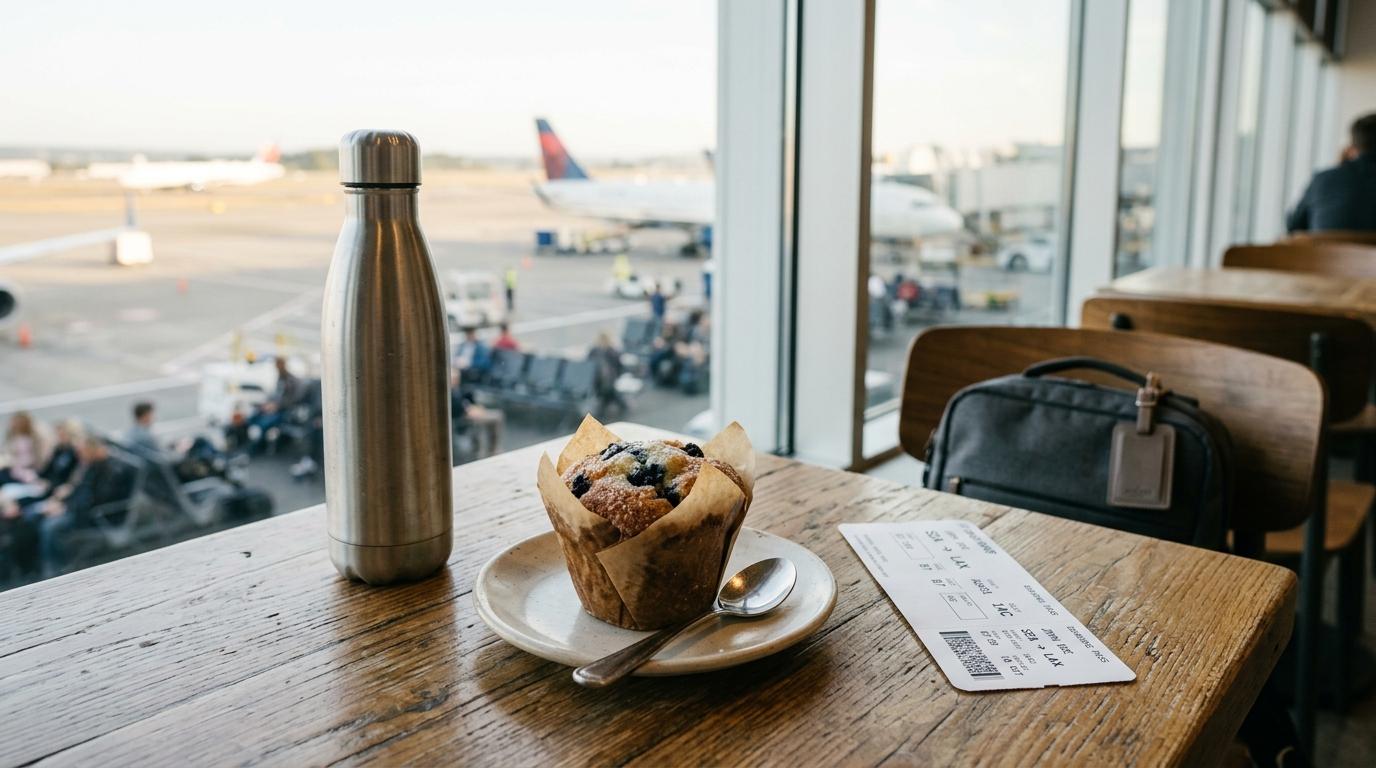
It’s way too early, your coffee hasn’t kicked in yet, and suddenly that airport bakery case is making a very convincing argument.
A blueberry muffin feels practical. A chocolate chip muffin feels like a treat you’ve earned. And one of those huge streusel-topped muffins? That looks like breakfast, dessert, and emotional support in a paper wrapper.
But are airport muffins before a flight actually a good idea?
Usually, yes. Muffins are one of the easier baked goods to bring on a plane because they’re solid, portable, and not usually offensive to the people sitting next to you. But they’re not always the best choice. It depends on the muffin, your stomach, your flight length, and whether you’re crossing an international border.
Quick Answer: Should You Buy, Pack, or Skip?
#Buy a muffin if you need a fast airport breakfast before a flight, especially after security, during a layover, or on one of those mornings when breakfast at home simply did not happen.
Pack a muffin if you want to save money, avoid airport food prices, control the ingredients, or make sure you have something to eat before a very early flight.
Skip the muffin if it’s cream-filled, sticky, crumbly, aggressively sweet, or likely to sit in your bag for half the day.
For airport security, the basic rule is simple: solid foods are generally allowed through TSA checkpoints. So a plain muffin, blueberry muffin, bran muffin, banana muffin, or chocolate chip muffin is usually fine in your carry-on.
The muffin itself usually isn’t the issue.
The extras are where things can get annoying. Butter, jam, honey, cream cheese, frosting, and other spreads count as liquids, gels, or pastes. That means they need to follow the TSA 3-1-1 liquids rule.
International flights are a different story. Just because a muffin gets through airport security does not always mean you can bring it into another country. Customs and agriculture rules vary, and some places are strict about food.
Buy, Pack, or Skip: Easy Decision Table
#Can You Bring Muffins on a Plane?
#Yes, in most cases, you can bring muffins on a plane.
For U.S. airport screening, TSA generally allows solid foods in both carry-on and checked bags. A regular muffin is a solid baked good, so it’s usually treated like bread, cookies, pastries, or similar snacks.
In other words, a normal muffin in your bag is not usually going to cause drama at security.
A few practical notes:
- You usually do not need to take the muffin out of your bag unless a security officer asks.
- TSA officers can inspect any food item if they need a closer look.
- Spreads are treated differently from the muffin itself.
- Butter, jam, honey, cream cheese, frosting, and similar items must follow the 3-1-1 liquids rule.
- That means containers must be 3.4 ounces, or 100 ml, or less and fit in your quart-sized liquids bag.
So if you’re bringing a muffin wrapped in a napkin or tucked into a container, you’re probably fine. If you’re bringing a muffin plus a full jar of jam, the jam is the problem.
When Buying an Airport Muffin Makes Sense
#Buying a muffin at the airport is the low-effort option, and sometimes low effort is exactly what travel requires.
It makes sense when you’re rushing, didn’t eat before leaving home, or have a connection long enough to need something with your coffee. It’s also nice when you’re already past security and don’t want to think about what’s allowed in your bag.
An airport muffin works well when:
- You plan to eat it soon.
- You want something quick with coffee or tea.
- You don’t want to pack food from home.
- You’re already through security.
- You need a snack, not a full meal.
- You’re on a layover and just want something familiar.
The main downside is that airport muffins are often enormous and very sweet. That may sound great at 6 a.m., but it can feel less great halfway into a long flight when you’re thirsty, tired, and suddenly hungry again.
If sweet breakfasts tend to make you crash, try eating half and saving the rest. Or pair the muffin with something more filling, like yogurt, nuts, cheese, or another protein-containing snack if you can find one.
When Packing a Muffin Is Smarter
#Packing your own muffin is usually the better move if you want to save money, avoid giant bakery portions, or choose ingredients that work better for you.
It’s also helpful for very early flights. Airport websites may say cafés open early, but anyone who has wandered through a half-asleep terminal knows that “open” can be a flexible concept.
Good muffins to pack include:
- Plain muffins
- Blueberry muffins
- Banana nut muffins
- Bran muffins
- Chocolate chip muffins
- Oat-based muffins
- Apple cinnamon muffins
- Muffins without cream, custard, or soft dairy fillings
The best travel muffin is sturdy, not too oily, and not covered in loose toppings. A beautiful bakery muffin with a tall crumb topping might be perfect at your kitchen table, but in a backpack it can turn into muffin gravel very quickly.
How to Pack a Muffin for Travel
#Muffins are easy to bring, but they’re also easy to smash. A little packing effort makes a big difference.
Use a hard-sided container
#A small reusable container is the best option. It protects the muffin from your laptop, chargers, books, water bottle, headphones, and everything else you’ve shoved into your personal item.
Wrap it first
#If the muffin is moist, sticky, or topped with sugar, wrap it in parchment, a napkin, or food-safe wrap before placing it in the container. This keeps the container cleaner and makes the muffin easier to eat later.
Keep it near the top of your bag
#If you don’t have a container, place the muffin in a bag and keep it near the top of your personal item. Do not bury it under shoes, electronics, or that hoodie you packed “just in case.”
Avoid messy toppings for onboard eating
#Streusel, coarse sugar, and crumb toppings are delicious. They also end up everywhere: tray table, lap, seat, floor, probably your passport somehow.
If you plan to eat the muffin on the plane, choose something cleaner.
Bring a napkin
#It sounds obvious until you’re trying to brush crumbs off your pants with a boarding pass. Pack the napkin.
Be Careful With Cream-Filled or Dairy-Heavy Muffins
#A plain muffin is pretty low maintenance. A cream-filled, custard-filled, or dairy-heavy muffin deserves a little more caution.
There are two things to think about: airport screening and food safety.
From a security standpoint, a normal baked muffin with a small filling is usually not a big deal. But if the pastry is loaded with loose custard, jelly, cream, or another gel-like filling, it may not look like a simple solid food on the scanner. TSA officers have discretion, so simpler foods usually make for smoother checkpoints.
From a food-safety standpoint, cream and dairy fillings should not sit at room temperature for hours. If your muffin has cream cheese frosting, custard, whipped filling, or another perishable filling, eat it soon after buying it.
It is not the best snack to save for six hours later.
If you want the least fuss, choose a traditional baked muffin without cream, custard, or soft dairy filling.
Crumbs, Smell, Sugar, and Hydration: The Real In-Flight Issues
#A muffin may be allowed through security, but that does not automatically mean it’s the perfect airplane snack. You still have to think about the reality of eating it in a cramped seat.
Crumbs
#Muffins crumble. Airplane tray tables are small. Your lap is directly underneath. You can see the problem.
To keep things manageable:
- Eat over the wrapper or bag.
- Break off small pieces instead of tearing the muffin apart.
- Choose a denser muffin instead of a dry, crumbly one.
- Keep a napkin nearby.
- Wait until the seatbelt sign is off if things are bumpy.
Smell
#Muffins are usually polite plane food. Blueberry, banana, cinnamon, vanilla, and chocolate are not likely to bother people the way hot, strong-smelling meals can.
Still, if the muffin has an oddly intense smell, maybe save it for the gate. A packed cabin is not the place to test everyone’s tolerance.
Sugar
#Many bakery muffins are basically cake with better branding. And honestly, that’s fine sometimes.
But a very sweet muffin can leave some travelers feeling sluggish, thirsty, or hungry again pretty quickly. If you know that happens to you, eat half, choose a smaller muffin, or pair it with something more filling.
Hydration
#Muffins can be dry, and airplane cabins are already dry. Bran, oat, and dense chocolate muffins especially can make you reach for water fast.
A good routine: fill or buy a water bottle after security, then eat the muffin slowly instead of inhaling it at the gate while your boarding group is being called.
Best Muffins for Travel Days
#If you’re choosing a muffin specifically for travel, aim for simple, sturdy, and not too messy.
Better choices:
- Blueberry muffin without heavy glaze
- Banana nut muffin
- Bran muffin
- Oat muffin
- Plain chocolate chip muffin
- Apple cinnamon muffin without cream filling
- Simple corn muffin
- Small or medium-sized muffins instead of giant ones
Messier choices:
- Muffins with lots of loose streusel
- Muffins with sticky glaze
- Cream cheese frosted muffins
- Custard-filled muffins
- Jelly-heavy muffins
- Very oily muffins
- Oversized muffins that are hard to finish neatly
The goal is not to find the most impressive muffin in the terminal. The goal is to find one you can eat without wearing half of it.
What About International Flights?
#This is where you need to be more careful.
Airport security rules are about what you can bring through screening and onto the plane. Customs and agriculture rules are about what you can bring into the country when you land.
Those are not the same thing.
If you’re flying internationally, don’t assume you can take an uneaten muffin off the plane. Some countries have strict rules around food, fruit, seeds, dairy, meat, nuts, and agricultural products. Even a harmless-looking baked good may need to be declared, or it may not be allowed at all.
The safest options are:
- Eat the muffin before you land.
- Throw it away before customs if you’re unsure.
- Declare food when required.
- Check your destination country’s customs rules before traveling with food.
“I bought it at the airport” does not automatically mean “I can bring it into another country.”
So, Are Airport Muffins Before a Flight Worth It?
#Most of the time, yes.
A muffin is one of the easier airport breakfasts. It’s solid, portable, usually security-friendly, and less disruptive than many other travel foods. It’s especially useful for short flights, early mornings, and layovers when you just need something quick and familiar.
Buy one if you’ll eat it soon. Pack one if you want to save money or control the ingredients. Skip it if it’s cream-filled, messy, too sweet for your stomach, or likely to sit unrefrigerated for too long.
The sweet spot is simple: choose a sturdy muffin, pack it well, bring water, and be careful with international customs rules.
That’s about as complicated as a muffin needs to be.