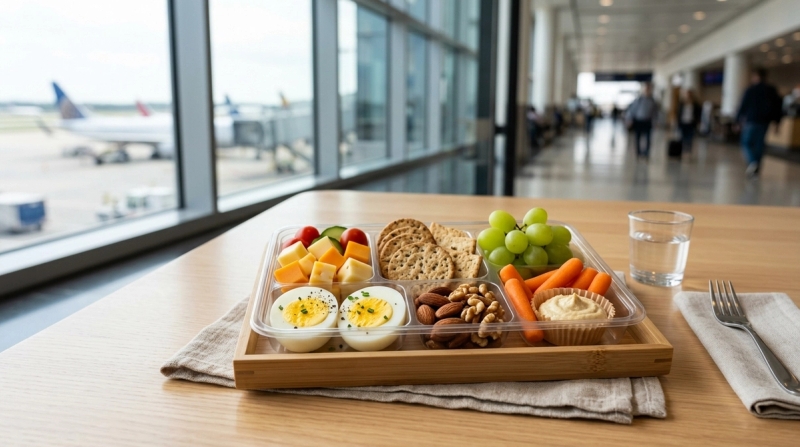
Airports have a special talent for making you hungry at the worst possible time.
Maybe you woke up before sunrise, rushed through security, grabbed coffee, and told yourself you would eat later. Then later becomes a delayed boarding time, a crowded gate, and you standing in front of a refrigerated case, holding a plastic tray of eggs, cheese, crackers, fruit, hummus, nuts, or sliced meat, wondering, “Is this actually a good idea?”
An airport protein box before a flight can be a smart move. It can also be overpriced, underwhelming, or just questionable enough that you should put it back.
The difference usually comes down to a few simple things: whether it is properly cold, how fresh it looks, what is inside, how soon you plan to eat it, and whether any allergies or stomach issues could make your flight unpleasant.
So here is the real-world answer: buy it, split it, or skip it.
Quick answer
#Buy it if the box feels truly cold, looks fresh, has a clear use-by date, is sealed properly, and you need something filling before a long travel day.
Split it if you only need a light snack, you are taking a short flight, or the box is heavy on cheese, eggs, meat, or dips and you do not want to feel overly full on the plane.
Skip it if the cooler feels warm, the box looks wet or tired, the date has passed, the packaging is damaged, or you have a serious allergy and the foods are sitting together in open compartments.
A good protein box can be one of the better high-protein airport snacks. A bad one is not worth the risk, especially when your next few hours involve a tight seat, limited bathroom access, and no easy escape.
When an airport protein box is a good idea
#An airport protein box makes sense when you want something more useful than chips, candy, or a muffin, but you are not in the mood for a full airport meal.
It can be a good choice when:
- You have a long flight and do not know what food will be available.
- You have a tight connection and need something quick.
- You want a more balanced airport meal with protein, carbs, and fat.
- You are traveling very early, very late, or at a weird hour when most places are closed.
- You know you get cranky, shaky, or headachy if you board hungry.
The appeal is the variety. Most protein boxes give you small portions of a few different foods: hard-boiled eggs, cheese, crackers, fruit, nuts, nut butter, hummus, vegetables, or sliced meat. That usually holds you over better than eating something sugary and hoping your energy does not crash halfway through the flight.
They are also flexible. You can eat the cheese and crackers at the gate, save the sealed nuts for later, and leave anything that looks questionable. With a hot meal, once you buy it, you are kind of committed.
That said, you may not need the whole thing. If you already ate recently or you are only taking a short flight, splitting one with someone else can be perfect. You get a little protein before boarding without feeling stuffed in your seat.
If you mostly want fruit, read the Airport Fruit Cups Before a Flight guide. If you are looking at drinks instead, Airport Fresh Juice Before a Flight covers the food-safety side of that too.
What to choose
#Start with the cold case, not the cute label.
A box can look healthy, expensive, and nicely packaged, but if it has not been kept cold, none of that matters.
Pick it up if you can. It should feel refrigerator-cold, not just slightly cool. Look at the bottom and corners for extra liquid, foggy plastic, wilted vegetables, slimy ingredients, or anything that looks dried out.
Then look at what is actually inside.
Eggs
#Hard-boiled eggs can be a solid protein choice if they look fresh and the box is properly chilled.
Choose eggs that are:
- Firm and intact
- Normal in color
- Not sitting in liquid
- Packed in a cold-feeling box
- Within the printed date
Skip eggs that look rubbery, watery, cracked, discolored, or loose in a warm tray. And if you open the box and the smell is off, do not try to talk yourself into it. Just do not eat them.
Cheese and dairy
#Firm cheese is usually the safest-looking dairy item in a protein box. Cheddar-style cubes, gouda-style slices, and other harder cheeses tend to hold up better than soft cheese or creamy spreads.
Choose cheese that looks:
- Firm
- Cold
- Not sweaty or oily
- Not dried out around the edges
- Not touching wet produce or meat juices
Skip soft cheese, creamy spreads, or dairy dips if the box does not feel properly cold. Also skip dairy if you know lactose can bother you and you do not want to find that out again at cruising altitude.
Meat
#Some airport protein boxes include sliced turkey, ham, salami, chicken, or other ready-to-eat meat. Be a little more cautious here. Meat is perishable, and when it looks bad, it is usually not subtle.
Choose meat only if:
- The box is properly chilled
- The meat looks fresh, not gray or slimy
- There is no liquid pooling in the tray
- The packaging is sealed and undamaged
- You plan to eat it soon
Skip meat if it looks shiny, sticky, dried out, wet, or just generally suspicious. Also, if salty processed meat tends to make you thirsty or puffy while flying, this may not be your best airport snack.
Hummus and dips
#Hummus can make a protein box feel much more like a meal, especially with crackers or vegetables. The best version is a small sealed cup inside the box.
Choose hummus or dips that are:
- In their own sealed container
- Cold
- Not swollen
- Not cracked
- Not leaking
- Not smeared across the rest of the box
Skip open dips, leaking dips, or hummus that has already spread into other compartments. Once you open it, eat it soon. Do not keep an opened dip warm in your bag for later. That is exactly the kind of travel gamble you do not need.
Crackers
#Crackers are usually the lowest-risk part of the box. They are dry, shelf-stable, and useful if the richer foods feel like too much.
Choose crackers that are:
- Dry and crisp
- Separately wrapped, if possible
- Not softened by wet foods
- Not crumbling into dips, cheese, or fruit juice
Skip crackers that are soggy or have soaked up moisture from fruit, vegetables, meat, or dips. Nobody needs damp airport crackers.
Cut vegetables
#Cut vegetables can be refreshing before a flight, but they need decent handling because they have already been washed, cut, packed, and stored.
Choose cut vegetables that look:
- Crisp
- Bright
- Cold
- Not slimy
- Not sitting in cloudy liquid
Carrot sticks, cucumber slices, celery, and peppers should not look mushy, dry-white, dull, or overly wet. If they look tired, leave them there.
Fruit
#Whole or less-handled fruit is usually the better choice. Grapes, berries, cherry tomatoes, or small whole fruits can be fine if they look clean and fresh.
Choose fruit that is:
- Firm
- Bright
- Not leaking
- Not moldy
- Not crushed against wet ingredients
Skip fruit that looks collapsed, sticky, fermented, bruised, or like it has already had a rougher travel day than you.
Nuts, seeds, and nut butter
#Nuts, seeds, and nut butter can add useful protein and fat, but they are also a major allergy issue.
Choose them if:
- You tolerate them well
- They are sealed or clearly separated
- There is no obvious cross-contact concern for you
Skip the whole box if you have a serious nut allergy and the nuts are sitting open beside the other foods. Those little compartments are close together, and crumbs or nut dust can move around.
What to skip
#Sometimes the best airport food decision is simply putting the box back and finding something else.
Skip the airport protein box if:
- The box feels warm or only barely cool.
- The cooler itself does not seem cold.
- The printed date has passed or is missing.
- The plastic seal is broken, loose, cracked, or leaking.
- There is liquid pooling at the bottom.
- The eggs, meat, cheese, hummus, or vegetables look slimy.
- The cut vegetables look mushy, dull, or dried out.
- The fruit looks crushed, sticky, moldy, or fermented.
- The crackers are soggy.
- The hummus or dip cup is open or leaking.
- You have a severe allergy and the box contains nuts, dairy, eggs, sesame, wheat, or other allergens in shared compartments.
Also skip it if you already know certain foods do not sit well with you before flying. This is not the moment to experiment with a new dip, a heavy cheese portion, or mystery meat from a terminal cooler.
If you want more control next time, packing your own food may be better. A simple homemade option from a Packed Sandwiches While Traveling guide can be easier to trust if you keep it cold and eat it within a safe window.
Food safety
#Food safety matters more at the airport because you have less control.
You do not know how long the box sat before it reached the cooler. You do not know whether the case stayed cold all morning. You also do not know if your “quick boarding snack” is about to turn into a three-hour delay.
That does not mean every airport protein box is risky. Plenty are perfectly fine. It just means you should be picky.
Use the cold test
#The box should feel truly cold when you pick it up.
Not room temperature. Not “kind of cool.” Not “probably fine.”
Cold.
If it feels warm, put it back. If the cooler seems open, crowded, poorly maintained, or not very cold, choose something shelf-stable instead.
When possible, take a box from a colder part of the case, but do not dig through everything and damage the packaging. Check the date, look for the freshest one, and move on.
Eat it soon
#Perishable foods like eggs, cheese, meat, hummus, and cut vegetables should not sit at room temperature for long. A common food-safety rule is to avoid leaving perishable food out for more than two hours, and less time is better in warm conditions.
For travel, be stricter.
If you buy an airport protein box and cannot keep it cold, plan to eat it within about an hour.
Do not buy it, carry it around the terminal, board the plane, shove it into the seatback pocket, nap for two hours, and then eat the eggs and hummus. That is exactly the situation you want to avoid.
Be careful with leftovers
#Some parts of the box are easier to save than others.
Usually safer to save for later:
- Sealed crackers
- Sealed nuts or seeds
- Sealed nut butter, if still unopened
- Whole fruit that has not been cut or contaminated
Better to finish or toss soon:
- Eggs
- Cheese
- Meat
- Hummus
- Dairy dips
- Cut vegetables
- Cut fruit
If the perishable foods have been warm, do not save them “just in case.” Being hungry while traveling is annoying. Getting sick while traveling is much worse.
Think about security rules before buying
#If you are buying food before the security checkpoint, remember that dips and spreads may be treated like liquids or gels in some places.
Hummus, nut butter, sauces, and creamy dips can all be an issue depending on the airport and the person checking your bag.
To avoid the hassle, the easiest move is to buy refrigerated meals after security if you plan to take them to the gate or onto the plane.
If you are packing your own food from home, check the rules for your departure airport, especially for dips, sauces, spreads, and ice packs.
Allergies deserve extra caution
#Airport protein boxes often put several common allergens in one tray: eggs, milk, nuts, peanuts, sesame, wheat, soy, fish, or meat ingredients, depending on the box.
Even if the foods look separated, the compartments may not be fully sealed from one another. Crumbs, nut dust, cheese moisture, or dip can move around inside the container.
If you have a serious allergy, do not rely on looks alone. Read the label carefully, check allergen statements, and choose sealed single-ingredient snacks if you need stricter control.
The buy, split, or skip decision
#Here is the simplest way to think about it.
Buy it when it is cold, fresh-looking, clearly dated, sealed, and genuinely useful for your travel day.
Split it when you want the protein but not the full portion, especially before a short flight.
Skip it when anything about the temperature, packaging, smell, texture, allergens, or timing feels questionable.
A good airport protein box before a flight can be practical, filling, and easy. It just needs to pass the same basic test as any refrigerated ready-to-eat meal: cold, clean, sealed, fresh, and eaten soon.