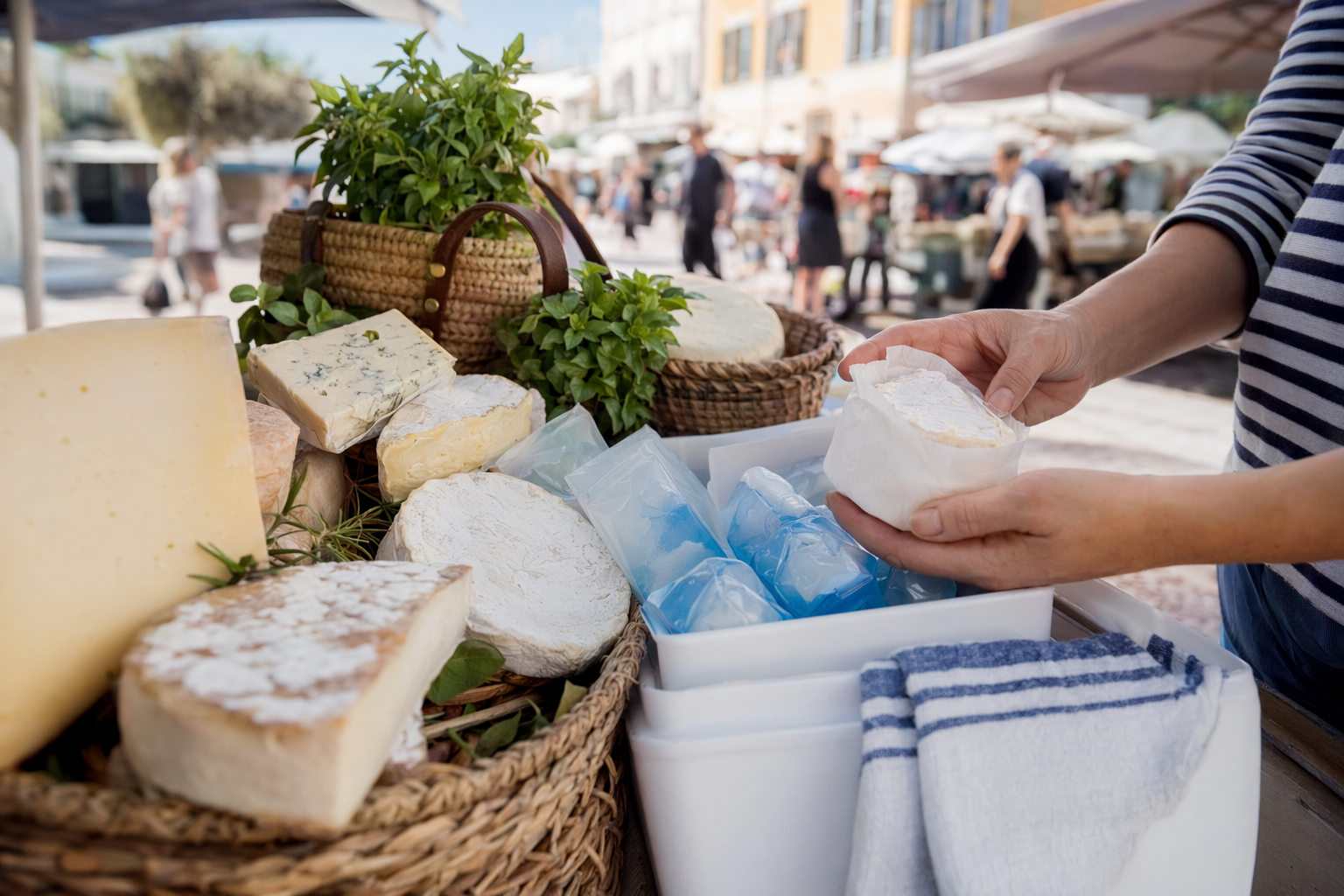
The market morning that taught me to respect a tiny round of chèvre
#I used to be dangerously casual about farmers market cheese. Like, embarrassingly casual. I’d buy a soft little puck of goat cheese at 10 in the morning, toss it into my tote next to peaches and postcards, then wander around some sunny town for hours pretending I was living inside a French film. Very romantic. Also kind of dumb. The wake-up call happened in Santa Fe, where me and my sister had gone for a long weekend of chile, galleries, and pretending we were not winded by the altitude. At the Saturday farmers market, I bought this ash-rubbed chèvre from a local dairy, still cool from the vendor’s cooler, creamy in that grassy, lemony way that makes you want to cancel all dinner plans and just eat bread on a bench. I had one sad little gel pack in my bag. By noon it was warm as a bath. By 2 p.m., the cheese smelled... not wrong exactly, but not right either. I threw it away and sulked for the rest of the afternoon.
That was the day I finally accepted that farmers market cheese is travel food, yes, but it is not casual travel food. Especially soft cheese. It needs a little planning, a cooler brain, and, honestly, a tiny bit of humility. Because the cheese counter at a market is always seductive. The vendor is usually lovely, the samples are amazing, the label is hand-written, there’s a dog nearby wearing a bandana. You feel safe. But bacteria don’t care that you’re on vacation or that the cheese was made by someone named June who milks goats at sunrise. Food safety guidance from the USDA is pretty clear on the basics: perishable foods should not sit in the danger zone, between 40°F and 140°F, for more than two hours, and if it’s over 90°F outside, that window shrinks to one hour. Farmers markets, beaches, rental cars, and summer sidewalks are basically designed to test that rule.
Soft cheese is the diva of the market bag
#Hard cheeses travel better. They just do. A wedge of aged cheddar, comté, manchego, or a proper dry jack has less moisture, more salt, and usually a sturdier personality. Soft cheeses are different animals: fresh chèvre, brie, camembert, ricotta, queso fresco, feta in brine, burrata, fromage blanc, creamy blue cheeses, those little bloomy-rind disks that look innocent until they turn into soup. They’re wetter, more delicate, and often meant to be eaten fresh. That’s exactly why I love them, by the way. A fresh goat cheese with market strawberries and a crusty roll is one of my favorite lunches on earth. But that moisture and mildness can also make soft cheese friendlier to bacteria if temperature control goes sideways. The FDA has long warned that soft cheeses made from unpasteurized milk can be riskier, especially for pregnant people, older adults, young kids, and anyone with a weakened immune system. Pasteurized soft cheese is safer, but it still needs cold handling.
And here’s the annoying bit: you can’t always smell danger. I know we all want to believe our noses are ancient survival tools and, sure, sometimes spoiled food announces itself like a dumpster in August. But pathogens like Listeria don’t always make cheese smell or taste off. So the little nibble test, which I have absolutely done before and am not proud of, is not a real test. If a soft cheese has been warm too long, I don’t do the dramatic sniff, the debate, the “maybe it’s just funky” conversation. I toss it. Painful? Yep. Cheaper than ruining a trip with food poisoning? Also yep.
- If the cheese needs refrigeration at the stall, it needs refrigeration in your bag too. I know, obvious, but vacation brain makes us weird.
- Buy soft cheese near the end of your market visit, not at the beginning when you still plan to browse ceramics, honey, vintage maps, and every tomato in the county.
- Ask the vendor how long it can safely travel and whether it’s pasteurized. Good vendors are usually happy to talk about this stuff, and some will even add extra ice if you ask nicely.
- Use a real cooler bag with frozen gel packs, not just a cute canvas tote and optimism. Optimism is not insulation.
Ice packs are boring until they save your lunch
#I have become that person who packs ice packs before socks. I’m not saying this is an attractive personality trait, but it has improved my travel eating by about 400 percent. For market cheese, I like two frozen gel packs, one below and one above the cheese, with a small towel or paper bag between the pack and anything delicate so the rind doesn’t get weird and wet. If I’m road tripping, I use a small hard-sided cooler and a cheap refrigerator thermometer because guessing cold is where people get into trouble. The goal is to keep dairy at 40°F or below. If you’re driving in summer, keep the cooler in the air-conditioned cabin, not the trunk, which can turn into a cheese sauna faster than you’d think. I wrote more about my cooler chaos and melted ice lessons in Road Trip Cooler Food Safety: Ice Melt Packing Guide, because apparently I have enough cooler opinions for a whole seperate rant.
Air travel adds another layer of silliness. Current TSA guidance generally allows frozen ice packs in carry-on bags if they are frozen solid when you go through screening. If they’re slushy or melted, they can be treated like liquids and may need to follow the 3.4-ounce rule, unless there’s a medical exception. Solid cheese is usually fine in carry-on, but spreadable or creamy cheeses can get treated more like gels, so I don’t gamble with a giant tub of fresh ricotta unless I’m checking a bag and keeping it properly chilled. Even then, checked luggage sits who-knows-where for who-knows-how-long. For flights, I usually buy harder cheese, vacuum-sealed if possible, and save the fragile soft stuff for eating nearby. Is that less whimsical? Maybe. But airport security arguing over brie is not the kind of food memory I’m trying to collect.
The best cheese mornings are always a little messy
#Some of my favorite travel days have started at markets. The Ferry Plaza Farmers Market in San Francisco, fog still hanging around the bay, coffee in one hand and a bag of fruit in the other. Union Square Greenmarket in New York, where you can build an entire hotel-room dinner from bread, apples, pickles, and a sharp local cheddar. Dane County Farmers’ Market in Madison, wrapping around the Capitol with squeaky cheese curds and people who know exactly what farm their breakfast came from. Borough Market in London is more of a food hall-market hybrid and tourist storm these days, but I still love standing there with a hunk of cheese and something pickled, pretending I’m not in everyone’s way. And in France, even a small town market can ruin you for supermarkets forever. You buy a little chèvre, a baguette, a tomato that actually tastes like tomato, and suddenly lunch becomes a religious occassion.
But every destination has its own cheese rhythm. In Vermont, I lean hard into aged cheddar and goat cheese with cider. In northern California, I want soft-ripened cow and goat cheeses with sourdough and stone fruit. In Oaxaca, I’m not carrying around soft French-style cheese at all, I’m eating queso Oaxaca melted into tlayudas while it’s hot and stretchy, because that’s the point. In Spain, I’d rather buy a wedge of manchego for the train and spend my soft-cheese energy on a restaurant plate where someone else handles the fridge. Food travel gets better when you stop forcing one fantasy onto every place. The local climate, the transport, the cuisine, even the market opening hours all matter. Cheese safety isn’t separate from culture, really. It’s part of how you eat well without being an idiot about it.
How I decide what cheese to buy when I’m away from home
#- First, I ask myself where I’m going next. If the answer is “straight back to a hotel with a fridge,” I might buy soft cheese. If the answer is “a museum, two buses, a beach walk, and then maybe dinner,” I buy aged cheese or I don’t buy cheese at all. Tragic, but adult.
- Second, I look at how the vendor stores it. Is the cheese on ice or in a refrigerated case? Are samples covered? Are they using clean utensils? A busy stall is usually a good sign because turnover matters, but busy isn’t magic. I’ve walked away from popular stalls when the sample plate looked tired and sweaty.
- Third, I ask about pasteurization and timing. “Is this made with pasteurized milk?” and “How long can this be out if I have ice packs?” are not rude questions. They are normal questions. If a vendor gets cagey or dismissive, I get cautious.
- Fourth, I buy small. Tiny cheese is travel cheese. A little round you can eat at lunch is better than a giant beautiful wedge you babysit all day and then throw away after it gets warm. I learned this the expensive way, naturally.
The picnic test, also known as “am I actually going to eat this soon?”
#There is a specific fantasy that happens at farmers markets: you imagine a picnic. You can see the blanket, the bread, the grapes, the soft cheese, maybe a bottle of something cold, everybody laughing in golden light. I love that fantasy. I chase it constantly. But the real picnic test is boring and practical. Can you keep the cheese cold until you eat it? Will you eat it within the safe time window once it comes out? Is there shade? Do you have a knife, napkins, and a plan for leftovers? If not, buy something else. I’ve got a companion piece on exactly that hard-versus-soft decision, including hotel fridge weirdness and picnic planning, here: Supermarket Cheese While Traveling: Fridge and Picnic Tips. It’s basically the article I wish I’d read before carrying brie through a humid afternoon in Charleston like a fool.
My personal rule: if the cheese is soft, creamy, fresh, or brined, it gets treated like seafood. Cold, quick, and not left in the sun while I take 87 photos of flowers.
Hotel fridges are their own little adventure. Some are barely cold, some freeze lettuce into green glass, and some are actually minibars with sensors that charge you if you breathe near the peanuts. When I’m depending on a hotel fridge for cheese, I check it early. Put a drink in, see if it actually chills. Keep cheese in its original wrapping if possible, then tuck it into a zip bag or container so your room doesn’t smell like a cave by midnight. Also, don’t put warm cheese into a weak mini fridge and assume it’ll magically recover. Refrigerators are better at keeping cold food cold than rescuing food that has been warm for hours. That sounds like something my dad would say, which is annoying because it’s true.
When I walk away from cheese, even when it hurts
#I hate walking away from good-looking food. It feels wasteful somehow, like I’m disrespecting the place. But travel has made me more picky in a useful way. If soft cheese is sitting in the open air on a hot day with no visible ice or refrigeration, no thanks. If samples are cut and left uncovered while flies are having a meeting on them, absolutely not. If the vendor handles cash and then grabs cheese with bare hands, I suddenly remember I have somewhere else to be. This is the same instinct I use at night markets and street stalls: look for turnover, temperature control, clean hands, clean tools, and food that is either kept properly cold or served properly hot. If you’re comparing market habits across different kinds of stalls, Night Market Food Safety: Traveler’s Hot-Food Checklist is a handy one to keep in your back pocket.
- Cold foods should feel cold, not cool-ish, not “probably fine,” and not room temp with a decorative leaf on top.
- Melted ice water is not the same as refrigeration. If packages are floating around in dirty cooler water, I get skeptical fast.
- Vacuum-sealed does not mean shelf-stable. Lots of vacuum-packed cheeses still need refrigeration, so read the label or ask.
- If you’re in a higher-risk group, be extra careful with soft cheeses, especially unpasteurized ones. This is not the time for travel bravado.
Cars, trains, ferries, and the weird geography of cheese travel
#Every form of transport changes the cheese equation. Cars give you control, which is great, but they also tempt you into overbuying because “we have a cooler” becomes a dangerous sentence. Trains are my favorite for cheese because you can actually eat like a civilized person, with bread and fruit on your lap while the countryside does its thing outside the window. But train stations can be warm, and delays happen, so I still pack cold. Ferries are romantic until you realize your tote has been sitting in direct sun on a metal deck. Buses are the hardest, in my opinion, because bags get shoved under seats or into luggage compartments and you lose track of the temperature. If I’m taking a long bus, I usually skip soft cheese entirely and go with nuts, fruit, hard cheese, or something shelf-stable.
Crossing borders with cheese is another place where people get tripped up. Rules vary a lot by country, and they can depend on whether the cheese is dairy, raw milk, fresh, commercially packaged, for personal use, or coming from a specific region. The safest advice is painfully unsexy: check the customs rules before you travel and declare food when required. Do not hide cheese. I know that sounds funny, like some noir film called The Smuggled Camembert, but agricultural rules exist for real reasons. I’ve carried packaged cheese within some regions without issue, and I’ve also eaten everything before the airport because I wasn’t sure. Honestly, that’s not the worst outcome. Sitting at a gate eating excellent cheese with crackers from your bag is a very underrated travel meal.
A few of my market cheese meals I still think about
#There was a morning in Marin County where I bought fresh chèvre, dry-farmed tomatoes, and a loaf that was still warm enough to fog the bag. I ate it in the car because we couldn’t find a picnic table and I had tomato juice running down my wrist. Not elegant. Perfect though. In Montréal, I bought cheese curds so fresh they squeaked like little rubber boots and ate them before they had any chance to become a safety question. In Provence, I once bought a tiny goat cheese from a woman who looked at my cooler bag and gave me an approving nod, which felt better than any passport stamp. And in Wisconsin, I learned that fried cheese curds are safest when they are hot, fast, and eaten immediately, preferably while standing near people who have strong opinions about football.
The funny thing is, safety planning doesn’t make these moments less spontaneous. It makes them possible. If I’ve got cold packs ready, I can buy the cheese I actually want instead of worrying for three hours. If I know I’m heading straight to a park, I buy bread too and make lunch happen. If it’s too hot or the route is too long, I pivot. Maybe I eat at the market stall instead. Maybe I ask the cheesemaker where their cheese is served locally and go there later. That’s one of my favorite travel moves, by the way. Vendors often know the best restaurants, bakeries, cideries, and little shops nearby. Ask, and you recieve these tiny local maps made of appetite.
My not-fancy cheese safety kit
#I don’t travel with a full kitchen, I promise. I’m not opening a lab in my backpack. But I do carry a few things if I know markets are part of the trip: a soft insulated lunch bag that folds flat, two small gel packs if I’ll have freezer access, a zip-top bag or two, a few napkins, a tiny cheese knife if I’m not flying carry-on, and sometimes a cheap thermometer for road trips. If I’m staying somewhere with no freezer, I’ll ask the hotel if they can freeze an ice pack overnight. Some will, some won’t, and occasionally they look at you like you’ve asked them to store a raccoon. In that case, I buy ice locally, double-bag it, and keep it away from paper-wrapped cheese so everything doesn’t turn into damp sadness.
Also, label reading matters more than people think. “Keep refrigerated” means exactly that. “Best by” is not a permission slip to warm it up all day. Raw milk cheese can be legal and delicious, especially aged styles made by skilled producers, but fresh or soft raw-milk cheeses are where I get more cautious. In the U.S., federal rules around raw milk cheese include aging requirements for certain cheeses, but that does not mean every cheese is equally low-risk, and state rules or market practices can vary. When in doubt, I ask. If I still feel unsure, I buy something aged and firm, then spend my soft-cheese money at a restaurant where the chef has refrigeration and I have a fork.
The sad truth about leftovers
#Leftover soft cheese from a travel picnic is where my heart and brain fight. My heart says wrap it up, it was expensive, you’ll eat it later with wine. My brain says how long was it out, how hot was it, did everyone’s knife touch it, did it sit beside sliced salami in the sun, and why is there sand in the wrapper? If soft cheese has been out for more than two hours, or one hour in serious heat, I don’t save it. If it stayed cold in the cooler and only came out briefly, fine, back into the cold it goes. But once cheese has done a long warm picnic shift, leftovers become a gamble. I hate this. I also hate stomach cramps in a rented apartment bathroom more.
One practical trick: portion before the picnic. Keep most of the cheese cold, take out only what you’ll eat, and don’t let the communal knife wander through every jar on the blanket. This is not about being fussy. It’s about making the food last and keeping the vibe good. Nothing kills a dreamy travel day like everyone quietly wondering if the cheese was “supposed to taste like that.” And yes, some cheeses are funky on purpose. That’s what makes this confusing. Funky is good when it’s controlled, cold-chain-respected, cheesemaker-intended funk. Warm, slimy, accidental funk is a different genre.
So, should you buy the soft cheese?
#Yes. Sometimes. That’s my deeply unhelpful but honest answer. Buy the soft cheese when you can keep it cold, eat it soon, and trust the vendor’s handling. Skip it when the day is hot, your plans are vague, or you’re crossing borders with no clue what customs allows. Choose hard cheese when you need something forgiving. Eat fresh cheese right near the market when you can. Ask questions. Carry ice packs. Don’t be embarrassed to be the person with the insulated bag, because that person is eating better later.
Food travel is partly about surrendering to a place, but it’s also about paying attention. The best market lunches I’ve had were not reckless. They were just prepared enough: cold cheese, good bread, local fruit, a shady bench, maybe a view if the travel gods were feeling generous. And when it all works, when that soft cheese is still cool and creamy and tastes like the farm it came from, it’s worth every slightly nerdy ice pack in your bag. Anyway, if you’re also the kind of person who plans trips around markets, snacks, and one perfect picnic, you’ll probably find more rabbit holes to enjoy over on AllBlogs.in.