For a first Camino de Santiago, count your walking days before choosing your starting town. Compare one short section of the Camino Francés, the Portuguese Way or the English Way, then check the longest day, overnight stops and transport at both ends. If earning the Compostela matters to you, confirm the route and credential requirements before booking.
The Camino is a network of pilgrimage routes to Santiago de Compostela. You could arrive there on a walk that began in France, Portugal or another part of Spain. You could also spend a few days on a section and finish your trip before Santiago. Those trips call for different plans even though both involve walking the Way.
Choose the kind of walk you want
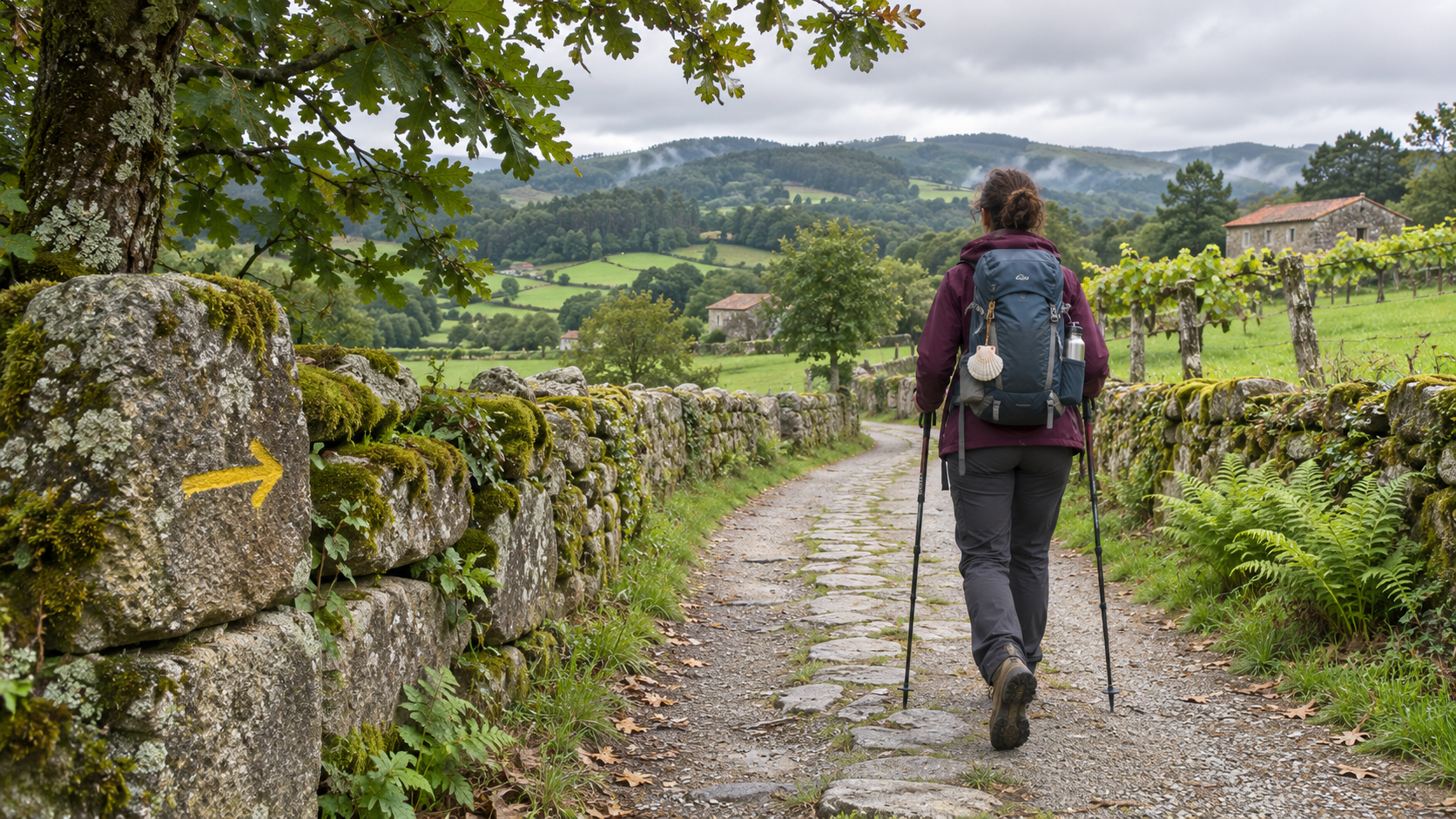
#The French Way is one of the best-known routes and a useful starting point for comparing stages. Sarria lies on its Galician section. Looking at Sarria as a start lets you plan several consecutive walking days without taking on the entire route. Farther back, starting in a different landscape brings more walking days and different terrain. Compare the section you will actually walk.
The Portuguese Way offers inland and coastal variants. Tui is a point to investigate on the inland route, just across the River Miño from Valença in Portugal. If you are drawn to time by the sea, study the coastal route separately. A route labelled “Portuguese” can lead through quite different towns and terrain. The variant matters when you book a bed, choose a transfer or check the distance that counts towards a certificate.
The English Way has a connection to pilgrims who reached northern Galicia by sea. Ferrol and A Coruña are two starting points documented by Galicia's official route guide. They lead into the same wider network, but they are different walks. A Coruña is a shorter start, so do not assume it satisfies the same certificate conditions as leaving from Ferrol. Check with the Pilgrim's Reception Office before putting any plan together around a particular credential outcome.
| Route to look at | Why it might fit | Check before choosing it |
|---|---|---|
| French Way from Sarria | You want to compare stages on a well-known route through Galicia | How the longer stages fall, where you could split them, and which beds suit your dates |
| Inland Portuguese Way from Tui | You want a border-town start and a route through towns such as Pontevedra and Padrón | How you will reach the starting point and which route variant your map uses |
| Portuguese Coastal Way | You want part of your route to follow the coastline before heading inland | Crossings, weather exposure and where the coastal route joins another path |
| English Way from Ferrol | You want a route shaped by Galicia's maritime pilgrimage history | Which stages have lodging and services that fit your daily pace |
When two routes still look good, choose one first day from each and look at it in detail. Check where you would start, where you would eat and whether the evening stop helps the next morning. That is often enough to make a choice that a photograph of Santiago cannot make for you.
Keep travel days separate from walking days
#Start with the time between leaving home and getting home. Remove the time to reach the first town and leave Santiago. Set aside any time you want in the city itself and a buffer that you would be comfortable spending on a missed connection, weather disruption or rest. The days left are the ones you can fairly give to walking.
Imagine you have eight calendar days. If you use one to reach your start, one to travel home and one for a buffer or time in Santiago, you have five planned walking days. That tells you what to compare. It does not mean any route advertised as a five-day trip will fit. Look at the hardest day on it, then ask whether you could do it after the walking scheduled the day before.
If you have only three walking days, consider a shorter part of a route. For example, you can make a trip out of walking a few stages and returning another time. If you intend to return and apply for the Compostela, check the rules on consecutive staged walks and stamps before starting. A straight walk from one village to the next is a simpler goal if you just want to see what walking the Camino feels like.
Check how you will reach your chosen start before paying for accommodation. Look up your exact date, day of the week and any gaps between connections. Rail or bus service to a nearby town does not mean there will be a suitable connection to the place you want that evening. Allow time to find your stay, eat and prepare for walking. On the last day, a tight onward ticket can leave little room to enjoy arriving or respond to any delay on the trail.
Plan each stage from a real overnight stop
#Take one official stage as a reference. Galicia's route guide lists Sarria to Portomarín as roughly 22 kilometres and describes an early descent, a climb near the start and stairs into town near the end. If 22 kilometres sounds manageable on paper, look at those details alongside what you will be carrying. A steep stretch at the start and steps after hours of walking are useful information that the total alone hides.
For another reference, the Portuguese Way stage from Redondela to Pontevedra is listed at about 18 kilometres by the Galicia route guide. The official page describes a route through villages before approaching Pontevedra. An 18-kilometre itinerary on a booking site could use slightly different endpoints. Use the same route and accommodation locations when working out what you will walk that day.
Make a small stage note for each day. Mark the town you will leave, the place where you will sleep and any lodging detour. Check the terrain, how much daylight you will have and the longest gap between services that you have actually verified. If there is one café you are counting on, check whether it opens on your date and carry a reasonable fallback.
Try your walking pace ahead of time with the shoes and load you expect to use. If you comfortably cover four kilometres in an hour on similar ground, a 22-kilometre day would already mean about five and a half hours of moving time at that pace. That example excludes breakfast, a wrong turn, hills that slow you down and stops. It is a way to check the shape of a day, with plenty of room to adjust your assumptions.
A stage can be split when there is a confirmed place to stay and you can resume where you stopped. An intermediate place marked on the map may have very few beds or limited food options. Check it before changing the rest of your bookings. On the first few days, leave enough time to see how walking on consecutive days feels. There is little value in stretching the first day just because a route table makes the total look tidy.
Make accommodation work with your pace
#An albergue is a hostel often serving pilgrims. Public pilgrim hostels and privately run albergues can have different rules, arrival windows, facilities and payment methods. Guesthouses and small hotels can make sense if you need a predictable booking, a private bathroom or more flexibility on rest days.
Galicia's public hostel guidance describes beds allocated on arrival and asks pilgrims to show a credential. Verify the current policy of the actual hostel before you rely on a place. Private properties can have their own reservation rules. If a bed is essential for accessibility, a dietary need or the rest of your group's plan, confirm the relevant detail directly rather than inferring it from a listing.
Check the distance to your bed from the route, the last check-in time, whether there is a way to get dinner nearby and when you need to leave in the morning. A place outside the centre may add walking after you are already tired. If an evening meal is included, ask about its timing and your dietary requirements before booking. If you plan to cook, check whether the hostel actually has the facilities and utensils you need.
Keep one backup for places where you have few options. Record a possible alternative town or stay, and check how you would get there if the original bed were unavailable. Be careful about making a longer next stage your only fallback. It is easier to manage a change when you know which leg can move and what that does to the following day.
Get the credential details straight before you go
#The credencial is the pilgrim credential that you carry and have stamped along the route. The Compostela is the certificate issued by the cathedral under the Pilgrim's Reception Office's conditions. The credential records your progress and is also relevant for access to certain pilgrim hostels. It does not guarantee an award or a bed.
The office's current detailed requirements describe at least 100 continuous kilometres on the same recognised route for walking pilgrims, with the route including the final stage into Santiago. For a recognised walk that starts outside Spain, the office also specifies a minimum distance walked within Spain. The Compostela has a stated religious purpose, and there are conditions and exceptions. If your plan involves an unusual start, breaks between trips or a short route, have the office clarify how the requirements apply.
Get an accepted credential before the walk or check where you can pick one up at the start. Follow the office's stamping instructions for your exact plan. In particular, if you are completing the minimum distance in stages, the office describes dated stamps at the start and end of each stage to show continuity. Keep your start and finish points clear in your notes and check the current requirements for stamps along the way.
Walking a short section can be worthwhile even if it does not satisfy the conditions for the Compostela. If you need a break or transport because carrying on would be unsafe, take it and ask the office about the certificate implications separately. Your transport decision should be based on what is sensible for the day you are having.
Pack for the stretch you are actually walking
#Start with shoes you have already used for longer walks, layers for the expected weather, a way to carry water, and whatever you need to keep clothes and documents dry. Take a practice walk with the packed bag. If the bag is uncomfortable on a local route, you have an opportunity to change it while you are close to home.
If you plan to have a bag moved, check that the service covers your route, dates and properties. Ask where and when each bag must be left, what happens if your bed changes and when you should expect delivery. Keep essentials including identification, the credential, any personal medication, water and weather layers with you. They need to follow your walking day.
Check trail notices, daylight and forecasts for the actual section. A route with plenty of services in one month may have fewer useful stops in another. A sunny morning does not remove the need for a plan if the day changes. Save your stage notes and a map for offline access, and make sure someone has enough of your plan to know where you expected to stop.
Shared accommodation also has its own rhythm. Check quiet hours, prepare your pack before others go to sleep, and leave drying and storage areas available for the next person. Follow local signs and stay on the marked path where directed. The Camino passes through communities where people work and live. It helps to treat a village stop as a visit rather than an entitlement to a bed, meal or stamp.
Put your route on one page before you book
#Write down your starting town, route variant, each overnight stop and your final destination. Add a date, approximate distance, terrain note and food or water check for each day. Mark the longest stage so you can see where a shorter alternative might make a difference. Write the transport details at each end separately.
Then do one realistic run-through from the first arrival to the last departure. Check what happens if you arrive late at your start, need to split a long day or reach Santiago later than planned. If you have one day to spare, decide which commitment you can move if you use the buffer early. If certificate eligibility matters, confirm it before paying for the travel that depends on it.
Once the first town is reachable, the stages fit your pace and you understand your overnight options, you have enough to start making decisions. Choose the route and dates that let you enjoy walking the next morning as well as getting to the finish.