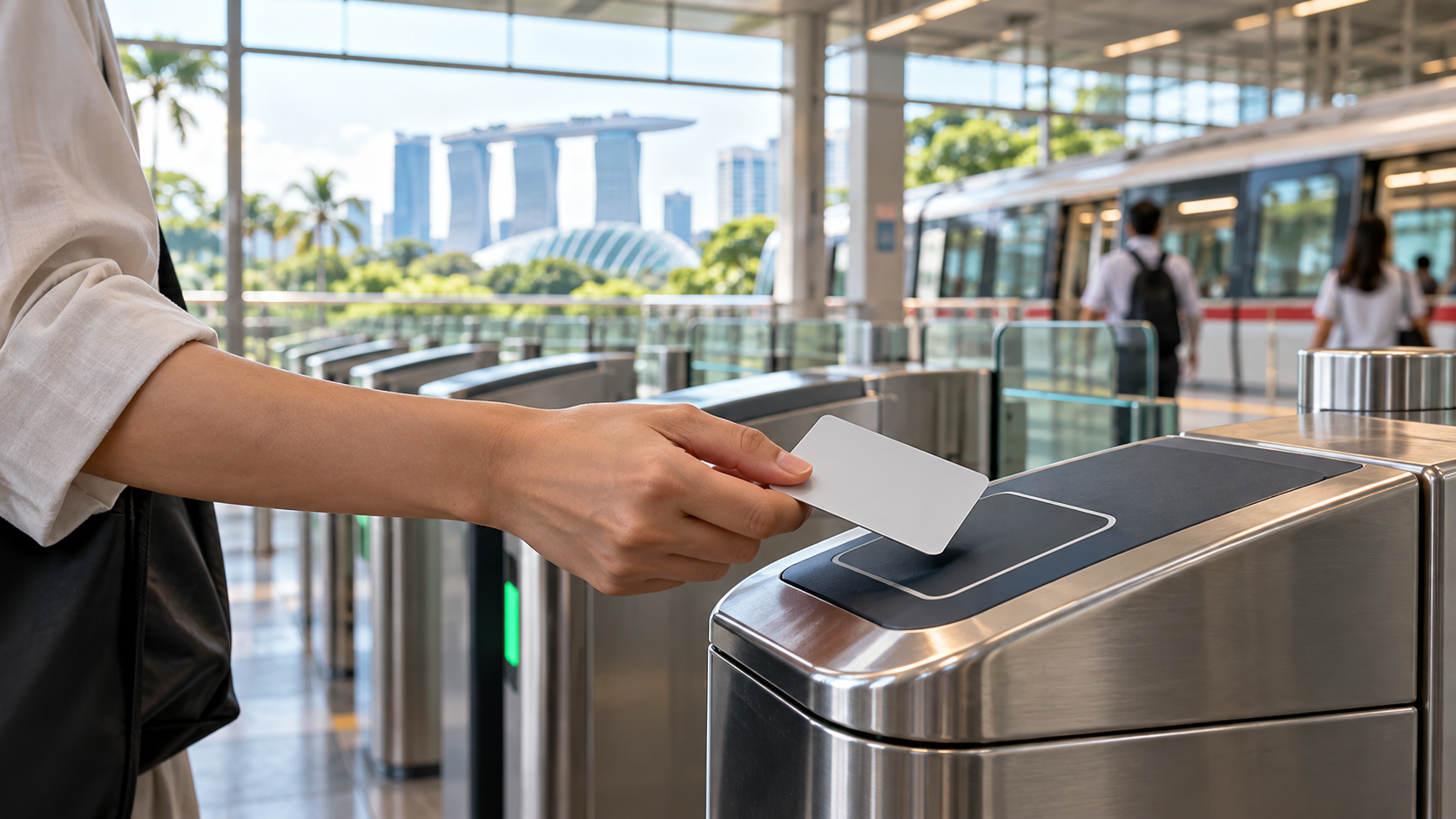
For a short Singapore visit with a few MRT or bus journeys each day, an accepted contactless bank card is often the simplest place to start. An EZ-Link card can make sense if you want a separate travel budget, already own a usable card, or will travel long enough for foreign-card fees to add up. The Singapore Tourist Pass deserves a calculation when you plan several busy days of covered public transport.
The pass does not become cheaper just because you visit several attractions. You may spend most of a day inside one attraction, walk between nearby places, or take a taxi home. Count the journeys you expect to pay for, then compare the total.
The prices and rules below were checked against SimplyGo, the Singapore Tourist Pass operator and the Public Transport Council on 24 October 2026. All amounts are in Singapore dollars. The worked budgets are examples, not quotes for named station pairs.
Compare the full cost of each option
#The three choices charge you in different ways. A Tourist Pass buys a period of unlimited covered travel. Contactless payment charges individual fares to your bank card. A normal EZ-Link card holds money that you spend on individual journeys.
SimplyGo is the payment system, so “SimplyGo versus EZ-Link” can be a confusing comparison. SimplyGo supports bank cards as well as SimplyGo EZ-Link cards. Buying a stored-value card does not buy unlimited rides.
| Option | What you pay | Main reason to choose it |
|---|---|---|
| Singapore Tourist Pass | Fixed pass price for consecutive days of covered travel | You expect enough covered fares to justify it, or value a fixed transport budget |
| Accepted contactless bank card or mobile wallet | Adult card fares, with applicable foreign-card and bank fees | You want to start travelling without buying or topping up a travel card |
| Standard EZ-Link card | Card purchase cost plus fares, with any top-up fees and unused balance to consider | You want a dedicated card or already have a usable one |
For a new standard EZ-Link card, the advertised S$10 purchase includes S$5 of travel value and a S$5 non-refundable card cost. That distinction matters. If you later spend S$18 on fares, your basic economic cost is S$23: S$18 in travel plus S$5 for the card. Adding S$10 and S$18 would count the initial travel value twice.
Also separate cost from cash committed. You might load more than you eventually use. That remaining balance still belongs in your departure plan, even though it is not another completed journey.
Singapore Tourist Pass prices and the days you actually get
#The current standard Singapore Tourist Pass offers these durations:
| Pass | Price | Price divided by covered days |
|---|---|---|
| 1 day | S$17 | S$17.00 |
| 2 days | S$24 | S$12.00 |
| 3 days | S$29 | About S$9.67 |
| 4 days | S$37 | S$9.25 |
| 5 days | S$45 | S$9.00 |
Use the whole pass price when deciding. The daily average helps you understand the offer, but you cannot buy one S$9 day by choosing part of a five-day pass.
A pass day runs from first use until the end of public transport service for that day. It is not a rolling 24-hour period. Multi-day passes require consecutive days. If you first use a three-day pass on Friday evening, Friday counts as the first day; you do not get three full days starting on Saturday morning.
This can change the sensible purchase. Imagine arriving on Thursday evening, sightseeing Friday through Sunday and leaving Monday morning. Compare a three-day pass for the busy middle days plus separate arrival and departure fares against a five-day pass. Five dates in Singapore do not automatically mean five days of heavy transport use.
The operator currently describes the pass as non-returnable and non-refundable. Base your budget on the advertised current price, rather than subtracting a refundable S$10 deposit you may have seen in older information. The pass also starts without a separate stored-value balance for other spending.
The standard pass covers MRT, LRT and basic public buses. It excludes services including Sentosa Express, RWS8, M2–Khatib Bus, express buses and other premium or niche services. Put those charges outside the comparison. A day centred on Sentosa or another attraction may involve less covered travel than a day moving around the city.
The foreign-card fee is small per day, but worth counting
#SimplyGo specifies a S$0.60 fee per day of use for foreign-issued Mastercard or Visa debit and credit cards. It is a daily fee for using that card, rather than S$0.60 on each journey. Your issuing bank may charge separate foreign transaction or currency conversion fees. Singapore-issued bank cards do not incur this foreign-card administration fee.
For the comparisons here, a foreign Visa or Mastercard therefore costs:
Planned adult card fares + S$0.60 × days used + issuer fees.
Three travel days add S$1.80 before bank fees. Five add S$3.00. A day when you walk or use only taxis should not be counted as a day of transit-card use in this estimate.
SimplyGo also accepts eligible foreign-issued American Express cards. Its specific foreign-card fee wording names Mastercard and Visa; do not assume identical fees across card schemes. Check your card's eligibility and issuer terms before relying on it.
The relevant question is what your existing card will cost for this trip. If it has a high fee or an awkward minimum charge, include that. If your bank charges no foreign transaction fee, keep the calculation simple. There is little value in buying another card merely to avoid S$1.80, then paying more in purchase costs.
Work out the break-even point from your fares
#Let F mean the total adult card fares for journeys covered by the pass. Compare the same dates and services on both sides.
For a three-day pass against a foreign Visa or Mastercard used on all three days, the arithmetic is:
S$29 pass versus F + S$1.80, before issuer fees.
The pass is cheaper once covered fares exceed S$27.20. At exactly S$27.20, the two totals tie before bank fees. Against an existing usable EZ-Link card with no purchase or top-up fee to recover, the threshold is S$29 in fares.
For a new standard EZ-Link card, adding its S$5 card cost means the three-day pass beats it once comparable fares exceed S$24, before top-up fees and unused balance. This does not prove the pass wins overall: the bank-card option may still cost less than both.
| Pass | Covered fares needed to exceed pass cost using foreign Visa/Mastercard on every covered day, before issuer fees |
|---|---|
| 1 day, S$17 | More than S$16.40 |
| 2 days, S$24 | More than S$22.80 |
| 3 days, S$29 | More than S$27.20 |
| 4 days, S$37 | More than S$34.60 |
| 5 days, S$45 | More than S$42.00 |
These are thresholds in fares, not a promised number of rides. Several short journeys can cost less than fewer long ones. A cheaper pass needs to beat the payment option you would actually use, with your fees included.
Three worked budgets: light, busy and extended stays
#The Public Transport Council's current adult card table lists S$1.28 for a journey up to 3.2 km, S$1.75 for 7.3–8.2 km and S$2.30 for 20.3–21.2 km on basic services. The examples use those published distance bands to show the calculation. Check your own station pairs or bus journey in the official fare tools; these figures do not assign distances to particular landmarks.
Each example assumes separate chargeable journeys, no early-morning discount, no concession eligibility and no issuer fee. The EZ-Link totals assume a new standard card, with all travel value used or recovered and no top-up convenience fee.
A relaxed one-day visit
#Suppose you make two longer journeys at S$2.30 each and two short journeys at S$1.28 each. That might represent travelling in and out of your main sightseeing area, with two additional local outings.
Your fares total S$7.16. A foreign Visa or Mastercard used that day costs S$7.76 before issuer fees. A new EZ-Link card brings the economic total to S$12.16, including its S$5 card cost. The one-day Tourist Pass costs S$17.
Contactless wins this example by S$9.24 against the pass. Even if you add one more S$1.75 journey, the pass remains far from breaking even. A full sightseeing day can still involve only a few paid journeys.
Three busy sightseeing days
#Now assume six separate S$1.75 journeys each day, with enough time between stops that these are new journeys rather than qualifying transfers. Daily fares come to S$10.50; three days total S$31.50.
The foreign-card total is S$33.30 before issuer fees. A new EZ-Link card costs S$36.50 including purchase cost. The S$29 three-day pass saves S$4.30 against the foreign card and S$7.50 against the new EZ-Link card.
That is a useful saving if the plan is realistic. But remove three S$1.75 journeys because you decide to stay longer at one place and walk elsewhere, and total fares fall to S$26.25. With S$1.80 admin fees, the foreign-card total becomes S$28.05, below the pass price.
This is why a small apparent saving deserves a second look. Do not add journeys you would not otherwise take just to make the pass feel worthwhile.
Five days with a slower pace
#Suppose you make four separate S$1.75 journeys per day for five days. Fares total S$35. A foreign card adds S$3 in daily fees, giving S$38 before issuer charges. A new EZ-Link card brings the economic total to S$40. The five-day Tourist Pass costs S$45.
The longer pass has the lowest daily average in the range, yet still loses this comparison. Length of stay and intensity of travel are separate questions.
If those same five days instead contain six such journeys daily, fares reach S$52.50. The S$45 pass then beats S$55.50 on the foreign card and S$57.50 on a new EZ-Link card under the stated assumptions. Replacing the assumed journeys with your real plan matters more than choosing by trip length.
Count journeys carefully: changing trains is not another full fare
#Singapore uses distance-based fares. A qualifying transfer can form part of one journey, so counting every train or bus boarding as a fresh full-price trip can exaggerate your pay-as-you-go budget.
SimplyGo's rules allow up to five transfers within a journey, with limits including 45 minutes between train and bus or different bus services, 15 minutes between different train stations, and two hours between the first and last boarding. Other restrictions apply, including repeating the same bus service and exiting and re-entering the same station.
For planning, distinguish a connection from a visit. Changing train lines to reach a museum is part of reaching that destination. Leaving the system, spending several hours there and travelling to dinner creates a different pattern. Use the fare calculator for the full journey rather than adding a minimum fare for each line on a map.
Build your budget from hotel to first stop, meaningful stops through the day, and the journey back. Add airport travel on the dates you expect to take public transport. Keep taxi plans and excluded services in a separate column so they cannot inflate the pass's apparent value.
EZ-Link can save money, but top-ups affect the result
#An existing usable EZ-Link card changes the comparison because you no longer need to recover a new card's S$5 cost. For a new card bought only for this visit, that S$5 equals just over eight days of S$0.60 foreign-card fees. The ninth used day is where avoided daily fees exceed S$5, assuming equal fares and no other costs.
That is a narrow calculation. SimplyGo charges for foreign-bank-card top-ups at Assisted Service Kiosks and Top-Up Kiosks: S$1.10 for a top-up of S$30 or less, and 4% for more than S$30. Cash is an alternative at the supported kiosks. Your bank may add its own charges.
Two S$10 top-ups with a foreign bank card would add S$2.20 in kiosk fees. In a short stay, that can wipe out the admin fees you hoped to avoid. Check the funding method before choosing EZ-Link on price.
Avoid loading a large amount simply to stop thinking about fares. Estimate what you need, leave time for any remaining-value enquiry before departure, and check the conditions for your exact card. The non-refundable card cost and unused travel value are different things; a refund of value does not make the card itself free.
Buy and use the option that fits your plan
#For the Tourist Pass, check the specific sales or collection point and its opening hours. The operator lists Changi Airport MRT kiosks at Terminals 2 and 3, with current hours of 5 am to midnight. A sales point being open does not guarantee a train is still running for your destination.
Automated Tourist Pass kiosks sell passes and redeem eligible online purchases; they do not top up stored value. Online buyers should read their confirmation for the correct collection location. Do not assume that a purchase confirmation alone replaces collecting the physical pass.
For bank-card travel, you do not need a SimplyGo account to begin. Set up the app if you want trip history and fare details. Enable overseas use with your issuer where required, and keep enough available funds or credit.
Tap in and out with the same card or the same mobile wallet on the same device. A physical card and the phone version of that card are different payment methods for matching your journey. Using your phone to enter and plastic card to leave can create separate transactions. Take the intended card out of your wallet to avoid presenting several cards at once.
Give each traveller their own suitable payment method. Keep a backup accessible, and charge the phone you plan to use. If a gate rejects a payment method or you mix methods during a journey, ask station staff for help; use the SimplyGo trip record to investigate a fare rather than guessing from one bank notification. Transit charges can appear as accumulated amounts, so one statement entry need not equal one ride.
Choose after checking your busiest realistic days
#Start with the journeys you expect to make, calculate covered fares, and add the actual fees for your payment option. Compare the pass against those same dates. If you have a quiet arrival evening and three busy days, price those parts separately.
When the difference is small, convenience can decide it. A fixed pass budget may suit you even with a modest premium. An existing bank card may suit you better when plans are loose. A dedicated EZ-Link card can help you keep transport spending separate, provided its purchase and funding costs make sense.
Keep the decision proportionate. Pick a method that works for each traveller, save the important payment details, and leave enough flexibility to change plans. Use the lower realistic fare estimate if you are still unsure how much sightseeing you will manage.