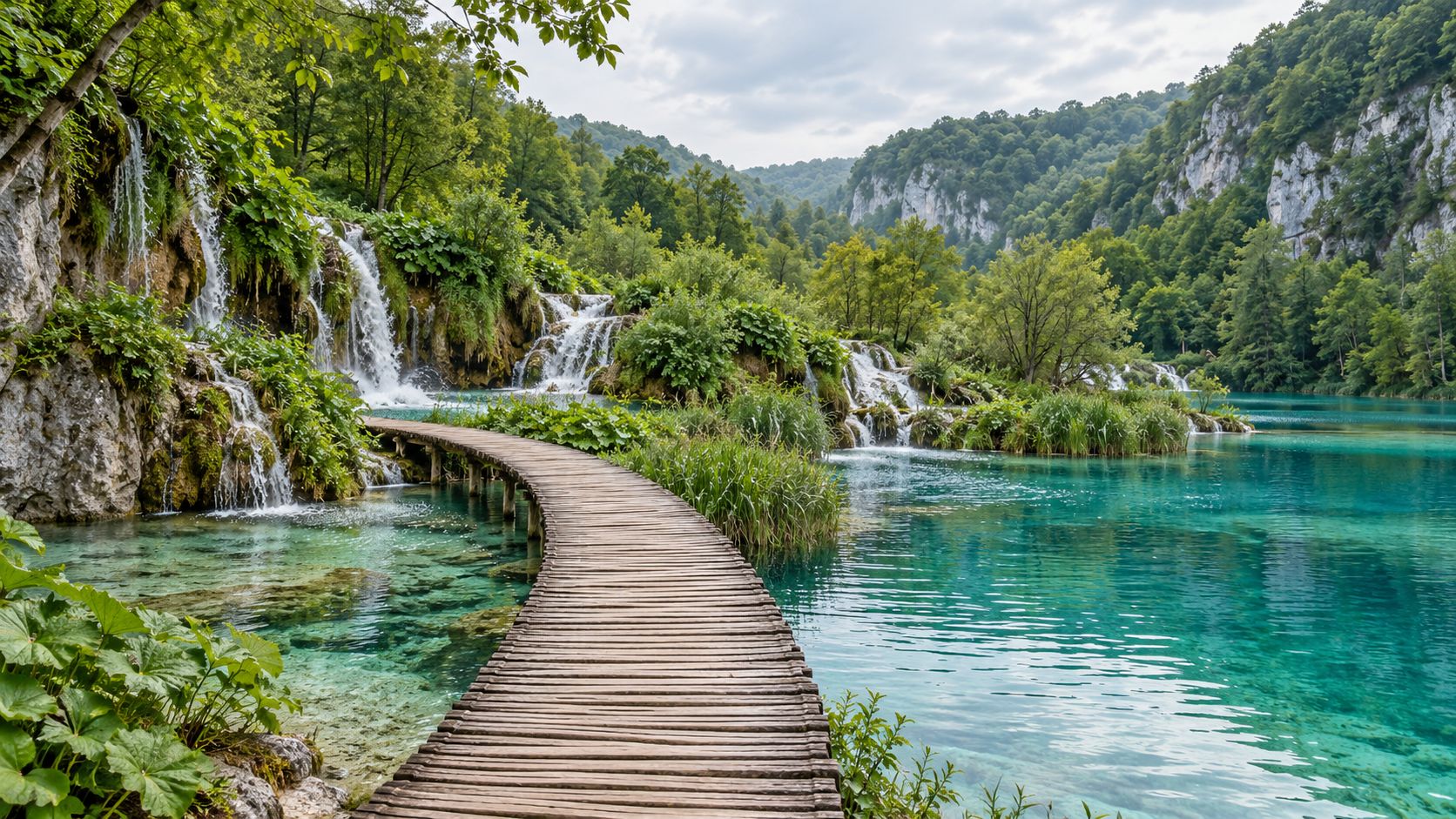
Yes, you can visit Plitvice Lakes National Park without a car. Intercity buses serve the park area, and there are bus stops near both main entrances. The difficult part is making three separate bookings agree: your arriving bus, your timed park ticket, and your departing bus. Choose the return journey first, check exactly where each bus stops, then choose a walking programme that finishes with time to spare.
This guide is for an independent visitor arriving from somewhere in Croatia, especially Zagreb or Zadar. It does not assume where you live or which passport you hold. Bus timetables, park operating hours and trail access change, so use the planning method here with the details shown for your actual travel date.
Decide whether a day trip really fits
#A day trip can work when an early bus arrives at the correct entrance and a later bus leaves enough time for the walk, breaks and the journey back to the stop. Do not judge it by road travel time alone. A bus that takes around two hours to reach the park can still leave too little time if it arrives late in the day or if the return service departs before the park's internal boat and panoramic vehicles finish operating.
An overnight stay is the calmer choice if the only practical arrival is around midday, if you want a longer Upper and Lower Lakes circuit, or if the return bus has little margin. It also helps when you are transferring between Zagreb and the coast and would rather keep your luggage in one place than hurry through a park visit between two buses. Staying nearby does not automatically make the park walkable: confirm how you will travel between your accommodation and the entrance, especially after dark or outside the main visitor season.
| Plan | Works best when | Main tradeoff |
|---|---|---|
| Same-day return | Both bus legs are confirmed and leave a generous park window | One delay can consume your walking or return-bus buffer |
| Stop between two cities | Your onward bus leaves from a confirmed stop after the route ends | Luggage and the correct direction of travel need extra attention |
| Overnight near the park | The bus timetable is awkward or you want an unhurried start | Adds a room booking and a local transfer to verify |
The park offers one-day and two-day tickets. A second park day can be useful if you genuinely want separate walks, but buying two days does not solve a missing bus connection. Build the transport plan first.
Book the bus you need, not a generic Plitvice pin
#The park's two main entrances are about 3 km apart. Both have bus stops nearby, on the road used by intercity services. That distance matters when you have a timed entry at one entrance and your bus leaves from the other. It is not a sensible last-minute connection to assume you can fix on foot, especially with luggage or in poor weather.
Search your exact date from your actual origin and check the operator's full stop name, map and direction. Zagreb and Zadar both have advertised bus routes to Plitvice, but a route page is not a promise that the bus you want stops at the entrance on your day. A booking labelled only “Plitvička Jezera” needs a closer look. If the stop description remains unclear, ask the operator before buying the park ticket. The bus stop for Zagreb-bound traffic is on the opposite side of the road from the coastal direction; do not guess from where other travelers are standing.
For a Zagreb day trip, the decision is whether the first workable arrival and a confirmed Zagreb-bound return leave enough hours inside the park. For a Zadar day trip, run the same calculation with the Zadar-bound return. A through journey, such as Zagreb to the park and then onward toward Zadar, can be efficient, but only when both buses and the chosen park entrance line up. Check where you will collect luggage before you board the onward bus.
Book the outbound and return as separate decisions even if one company sells both. Look at the date, departure point, arrival point, boarding side and whether the itinerary has a change. Save both confirmations offline. Do not rely on a search-result snippet showing a “first bus” or “last bus”: operator landing pages can display a general pattern while the actual booking for your date has different departures or no suitable return.
Match the entrance to the walk
#Entrance 1 is the northern start for the park's A, B and C programmes. Entrance 2 is the southern start for E, F and H. The park's longer K programmes also start at the respective entrances, but their published 6–8 hour walking estimate makes them a poor default for a bus-timed day trip. The published routes are circular: plan around the entrance where your selected programme starts and returns, subject to that day's operating conditions.
| Programme | Start | Published walk | What it covers |
|---|---|---|---|
| A | Entrance 1 | 3.5 km; 2–3 hours | Lower Lakes and Great Waterfall without the longer boat circuit |
| B | Entrance 1 | 4 km; 3–4 hours | Lower Lakes, a boat ride and panoramic vehicle return |
| C | Entrance 1 | 8 km; 4–5 hours | Upper and Lower Lakes with boat and panoramic vehicle sections |
| E | Entrance 2 | 5.1 km; 2–3 hours | Upper Lakes with a short boat ride and vehicle return |
| F | Entrance 2 | 4.6 km; 3–4 hours | Lower Lakes and Great Waterfall from the southern entrance |
| H | Entrance 2 | 8.9 km; 4–6 hours | Both lake areas with boat and panoramic vehicle sections |
Those are the park's indicative distances and durations, not promises of how long your visit will take. A queue for a boat, a closed section, an uneven path or simply a slower group changes the calculation. Route F also has a steep ascent from the Great Waterfall area to the upper canyon side. A shorter published distance does not always mean an easier walk for every person.
Choose the part of the park you most want to see before reaching for the longest programme. A is a reasonable Lower Lakes choice if your bus window is short. E is the Upper Lakes counterpart from Entrance 2. C and H make sense when you have a fuller, reliable day and want both areas. If the bus schedule is tight, a complete shorter circuit is better than starting a long one and worrying about the return bus for the last hour.
Work backward from your return bus
#Here is an illustrative schedule, not an actual timetable or a booking recommendation. Suppose your bus reaches the correct entrance area at 10:00 and your return bus is due at 17:00. The seven hours between them are not seven hours of walking time.
Allow around 30 minutes to find the entrance, deal with luggage if needed and validate your ticket. Set aside another 30 minutes after the route to reach the correct bus stop and collect bags. Aim to be at the stop at least 30 minutes before departure. That leaves roughly five and a half hours for the park itself, including any food break and wait for internal transport. On paper, the park's 4–5 hour C programme could fit. The 4–6 hour H programme is far less comfortable because its upper estimate already uses more time than this budget allows.
The numbers are planning allowances, not park or bus rules. If you walk slowly, travel with children, need a longer meal stop, or arrive during a busy period, increase them. If your chosen programme depends on a late boat or panoramic vehicle, check that service's operating time for the date. Do not count on the last published departure being the one that rescues an overlong walk.
A simple test helps: subtract your planned park entry time from the time you need to be back at the correct bus stop. Compare the remainder with the upper end of the park's route estimate, then add time for a break and an unexpected delay. If the result is negative, shorten the route, choose an earlier arrival, book a later return, or stay overnight.
Buy the park ticket after the transport check
#The park recommends advance online purchase. During checkout, choose the entrance and time slot that match your arrival. An online ticket must be shown on your phone or printed and validated at the entrance selected during purchase within its specified time period. A bus ticket and a park ticket are different things. Save the park confirmation offline as well, and keep the valid ticket with you while you walk.
The admission fee covers the electric boat and panoramic vehicle within the selected sightseeing programme. It does not cover the intercity bus. The park's 2026 adult one-day list shows €23 for April, May and October, €40 for the standard June–September period, and €10 for January–March and November–December; later summer entry has a different rate. Those figures were checked in October 2026 and the park reserves the right to change them. Look up the amount for your date and entry time before paying. Bus fares vary by service and booking date, so a generic advertised “from” fare is not a usable trip budget.
To estimate your own cost, add the two actual bus fares, the park ticket for your date, food, and any accommodation or local transfer. If you stay overnight and plan a second park day, compare the two-day ticket with your actual plan. Do not pay for an extra day just because a long route will not fit a late arrival.
Know what the boat and panoramic vehicle do
#Inside the park, electric boats cross Lake Kozjak and panoramic vehicles connect points used by the official programmes. These are part of the park visit when your valid ticket and selected route include them. They are not an intercity shuttle, and they should not be treated as a guaranteed way to reach whichever road bus stop you booked.
The park publishes separate operating hours for entrances, boats and panoramic vehicles, and says hours change with the season. A lake circuit can be open while a particular internal connection is running on a shorter timetable or a path is temporarily closed. Check the park's current conditions and working hours shortly before travel and again on arrival. Ask staff which published circuit is practical that day if an Upper Lakes section, boat or vehicle is unavailable.
Keeping to the marked programme also protects the place you came to see. The lake paths include narrow boardwalks, uneven ground and wet rock. The park asks visitors to remain on marked routes and warns that rocks can be slippery, especially after rain. Swimming in the lakes is prohibited. Shoes with grip and a layer for changing weather are more useful here than a plan built around a photo stop.
Luggage, food and an overnight base
#The park says there is free luggage storage in designated areas at Entrance 1, Entrance 2 and the Flora auxiliary entrance. Ask staff where it is and confirm its current procedure before leaving a bag. For an onward journey, choose a circular walk that returns to the same entrance where you stored your luggage. Otherwise, collecting the bag can turn into an unwanted cross-entrance transfer.
Travel light for the walk. Bring water, a modest snack, a charged phone with offline tickets, weather protection and shoes suited to uneven paths. The park has food facilities, but their availability can be reduced in the colder season. If you have a fixed return bus, a long restaurant stop belongs in the time budget, not in the spare minutes at the end.
If you stay nearby, compare accommodation by the actual journey to the entrance, not just its map distance from the lakes. The park says Korana and Borje camps have organized buses to and from the park, with departure information available at their receptions. Other stays may have different arrangements. Confirm the transfer before booking, especially if your plan needs an early park entry or a late return. Check whether a hotel or campsite booking includes any ticket extension before buying a separate two-day ticket; conditions belong to the specific booking.
Season and access can change the best plan
#The park opens throughout the year, but visitor hours and available facilities vary. The park's FAQ says the Lower Lakes are usually open in winter while the Upper Lakes are generally closed until weather permits reopening, often in early April. “Usually” matters. Do not book an Upper Lakes programme solely because it appears in an evergreen article. Look at current alerts for your actual date.
The route is also a real physical walk. The park says its lake trails are not fully adapted for wheelchairs and does not recommend children's strollers. A panoramic vehicle or boat ride does not make the full circuit step-free. If a member of your group has limited mobility, ask park staff which section is feasible for them before committing to a route or a tight bus schedule. If the answer does not meet their needs, choose a different visit plan rather than relying on the shortest kilometre figure.
Rain and variable weather can make a route slower and may close paths or limit internal transport. This is another reason to plan with the upper end of a duration range. If you are traveling in a colder month, check both the return bus and the final internal boat or vehicle service; the park day may end much earlier than a summer guide suggests.
When the plan changes on the day
#If your inbound bus is late, recalculate before entering. A shorter route may preserve a worthwhile visit and the return journey. If the remaining window is too small even for a short circuit, ask park staff about your ticket conditions and use the operator's current information for an alternative departure. Do not assume a missed timed entry or bus ticket will be automatically changed.
If the park closes your chosen route, ask staff what is open from your booked entrance. The two entrances are separate arrival points, so changing to a programme from the other one may create another transport problem. Do not leave marked paths or rush slippery boardwalks to keep the original schedule.
If the return bus is delayed, wait at the stop and direction printed on your booking, follow the carrier's live information where available, and keep enough phone battery to show the ticket. If you miss it, the realistic fallback may be a later service or an overnight stay, depending on that day's timetable. This is why checking the return before buying a park ticket matters more than finding the earliest bus into the area.
A booking checklist that prevents most problems
#- Confirm the date-specific inbound and outbound bus, including the exact park stop and direction.
- Choose a park entrance that matches the arrival stop and a circular programme that returns to your bags and departure stop.
- Compare the route's upper time estimate with your actual park window, allowing for entry, breaks, internal transport and an early arrival at the bus stop.
- Buy the timed park ticket for the selected entrance and save both bus and park confirmations offline.
- Recheck park hours, alerts, weather and the carrier schedule shortly before travel.
Plitvice without a car is very possible. The best version is the one that leaves you enough room to enjoy the lakes and still make the bus. If this stop is part of a longer route from India, the Croatia budget itinerary gives wider country context; use the entrance and return-bus checks here for the park day itself.