The Bottom Line: Which Side of Patagonia Fits Your Style?
#If you want world-famous multi-day backpacking, have a bigger budget, and plan your trip at least six months ahead, go to Chilean Patagonia. Torres del Paine National Park gives you the classic W Trek, luxury eco-lodges, and dramatic views of the granite towers rising above turquoise lakes.
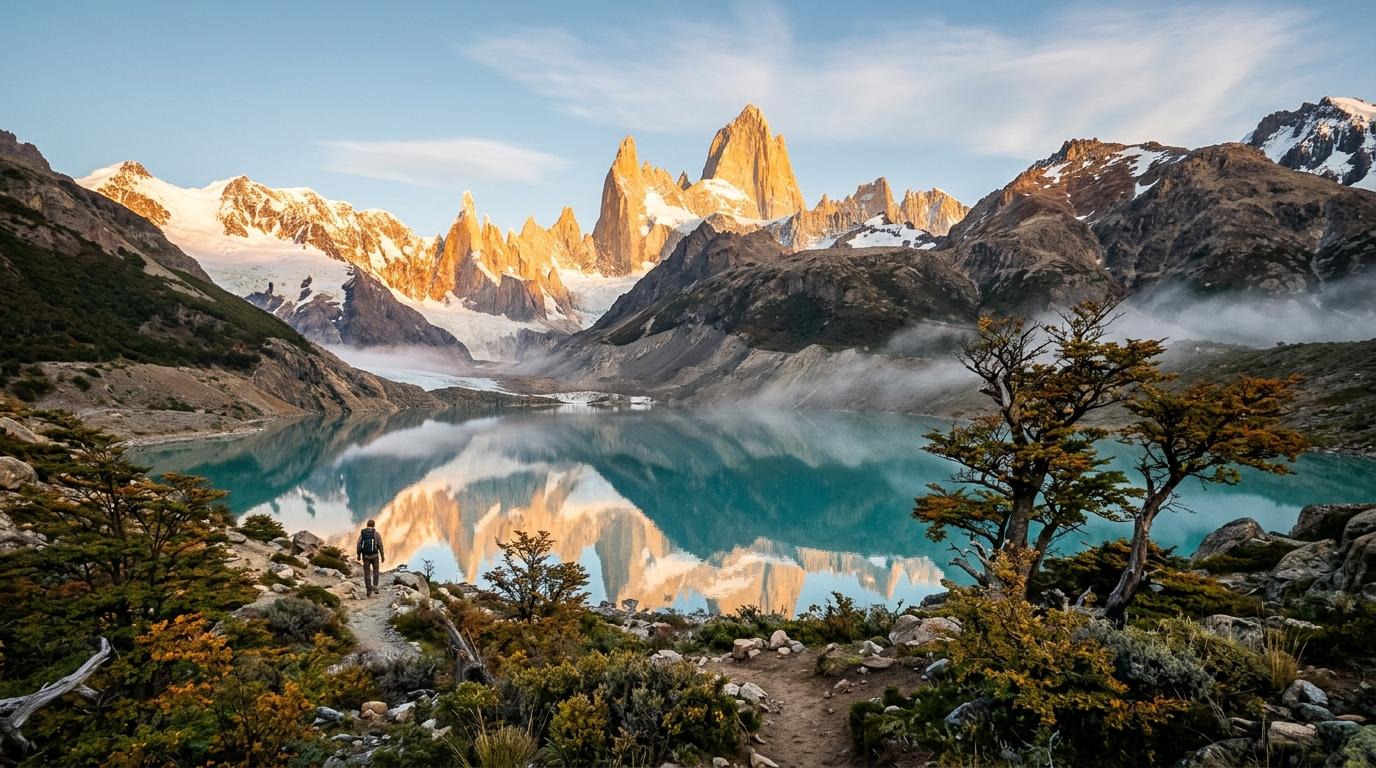
If you want flexible day hikes, travel on a normal budget, and hate rigid advance bookings, go to Argentine Patagonia. El Chaltén lets you walk straight from your hotel door to the base of Mount Fitz Roy for free, while nearby El Calafate puts you right in front of the thunderous Perito Moreno Glacier.
Many first-timers assume Patagonia is one single park where you easily wander back and forth. 
In reality, the Andes Mountains split Patagonia between Chile and Argentina. Crossing between the main trekking hubs—Puerto Natales in Chile and El Calafate in Argentina—takes a full half-day on a cross-border bus through remote windswept steppe.
If you have less than 10 days, pick one side. Here is the honest breakdown of trail logistics, booking hurdles, costs, and weather to help you choose the right side for your first trip.
The Core Geography: Torres del Paine vs Los Glaciares
#To understand the difference, you have to look at the towns and the parks.
Chilean Patagonia centers on Torres del Paine National Park. The gateway town is Puerto Natales. 
Puerto Natales is not inside the park. It sits about 70 miles (112 kilometres) south of the park entrance, which means you have a two-hour bus or rental car drive across gravel roads just to reach the trailheads. 
Inside the park, services are spread out, roads are unpaved, and you rely on catamarans, park shuttle vans, or guided transfers to move between trail sectors.
Argentine Patagonia centers on two separate towns in Santa Cruz province: El Calafate and El Chaltén. 
El Calafate is the larger airport town sitting on the shore of Lake Argentino. It serves as the base for visiting the Perito Moreno Glacier, which is located 50 miles (80 kilometres) away inside Los Glaciares National Park. 
El Chaltén sits three hours north of El Calafate by paved highway. It is a tiny, purpose-built hiking village tucked directly into the shadow of the mountains. 
When you stay in El Chaltén, the national park boundary literally starts where the village pavement ends. You do not need buses, rental cars, or park shuttles to go hiking.
Trail Logistics: Multi-Day Hut Backpacking vs Free Day Hikes
#How you hike each day is the biggest functional difference between Chile and Argentina.
Chile’s Torres del Paine is designed primarily around point-to-point multi-day treks. 
The most famous route is the W Trek, a 4-to-5-day, 45-mile (72-kilometre) route that takes you up the Ascencio Valley to the base of the Towers, into the French Valley, and alongside Grey Glacier. 
Because you are hiking point-to-point, you must sleep in the park each night. You either carry a heavy backpack with a tent, sleeping bag, and food, or pay high prices to sleep in rustic mountain refugios (dorm huts) with pre-booked meal plans. 
Every single night of your trek must be locked in beforehand. You cannot simply stay an extra day at a campsite if you get tired or if bad weather rolls in.
Argentina’s El Chaltén operates entirely on self-guided day hikes. 
Every morning, you wake up in a warm bed at your guesthouse, eat breakfast, grab your daypack, and walk five minutes to the trailhead at the end of the street. 
The two premier hikes in the park are:
- Laguna de los Tres: A 13-mile (21-kilometre) round-trip hike that leads you directly to the turquoise glacial tarn sitting beneath the sheer granite face of Mount Fitz Roy.
- Laguna Torre: A 12-mile (19-kilometre) gentler valley hike leading to a glacial lake filled with floating icebergs from Glacier Grande.
After hiking 6 to 8 hours, you walk right back into town, take a hot shower, and eat a hot meal at a local steakhouse or craft beer bar. 
There are zero trail fees, zero permits required for day hikes, and zero rigid itineraries. If it rains sideways on Tuesday, you stay in town, drink coffee, and hike on sunny Wednesday instead.
Booking Friction and Planning Timelines: 6 Months vs 0 Days
#If you want to hike the W Trek in Chile during peak summer (December through February), you must book your campsites 6 to 9 months in advance.
Booking Torres del Paine is notoriously frustrating because the campsites along the trail are not managed by a single entity. They are split between three different operators:
- CONAF (the Chilean national park service, which runs basic free campsites that fill instantly).
- Las Torres Patagonia (a private company operating the eastern sector camps like Central, Chileno, and Francés).
- Vertice Travel (a private company operating the western sector camps like Paine Grande and Grey).
You have to open multiple booking websites at the same time and match your dates in a strict geographic sequence. If one camp is fully booked on Day 3, your entire multi-day itinerary collapses. 
If you show up at the park entrance without confirmed reservation vouchers for every single night, park rangers will turn you away at the gate.
Argentina requires almost zero advance trail planning. 
In El Chaltén, you do not need hiking permits, trail reservations, or timed-entry slots for day hikes. You only need to book your hotel or hostel bed in town. 
Even during peak season, while town accommodations fill up, you can easily plan an Argentine Patagonia trip two months ahead without worrying about national park permit bureaucracy.
Budget Reality: Chilean Prices vs Argentine Value
#Patagonia is not a cheap destination, but Chile is substantially more expensive than Argentina.
In Chile, everything inside Torres del Paine carries a heavy premium because of its remote location. 
- The park entrance fee is roughly $40 to $45 USD per person.
- A simple one-way catamaran ride across Lake Pehoé to reach the Paine Grande trailhead costs around $35 to $40 USD in cash.
- A basic dorm bed in a mountain refugio along the W Trek easily runs $120 to $160 USD per night, and adding a basic breakfast and dinner package pushes it past $220 USD per person per day.
- Private eco-lodges inside the park often cost upwards of $800 to $1,500 USD per night.
Argentina offers significantly better value for independent travelers. 
Entering the northern sector of Los Glaciares National Park from El Chaltén has historically been completely free for hikers, though seasonal conservation fees of around $15 to $30 USD have been introduced for specific areas. 
Because El Chaltén has dozens of competing family-run hosterías, bakeries, pizzerias, and supermarkets, daily living costs are manageable:
- A comfortable private double room in a local guesthouse averages $70 to $130 USD per night.
- You can buy fresh empanadas, bread, cheese, and fruit from local grocery stores to pack your own trail lunches for under $8 USD.
- A hearty dinner of Argentine steak and local Malbec wine in town costs around $25 to $35 USD.
If you are traveling on a strict budget, Argentine Patagonia will stretch your money at least twice as far as Chilean Patagonia.
Glaciers and Lakes: Perito Moreno vs Grey Glacier
#Both sides have massive glaciers fed by the Southern Patagonian Ice Field, but how you experience them is completely different.
Argentina is home to the Perito Moreno Glacier, arguably the most spectacular and accessible glacier in the world. 
Located 50 miles from El Calafate, Perito Moreno is unique because it is one of the few glaciers on Earth that is currently in equilibrium rather than rapidly retreating. 
The national park has built an extensive network of steel catwalks and viewing balconies that bring you within a few hundred yards of the towering 200-foot (60-metre) wall of blue ice. 
You can stand comfortably on the viewing decks and watch massive apartment-building-sized chunks of ice calve off the face and crash into Lake Argentino with a sound like cannon fire. You can also book guided ice-trekking tours that let you strap on crampons and hike across the surface of the glacier.
Chile’s most famous glacier is Grey Glacier, located at the western end of the W Trek in Torres del Paine. 
Grey Glacier is magnificent, but seeing it up close requires significant effort. You either have to hike 7 miles from Paine Grande to the Grey campsite or pay around $120 to $140 USD for a specialized boat excursion across Lake Grey. 
While the view of the blue ice tongue spilling down from the ice field is stunning, it does not match the sheer deafening roar and immediate proximity of Perito Moreno.
For glacier viewing, Argentina wins easily.
Weather, Wind, and Flexibility: The 4-Season Day
#Patagonia’s weather is legendary for its ferocity. Locals say you can experience all four seasons in a single twenty-minute span.
Winds across the southern plains routinely hit 50 to 70 mph (80 to 110 km/h). These gusts are strong enough to blow hikers off their feet, turn rain sideways, and cause catamarans on glacial lakes to suspend operations.
Because Chilean treks are locked into rigid sequential bookings, you have to hike regardless of the weather. 
If Day 2 brings 60-mph gale-force winds and driving rain, you still have to strap on your heavy pack and hike 8 miles to your next reserved shelter. If you reach the Base of the Towers viewpoint on a day socked in by thick fog, you see nothing, and you cannot try again the next day because your bed is miles away down the trail.
In Argentina, your flexibility is your greatest asset. 
Because you sleep in town every night, you monitor the daily wind and cloud forecasts on apps like Windguru. 
If Monday is clear and calm, you tackle the strenuous 13-mile hike to Mount Fitz Roy. If Tuesday brings a raging rainstorm, you sleep in, visit the local artisan chocolate shops, and read by the fire in town. You wait for the weather window rather than fighting it.
Getting There and Border Crossings: Puerto Natales to El Calafate
#Reaching either side requires a domestic flight from the respective capital city.
To reach Chilean Patagonia:
- Fly from Santiago (SCL) to Punta Arenas (PUQ) or directly to the smaller seasonal airport in Puerto Natales (PNT).
- A direct flight from Santiago to Puerto Natales takes about 3 hours and 15 minutes.
- From Puerto Natales, take a 2-hour bus to the national park.
To reach Argentine Patagonia:
- Fly from Buenos Aires (AEP or EZE) to El Calafate (FTE).
- A direct flight takes about 3 hours and 20 minutes.
- From El Calafate airport, El Chaltén is a 3-hour direct bus ride along paved Route 40.
If you want to see both sides on a longer trip (12 to 14 days), crossing the border between them is straightforward. 
Comfortable public long-distance buses (such as Bus-Sur and Turismo Zaahj) run daily between Puerto Natales and El Calafate. 
The bus journey covers roughly 170 miles (275 kilometres) and takes about 5 to 6 hours, depending heavily on the wait times at the Paso Río Don Guillermo border post. 
You disembark on the Chilean side to stamp out, drive across no-man's-land, and disembark on the Argentine side to clear customs. Note that Chile has strict biosecurity rules: you cannot bring any fresh fruit, vegetables, honey, or unsealed animal products across the border into Chile.
Summary Comparison Table: Chile vs Argentina
#| Factor | Chilean Patagonia (Torres del Paine) | Argentine Patagonia (El Chaltén & Calafate) |
|---|---|---|
| Primary Hub Town | Puerto Natales (2 hours from park) | El Chaltén (hikes start in town) |
| Hiking Style | Multi-day point-to-point backpacking (W Trek) | Self-guided day hikes returning to town nightly |
| Advance Booking | 6 to 9 months ahead for trail campsites | 1 to 2 months ahead for town hotels |
| Trail Costs & Permits | ~$40 entry fee + expensive refugio beds | Free or low-cost day trail access |
| Daily Budget Range | High ($180–$350+ USD per day) | Moderate ($70–$150 USD per day) |
| Glacier Highlights | Grey Glacier (boat trip or 7-mile hike) | Perito Moreno (walkway access & ice treks) |
| Weather Flexibility | Low (locked into sequential camp dates) | High (pick hiking days based on weather) |
| Top Iconic View | The Three Granite Towers (Las Torres) | Mount Fitz Roy (Laguna de los Tres) |
| Best For | Hardcore backpackers, hut trekkers, luxury lodges | Independent hikers, budget travelers, flexibility |
Final Recommendation: How to Choose or Combine Both
#Choose Argentine Patagonia if this is your very first trip to South America, you prefer comfortable day hikes over sleeping in tents, you want to see the Perito Moreno Glacier up close, or you are planning your trip on relatively short notice. El Chaltén offers some of the most dramatic mountain scenery on the planet with none of the stressful campsite booking friction.
Choose Chilean Patagonia if completing the legendary W Trek has been a lifelong bucket-list goal, you love the camaraderie of multi-day mountain huts, and you have the time and budget to lock in reservations months in advance. Standing at the base of the granite towers as the dawn sun turns the rock bright orange is an experience you will never forget.
If you have two full weeks, do not choose between them—combine both. Fly into El Calafate, spend three days watching Perito Moreno, take the bus north to hike Fitz Roy in El Chaltén for four days, cross the border by bus to Puerto Natales, and spend four days exploring Torres del Paine. Experiencing both sides shows you the full, wild diversity of the southern tip of the world.