Every commercial airline passenger has witnessed the high-stakes drama unfold at the boarding gate: a traveler wrestling an overstuffed roller bag into a cold steel measuring frame while gate attendants watch with clipboards and payment terminals. For frequent flyers and casual vacationers alike, few travel experiences cause as much friction as unexpected carry-on luggage enforcement. A suitcase marketed as official airline carry-on approved by a retail store can easily fail an airport sizer box, triggering an immediate mandatory gate-check fee ranging from thirty-five to seventy-five dollars, while routing fragile electronics into the cargo hold.
Navigating carry-on allowances requires understanding that the global aviation industry does not operate under a single universal luggage standard. Instead, passengers navigate a fractured landscape divided between domestic United States mainline regulations, European budget carrier restrictions, Asian legacy airline rules, and regional turboprop equipment constraints. Understanding the physical geometry of sizer boxes, the mathematical limitations of linear inches, the engineering behind overhead bin weight ratings, and the critical design differences between two-wheel and four-wheel luggage separates seamless boarding from stressful gate penalties.
The Airport Sizer Box: Why Your Bag Fits at Home but Fails at the Gate
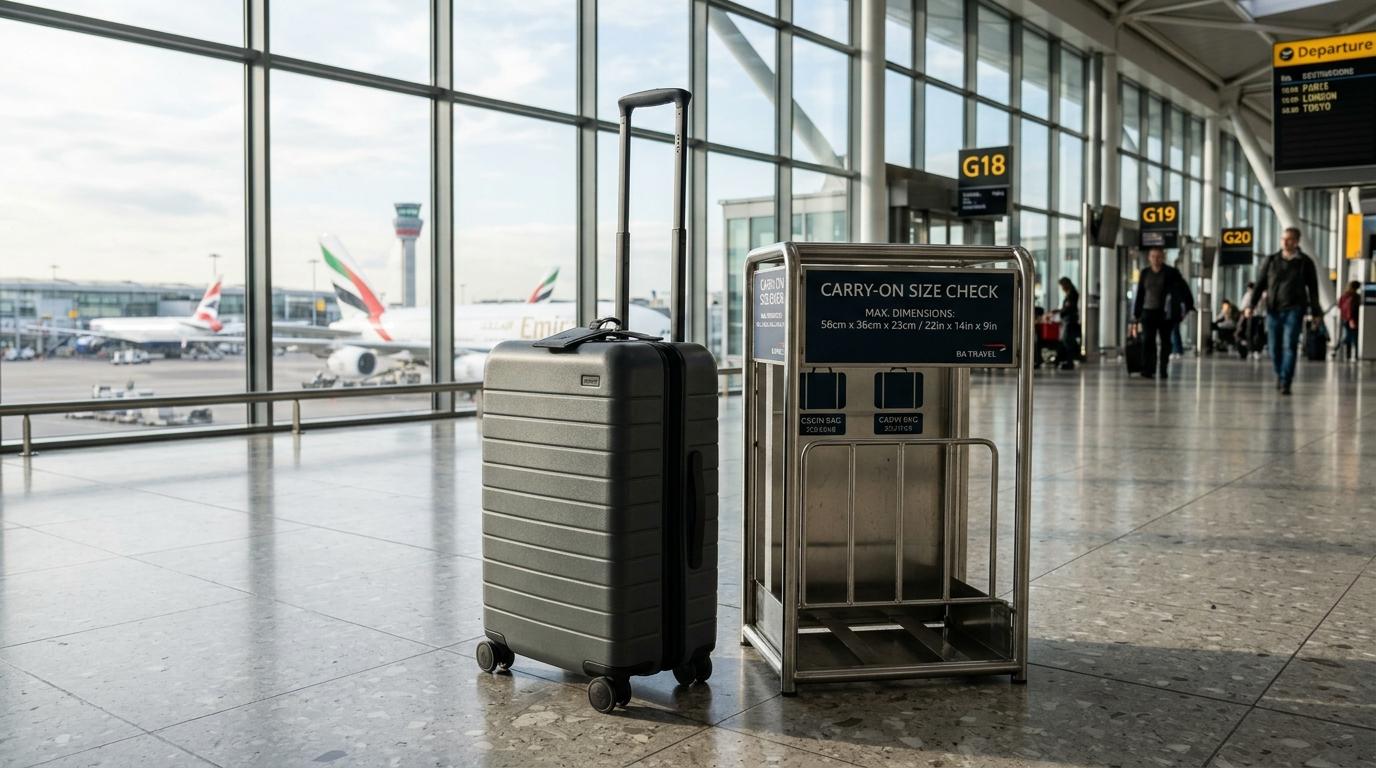
#The airport baggage sizer is a rigid, open-topped or three-sided metal apparatus stationed at check-in desks and boarding gates. Its dimensions represent the absolute volumetric ceiling an airline permits inside passenger cabin compartments. While travelers measure their luggage at home with soft tape measures along fabric seams, airport sizers evaluate three-dimensional outer clearance.
The primary reason luggage fails the sizer test is the discrepancy between internal packing volume and external envelope dimensions. Luggage manufacturers frequently advertise the internal height of the packing tub. A tag promoting a twenty-inch continental carry-on typically reflects only the internal fabric compartment where clothing rests. However, airline gate sizers measure every millimeter extending beyond that fabric shell:
- Protruding spinner caster wheels that extend two to three inches below the base of the bag.
- Fixed top, side, and bottom grab handles that add half an inch to an inch of exterior profile.
- Retracted telescoping trolley handles whose plastic housings and release buttons protrude past the top fabric margin.
- Exterior accessory pockets packed with tablets, chargers, and water bottles that bulge outward.
- Hard protective corner bumpers and side molded feet designed to keep the suitcase upright.
When an airline gate agent orders a passenger to test their bag in the sizer, the bag must drop completely into the frame under its own weight without forcing, compression, or sit-on assistance. If the telescoping handle sticks out above the top bar, or if an overstuffed outer pocket snags on the metal frame, the bag fails the test. Under commercial airline contracts of carriage, gate agents possess sole discretion to deny cabin placement to any piece of luggage that fails clean insertion.
Domestic US vs International Airline Allowances: The Dimensional Divide
#The most common mistake international travelers make is assuming their domestic carry-on suitcase complies with overseas carriers. United States domestic carriers generally operate under a standardized dimensional envelope, whereas international and European low-cost carriers enforce much narrower tolerances.
Domestic United States Standards
#Mainline United States carriers—including Delta Air Lines, United Airlines, and American Airlines—standardize their overhead bin allowances at 22 x 14 x 9 inches (56 x 36 x 23 centimeters). This specific dimensional standard was engineered around the interior architecture of mainline narrowbody aircraft like the Boeing 737 family and Airbus A320 series.
Crucially, major domestic US carriers rarely impose a strict weight limit on standard carry-on bags. As long as a passenger can hoist the bag into the overhead bin unassisted without endangering crew members or fellow passengers, the bag is accepted regardless of whether it weighs fifteen pounds or forty pounds. The primary exception occurs on regional feeder flights operated by regional jets (such as the Embraer 175 or Bombardier CRJ series), where narrower overhead bins necessitate valet gate-checking regardless of compliance with mainline dimensions.
International and European Low-Cost Standards
#Outside the United States, airline allowances shrink substantially. Across Europe, the Middle East, Asia, and Oceania, the prevailing international cabin benchmark is 21.7 x 15.7 x 7.9 inches (55 x 40 x 20 centimeters). Notice the critical dimension: depth. While US airlines provide nine inches of depth, international carriers routinely restrict depth to 7.9 inches (20 centimeters). That single inch of lost depth eliminates approximately five to seven liters of packing volume.
Furthermore, European ultra-low-cost carriers (ULCCs) such as Ryanair, Wizz Air, and easyJet have decoupled overhead bin access entirely from standard base ticket fares. On these carriers, an unbundled economy ticket includes only a small personal item that must fit beneath the forward seat (typically 40 x 20 x 25 centimeters). Access to the overhead locker requires purchasing a priority boarding add-on or a specific cabin bag bundle, which is rigorously checked at the boarding gate.
| Airline Operator | Overhead Cabin Bag Limit | Max Weight Allowance | Personal Item Allowance | Enforcement Rigor |
|---|---|---|---|---|
| Delta Air Lines | 22 x 14 x 9 in (56 x 36 x 23 cm) | No maximum weight limit | One personal item included | Moderate at gate |
| United Airlines | 22 x 14 x 9 in (56 x 36 x 23 cm) | No maximum weight limit | One personal item included | Strict for Basic Economy |
| American Airlines | 22 x 14 x 9 in (56 x 36 x 23 cm) | No maximum weight limit | One personal item included | Moderate at gate |
| British Airways | 22 x 18 x 10 in (56 x 45 x 25 cm) | Up to 51 lb (23 kg) | One personal item included | Generous dimensions |
| Air France / KLM | 21.7 x 13.8 x 9.9 in (55 x 35 x 25 cm) | 26.4 lb (12 kg) combined | Combined with personal item | Strict weight checks |
| Lufthansa Group | 21.7 x 15.7 x 9.0 in (55 x 40 x 23 cm) | 17.6 lb (8 kg) maximum | One personal item included | Strict scales at gate |
| Singapore Airlines | 22 x 15.7 x 7.9 in (55 x 40 x 20 cm) | 15.4 lb (7 kg) maximum | One personal item included | Strict weighing at counter |
| Emirates | 22 x 15 x 8 in (55 x 38 x 20 cm) | 15.4 lb (7 kg) maximum | No extra bag in basic economy | High scrutiny at check-in |
| Ryanair | 21.7 x 15.7 x 7.9 in (55 x 40 x 20 cm) | 22.0 lb (10 kg) with Priority | Small personal item only base | Extreme scrutiny and sizers |
The Linear Inch Equation: Mathematical Flaw vs Gate Reality
#Many airline baggage policies mention an overall size threshold called linear inches, most commonly forty-five linear inches (115 linear centimeters). Linear measurement is calculated by taking the sum of the luggage exterior dimensions:
Total Linear Inches = Exterior Length + Exterior Width + Exterior Height
Mathematically, a standard 22 x 14 x 9 inch suitcase yields exactly forty-five linear inches (22 + 14 + 9 = 45). However, relying exclusively on the linear inch sum is one of the most widespread traps in modern air travel.
Airlines do not enforce linear inches in isolation; they enforce linear limits in conjunction with fixed three-axis dimensional restrictions. A bag can easily satisfy the forty-five linear inch mathematical threshold while completely failing the physical space inside an aircraft overhead bin or airport sizer box:
- A soft-sided gym duffel measuring 25 x 10 x 10 inches totals forty-five linear inches. Yet because its length is twenty-five inches, it will not fit straight into an overhead bin that closes at twenty-two inches, nor will it slip into a twenty-two-inch vertical sizer frame.
- A square rolling business case measuring 18 x 18 x 9 inches totals forty-five linear inches. However, its eighteen-inch width will jam against the fourteen-inch sizer guides, blocking entry.
- A round cylindrical weekend duffel packed to capacity can expand into a uniform circular cross-section, bulging far past the nine-inch depth slot even though its uncompressed seams satisfy linear guidelines.
When purchasing or packing luggage, travelers must treat the individual length, width, and height dimensions as three non-negotiable boundaries. If any single axis exceeds the airline limit by even a fraction of an inch, the mathematical compliance of the remaining axes becomes irrelevant.
The Weight Limit Paradox: Why International Carriers Enforce 7 Kilograms
#One of the most jarring shocks for domestic flyers traveling abroad is having their carry-on suitcase placed on a digital scale at the check-in desk or boarding jet bridge. While domestic US airlines largely ignore carry-on weight, international carriers across Europe, Asia, Australia, and South America enforce rigid limits, typically set at seven kilograms (15.4 pounds) or eight kilograms (17.6 pounds).
Understanding why this weight limit exists clarifies why gate agents enforce it so relentlessly.
Aircraft Overhead Bin Structural Certification
#Commercial aircraft overhead bins are mechanical structures bolted to the fuselage airframe. During aircraft certification by aviation authorities (such as the Federal Aviation Administration and European Union Aviation Safety Agency), overhead bin assemblies undergo rigorous structural stress testing. They are rated to withstand intense upward and downward g-forces during severe atmospheric turbulence and emergency hard landings.
Every bin carries a certified placarded weight rating—often between 60 and 100 pounds per bin section. If four passengers load four carry-on bags weighing thirty-five pounds each into a single three-bag bin compartment, the combined weight exceeds 140 pounds. In severe turbulence, an overloaded bin can fail its latch mechanism, dumping heavy luggage directly onto the heads of seated passengers, or in extreme scenarios, tearing the bin mounting brackets from the airframe.
Occupational Safety and Worker Health
#In many international jurisdictions—most notably across the European Union, Australia, and New Zealand—workplace health and safety regulations govern the physical demands placed on ground staff and cabin crew. Flight attendants assist passengers with bin closures dozens of times per day. Repetitive strain injuries caused by lifting heavy forty-pound bags into overhead bins represent one of the leading causes of flight attendant workers compensation claims. Restricting individual bag weights to seven or eight kilograms keeps lifting loads within safe biomechanical parameters.
Aircraft Weight, Balance, and Fuel Burn
#A commercial airliner burning thousands of gallons of jet fuel per hour must calculate its center of gravity and total takeoff weight prior to departure. Mainline carriers calculate cabin passenger weight using standardized statistical averages that incorporate carry-on luggage allowances. On smaller regional commuter planes, an extra ten pounds per passenger across seventy seats alters trim calculations and burns unnecessary fuel.
| Geographic Region | Typical Weight Allowance | Primary Enforcement Location | Weight Calculation Method | Excess Fee Structure |
|---|---|---|---|---|
| North America Mainline | No fixed cabin weight cap | Boarding gate observation only | Passenger must lift unaided | Gate-check fee if oversized |
| Western Europe Legacy | 8 kg to 12 kg (17.6 to 26.4 lb) | Check-in desk and gate scales | Roller bag weighed separately | Cargo hold rerouting fee |
| European Ultra-Low-Cost | 10 kg (22 lb) paid tier | Boarding gate electronic sizers | Combined bag and personal item | Heavy gate penalty surcharge |
| Asia-Pacific Carriers | 7 kg (15.4 lb) standard | Check-in counter mandatory scale | Precise electronic scale reading | Per-kilogram baggage charges |
| Australia Domestic | 7 kg (15.4 lb) single bag limit | Boarding lounge roving scales | Strict visual and scale enforcement | Instant mandatory hold check |
Spinner Casters vs Two-Wheel Rollaboards: The Lost Volume Trade-Off
#The modern luggage market is overwhelmingly dominated by four-wheel spinner suitcases that glide effortlessly in any direction on 360-degree rotating casters. While spinners offer superior ergonomics on polished airport terminal floors, they introduce a massive structural disadvantage when measured against airline size restrictions.
The Caster Clearance Tax
#A traditional two-wheel rollaboard features recessed wheels integrated directly into the bottom corners of the luggage body. These inline-skate wheels sit largely inside the protective molding of the suitcase shell, adding only half an inch to an inch of exterior height.
In contrast, four-wheel spinner casters must mount entirely outside the suitcase tub on protruding swivel ball bearings to permit full 360-degree rotation. These casters typically project two to three full inches below the bottom base of the suitcase. Because airline sizers evaluate total external length from wheel tread to retracted handle, those two inches of spinner hardware count directly against your twenty-two-inch allowance.
This structural reality creates an unavoidable volume penalty:
- A two-wheel rollaboard measuring 22 x 14 x 9 inches provides roughly twenty-one inches of usable internal packing height, translating to approximately thirty-eight to forty liters of internal volume.
- A four-wheel spinner measuring 22 x 14 x 9 inches provides only nineteen inches of usable internal packing height, reducing internal volume to roughly thirty-one to thirty-four liters.
By choosing a four-wheel spinner over a two-wheel rollaboard, travelers sacrifice roughly fifteen to twenty percent of their usable packing space simply to accommodate the wheels within the airline sizer box. Furthermore, external spinner wheels are far more vulnerable to snapping off if forced into tight overhead bins or tossed roughly by ramp handlers during gate checks.
The Expansion Zipper Trap: The Hidden Extra Two Inches
#A major marketing feature found on both soft-sided and hard-shell suitcases is the wraparound perimeter expansion zipper. Unzipping this secondary zipper releases an accordion gusset of heavy fabric, expanding the depth of the suitcase by 1.5 to 2.5 inches.
While expansion zippers are convenient for packing extra souvenirs on road trips, utilizing them on an airplane flight almost guarantees an sizer box failure.
Consider the dimensions: a standard compliant carry-on measures 22 x 14 x 9 inches. When the expansion zipper is opened, the depth expands from nine inches to eleven or 11.5 inches. In this expanded state:
- The suitcase will not fit into standard nine-inch domestic sizer frames.
- The suitcase cannot be loaded wheels-first into older narrowbody overhead bins, forcing it to be placed sideways and taking up space meant for three passengers.
- Flight attendants monitoring boarding will immediately spot the bloated profile and direct the passenger to gate-check the bag.
Even if an expansion zipper remains closed, packing the main compartment to bursting pressure creates outward fabric tension. On soft-sided nylon luggage, this internal pressure bulges the front face outward by an inch or more. On hard-shell polycarbonate luggage, overpacking bows the clamshell halves outward at the center zipper line. A bag that measures nine inches deep at the corner frame can easily swell to 10.5 inches across its center belly, wedging tightly against sizer rails.
Strategic Packing Tactics to Pass Strict 7 kg Limits
#Traveling internationally with only a carry-on bag when restricted to a seven-kilogram (15.4-pound) limit requires meticulous planning. When seven kilograms is the maximum gross weight, every component of your travel gear matters.
Audit the Tare Weight of Your Luggage
#The single largest consumer of your seven-kilogram weight allowance is the empty suitcase itself. Many traditional ballistic nylon rollers and aluminum-frame hard cases possess an empty tare weight of eight to ten pounds (3.6 to 4.5 kilograms). In an eight-pound suitcase, packing just five pounds of clothing reaches the seven-kilogram limit before toiletries or electronics are added.
To succeed under strict weight caps, travelers must transition to ultra-lightweight luggage options:
- High-grade unlined polycarbonate spinners weighing five pounds (2.3 kilograms) or less.
- Frameless ripstop travel backpacks weighing 2.2 to 2.8 pounds (1.0 to 1.3 kilograms).
- Ultralight wheeled duffels with minimal internal structure.
Cutting your empty bag weight from four kilograms down to two kilograms instantly doubles your allowable clothing and gear payload.
The Wearable Gear Strategy
#Airline weight limits apply strictly to items placed on the scale—they do not apply to the clothing worn on your body. Savvy travelers leverage this distinction when facing aggressive check-in or boarding gate scales:
- Wear your heaviest footwear (such as leather boots or athletic trainers) during transit rather than packing them in the suitcase.
- Wear your heaviest outerwear, such as a down parka, wool coat, or technical fleece.
- Place dense items into coat pockets. A heavy laptop power brick, metal portable battery bank, and solid toiletry kit can easily weigh four pounds. Carried inside an overcoat pocket, these items do not register on the luggage scale. Once past the boarding gate, these items can be transferred back into your bag.
Strategic Allocation Between Roller and Personal Item
#Most airlines permit one carry-on bag plus one smaller personal item (such as a laptop backpack, shoulder bag, or purse) designed to fit underneath the seat in front of you. When an airline enforces a weight limit specifically on the primary carry-on roller, transfer the densest items—laptops, camera bodies, hardcover books, and electronic cords—into your personal item backpack. While some budget carriers enforce a combined weight cap, legacy international carriers frequently weigh only the overhead roller case.
What to Do If Your Carry-On Is Gate-Checked
#Despite careful preparation, a full flight, an undersized regional aircraft bin, or a strict gate agent may result in your carry-on luggage being gate-checked. Handling this transition smoothly protects your critical possessions and avoids lost luggage nightmares.
Immediate Removal of Hazardous and Critical Items
#Never allow a carry-on bag into the cargo hold without removing critical regulatory and personal essentials. Federal aviation safety regulations strictly prohibit loose lithium-ion batteries and power banks in the cargo hold due to thermal runaway fire hazards. Before handing your bag over to the jet bridge crew:
- Remove all lithium-ion power banks, spare camera batteries, and portable chargers.
- Remove all daily prescription medications and essential medical devices.
- Remove high-value fragile electronics, including laptops and tablets, which can suffer screen cracks under shifting cargo loads.
- Remove your passport, boarding passes, wallet, and house or car keys.
Understanding Tag Classifications: Gate Valet vs Cargo Carousel
#Pay close attention to the specific tag the gate agent affixes to your suitcase handle:
- Valet or Green/Pink Tags: On regional flights where bins cannot accommodate standard rollers, agents issue a gate-valet tag. These bags are loaded into the belly at the aircraft stairs and returned directly to the jet bridge upon arrival. You pick up your bag immediately upon stepping off the aircraft.
- White Cargo Baggage Tags: On mainline flights where overhead bins have reached full capacity, agents process bags as standard checked luggage. These bags receive a barcode baggage tag and are transferred into the airport baggage system. They do not return to the jet bridge; you must collect them at the final baggage claim carousel in the airport terminal.
Always retain your paper claim tag receipt or take a clear photograph of the barcode on your smartphone before stepping onto the aircraft.
Final Practical Framework for Seamless Boarding
#Successfully navigating carry-on rules comes down to a clear pre-travel sequence:
- Check your specific operating airline aircraft type and cabin tariff forty-eight hours before departure.
- Measure your bag at home from the bottom of the wheel tread to the top of the unextended handle, including all side bulges.
- Weigh your fully packed bag with a digital luggage hook scale to confirm compliance with international seven-kilogram ceilings.
- Never deploy expansion zippers unless traveling by train or automobile.
- Keep your personal item organized so electronics and medications can be extracted within thirty seconds if a gate check occurs.
By adhering to dimensional realities rather than retail marketing claims, travelers can navigate any airport gate with complete confidence.