The Quick Verdict: Which Island Fits Your Trip?
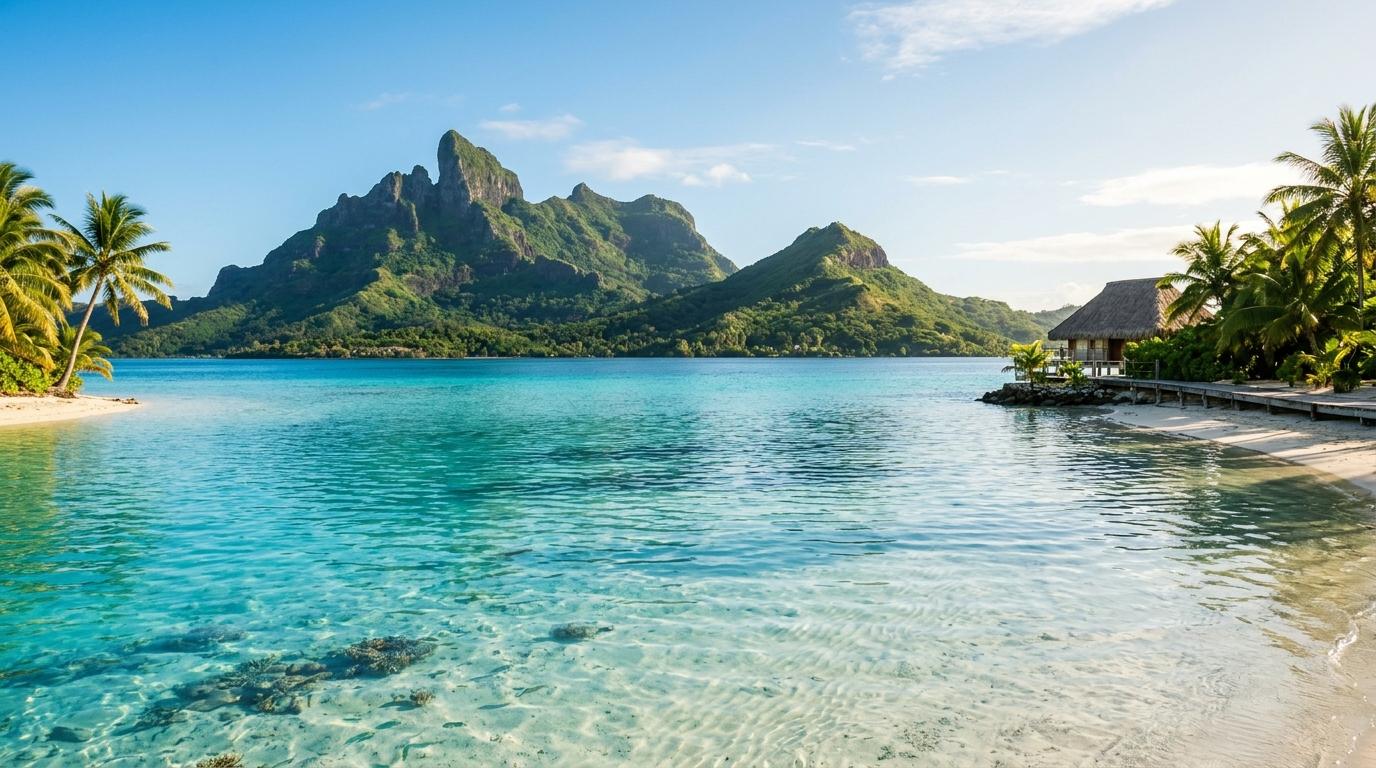
#If you want an ultra-private, ultra-romantic bucket-list splurge where you sleep in an iconic overwater bungalow with Mount Otemanu rising above a calm neon-blue lagoon, choose Bora Bora. It is quiet, exclusive, and tailored specifically for couples who want to disconnect from the world and do very little beyond their private deck.
If you want warm island hospitality, world-class soft coral diving, active adventures like rainforest hikes and river rafting, and a trip that can fit anything from a modest family budget to high luxury, choose Fiji. Fiji is lively, culturally rich, and spans over 300 islands with far more variety in accommodation, food, and activities.
Both islands sit in the South Pacific, but they feel like entirely different worlds. 
Bora Bora is an intimate, French-speaking Polynesian lagoon encircled by sandy islets (motus). Fiji is an independent Melanesian nation with deep communal village traditions, lively kava ceremonies, and a sprawling archipelago.
Here is the honest breakdown of accommodation, flight logistics, costs, diving, and daily vibe so you can spend your travel budget on the right paradise.
Atmosphere and Vibe: Warm Community vs Quiet Romance
#The daily rhythm of these two destinations could not be more different.
Fiji is famous around the world for its genuine, radiant hospitality. 
From the second you step off the plane in Nadi, people greet you with a booming "Bula!" and broad smiles. The Fijian culture is deeply communal and family-centered. If you stay on an island resort in the Mamanucas or Yasawas, the staff will quickly learn your name, sing traditional farewell songs when you leave, and invite you to join evening kava circles. You feel like an invited guest in an active, living community rather than just a customer at a hotel.
Bora Bora is built around privacy, seclusion, and quiet luxury. 
The atmosphere in Bora Bora is hushed and romantic. Most visitors are honeymooners or couples celebrating major anniversaries who rarely leave their private overwater villas. 
Aside from boat captains and resort staff, you have relatively little interaction with local French Polynesian village life unless you actively book a tour of the main island of Vaitape. The prevailing mood is understated French elegance, chilled Champagne, and peaceful solitude overlooking quiet water.
If you thrive on social energy, lively music, and meeting locals, Fiji will capture your heart. If you want absolute silence, privacy, and zero distractions with your partner, Bora Bora delivers that seclusion.
Overwater Bungalows vs Beachfront Bures: Where You Sleep
#How and where you sleep is usually the deciding factor for most travelers.
Bora Bora is the global capital of the overwater bungalow. 
Virtually every luxury resort in Bora Bora—including the St. Regis, Four Seasons, Conrad, and InterContinental Thalasso—is situated on an outer motu (barrier reef islet) looking across the lagoon at Mount Otemanu. These overwater villas are masterpieces of luxury engineering. They feature glass floor panels to watch stingrays swim beneath your feet, private plunge pools suspended over the water, deep soaking tubs, and wooden stairs that lead directly into calm, crystal-clear 80-degree water.
Fiji has overwater bungalows, but they are relatively rare and not the country's specialty. 
Only a handful of Fijian resorts, such as Likuliku Lagoon Resort, feature true overwater bures. 
Instead, Fiji specializes in beachfront bures—traditional thatched-roof cottages tucked into lush palm groves just steps from the sand. These bures feature outdoor stone showers, hand-woven vaulted ceilings, hammocks strung between palm trees, and private plunge pools right on the beach. 
Fiji also offers exceptional private island resorts (like Turtle Island, Kokomo, and Laucala) where you get entire stretches of secluded coastline to yourself.
If waking up directly over calm lagoon water on stilts is your non-negotiable dream, Bora Bora is the clear winner. If you prefer the rustle of palms, larger private gardens, and authentic beachfront living, Fiji offers spectacular value.
Cost and Daily Budgets: Affordable Luxury vs Uncompromising Splurge
#There is no getting around it: Bora Bora is significantly more expensive than Fiji at every tier of travel.
Bora Bora is consistently one of the most expensive resort destinations on the planet. 
- Overwater bungalows during high season (May through October) rarely cost less than $1,200 USD per night, with premier five-star properties regularly charging $2,000 to $3,500 USD per night.
- Because motu resorts are isolated, you are dependent on hotel restaurants where a casual burger and fries at lunch costs $35 to $45 USD, and a three-course dinner for two easily tops $250 to $400 USD without heavy alcohol consumption.
- Airport transfers are not cheap; private boat shuttles from Bora Bora Airport to your motu resort run between $100 and $200 USD per person each way.
- A realistic budget for a 7-night luxury honeymoon in Bora Bora runs between $10,000 and $20,000 USD, excluding international flights.
Fiji offers a broad spectrum of prices that can accommodate almost any budget.
- Backpacker and mid-range travelers can find charming beachfront eco-resorts and guesthouses in the Yasawa Islands for $80 to $200 USD per night, often including full-board meal plans.
- High-end four-star and five-star beachfront resorts (such as on Denarau Island, the Coral Coast, or the Mamanuca Islands) average $350 to $750 USD per night.
- Food and drinks in Fiji are reasonably priced. A delicious meal of fresh fish curry or Kokoda (Fijian marinated raw fish in coconut cream) in a local restaurant costs $12 to $20 USD.
- A couple can easily spend a fantastic, luxurious week in Fiji for $4,000 to $7,000 USD, half the cost of an equivalent stay in Bora Bora.
Getting There and Flight Connections: Direct Hubs vs Double Flights
#Reaching remote South Pacific islands requires thoughtful flight planning.
Fiji is the primary aviation hub of the South Pacific and is surprisingly easy to reach. 
Fiji Airways operates direct flights to Nadi International Airport (NAN) from several major global gateways, including Los Angeles, San Francisco, Vancouver, Honolulu, Tokyo, Singapore, Sydney, Melbourne, and Auckland. 
Once you land in Nadi on the main island of Viti Levu, you have convenient transfer options:
- You can take a 20-minute taxi to Port Denarau and hop on a fast passenger catamaran (like the South Sea Cruises ferry) to reach resorts in the Mamanuca Islands within 45 to 90 minutes.
- For outer island resorts, scenic 15-minute seaplane or helicopter flights depart right near the airport.
Reaching Bora Bora requires an extra domestic flight and longer travel days. 
You must first fly to Fa'a'ā International Airport (PPT) in Papeete on the main island of Tahiti. Direct flights to Tahiti operate from Los Angeles, San Francisco, Seattle, Honolulu, Paris, Tokyo, and Auckland. 
Once in Tahiti, you must clear customs, collect your bags, and board an Air Tahiti propeller aircraft for a 50-minute inter-island flight to Bora Bora Airport (BOB). Bora Bora Airport is built on its own separate motu (Motu Mute), meaning you cannot take a car from the runway; you must board your resort's boat transfer straight from the airport dock.
Fiji is easier, faster, and usually cheaper to reach for most international travelers.
Activities Beyond the Resort: World-Class Diving vs Private Lagoon Cruising
#What you can do outside your room highlights the geographical difference between the two destinations.
Fiji is known among ocean lovers as the "Soft Coral Capital of the World." 
Sites like the Great White Wall in the Somosomo Strait off Taveuni and the Namena Marine Reserve offer some of the most vibrant, multi-colored coral reef systems anywhere on earth. Marine life is dense, featuring manta rays, reef sharks, sea turtles, and massive schools of barracuda. 
On land, Fiji's large mountainous islands offer serious adventure:
- White-water rafting down the Upper Navua River gorge through dramatic rainforest canyons.
- Hiking to cascading multi-tiered waterfalls in Bouma National Heritage Park.
- Visiting local inland villages, attending traditional church services, and participating in an authentic underground lovo earth-oven feast.
Bora Bora is all about its lagoon and marine encounters. 
The reef system inside Bora Bora's lagoon is calm, protected, and incredibly shallow. 
The premier activities in Bora Bora include:
- Lagoon boat tours where you stand in waist-deep turquoise water and hand-feed stingrays or swim alongside harmless blacktip reef sharks.
- Snorkeling at the Coral Gardens, a shallow reef shelf packed with butterflyfish and parrotfish.
- Renting a small private motorboat (no boat license required) to explore the lagoon at your own pace and picnic on a deserted sandy sandbar.
- Jet skiing around the perimeter of the main island under the shadow of Mount Otemanu.
If you want rugged land adventures, dense rainforests, and world-class scuba diving, Fiji offers ten times more variety. If your goal is relaxed snorkeling in bath-warm lagoon water and lounging on a boat, Bora Bora is unmatched.
Food, Dining, and Nightlife: Resort Isolation vs Local Flavors
#Dining styles reflect the cultural heritage of each nation.
French Polynesia blends French culinary technique with fresh tropical seafood. 
In Bora Bora, dining is refined, sophisticated, and heavily French-influenced. You can expect fresh baguettes, fine French cheeses, imported wines, and Poisson Cru (tuna marinated in lime juice and fresh coconut milk). 
However, because resorts are spread out across isolated motus, eating outside your hotel requires coordinating boat shuttles to the main island of Vaitape. There, you can find legendary local spots like Bloody Mary's or simple waterfront roulottes (food trucks) serving steak-frites and grilled mahi-mahi. Nightlife in Bora Bora is virtually nonexistent; evenings are dedicated to slow romantic dinners and quiet stargazing.
Fiji blends traditional indigenous Melanesian staples with rich Indo-Fijian spices. 
Because roughly a third of Fiji's population is of Indian heritage, Fijian food is a phenomenal blend of curry spices, fresh root crops (dalo and cassava), coconut milk, and fresh seafood. 
Signature dishes include:
- Kokoda: Raw mahi-mahi or walu cured in lime juice and tossed with fresh coconut cream, tomatoes, chilies, and onions.
- Lovo: Meat, fish, and root vegetables wrapped in banana leaves and slow-steamed over hot river stones buried underground.
- Fijian fish curry cooked with fresh turmeric, cumin, and coconut.
Resorts in Fiji frequently host Meke nights, where local villagers perform traditional warrior dances and harmonized choral singing. While Fiji is not a wild nightclub destination, resort beach bars are lively, social, and full of music.
Families vs Honeymooners: Who Each Island Serves Best
#Your travel party should play a huge role in your final choice.
Fiji is universally regarded as one of the most family-friendly tropical destinations on Earth. 
Fijians adore children. Many family-oriented resorts in the Mamanucas and Coral Coast offer free or low-cost Kids Clubs with genuine, dedicated Fijian nannies (known as "Meimei"). Parents can enjoy a quiet beachfront massage or scuba dive knowing their children are learning how to husk coconuts, weave palm fronds, and snorkel in shallow reefs under watchful, caring eyes. 
At the same time, Fiji has dozens of strictly adults-only resorts (like Likuliku, Tokoriki, and Royal Davui), ensuring honeymooners get absolute romantic peace without children splashing nearby.
Bora Bora is almost exclusively engineered for adult romance and quiet couples. 
While families certainly visit, very few resorts cater specifically to children, and overwater bungalows often carry safety age restrictions for young toddlers due to open ocean drop-offs and railing heights. The quiet, hushed ambiance at motu resort pools can feel slightly stifling for parents trying to keep energetic children entertained.
For families, multigenerational groups, and solo travelers, Fiji is far and away the better choice. For honeymooners, Bora Bora remains the ultimate romantic sanctuary.
Summary Comparison Table: Fiji vs Bora Bora
#| Factor | Fiji | Bora Bora (French Polynesia) |
|---|---|---|
| Primary Vibe | Warm community, lively culture, adventure | Ultra-private, quiet luxury romance |
| Signature Stay | Beachfront thatched bures & private islands | Iconic luxury overwater bungalows on motus |
| Daily Budget | $150 to $600 USD per day | $600 to $2,000+ USD per day |
| Flight Ease | Direct flights to Nadi from major global cities | International flight to Tahiti + domestic hopper |
| Ocean Highlights | World-class soft coral diving & manta rays | Shallow turquoise lagoon & stingray encounters |
| Land Adventure | Rainforest hiking, river rafting, waterfalls | Limited; 4x4 island tours & quad biking |
| Food Style | Kokoda, Indo-Fijian curries, lovo feasts | French-Polynesian fusion, Poisson Cru, fine dining |
| Best For | Families, divers, adventurers, varied budgets | Honeymooners, luxury splurges, total seclusion |
Final Decision: How to Choose What Is Right for You
#Choose Bora Bora if you have saved for a once-in-a-lifetime luxury splurge, your heart is set on stepping right from your bed into a calm neon-turquoise lagoon, and you want quiet romantic seclusion with your partner. The visual majesty of Mount Otemanu reflected across the water at sunset is something no camera can fully capture.
Choose Fiji if you want a warm, vibrant cultural connection, world-class diving on colorful soft coral reefs, the flexibility to explore different islands, or a vacation that gives you high luxury without draining your entire savings. The genuine warmth of the Fijian people will stay with you long after your tan fades.
Both destinations are paradise, but knowing whether you want quiet French sophistication or vibrant Melanesian heart will make all the difference in your trip.