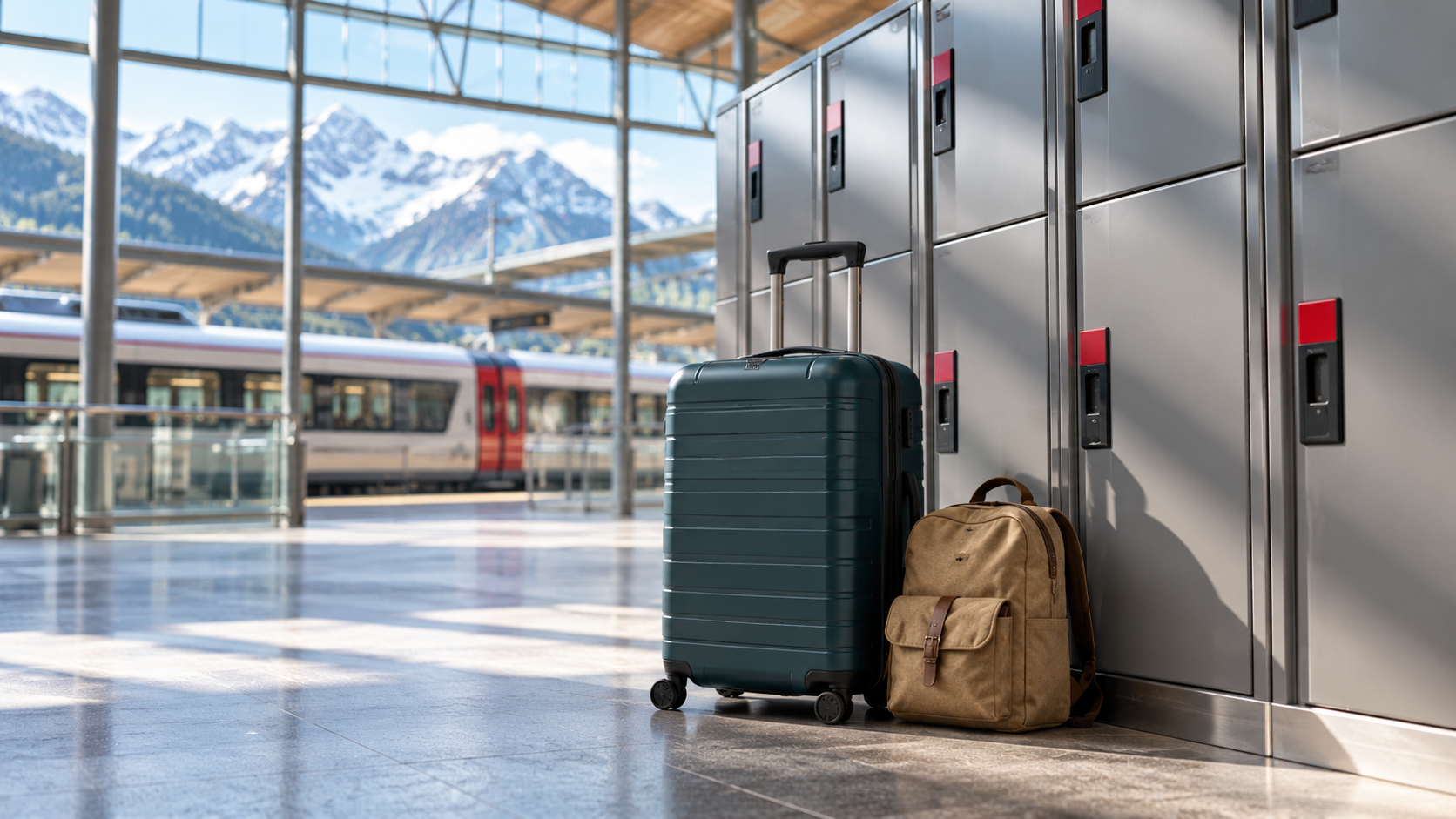
Swiss train station luggage lockers can turn a transfer into a useful stopover. Choose a station you will return to, check its own storage rules, and leave enough time to collect your bags before the next departure. A station having lockers does not tell you whether your suitcase fits, how the rental is charged, or when the staffed counter closes.
The most useful distinction is between leaving luggage in one place and sending it somewhere else. This guide covers collecting your own bags after a few hours of exploring. It also explains why one Swiss station's rules should not become the rule for your whole trip.
Start with your return route
#Before comparing storage prices, look at where your day ends. If you arrive and depart from the same station, a locker can remove the need to carry a suitcase around town. If you finish somewhere else, collecting it may create a journey you had not allowed for.
Write down three places: your arrival station, your storage location and your onward departure station. Use the exact names. A city name alone is not enough when a booking or timetable lists more than one station.
This matters in Interlaken, where Ost and West are separate stations. A bag left at Ost still needs collecting there even if your afternoon finishes near West. The sensible storage point is the one that works with the whole route, including the return with luggage.
There is also a perfectly reasonable option to skip storage. With one manageable bag and a short break for lunch, depositing and collecting it may consume more time than it saves. Storage earns its place when it makes the activity easier: walking, browsing a museum, or spending an afternoon without managing a suitcase.
Locker or staffed luggage deposit?
#A locker is a compartment you operate yourself. A staffed deposit involves handing luggage to a person and returning while that service is open. Neither should be treated as guaranteed space simply because it appears on a station page.
| Your situation | Option to investigate | Important check |
|---|---|---|
| A few hours in town, returning to the same station | Station locker | Bag dimensions, rental period and access |
| A bag too bulky for the available compartment | Staffed luggage deposit | Acceptance, weight limit and collection hours |
| An evening return after the luggage counter closes | Locker with suitable access hours | Exact facility hours and a working collection method |
| Sightseeing near your accommodation | Storage agreed with the property | Permission, security and return arrangements |
| Continuing elsewhere without returning | A different storage location or luggage transport | Whether the service actually moves the bag |
SBB's staffed luggage-deposit guidance lists a 23 kg limit per item. Access follows the luggage counter's opening hours, and acceptance depends on capacity. Check with the relevant station if your bag is unusually heavy or awkwardly shaped.
For a couple or family, compare the arrangement for all the bags. One person's small backpack and another person's large case may need different spaces. Agree who holds each receipt or access code before splitting up for the afternoon.
Check the exact station, not a national price list
#Use SBB's station information to find the luggage section and locker details for your chosen stop. Read the entry for the actual facility. Save the relevant information before travelling, then check the instructions displayed when you arrive.
Make a short note of the compartment dimensions, starting charge, included period, extra-time charges, maximum rental and access hours. These answer different questions. The maximum is how long the bag may remain; it does not mean the initial payment covers that entire time.
Do not assume every locker uses a six-hour period. SBB's general guidance gives six hours as the standard period for its red-and-grey and digital blue systems, with extra payment due on collection after that. However, the station-specific listing for Interlaken Ost uses a different arrangement.
For an ordinary afternoon stop, the practical consequence is straightforward: price the hours you will actually use. A headline amount without its time period is not a useful comparison.
If the station information and the machine disagree, resolve it before depositing. Photograph the displayed terms for your own records and ask the operator when something important is unclear. An old screenshot from another traveller cannot settle today's conditions.
Three useful station examples
#These details were checked on 29 October 2026. They illustrate the checks to make rather than promise future prices, empty compartments or unchanged hours.
Interlaken Ost: separate the counter from the lockers
#The SBB listing shows large lockers at CHF 10 for a standard 24-hour period, a maximum rental of 144 hours, and continuous access. It lists dimensions of 44.7 × 88.0 × 61.5 cm. The staffed luggage service is separately listed as open daily from 07:30 to 16:30.
That difference matters if you expect to return in the evening. A plan that works with a locker may fail with a bag behind the counter. Check which service you are using before walking away.
Treat the dimensions as a fit check, not a promise that every large suitcase works. Include wheels, handles and anything strapped outside. Do not force a door against your bag. If two bags appear to fit together, check that the compartment closes properly and the displayed rental conditions allow your arrangement.
Zurich HB: a central stop with several services
#Zurich Tourism confirms lockers and a baggage drop-off point at the main station. It describes a six-hour standard locker rental and a maximum of 96 hours. The station is central, which makes it worth investigating for a city break between trains.
Still allow time to find the storage area and return to the correct platform. A central location does not make every transfer within a station instant. Record the locker bank or nearby landmark so you can retrace the route when you return with less time to spare.
Geneva Airport: storage is at the railway station
#Geneva Airport places its automatic lockers in the connected Genève-Aéroport railway station and lists them as accessible around the clock. It also identifies staffed storage for bags that do not fit, subject to availability.
For an airport stopover, first establish whether you can enter the public area and have enough time for the entire excursion. This guide does not assess immigration eligibility or the time required for your flight. Storage does not check a bag in with an airline; you must collect it and complete the airline's process yourself.
Know how you will open the locker again
#Identify the system before paying. SBB describes red-and-grey lockers that issue a paper QR receipt, digital blue lockers operated through a smartphone, and cash-operated blue lockers using a key. Follow the instructions on the unit in front of you.
For the paper-receipt system, keep the receipt accessible. For the digital system, check that your collection message has arrived and that you can retrieve it. For a keyed locker, secure the key somewhere you will not leave behind.
The important preparation happens before closing the bag: keep the phone, payment method and access information outside. Put your charger in your day bag too. A beautifully organised suitcase is little help if the item needed to retrieve it is inside.
Do not publish a collection code in a social photo or send it to an untrusted person. Think of it as part of the access to your belongings. When travelling together, decide whether a second trusted adult should know where the receipt is kept.
Build a stopover that still works on the way back
#Start with your onward departure and work backwards. Allow for the walk back, bag collection, any payment or queue, reaching the platform, and a margin for things taking longer than expected. Then decide what fits into the remaining time.
Here is an illustrative planning calculation, not a timetable or recommended connection allowance. Suppose arrival is at 10:00 and the next departure is at 15:00. You set aside 30 minutes after arrival to find storage and get organised, and want to be back at the storage point at 14:00. That leaves 3 hours 30 minutes between finishing the deposit and returning for collection.
That window still includes travel to your chosen activity and back. If those journeys take 25 minutes each, the activity itself has about 2 hours 40 minutes. A five-hour gap has become a much smaller sightseeing window without anything going wrong.
Choose the margins for your own circumstances. A family repacking children's belongings, someone using step-free routes, or a traveller unfamiliar with the station may need more time. If you have a flight later, calculate the airport journey and flight processes separately.
For a short stop, one main activity usually makes an easier plan than several timed admissions. Add a café or short walk only when there is room. Leave the optional part easy to drop if arrival or storage takes longer.
Also check that your rail ticket permits the journey and trains you intend to use. The existence of a luggage locker says nothing about whether a particular ticket allows a stopover or a later departure.
Compare the whole cost of storage
#Include the rental, any extension, and travel needed to reach or return to the storage point. Then consider how much useful time the arrangement preserves.
For example, suppose two storage options are quoted at CHF 8 and CHF 12 for your intended use. These are hypothetical prices. If the cheaper one adds CHF 6 in transport, its direct cost becomes CHF 14 before you consider the detour. The higher storage price may make the simpler day.
The reverse can also be true. If both places sit on your route and have suitable hours, the lower quote may be perfectly sensible. Convenience is specific to your itinerary; it is not a reason to pay more automatically.
Check the charging unit as well. A price per compartment is different from a price per bag. Do the calculation for your actual luggage and the full rental period. Keep the comparison in Swiss francs so exchange-rate estimates do not distract from the service terms.
SBB's staffed-deposit page currently describes daily pricing based on local locker rates, with possible changes during regional events and holidays. Ask for the applicable quote rather than relying on a single nationwide daily figure.
Pack the day bag before you reach the lockers
#Keep your passport or identity document, tickets, payment cards, essential medication, phone and valuable items with you. Add the practical things you expect to need: water, a suitable layer, rain protection and charging equipment.
Think about the activity rather than packing another full suitcase. If you are going indoors for lunch and a museum, your needs differ from an outdoor afternoon. Check admission and bag rules for the place you intend to visit, including whether your smaller backpack is acceptable.
Do a quick check with everyone in the group before depositing. It is easier to take out a child's spare layer or someone's glasses now than reorganise the rental later. Avoid building a day that depends on repeatedly returning to the stored case.
Photograph your closed bag and record where you left it. Keep the storage receipt separate from any train or attraction receipt so it is easy to find. These are simple organisational steps, not a guarantee against loss or damage.
Have a fallback before the storage search starts
#Choose a point at which you will stop searching and change the plan. Otherwise, trying one more locker bank can quietly consume the time you meant to spend exploring.
If suitable compartments are unavailable, ask whether a staffed deposit can accept the bag and whether its collection hours work. If that option fails, consider storage already agreed with your accommodation, a separately checked private service, or an activity you can comfortably do with your luggage.
A private listing needs its own checks: the exact address, opening hours, bag limits, acceptance arrangements and retrieval process. Do not treat a shop's general opening hours as confirmation that your specific storage booking will be accepted.
If a payment or opening mechanism fails, stay at the facility and use the assistance details displayed there. Preserve receipts and payment confirmations. Do not force the door, leave your belongings unsecured, or keep making payments without understanding what happened.
If the problem threatens your next departure, deal with the luggage and onward journey before adding sightseeing. A smaller visit is still a useful stopover. A bag you cannot retrieve in time changes the rest of the trip.
Before you leave the station
#Make sure the bag is secured, you have the collection method, and the return point is clear. Set a reminder for the time to head back, allowing for the journey to the station rather than only the collection itself.
The best storage choice is the one that fits your actual day: the right station, a suitable compartment or counter, clear rental terms and a realistic return. Once those are settled, your attention can go back to the place you came to see.