Choose the Bernina Express if you want a panoramic carriage and a planned, reserved ride. Choose a regional train on the Bernina Line if you want more departure choices and the option to build a day around stops. On the shared St. Moritz–Tirano section, you are choosing a different way to enjoy the railway, rather than buying access to a separate landscape.
The useful question is what you want your day to look like. A couple transferring between hotels with suitcases may value a simple through journey. Someone staying nearby for two nights may prefer a slower day with a break. Neither choice needs to win for every traveler.
Before paying, settle three things: the route, the kind of carriage and the documents needed to board. They are separate decisions, and confusing them is where an attractive train trip becomes an awkward booking.
Bernina Express vs regional train at a glance
#| Decision | Bernina Express panoramic carriage | Regional train |
|---|---|---|
| Main appeal | Panoramic windows and a planned onboard experience | More control over the shape of the day |
| Seat booking | Mandatory paid reservation alongside a valid ticket | Optional reservations offered on St. Moritz–Tirano |
| Best starting question | Does this departure fit the rest of the trip? | Which connections and stops fit the day? |
| Breaks along the route | Plan around the train and reservation booked | Check ticket conditions and later departures before stopping |
| Cost comparison | Include the fare or pass and reservation | Include the fare or pass and any chosen reservation |
| Common mistake | Buying a reservation without valid travel entitlement | Assuming an optional reservation means an empty train |
If the big windows are part of the experience you want, paying for them can be reasonable. If you mainly want time in the places along the line, spend your attention on the timetable and stopover plan. Judge the choice against that purpose before comparing the final price.
Choose the route before the carriage
#Chur–Tirano and St. Moritz–Tirano are different trip lengths. Switzerland Tourism describes the longer crossing through the Albula and Bernina landscapes, including the Landwasser Viaduct. Starting in St. Moritz does not include the earlier Albula section simply because your booking says Bernina.
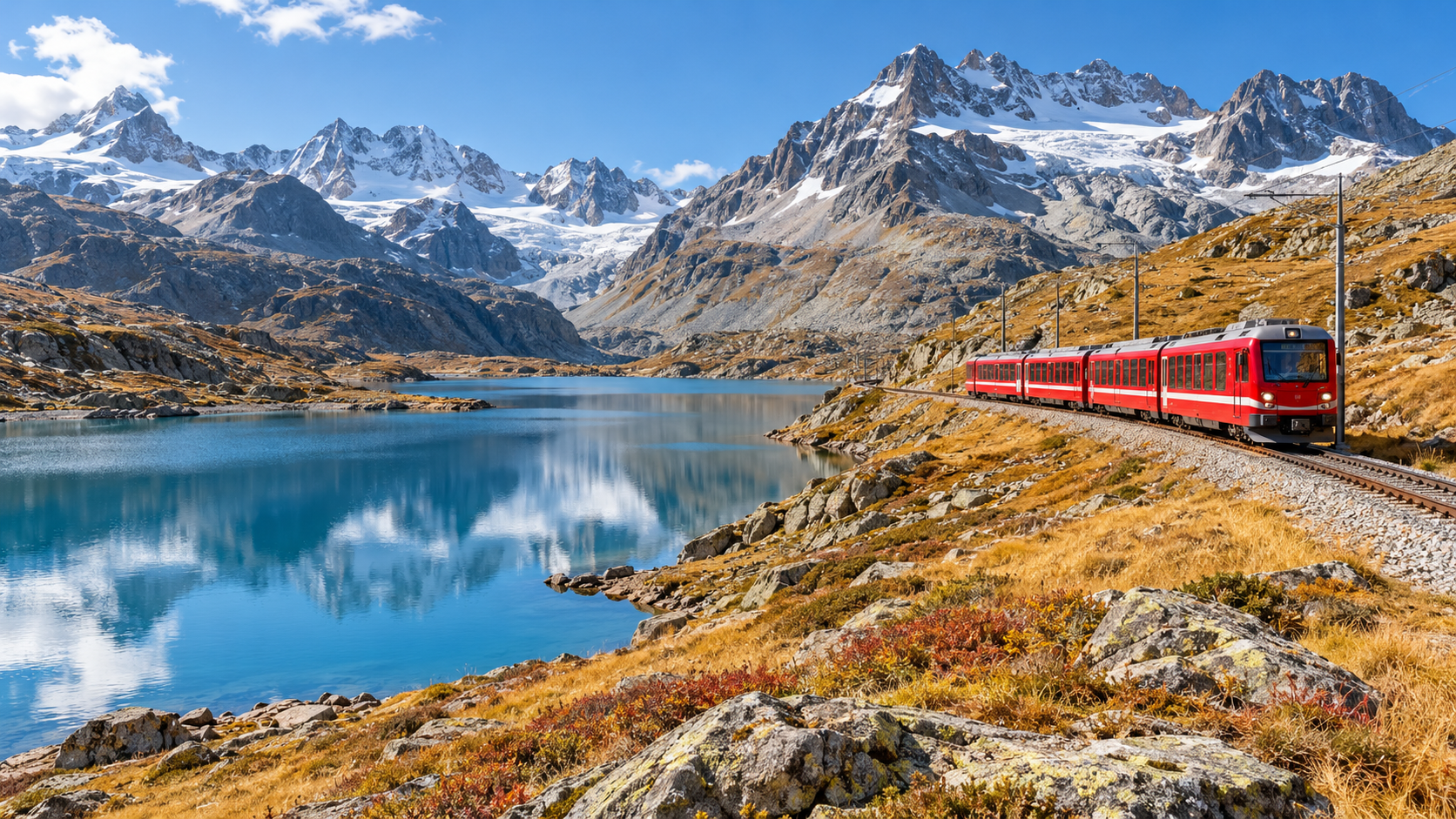
On the Bernina section, highlights include Lago Bianco, Alp Grüm and the Brusio Circular Viaduct. Look at a route map with the actual starting point marked. A photograph of a famous viaduct on a booking page is not a substitute for checking whether your selected journey passes it.
This also helps with hotel planning. If you already sleep in the Engadin, beginning nearby may create a much calmer day than traveling north first to recreate someone else's full crossing. If the Albula railway is a central reason for your trip, make space for that section instead of assuming it comes with every service.
Write down the scenery or places that matter most to you. Then check the journey against that short list. For example, a traveler whose priority is the mountain-lake section has a different planning problem from someone who specifically wants the Landwasser crossing. The train brand alone cannot resolve either one.
Check engineering notices for your date
#At the time of checking on 30 October 2026, RhB announced that Bernina Express trains 951 and 952 would run via Vereina from 29 October to 13 November 2026 because of engineering work. A diversion changes the route, so do not assume the usual Albula scenery is included on an affected departure.
For travel during that period, ask RhB to confirm the actual route before committing around a particular landmark. For later dates, check current notices again. A dated diversion is neither a permanent route description nor a reason to assume everything returns unchanged without checking.
What the panoramic carriage adds
#RhB's comparison describes the Bernina Express panoramic cars as having large windows curving towards the roof, with onboard information, Wi-Fi and service. Regional coaches have conventional windows; the operator describes opening windows and sun protection on the regional service. Equipment on the particular departure still matters.
Think about the value of those features during your actual journey. A traveler who wants to sit down, stay with the group and enjoy the passing landscape may appreciate the panoramic setup. Someone who wants a relaxed lunch break between trains may get more value from a timetable with room to pause.
Large windows also do not promise perfect photographs. Reflections, the angle of light, weather and other passengers still affect a picture. Treat photography as one part of the ride, rather than choosing an entire itinerary around the assumption that every frame will be clear.
You do not need to chase a single supposedly perfect seat side. Decide first whether the available seats let your group travel comfortably. If a specific view matters, ask about the direction and carriage arrangement for that departure. Avoid turning a scenic day into an argument over a seat recommendation copied from a different journey.
The ticket and the reservation do different jobs
#A ticket or applicable pass establishes your right to travel under its conditions. A seat reservation allocates a place on the specified service. RhB requires both valid travel entitlement and a paid seat reservation for the Bernina Express panoramic carriage.
RhB lists Swiss Travel Pass, Eurail and Interrail among accepted travel products, with the panoramic reservation purchased separately. Check your own product, class, validity date and route. Seeing a pass name on a list is not enough if your particular pass is inactive or does not cover the journey you selected.
Keep a simple booking note with two headings: travel entitlement and seat. Under the first, record the ticket or pass and relevant conditions. Under the second, record the train, date, route, coach and seat shown on the reservation. This makes a missing part much easier to spot before departure.
If you are buying through an intermediary, read the itemized confirmation. What train is actually included? Does the price cover transport, a seat, a guided excursion or a combination? What changes if you miss it? Compare those details with the product you intended to buy, rather than judging from the headline alone.
Regional reservations: the detail older advice can miss
#Do not rely on the blanket claim that Bernina regional trains cannot be reserved. RhB currently offers optional seat reservations between St. Moritz and Tirano for CHF 5 per person per route, including first and second class. The operator recommends them on this busy section.
Only a limited number of seats are reservable. RhB says travelers can still make the journey without a reservation when that allocation has sold out, although high demand may mean longer waiting. A sold-out reservation screen and a canceled train are different situations.
The regional booking page also flags a technical restriction on individual reservations for April 2027. Check the conditions for your own date rather than treating today's booking option as a permanent promise.
If sitting together is important, investigate the available reservation before building the rest of the day around that train. If you prefer to travel without reserving, allow room to adapt. Flexibility is more useful when your onward hotel, meal or train does not depend on the first departure working exactly as hoped.
For an illustrative cost check, four travelers choosing a CHF 5 reservation each would pay CHF 20 in reservation charges for one route. That is not the total travel fare. Keep optional seat costs separate from tickets or passes when comparing alternatives.
Build a day that works beyond the train window
#Start with where you will sleep that night, then work backwards. A journey ending in Tirano is one plan; a journey followed by another train and a late hotel check-in is a longer one. Compare the whole chain before choosing a departure.
The following are planning patterns, not published timetables or guaranteed connections. Use your travel date to check the actual trains, transfer requirements and service notices.
Pattern one: make the crossing your main activity
#Choose a booked panoramic departure that fits between your accommodation and onward travel. Keep the arrival end simple: a meal, a short look around or an overnight stay rather than several timed commitments.
This can suit travelers who prefer one clear anchor for the day. Its weakness is dependence on a particular service, so check what your bookings allow if the plan changes. The point is to reduce decisions during the journey while understanding the conditions you accepted beforehand.
Before booking a separate onward train, examine the consequences of a missed connection. Is there another practical departure? Does your ticket allow it? Would you still reach your accommodation within its arrival arrangements? A cheaper connection can become poor value if the rest of the evening has no room to recover.
Pattern two: use a regional journey for one proper break
#Choose one stop you actually want to spend time in, then inspect the arrival and departure options around it. Places shown on the line include Alp Grüm and Poschiavo, but choose a stop only after checking what you can realistically do there that day.
Separate station time from activity time. Looking at scenery near the station needs a different plan from a walk, a restaurant booking or a visit elsewhere. Check opening hours, walking conditions and the return to the platform before making an activity essential.
Use a small planning calculation. Suppose your chosen gap between trains is 90 minutes. If you allow 15 minutes to get oriented and 15 minutes to return and prepare to board, 60 minutes remain before any walk to the activity. Those numbers are illustrative, not recommended connection allowances. Set margins for your group and conditions.
Choose a later fallback departure too. If the next workable train would make your onward journey fail, the stop may be too ambitious. It is easier to remove an optional break while planning than to discover that problem on the platform.
Pattern three: shorten the railway day
#If a full crossing requires an exhausting start and finish, choose a shorter section or stay closer to the route. A trip does not become better merely because it covers every place shown on a map.
This is particularly useful when one person in the group enjoys long train rides more than everyone else. Agree on the main shared experience, then protect time for meals and rest. A manageable journey with attention left for the view may be more satisfying than a longer one spent watching the clock.
Compare the whole cost, with the same assumptions
#Put both options on the same basis: same date, passengers, class, starting point and destination. Add the applicable fare or pass allocation, reservations, transfers and any extra accommodation required by the departure you choose.
Do not count a pass you already own as a new purchase twice. Equally, do not buy a multi-day product solely because a single ride looks expensive before checking the rest of your itinerary. The right comparison depends on whether you are deciding to buy a pass or deciding how to use one already purchased.
Keep flexibility visible in the comparison. A price tied to a specific train may serve a fixed trip well. A more flexible option may have value if you want a stopover or weather-dependent day. Read the actual conditions; the word regional does not automatically make every ticket unrestricted.
Write down what would make you choose the more expensive option. It might be a preferred carriage, easier timing or fewer stressful decisions. If you cannot name a benefit you care about, there is little reason to pay more simply because a package sounds more prestigious.
Luggage, accessibility and comfort deserve their own check
#RhB permits luggage on the Bernina Express but notes that storage space is limited. It also provides designated wheelchair-accessible seats through Railservice, with boarding and alighting assistance arranged in advance through SBB. Confirm the complete journey and transfers when requesting assistance.
For your own packing, keep tickets, identity documents, essential medication, water and a useful layer accessible. A train journey is easier when you do not need to unpack the main suitcase to find a small item. Check food arrangements if dietary needs make buying something on the day uncertain.
If you plan to leave bags while exploring, investigate the exact station or accommodation rather than assuming storage exists at every stop. Check location, capacity, access and collection time separately. A storage point is only useful if you can retrieve the bag before continuing your journey.
Discuss practical needs with the whole group. A short connection that looks comfortable to one traveler may be unsuitable for someone who needs a step-free route, more time boarding or a rest. Build the day around those needs before adding optional sightseeing.
Before you press pay
#Check the actual service name, route, date and class against your plan. Confirm whether you are buying a panoramic reservation, a regional reservation, a travel ticket or a combined product. Save the documents so they remain accessible during the trip.
Look once more at engineering notices and the full onward journey. Check daylight for your date if seeing the scenery is the main purpose. Carry the travel documents required for your nationality and itinerary when crossing between Switzerland and Italy; a train booking does not establish entry eligibility.
Then choose the experience you will enjoy using. The panoramic service works well when its carriage and fixed departure are part of the appeal. A regional plan works well when its connections give you useful control of the day. Both choices benefit from the same preparation: the right route, valid documents and enough time to enjoy arriving.