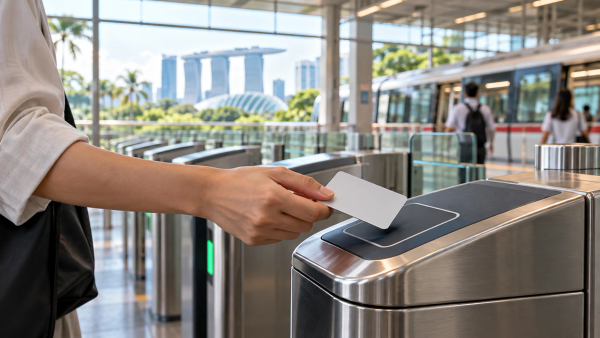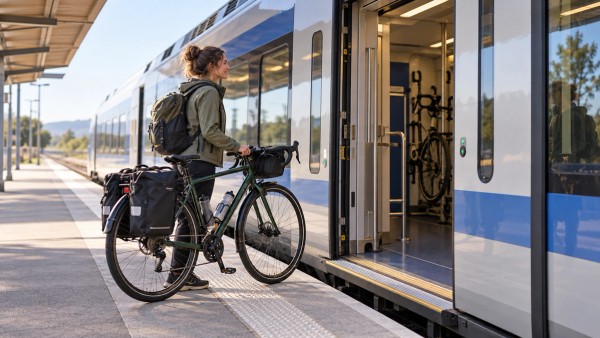
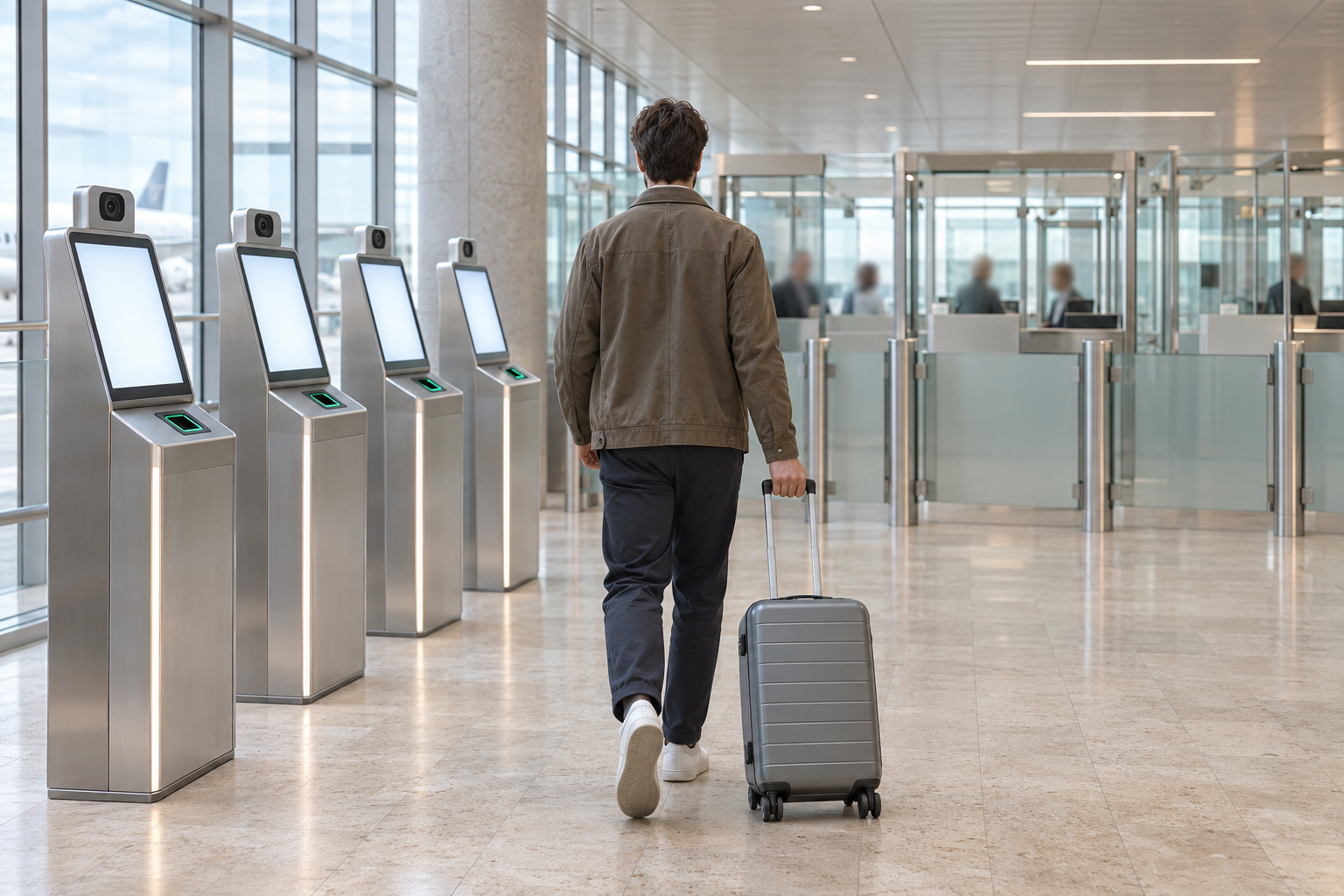
If you are not an EU or Schengen national and you are visiting Europe for a short stay, your passport is no longer stamped at the Schengen external border. Since 10 April 2026, the Entry/Exit System (EES) records your entry and exit digitally, and the first time you cross after it started, border staff take a photo of your face and, in most cases, your fingerprints.
That first registration takes longer. Later crossings are mostly a quick face or fingerprint check. EES also counts your 90 days in any 180 automatically, so overstays are now very hard to miss. ETIAS, the separate travel authorisation, is still not live and nobody can apply for it yet.
So here is what changes, who it applies to, how to plan your time, and what to check before you fly.
What EES is and when it started
#EES is an automated EU border database. It registers non-EU nationals who come for a short stay, each time they cross the external border of a country that uses the system. It records who you are, when and where you entered and left, your biometrics, and any refusal of entry.
It did not switch on in one day. The European Commission set 12 October 2025 as the start of a six-month progressive rollout, where countries added the system crossing point by crossing point. That phase ended on 9 April 2026. From 10 April 2026, EES has been fully operational at all external border crossing points, and manual passport stamping has been abolished in the countries using it.
The rules on how long you can stay did not change. EES just replaces the stamps with a digital record that the system can calculate on its own.
Which countries use EES
#EES is used by 29 European countries:
- Austria, Belgium, Bulgaria, Croatia, Czechia, Denmark, Estonia, Finland, France, Germany
- Greece, Hungary, Iceland, Italy, Latvia, Liechtenstein, Lithuania, Luxembourg, Malta, the Netherlands
- Norway, Poland, Portugal, Romania, Slovakia, Slovenia, Spain, Sweden, Switzerland
Two EU members are not on that list. Cyprus and Ireland do not use EES, and passports are still stamped manually there. The UK is not part of Schengen either, but EES checks for some UK departures happen on UK soil (more on that below).
"External border" matters here. You register when you enter or leave the 29-country area from outside, for example flying from New York to Paris, Dubai to Frankfurt, or London to Amsterdam. Moving between two EES countries, such as France to Spain, is not an external border crossing.
Does EES apply to you?
#EES applies if you are a non-EU national on a short stay, meaning up to 90 days in any 180-day period. For EES, "non-EU national" means you do not hold the nationality of an EU country or of Iceland, Liechtenstein, Norway or Switzerland.
It applies in both of these cases:
- You need a short-stay Schengen visa. You still get the visa first, then EES records your actual crossings.
- You travel visa-free. Visa-free visitors, such as UK passport holders on holiday, are registered too.
So the question is not "is my country on some EES list". It is whether you are a non-EU short-stay visitor without an exemption.
If you still need a visa, EES does not change that process. If you are stuck at that stage, our guide on getting a Schengen visa appointment covers what to do when slots are hard to find.
Who is exempt
#According to the EU's official exemptions list, EES does not apply to:
- Nationals of the 29 EES countries, plus Cyprus and Ireland
- Holders of residence permits and long-stay (D) visas
- Non-EU family members of EU citizens who hold a residence card
- Non-EU family members of people who can move freely in Europe like EU citizens, if they hold a residence card or residence permit
- People coming for an intra-corporate transfer, research, studies, training, voluntary service, pupil exchange, educational projects or au pairing
- Nationals of Andorra, Monaco and San Marino, and holders of Vatican City or Holy See passports
- People exempt from border checks or with special border-check privileges
- Holders of a valid local border traffic permit
- Crew members of passenger and goods trains on international connecting journeys
If you are exempt, you do not register. You show your exemption document, such as your residence permit, to the border officer.
Two cases that confuse people
#Family members of EU citizens without a residence card. These travellers are registered, but sometimes under a lighter set of rules. The EU's FAQ gives two examples. A 17-year-old US citizen visiting his German father who lives in Spain is registered as a family member, with shorter data retention and no automated stay calculator. A US citizen visiting their French spouse in France, where the spouse lives, is registered as a regular traveller. The difference is that EU free-movement rules only kick in when the EU citizen is in a country other than their own.
UK nationals living in the EU under the Withdrawal Agreement. They are exempt only if they hold one of the specific residence or frontier worker documents issued under that agreement, or a qualifying residence permit. Without one, they are registered and can later ask for the record to be deleted or corrected once they show the document.
What data EES collects
#EES stores the details from your passport (name, date of birth, nationality and so on), the date and place of each entry and exit, any refusal of entry, and biometrics. Which biometrics depends on your situation.
| Your situation | What EES stores | Why |
|---|---|---|
| Visa-free traveller, 12 or older | Facial image and 4 fingerprints | No earlier EU biometric record exists |
| Short-stay visa holder | Facial image only | Your fingerprints are already in the EU Visa Information System from your visa application |
| Child under 12 | Facial image and passport data, no fingerprints | The EU says fingerprints of under-12s are currently not scanned |
Note the word "currently" in that last row. The EU uses it in its own FAQ, so this could change. Check before a family trip.
Refusing is not really an option. If you refuse to give your fingerprints or have your photo taken, you will be denied entry.
You do not need a new passport for EES. Both chip (biometric) and older non-chip passports are accepted in principle, as long as they are valid and you meet the other entry conditions. The only catch is that self-service kiosks and the pre-registration app need a chip passport. EES also does not change passport validity, so it is still worth checking the passport validity rules before you book.
What happens at your first crossing
#Your first crossing since EES started is the slow one. Here is what to expect.
At the border
#A passport control officer, or a self-service machine before the desk, scans your passport, takes your photo and scans your fingerprints if they apply to you. This creates your digital file. Your passport is not stamped.
The officer can still ask the usual entry questions, like the purpose of your trip, where you are staying, and whether you have enough money for the stay. EES does not replace those entry conditions. It only replaces the stamp.
Self-service kiosks, where available
#Some airports and ports have self-service machines. If one is available, you can register your data there, then go to a border lane. The officer already has your identity check, the results of database checks and your remaining days of stay. They then decide whether to let you in.
Kiosks are not everywhere, and each country chooses how much to automate. Follow the signs and staff at your crossing point.
The pre-registration app
#The EU has an official app called Travel to Europe. Where a country supports it, you can pre-register your passport data, a selfie and an entry questionnaire up to 72 hours before you reach the border. It is optional and needs a chip passport.
As of November 2026, the EU's app page lists Sweden (passport data, face image and questionnaire) and Portugal (questionnaire only). Other EES countries may add it later, with different features. Check the official app page for your arrival country before relying on it, and remember it does not replace the border check.
What happens at later crossings
#Once your file exists, the officer only verifies your face and/or fingerprints against it, which is quicker. In rare cases they may need to collect your data again.
If you have a chip passport and the crossing point has self-service gates, you may be able to go through automatically. When your file is clear, you will usually not need to see an officer. Officers can still stop you and take your photo again at any time.
Exits are registered too. When you leave the 29-country area, your exit is recorded, and you may be asked for a fingerprint or face scan. That exit record is what closes your stay in the 90/180 count, so do not skip a check if you are directed to one.
Leaving from Dover, Folkestone or St Pancras
#UK travellers going to France by ferry, Le Shuttle or Eurostar have a different setup because of juxtaposed controls. French border checks happen in the UK before departure, so EES checks happen there too.
UK government guidance says:
- Port of Dover: EES checks take place in a purpose-built processing area at the Western Docks.
- Eurotunnel Le Shuttle, Folkestone: there is a dedicated pre-registration area with self-service kiosks.
- Eurostar, St Pancras International: self-service pre-registration kiosks are in three areas of the station, before the ticket gates. You may be asked to use them.
If you travel by air or by ferry from other ports, you register when you arrive in the destination country.
The practical point is simple. At these three crossings, the extra EES time comes out of your departure time in the UK, not after you arrive in France. Your rail or ferry operator's check-in advice is the one to follow.
How much extra time to budget
#There is no official "add X minutes" figure. UK government guidance says each passenger may need extra time and to be prepared to wait longer than usual, especially at busy times. That matches how the system works. A first-time registration takes longer than a quick verification, and a whole flight or coach of first-timers arriving together makes queues.
A sensible way to plan:
- First trip since April 2026: treat it as your slow crossing. Keep buffer on arrival before trains, car hire pick-ups or tight connections.
- Busy periods: official guidance warns that checks can take longer at busy times, so peak travel days need more buffer.
- Groups and families: each person is registered, including children, so a family takes longer than one traveller.
- Return trips: you also go through an exit check, so keep a buffer for the departure leg too.
- Juxtaposed routes from the UK: follow your operator's latest advice on how early to arrive.
Is the summer flexibility still in place?
#During the 2026 launch, EU rules allowed some breathing room. For 90 days after the progressive rollout ended, a country could partly suspend biometric registration at a specific crossing point for up to six hours at a time if waiting times became excessive. That window extended automatically by 60 days if fewer than 80% of records created during the rollout contained biometric data.
Those dates put the end of that special window somewhere between early July and early September 2026. We did not find any official notice extending it further. So for trips now, expect full EES checks. Even so, how much is done at kiosks versus desks, and how long queues are, still varies by border post.
How EES counts your 90 days in 180
#The short-stay rule itself is unchanged: you can be in the Schengen area for up to 90 days within any 180-day period. What changed is that EES now does the counting.
A few rules to keep in mind:
- It is a rolling window. For each day you are in the area, count back 180 days and add up the days you were present. The total must not go above 90.
- Entry and exit days both count. Under the Schengen Borders Code, your entry date is your first day of stay and your exit date is your last day.
- It is one count for all 29 countries. Ten days in Italy and ten in Germany are 20 days, not two separate allowances.
- Time on a residence permit or long-stay visa does not count. Those stays are outside the 90/180 calculation.
A worked example
#This is a hypothetical example to show the method. Say you were in the Schengen area from 1 May to 30 May 2026 (30 days) and from 10 July to 20 August 2026 (42 days). That is 72 days.
You want to come back on 1 October 2026. Counting back 180 days from 1 October takes you to 5 April, so both trips are inside the window. You have 18 days left. If you enter on 1 October, your last allowed day is 18 October. Staying until 19 October would put you at 91 days, because the May trip is still inside the 180-day window on that date.
If you waited until early November, the May days would start dropping out of the window and you would have more room. This is why the rolling window catches people out. Your allowance depends on the exact date you look from.
Checking your remaining days
#The EU's official travel website has an EES online tool where you enter your passport details, the country and your planned dates. It tells you if your entry is "OK" or "not OK" and how many days you can still stay. Some border crossing points also have equipment that shows this, and you have the right to ask a border officer.
One important limit: the tool does not include any time you spent in the Schengen area that began before 10 April 2026, even if that stay continued after that date. If you had a long trip spanning April 2026, do your own count as well, using your old passport stamps.
If you have questions about your remaining stay, contact the authorities of the country where you last entered or left the Schengen area. If you have not visited since 10 April 2026, contact the country you plan to visit.
What happens if you overstay
#This is where EES really changes things. Before, an overstay was found only if an officer carefully counted the stamps. Now the system flags it automatically.
If you stay longer than allowed, you are identified as an overstayer and added to a list that border officers, immigration officers and visa staff can see. What happens next depends on the national law of the country involved. The EU lists examples such as removal from the territory, fines or detention, and being prevented from coming back in the future.
If you are returned under a formal return decision, an entry ban may be issued and recorded in the Schengen Information System. In principle, such bans do not exceed five years, but the length depends on the case.
There is also a simple front-door rule. If you have already used your 90 days in the past 180 and try to enter again, you will be refused entry, and that refusal is recorded in EES.
What if something outside your control kept you there, like a hospital stay after a serious injury? If you give credible evidence to the border or immigration authorities, your record can be corrected and you can be taken off the overstayer list. Keep documents, such as hospital or airline records, that show why you could not leave on time.
Airlines and other carriers also have a role. For visa holders, carriers must check before boarding that you have a visa and have not used up its permitted entries. They now do this through an online system instead of looking at stamps.
How long your EES data is kept
#EES data is not kept forever. The EU's data page gives these periods:
| Record | How long it is kept | Counted from |
|---|---|---|
| Each entry, exit or refusal record | 3 years | The date the record was created |
| Your individual file (personal data and biometrics) | 3 years and 1 day | Your last exit, or your refusal of entry |
| Your file if no exit was recorded | 5 years | The date your authorised stay expired |
| Entry/exit records of qualifying family members of EU, EEA or Swiss citizens | 1 year | The date of the exit record |
For those qualifying family members, data is not kept if no exit is recorded, and their stay is not calculated by the system.
In practice, if you visit Europe every year, your file stays active and you skip the full registration on later trips. If you stop visiting for more than three years after your last exit, your file is deleted, so expect the full first-time registration again on your next trip.
You have the right to ask for access to your EES data, and to ask for wrong or incomplete data to be corrected or unlawfully processed data deleted. You contact the data controller in an EES country, ideally one you travelled to. If that does not work, you can complain to the national data protection authority or, for EU agencies, the European Data Protection Supervisor.
Where ETIAS stands now
#ETIAS is a different system. EES records your border crossings. ETIAS will be an online travel authorisation that visa-free visitors get before they travel.
As of mid-November 2026, the official ETIAS website says ETIAS is not in operation and no applications are being collected. The EU says it will announce the start date several months before launch. The Commission's planning target had been the last quarter of 2026, but no start date has been announced.
So for now, no action is needed. When it does launch, the official site describes it this way:
- It will be needed by visa-exempt non-EU travellers, such as UK passport holders without a visa or residence permit.
- It will cover 30 European countries.
- It will cost EUR 20.
- It will be valid for three years or until your passport expires, whichever comes first.
- You will apply through the official ETIAS website or the official app.
If you need a Schengen visa, ETIAS is not for you. Your visa does that job.
Be careful with websites that offer to "apply for ETIAS" today. Since ETIAS is not running, anything charging you for it now is not an official application. UK government guidance calls such sites fraudulent. Even after launch, the EU warns that intermediary sites may add their own fees on top of the EUR 20 and handle your personal data, so use the official channels.
Quick checklist before your next Europe trip
#- Check your status. Are you a non-EU short-stay visitor, or do you have an exemption like a residence permit?
- Check your passport. It must be valid for your trip. A chip passport lets you use kiosks and the app where available.
- Check your days. Count your last 180 days yourself, and use the EU's online tool for stays from 10 April 2026 onwards.
- Check the app. If your arrival country supports the Travel to Europe app, you can pre-register up to 72 hours before.
- Plan time. Add a buffer for your first crossing, busy periods, families and the exit check. On Dover, Folkestone or St Pancras routes, follow your operator's arrival advice.
- Keep records. If something delays your departure, keep proof so you can get your record corrected.
- Ignore paid ETIAS offers. It is not live yet.
This is general information based on official EU and UK guidance as of November 2026, not legal advice. Border rules and app coverage change, so recheck the EU's official travel website and your carrier's advice close to your travel date, and follow what the border officer tells you on the day.