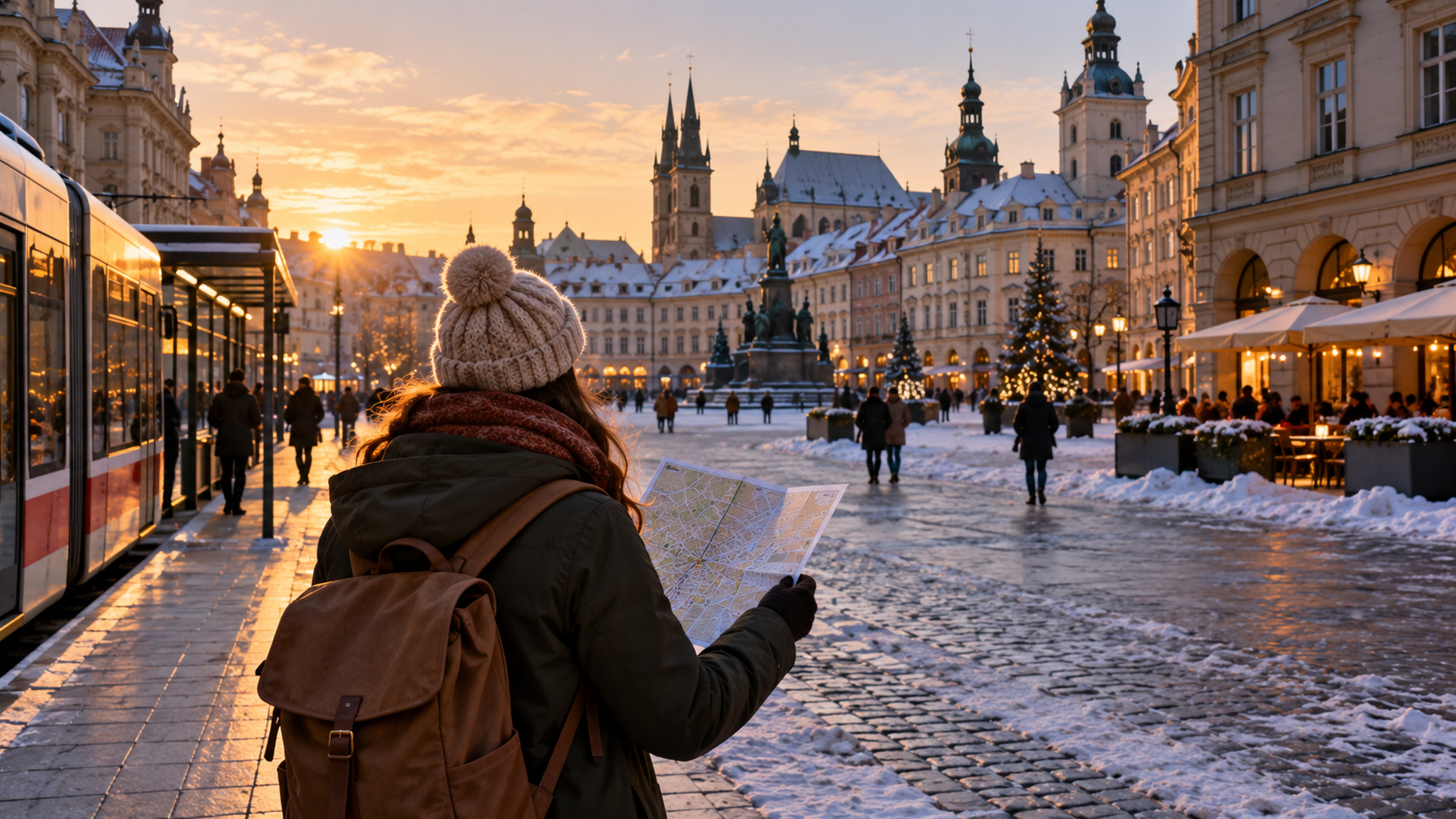
A winter city trip works best when you plan the outdoor parts around the daylight you will actually have on your travel dates. Check sunrise and sunset for the destination, choose one or two places that truly need natural light, and keep museums, meals and lit streets for the darker hours. Then check opening times and transport for those exact days. A short day can still be a full day out; it just needs a different order.
The mistake is to copy a summer itinerary and move faster. If a viewpoint closes before sunset, a long lunch occupies the brightest hour, and the last bus leaves early, rushing will not bring the light back. A better plan gives each daylight hour a job and leaves some room for weather and ordinary delays.
Start with your dates and the right city
#“Winter daylight” is not one fixed number. It changes with latitude, date and location. A city break in one part of the world may have a gentle early sunset; another destination may have only a few hours between sunrise and sunset. Winter also falls in different months in the northern and southern hemispheres. Plan for the destination's local season, not the month that feels like winter at home.
Look up sunrise and sunset for the city on each full sightseeing day. Use the actual date, especially if you are traveling over several weeks or around a clock change. A sunrise time from a generic “December in Europe” article is too broad to build an appointment around. Check the destination's local time zone as well. Sunrise and sunset tools usually display local clock time, while your flight confirmation may still be shown alongside times at your origin.
Those numbers are a starting point, not a promise of perfect visibility. Tall buildings, a valley, a low winter sun or thick cloud can make a street or viewpoint feel dark earlier than the official sunset. Likewise, civil twilight can leave some usable light after the sun sets, but it is not a safe extra hour to assume for a remote walk. If a particular scene matters to you, plan to reach it before the end of the published daylight window.
Before you book anything non-refundable, note the light window beside the hours of the places you care about. Some attractions shorten their winter opening hours, close on particular weekdays, or change schedules around public holidays. Check each venue and transport operator for the exact date. A museum open late on Saturday cannot rescue a Thursday plan, and a viewpoint that closes at 15:00 does not care that sunset is later.
Give daylight to the sights that need it
#Make two short lists. The first holds the experiences that lose most of their value in the dark: a park walk, a skyline view, an outdoor market you want to see in daylight, a waterfront route or architectural details on a street. The second holds experiences that still work after sunset: a museum with verified evening hours, a performance, a meal, a covered market that is actually open, or a walk through well-lit central streets.
This is about what you want from the place, not a universal rule. A city square might be best in daylight if you want to study its buildings, and best after dark if the lights are the reason you came. A museum may be a top priority even at midday if it has a timed entry you cannot move. Put fixed commitments on the page first; then protect the remaining light for the outdoor experience you would most regret missing.
Resist the urge to label every outdoor stop “essential.” On a short winter day, one substantial outdoor area plus a nearby second stop often feels more complete than five distant photo stops. You can spend time looking rather than checking the clock. If a second outdoor sight requires a cross-city ride, decide whether it is worth displacing the first one. Leaving a place for another day is often the better choice.
Build a daylight budget, not a packed timetable
#Imagine a city where your checked travel-date estimate shows daylight from 09:00 to 16:00. These times are an illustration, not a forecast for any real destination. Seven hours on paper does not mean seven hours at sights. Breakfast, the ride to the first area, a queue, lunch and the trip between neighborhoods all come out of the same window.
Suppose you want an old-town walk, a riverside viewpoint and a museum. You might reach the old town at 09:30, explore one connected area until 11:30, have a short lunch nearby, then use the early afternoon for the riverside. The museum becomes the late-afternoon plan only if its actual entry and closing times support that order. If it closes early, reverse the museum and riverside or move the museum to a different day. The point is to change the order before you pay for timed tickets.
Build this plan around arrival times, not only departure times. A transit app may say the train ride is fifteen minutes, but walking to the station, waiting, finding the correct exit and getting oriented still take time. A popular attraction may have a security or ticket queue. You do not need a precise minute-by-minute forecast; you need enough slack that one small delay does not erase your only outdoor priority.
For each day, write one line with four items: the daylight window, the outdoor anchor, the latest sensible time to reach it, and the indoor or evening alternative. If you cannot name the latest useful arrival time, the plan may be hiding too much travel. A winter day is easier to manage when its main choice is visible at a glance.
Keep the route compact
#Travel between sights is often the quietest thief of daylight. Group places by neighborhood or by a simple transit line. If the morning walk and afternoon viewpoint are on opposite sides of a city, you may spend the strongest light underground or in traffic. Two places within one area can be more satisfying than two famous places far apart.
Look at the route door to door. Can you walk between the outdoor stops on an accessible path in current conditions? Is there a direct bus or train? Is the return after dark simple and comfortable for your group? A route that looks short on a map may involve a steep hill, icy steps, a long station transfer or a waterfront exposed to wind. Check the actual path and conditions rather than treating map distance as walking time.
Choose accommodation with that daily route in mind. A room near the places you want to visit in the evening may save repeated trips after dark; one near the morning transit link may protect the first daylight hour. “Central” is useful only if it is central to your plan. Before booking, trace one typical morning and one evening journey from the address. Compare the total trip friction, including a late return, rather than the hotel's map pin alone.
If you have several days, avoid scheduling all outdoor highlights on a single date. Spread them so that a poor-weather morning can be swapped with a museum day. Keep one flexible block rather than filling every hour with paid reservations. Flexibility is most valuable where a change of weather would otherwise make the trip feel lost.
Use the darker hours deliberately
#Short daylight does not make the evening empty. Many city pleasures are naturally evening activities: a performance, a relaxed meal, illuminated streets or an indoor cultural stop with verified opening hours. Decide what you actually enjoy after dark instead of adding “nightlife” as a placeholder. A quiet dinner close to your stay may be a better finish than another cross-city transfer.
Check the difference between a place being open and the visit being worthwhile at that hour. A museum's listed closing time may be later than its final admission. An outdoor market may close before the lights come on. A riverfront may be lit in its central stretch but not along the route you planned to walk back. Confirm the specific venue, entrance and return route from current official information where the detail matters.
Twilight can be beautiful, but it is a transition, not a second daylight period you can spend twice. It may suit a short city-center walk or a planned photograph from an easy-to-reach viewpoint. It is less reliable for navigation on unlit paths. Sun calculators distinguish daylight from several types of twilight; the usable light depends on local terrain, cloud and street lighting. Plan conservative outdoor finish times, especially when you are unfamiliar with the area.
Treat arrival and departure days differently
#The first day often looks longer in a calendar than it feels in practice. A flight or train arrival is followed by baggage, the ride into town, check-in or luggage storage, and getting oriented. If the city has an early winter sunset, a midday arrival may leave very little time for a faraway outdoor landmark. Give the arrival day a nearby walk, a meal and a simple route back. If you get more light than expected, that is a bonus.
The departure day has its own trap. A late flight can tempt you to book a full daylight itinerary, yet hotel checkout, stored bags and the trip to the airport may divide that day into awkward pieces. Choose a small, accessible area and set a clear time to leave it. Do not put your one must-see view on the departure day unless the transport plan leaves a comfortable margin.
For a two-night break, you may have only one genuinely full sightseeing day. Let that day carry the main daylight-dependent experience. Use the two partial days for smaller neighborhoods, food or indoor stops near your arrival and departure routes. This simple distinction prevents a “three-day trip” from promising three complete daylight windows.
Have a weather swap that stays nearby
#A useful backup is specific. “Go to a museum if it rains” is vague if that museum is across town, closed on Mondays or sold out. For each outdoor anchor, identify one indoor alternative in the same area and check whether it needs a reservation. If the forecast deteriorates, you can swap the order without sacrificing another hour to transport.
Weather also changes the decision itself. Light rain may only call for a shorter walk and dry clothing. Ice, strong wind, a storm warning or a local closure can make an exposed viewpoint or waterside route unsuitable. Check the local forecast and any official travel or site notices on the day, and follow restrictions. A booked ticket is not a reason to ignore a closure or unsafe conditions.
If an outdoor day is lost, decide whether to move the experience or release it. Rebooking every missed stop into the next day often creates an exhausting plan. Keep your highest priority, then choose a different indoor experience that fits the conditions. A winter trip can still feel like the place you came to see without completing every pin on a map.
Decide when a day trip is worth the light it consumes
#A day trip beyond the city may sound appealing, but winter makes its transport cost more visible. Add the journey from your accommodation to the departure point, waiting time, the main ride, the last leg to the sight and the return. Then compare the usable time at the destination with its actual opening and daylight window. A two-hour ride is not just two hours if the connection runs infrequently.
If the destination is mainly an outdoor view, reaching it shortly before sunset may not justify the trip. An overnight stay, a closer alternative or a different season may serve the experience better. If the destination has meaningful indoor activities after dark and a reliable return, the day trip may still work. The decision depends on what you want to do there, not only the distance.
Check seasonal timetables directly. Tourism guidance for some winter destinations warns that transport frequency, weather and road access can change with the season. Even for an urban break, do not assume the summer version of a ferry, sightseeing bus or regional route is still running. Book a fragile transport leg only after you know how it fits the daylight you expect.
A simple plan to keep before you leave
#For each day, save the local sunrise and sunset, the current hours for your key venue, the outward and return transport, and one nearby alternative. Put the date beside every opening time so you do not accidentally use a schedule from a different weekday or holiday. Keep essential tickets and addresses available offline, and revisit weather and service notices shortly before the day begins.
The goal is not to squeeze the most attractions into the light. It is to know which parts of the city need that light for you, reach them without a frantic route, and let the darker hours have their own purpose. When you plan in that order, a short winter day feels like a clear choice instead of a race against sunset.