If you’re planning a Hong Kong trip from India and you’re stuck on this one very specific but actually super important question — Octopus Card or Tourist Day Pass — yeah, been there. I thought it would be some tiny decision I’d make in 2 minutes at the airport. It wasn’t. Because transport in Hong Kong is so smooth, so fast, so woven into daily life that the card you choose kind of changes your whole rhythm in the city. And trust me, in a place where you’re hopping between MTR stations, ferries, buses, trams, convenience stores and random snack stops, the wrong choice gets annoying real fast.
I went in thinking the Tourist Day Pass would obviously save money because, you know, “unlimited” always sounds smart. But after a couple of long days around Tsim Sha Tsui, Central, Mong Kok, and one very confusing detour where me and my friend ended up taking the wrong exit and walking like mad in humidity that felt like Mumbai in August... I changed my mind a bit. Actually more than a bit. So this post is the practical version of what I wish someone had told me before I landed in Hong Kong with my backpack, tired eyes, and too many screenshots.
First up, what’s the actual difference?
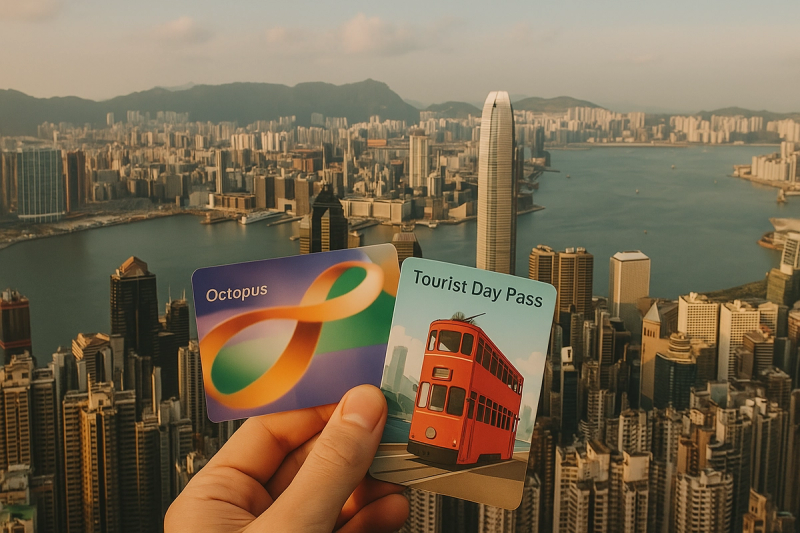
#The Octopus Card is basically Hong Kong’s all-purpose stored-value smart card. You load money into it and use it on MTR, buses, trams, ferries, and even at a lot of shops like 7-Eleven, Circle K, fast food places, vending machines, some bakeries, and other everyday spots. It’s not just a transport card, it becomes this weirdly satisfying little travel companion. Tap tap and done.
The Tourist Day Pass, on the other hand, is more limited but simple. It usually gives you one day of unlimited rides on the MTR for a fixed period after first use, with some exclusions depending on the pass type and airport routes not generally being included. Sounds amazing on paper. And for some travelers, it genuinely is. But the catch is this — Hong Kong is not a city where everyone only uses the MTR all day. Sometimes the tram is nicer. Sometimes the Star Ferry is half the fun. Sometimes the bus gives you better views and drops you closer. That’s where the comparison gets interesting.
What I actually used in Hong Kong, and where it started making sense
#I started with an Octopus Card because it was the easiest thing after arrival. If you’re flying from India, chances are you’ll arrive tired and just want zero drama. That was me. I didn’t want to stand there calculating routes, zones, restrictions and “validity from first use” logic while dragging luggage. I just wanted to get moving. You can get Octopus pretty easily at the airport or MTR customer service counters, and these days many travelers also check mobile wallet support before flying because digital options keep getting better. Still, the physical card is dead simple and honestly kinda iconic.
On my first day, I used the MTR, then a bus, then bought water from a convenience store, then used the ferry, then paid for a quick snack. That was the moment I realised why locals love Octopus so much. It removes friction. It’s not just about cost, it’s about brain space. You don’t keep thinking before every tiny purchase or trip. You just move.
If your travel style is flexible, slightly impulsive, and full of little unplanned stops, the Octopus Card feels less like a ticket and more like a key to the city.
When the Tourist Day Pass is actually better
#Okay but let me be fair, because the Tourist Day Pass is not useless at all. If you have one of those packed sightseeing days where you know for sure you’ll do a lot of MTR rides back-to-back, it can save money. Say you’re staying in Kowloon, then heading to Central, then Causeway Bay, then Quarry Bay, then back to Tsim Sha Tsui, then up to Mong Kok at night. That’s the kind of day where unlimited MTR starts looking pretty good. Especially if you’re the sort who gets tired and keeps changing plans, because with a pass there’s no guilt in making one extra train ride.
I tested that too. On one very ambitious day, I did multiple MTR-heavy hops and used a day-pass style strategy, and yes, financially it made sense compared to paying point-to-point for every single ride. But even then, I still ended up paying separately for other transport and snacks, because life in Hong Kong doesn’t stay inside neat ticket boundaries. You step out for dim sum, take a tram because it looks charming, hop on a ferry because the skyline is calling, and suddenly the “unlimited” part feels less unlimited than you imagined.
So who should pick which? Here’s the simple version
#- Pick the Octopus Card if this is your first Hong Kong trip, you want zero hassle, and you’ll use mixed transport not just MTR
- Pick the Tourist Day Pass if you have 1 or 2 intense sightseeing days with heavy MTR use and a very planned itinerary
- Pick Octopus again if you’re traveling with parents or kids, because flexibility matters more than squeezing every last dollar out of train fares
- Pick the pass only if you’ve already mapped your route and know you’ll be station-hopping like crazy
Honestly, for most Indian travelers doing 4 to 6 days in Hong Kong, I’d say Octopus wins. Not in a dramatic landslide maybe, but still wins.
The money side, because yeah that matters
#Hong Kong is not exactly a budget destination, especially if you’re converting everything into rupees in your head every 20 minutes like I was. Accommodation, food in tourist areas, airport transfer, attraction tickets — it adds up. So transport savings matter, but not in isolation. Typical hotel prices can vary wildly. A hostel bed or super basic guesthouse in areas like Tsim Sha Tsui, Jordan, or Mong Kok might start around HKD 250 to 500 on cheaper dates. Mid-range hotels are often somewhere around HKD 700 to 1,400 or more, and if you want proper harbour views then, well... prepare yourself.
That’s why I usually tell friends from India not to over-optimise this one transport choice. Save where it makes sense, sure, but don’t trap yourself into a pass that only works well under perfect conditions. Octopus can sometimes cost a bit more than a perfectly maximised MTR pass day, but it can also save you from mistakes, extra ticket lines, and random stress. And on a short holiday, that has value too. Maybe not spreadsheet value, but real value.
What transport in Hong Kong feels like on the ground
#The MTR is brilliant. Clean, fast, organised, easy enough once you stop overthinking the exits. But buses are underrated, the trams are ridiculously charming, and ferries are not just transport, they’re part of the experience. The Star Ferry ride is one of those cheap little joys that still feels special no matter how many skyline photos you’ve seen online. If you only focus on MTR because of a day pass, you miss a bit of Hong Kong’s personality, I think.
Also, one thing Indian travelers often appreciate — public transport in Hong Kong generally feels very safe, even at night in busy areas. Of course use common sense, watch your belongings, and don’t wave your phone around in a packed crowd. But overall the city remains one of the easier major Asian cities to navigate. Recent travel conditions have been pretty stable, transport runs efficiently, and tourist zones like Central, Tsim Sha Tsui, Wan Chai, Causeway Bay, and Mong Kok stay lively late into the evening. During typhoon or heavy rain warnings, though, always check service updates because weather can mess with plans fast.
Best months to go, because the weather changes everything
#I’ll say this straight — if you hate sticky heat, avoid peak summer if possible. Hong Kong humidity can humble you. Like fully. You think you can handle it because you’re from India, then you climb one slope or rush one station connection and your T-shirt is finished. October to December is lovely for most people, cooler and easier for walking. January and February can be nice too, though some days feel unexpectedly chilly. March to May is mixed, greener maybe, but more humid. June to September is the sweaty, rainy, storm-watch period, and if a typhoon signal goes up your perfectly planned transport day can go sideways.
If you’re visiting during festive periods, weekend rush, school breaks, or around big events and exhibitions, expect transport hubs and hotels to be busier. Hong Kong also gets a lot of event traffic — art fairs, rugby crowds, shopping surges, theme park visitors, concerts, seasonal harbour celebrations. Not a reason to avoid it, just book earlier. Prices jump fast, no joke.
Where I stayed, and why that affects the card choice more than people say
#This part gets ignored a lot. Your area matters. If you stay in Tsim Sha Tsui or Jordan, you’re already plugged into efficient transport and close to food, shopping, and harbour walks. Great for first-timers. Mong Kok is fantastic if you like energy, street markets, local eats, and a more crowded neighborhood vibe. Central is polished, business-heavy, scenic in its own way, but pricier. North Point and Quarry Bay can be good if you want a slightly more lived-in feel and decent connections.
When you stay in a well-connected area, an Octopus Card becomes even more useful because you’ll naturally combine different transport types. Quick MTR here, tram there, maybe ferry, maybe bus. If you stay farther out and plan to use MTR for repeated city entries in one day, then yes, a Tourist Day Pass can start looking better. So the right answer depends partly on your hotel, not just your sightseeing list.
Food stops, local habits, and why Octopus feels more natural
#One underrated thing about Octopus — it fits into how Hong Kong moves. You grab tea, bread, noodles, packaged fruit, maybe some egg tarts, and keep going. I loved those in-between moments. Not fancy dining, just regular city eating. In many neighborhoods you’ll find cha chaan teng cafes, roast meat shops, noodle spots, dessert places, bakeries, and convenience stores everywhere. As an Indian traveler, I also found enough vegetarian and Indian food options in places like Tsim Sha Tsui, Chungking Mansions side lanes, Jordan, and parts of Central, though pure veg can still take some effort. Carrying a card you can use beyond trains just feels practical.
And btw, don’t skip local things only because they’re not famous on Instagram. Ride the Ding Ding tram on Hong Kong Island. Walk around Sheung Wan. Take a ferry not just for transport but for the breeze. Explore a wet market if you’re comfortable with that. Visit a neighborhood bakery early evening. These are exactly the moments where rigid pass math starts to matter less and easy movement matters more.
A few mistakes I made, so maybe you don’t
#- I assumed all the useful transport would be covered by a tourist pass type option. Nope, always check exclusions properly.
- I underestimated how much walking happens inside stations and between exits. A cheap route isn’t always the easiest route.
- I forgot that convenience is part of the budget too. Saving a little money and wasting time is not always a win.
- I tried to over-plan one day and under-plan another. Funny thing is, the relaxed Octopus day went smoother.
So... Octopus Card or Tourist Day Pass? My real answer
#If you want my plain, no-nonsense recommendation: get an Octopus Card first. For most travelers, especially first-time visitors from India, it’s the better overall choice. It works across more situations, feels more natural in the city, saves mental effort, and supports the way people actually move around Hong Kong. Then, if your itinerary has one very MTR-heavy day and you’ve checked that a Tourist Day Pass gives better value for that day, you can consider it separately. But as your main transport tool? Octopus is the safer bet.
The Tourist Day Pass is a tactical item. The Octopus Card is a lifestyle item. That sounds dramatic lol, but after using transport there from morning till late night, that’s honestly how it felt. One is good for maximising a schedule. The other is good for experiencing Hong Kong without constantly stopping to think.
And maybe that’s the whole point. Hong Kong is best when you let it flow a bit. You step out for one thing and somehow end up doing three more. A skyline view turns into a ferry ride, that turns into a tea break, that turns into a random shopping lane, that turns into dessert. Cities like this reward flexibility. So yeah, my vote goes to the Octopus Card, with a small side nod to the Tourist Day Pass for planners, spreadsheet lovers, and people doing one monster MTR day.
Hope this saves you from the same overthinking I did standing there after landing. If you’re building your Hong Kong itinerary next, do check hotel location, weather, and your daily route style before deciding. And if you like practical travel posts written in an actually usable way, have a look at AllBlogs.in too.