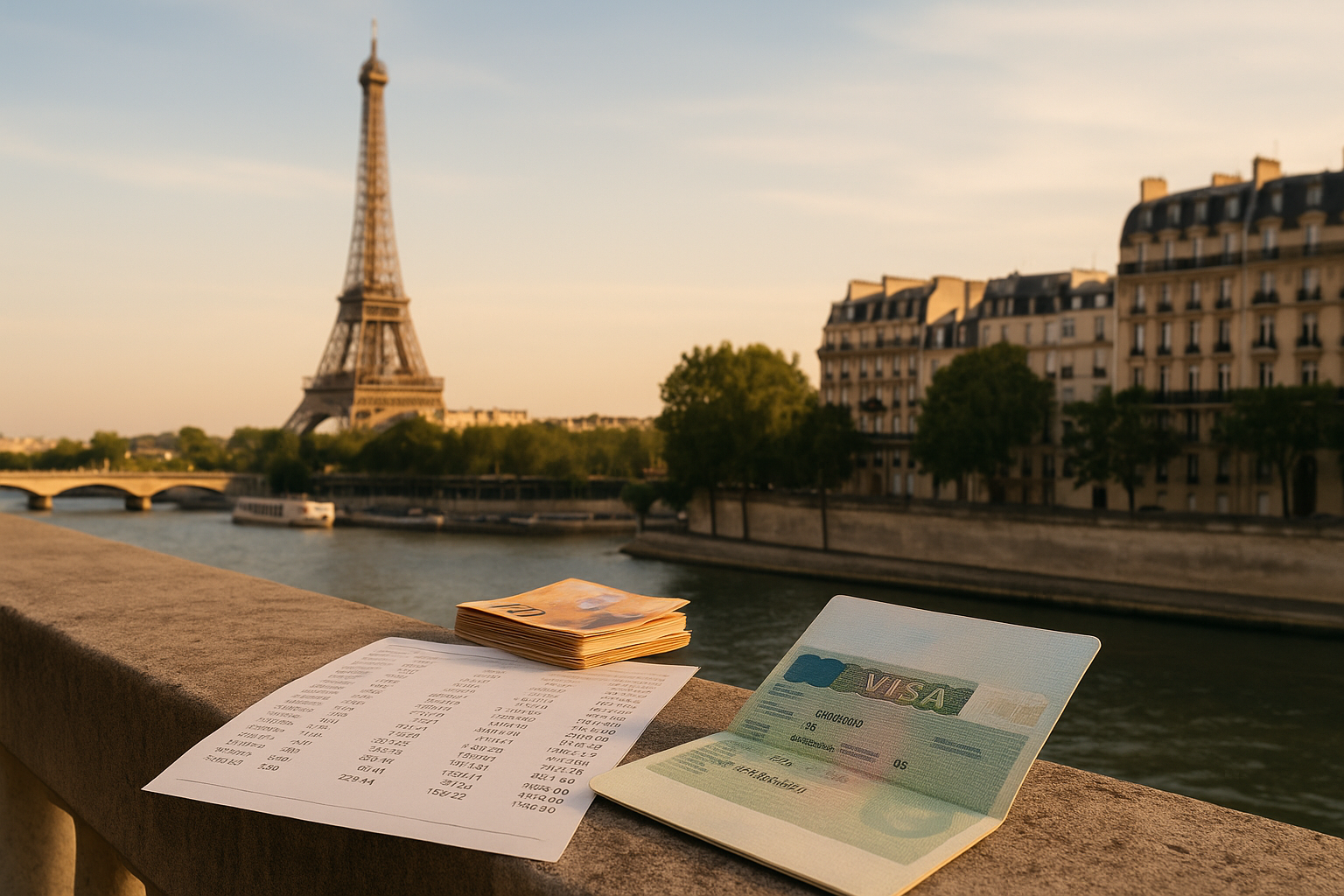
If you’re applying for a Schengen visa from India, this bank balance question will 100% mess with your head. It did with mine. I kept googling stuff like “minimum bank balance for Schengen visa from India”, “is 1 lakh enough”, “do embassies check every transaction” and honestly, the internet made it worse. One site says keep Rs 50,000, another says Rs 3 lakh, someone on Reddit is like bro just show sponsorship, and then your cousin’s friend says his visa got rejected even after having money. So yeah... confusing.
Let me say the short answer first, because I wish someone had told me this in one straight line. For most Indian travellers, keeping around Rs 1.5 lakh to Rs 3 lakh per person in accessible bank balance is usually a comfortable range for a short Schengen trip of about 7 to 15 days, especially if flights and hotels are already booked or at least reserved. Can you get approved with less? Sometimes yes. Do some people show much more? Also yes. There isn’t one magic number stamped across all embassies. It depends on trip duration, country, your income, leave approval, travel history, who is paying, and whether your documents actually make sense together.
The visa officer is not just looking for a random fat bank balance. They’re looking for a believable story on paper. Your money, job, itinerary, leave letter, ITR, bookings — all of it should match. That’s the real game.
First thing — there is no single official “minimum balance” for every Schengen visa
#This is where many Indian applicants get tripped up. Schengen is one visa system, yeah, but different member countries can have their own expected proof-of-funds levels. Some countries openly mention daily required amounts, some are more vague and just ask for proof that you can cover your stay, return travel, and daily expenses. Plus, VFS is not the decision maker, the embassy/consulate is. So when people say “Schengen visa needs exactly this much money”, take it with a pinch of salt.
Still, there are practical patterns. If your trip is short, your hotel is prebooked, your return flight is there, and your salary/income is stable, then showing enough funds for the full trip plus extra buffer usually works better than trying to hit some bare minimum. I’d honestly rather over-prepare than save face and under-show. Visa rejection is costlier, yaar.
So how much bank balance should an Indian traveller actually show?
#Okay, let’s make this real-world. If you are going for 7 days, a lot of travellers from India comfortably show somewhere around Rs 1.2 lakh to Rs 2 lakh in savings, especially when flights and stay are booked. For a 10 to 15 day trip, Rs 1.5 lakh to Rs 3 lakh is a safer zone for many applicants. If it’s a longer multi-country Europe trip, naturally the expected amount goes up. And if you are self-employed, freelancer, or between jobs, having a bigger cushion helps because your profile needs more reassurance.
I’m not saying Rs 1.5 lakh is some official threshold. It’s not. I’m saying this is the kind of amount that looks practical for a modest Europe itinerary from India if the rest of your file is solid. If you’re planning Switzerland + Paris + Amsterdam in peak summer, staying in central hotels, and showing only Rs 70,000 in your account... uh, that file may not look convincing. On the other hand, if you’re doing a budget trip in Eastern Europe, hostels, internal buses, staying 6 nights, and already paid major costs, the amount can be lower.
- For a short 5 to 7 day trip, many people try to keep at least around Rs 1 lakh or a bit above, but more is better if possible
- For 10 to 15 days, Rs 1.5 lakh to Rs 3 lakh is generally more reassuring
- If flights and hotels are unpaid or only partially reserved, keep a stronger buffer
- If someone else is sponsoring you, then sponsor’s bank statements, income proof, and sponsorship letter matter a lot too
What embassies actually want to see in your bank statement
#This part matters more than people think. It’s not just “show money”. They usually want recent bank statements, often last 3 to 6 months depending on the consulate checklist. And no, a sudden giant deposit right before visa filing does not look great. That was my biggest stress point. I had some money moved around from FD breakup and family transfer and I got super paranoid that it would look fake. In my case, I attached supporting documents and kept the rest of the file clean.
A healthy bank statement usually shows regular salary credit or regular business income, normal spending patterns, and a closing balance that can support the trip. If your account is usually at Rs 8,000 and suddenly becomes Rs 2.2 lakh three days before appointment, that can raise eyebrows. Not always a rejection by itself, but then be ready to explain where the money came from. Savings account, salary account, FD proof, mutual fund redemption, family support — all can be valid, just don’t make the officer guess.
- Steady inflow looks better than random cash dumping
- Closing balance should be enough for the itinerary you submitted
- Big unusual credits should have some paper trail if possible
- Your financials should match your lifestyle and travel plan, otherwise it feels off
My own Schengen visa file from India — what worked for me
#When I applied, I was travelling for under two weeks and I didn’t want any nonsense in my file. I showed salary slips, ITR, leave approval, flight reservation, hotel bookings, travel insurance, and bank statements with a balance that was comfortably above my estimated trip cost. Not billionaire level, not fake-rich level, just sensible. My rough trip budget was around Rs 1.6 lakh including flights, hotels, transport, food, insurance, and a shopping buffer. I made sure my account had more than that. That gave me peace of mind honestly.
And this is important — I didn’t build the file around one number. I built it around logic. Salary was consistent. Leave dates matched itinerary. Hotels matched the cities. Insurance covered the full stay. ITR backed up the income. So even if someone else had a slightly lower bank balance and still got visa, I didn’t care. I just wanted my application to look clean and human. Not jugaad.
Estimated Europe trip cost from India, because balance depends on your style of travel
#A lot of people ask for minimum bank balance without calculating actual trip spend. That’s backwards, no? First estimate your realistic budget. A budget Schengen trip from India for 7 to 10 days can still cost roughly Rs 1.1 lakh to Rs 1.8 lakh per person depending on season and route. If you’re booking smart, taking budget flights, using hostels or simple hotels, and not shopping like crazy, it can stay in that range. Mid-range travel usually goes higher, around Rs 1.8 lakh to Rs 3 lakh or more.
| Expense | Budget Range for Indian Traveller |
|---|---|
| Return flights from India to Europe | Rs 35,000 to Rs 75,000+ |
| Hostels/basic hotels per night | Rs 2,500 to Rs 8,000 |
| Mid-range hotels per night | Rs 8,000 to Rs 18,000+ |
| Daily food and local transport | Rs 3,000 to Rs 7,000 |
| Travel insurance | Rs 800 to Rs 2,500 |
| Intercity trains/buses/flights | Rs 5,000 to Rs 25,000+ |
| Visa fee + service charges | Usually around Rs 8,000 to Rs 10,000+ depending on forex/service rates |
Peak summer, Christmas markets season, and school holiday periods can push hotel and flight rates up pretty badly, especially for Paris, Switzerland, Italy, Amsterdam type routes. Shoulder months are often kinder on the wallet and honestly nicer to travel in. April to June and September to early November are generally sweet spots for a lot of Europe itineraries. Winter can be magical too, but days are shorter and some first-time travellers from India underestimate the cold. Me included. Big mistake, froze my ears off in Prague.
Documents that support your bank balance, and make the file stronger
#Bank statement alone is not the hero. It needs backup singers. For salaried applicants from India, last 3 months salary slips, Form 16 if available, ITR acknowledgment, and a proper NOC or leave approval from employer add a lot of weight. For self-employed people, GST papers, business registration, company bank statements, ITRs, CA cover letter if needed, these things matter. Students usually need sponsor documents, relationship proof, and sponsor’s financials. Retired parents travelling? Pension proof and family sponsorship docs can help.
- Recent bank statements, usually 3 to 6 months as per checklist
- ITR acknowledgements, ideally last 2 to 3 years if you have them
- Salary slips or business income proof
- Leave approval letter if employed
- FDs or other liquid assets can help as supporting docs, but savings balance is still important
- Cover letter explaining trip plan in simple words — underrated, but useful
Common mistakes Indians make while showing proof of funds
#Ohhh, there are many. Some are small but they create doubt. One is borrowing money for two days just to inflate the balance. Another is showing a huge amount but no income source to justify it. Then there’s the classic issue of submitting a luxury itinerary with a tiny bank balance and saying the trip will be budget. Europe doesn’t work like a random weekend in Goa where you figure it out later. The embassy wants to know you can actually afford what you’re claiming.
Another mistake, and I’m saying this with love, is obsessing only over balance and ignoring transactions. If your statement is full of cash deposits with no pattern, bounced payments, or weird movement, it can look messy. Not criminal-movie level messy, but enough to create confusion. Keep things as clean as possible for a few months before applying. And please check names, account number, bank seal if required, statement dates, all that boring stuff. One silly mismatch can become a headache.
What if your bank balance is low right now?
#It happens. Europe is expensive in rupees, and not everyone has Rs 2 lakh just chilling in savings. If your balance is low, don’t panic and don’t do drama-deposits without explanation. You still have options. You can postpone the trip by a few months and build a healthier statement, which honestly is the smartest route. You can travel for fewer days. You can choose more affordable Schengen countries. You can get sponsored by parents or spouse if genuine. You can show fixed deposits and additional assets as support, though liquid funds still matter more for day-to-day travel capability.
Sometimes reducing itinerary helps a lot. Instead of a 15-day France-Switzerland-Italy dream trip, do a neat 7-day trip focused on one or two places, with realistic costings. A smaller believable plan is better than a giant plan that your documents can’t support. Trust me, visa officers have seen every version of overconfidence already.
Country-wise vibe matters a bit too
#Even though it’s a Schengen visa, people do have different experiences based on the main destination country and how organized their file is. Some applicants feel countries like Switzerland, France, Netherlands, Italy or Spain get stricter scrutiny simply because applications are high volume and itineraries are often expensive. Is one embassy universally easiest? Nah, that’s overhyped internet talk. The better idea is to apply through the country where you’ll spend the most nights, or first point of entry if stay duration is equal, exactly as rules say. Don’t create a fake itinerary just because some Telegram group said one consulate is easier. That can backfire.
Also, processing times can fluctuate based on season. Summer rush is real. Apply well in advance of your trip. Recent demand for Europe travel from India has been pretty strong again, so waiting till last minute is asking for stress. If biometrics slots are limited in your city, that’s another thing. Mumbai, Delhi, Bengaluru, Chennai, Hyderabad, Kolkata — VFS traffic can get mad during peak periods.
A quick word on safety, spending, and on-ground travel in Europe
#Since this blog is not just about visa paperwork, let me tell you this too. Europe felt mostly safe to me, but petty theft in tourist-heavy areas is very real. Paris metro, Barcelona lanes, crowded train stations, even some Christmas markets — keep your phone and wallet zipped. Don’t carry huge cash just because you showed a big bank balance in India. Use forex card, international debit/credit card, and keep a little cash. Most places are card friendly anyway. UPI nostalgia won’t save you there, sadly.
Accommodation has become pricier in many major cities, especially central areas. If you’re budgeting from India, consider staying slightly outside the center but near metro or tram lines. It saves serious money. Food can also be managed smartly. Supermarkets, bakery breakfasts, kebab shops, pizza slices, meal deals — these helped me not burn cash daily. And if you’re vegetarian or travelling with parents, do some homework in advance. Indian restaurants exist in most major cities, but relying only on them gets expensive fast.
My practical thumb rule for Schengen visa bank balance from India
#Here’s the simplest version I can give after all the stress, research, and actual travel. Add your full trip cost in rupees. Then keep extra buffer on top of it. If your estimated Europe trip is Rs 1.4 lakh, try not to show exactly Rs 1.4 lakh and call it a day. Showing somewhat more gives confidence. For many regular Indian applicants, keeping 20% to 50% above expected trip cost feels like a sensible zone. Not an official formula, just a practical one.
So if your trip cost is around Rs 1.2 lakh, showing maybe Rs 1.6 lakh or more looks more comfortable. If your trip cost is Rs 2 lakh, then Rs 2.5 lakh plus is obviously stronger. Again, there’s no guaranteed amount because visas are never guaranteed, but this way your file doesn’t look financially fragile. And yes, if you have strong salary, long work history, previous travel to countries like UK, UAE, Singapore, Japan etc, that can help your overall profile feel more trustworthy too.
Final thoughts, from one Indian traveller to another
#Honestly, the Schengen visa process from India feels more intimidating than the actual trip sometimes. The bank balance part especially. But once you stop hunting for one magic number and start building a solid, believable application, it gets less scary. If you want my straight-up opinion: for a typical short Europe trip, don’t try to scrape through with the absolute bare minimum if you can help it. Show enough funds to cover your journey properly, keep your documents consistent, and make the itinerary look real because, well, it should be real.
And one last thing, don’t compare your case too much with random WhatsApp stories. Someone got approved with less, someone got rejected with more — both can be true. Your profile is your profile. Keep it clean, honest, and financially sensible. That’s the best shot. Hope this saved you a few hours of panic-googling. If you like this kind of practical travel stuff written in normal human language, check out AllBlogs.in too, pretty handy for trip planning and visa confusion days.