The sad bag of spinach that finally taught me something
#I used to be the person who bought one of those giant tubs of baby spinach with heroic, totally unrealistic plans. Green smoothies every morning. Big lemony salads. Maybe a spinach and feta omelet because I was suddenly a wellness person, apparently. Then Thursday would arrive and the bottom of the tub looked like a swamp creature moved in. Slimy leaves, that weird damp smell, and me standing in front of the fridge whispering, “how did this happen again?” Honestly, it was embarassing. I love food too much to keep throwing it away like that.
Leafy greens are dramatic little things. Gorgeous at the market, perky and cold and full of promise, and then two days later they’re collapsed like they heard bad news. But once I started treating them less like a random fridge item and more like actual living produce, everything changed. My greens started lasting longer, my salads got better, and I stopped doing that guilt spiral where you find liquified cilantro behind the yogurt. You know the one.
The big secret is boring: moisture, cold, and air
#Here’s the whole leafy green storage situation in plain kitchen language: greens need cold, but not freezing cold. They need a little moisture, but not wetness. They need airflow, but not so much they dry into sad confetti. That’s it. Not sexy. Not viral. But it works.
Most food-safety guidance says to keep your fridge at 40°F, or 4°C, or colder. That’s not just a random number people say to sound official. Leafy greens are perishable, and cold slows spoilage. It doesn’t stop it completely, because food is rude like that, but it buys you time. I keep a cheap fridge thermometer in mine because my old fridge lies. The dial says “cold” and then the lettuce in the door is basically sunbathing. If your greens are going limp too fast, your fridge temp might actually be part of the drama.
The other big villain is trapped water. Wet leaves pressed together in a bag are basically asking for slime. And yet totally dry leaves can wilt, especially tender stuff like arugula and baby spinach. So the goal is this slightly annoying middle place: dry surfaces, humid environment. Like a spa day, but for kale.
My basic leafy greens routine, the one I actually use
#- First, I shop with storage in mind. I know, I know, annoying advice. But it matters. I look for greens that are crisp, bright, and not already wet inside the bag. If there’s condensation dripping everywhere or one rotten leaf hiding in there, I usually skip it. One bad leaf really does bully the whole bunch.
- When I get home, I sort them before they go in the fridge. Not a full spa treatment every time, but I pull out yellow leaves, bruised bits, and anything that looks suspicious. If you leave those in, they speed up the sad ending. Same with rubber bands on bunches. I loosen them because tightly bound greens bruise easier.
- Then I decide: wash now or wash later. This depends on the green, my week, and honestly my mood. If I know I’ll cook them soon, I usually leave hearty greens unwashed. If it’s salad greens and I want weeknight salads to actually happen, I wash and dry them properly. Properly is the key word. A wet salad spinner job is not properly, sorry.
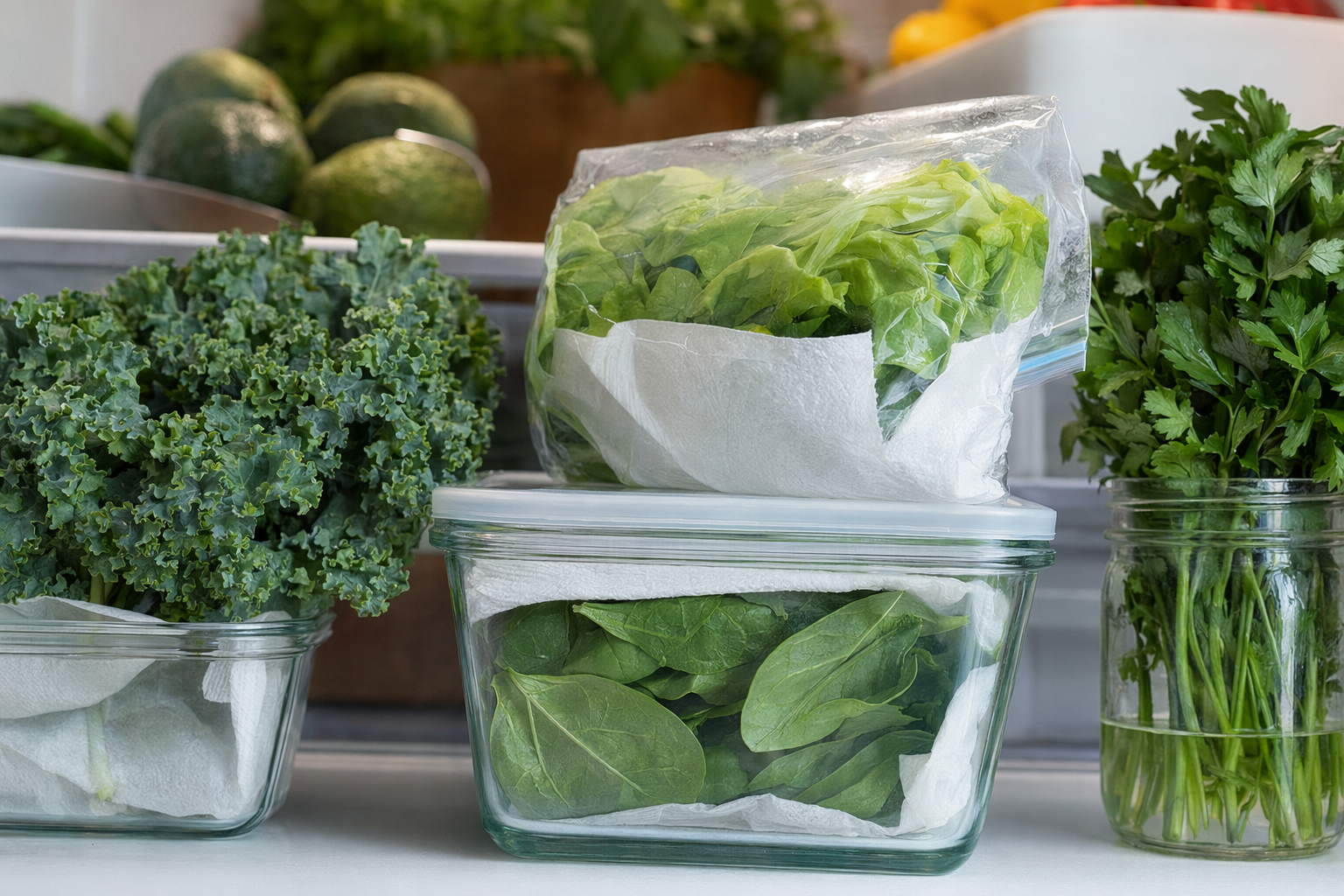
- Finally, I store them with a towel. Sometimes paper towel, sometimes a clean cotton tea towel. The towel catches extra moisture so the leaves don’t sit there sweating on each other. This one little habit has saved me more money than any fancy produce container I’ve bought at 11 p.m. after watching kitchen organization videos.
Should you wash leafy greens before storing them?
#This is the part where people get weirdly intense, and I get it. Some folks swear you should never wash greens until right before eating. Other people meal prep every leaf the second they get home. I’ve done both, and I think the honest answer is: it depends on the green and how dry you can get it.
Food safety folks generally recommend rinsing fresh leafy greens under running water before eating, unless the package says pre-washed or ready-to-eat. If it’s already triple-washed in a sealed bag, I don’t rewash it because extra handling can actually add contamination if your sink, spinner, or hands aren’t clean. That’s one of those things that made me feel weird at first, but now I just trust the label and use common sense.
For loose bunches from the farmers market, especially sandy spinach or muddy mustard greens, I wash. I fill a big bowl with cold water, swish the leaves around, lift them out instead of dumping the grit back over them, and repeat if needed. Then I spin them dry like I’m training for a salad Olympics. After that, I spread them on a towel for a few minutes because the spinner never gets everything. Never. There’s always sneaky water hiding in curly leaves.
The dry-storage method, for lazy nights and sturdy greens
#If I come home tired, which is most grocery nights because why is the store always exhausting, I do dry storage. I don’t wash the greens. I remove any ugly leaves, wrap the bunch loosely in a dry towel, and tuck it into a produce bag or container. This is great for kale, collards, chard, beet greens, and whole romaine heads. They hold up better than baby greens and don’t punish you immediately for not being perfect.
The only catch is that you have to remember to wash them later. I have absolutely chopped unwashed kale into a pan and then had that tiny panic moment like, wait... did I rinse this? So now I leave a mental note by keeping unwashed greens in their bunch form. Washed greens go in a container. Unwashed greens stay wrapped like a bouquet. It’s not a real system, but it works for my brain.
The wash-and-store method, for people who want salads to happen
#When I’m trying to eat more salads, I wash and store greens right away. Because if I have to wash lettuce at lunchtime, I’m suddenly eating toast. Clean, dry greens are like a gift to future me, who is always hungry and slightly impatient.
- Wash in cold water, not hot. Hot water makes tender greens wilt and feel weird.
- Spin more than you think. Then spin again. I’m serious.
- Lay the leaves on a clean towel for 10 minutes if you have time. If you don’t, just do your best. We are not running a restaurant here.
- Store in a roomy container lined with towel, not packed down like you’re shipping bricks.
For baby spinach and spring mix, I’m extra gentle. Those leaves bruise if you look at them wrong. I line a container with paper towel, add a loose layer of greens, then another towel if the container is deep. Not too many layers. If I cram a whole pound of delicate greens into one box, the bottom turns mushy, and then I act surprised even though I caused it.
The paper towel trick is not a myth, but don’t overdo it
#The towel thing works because it manages moisture. Leafy greens release water as they sit, and fridges are humid in weird uneven ways, especially in the crisper drawer. A towel catches the extra dampness before it turns into slime. This is the same general kitchen battle as storing dry goods in damp weather, just in reverse. If humidity is your kitchen enemy too, the moisture-control thinking in Store Rice Flour in Humid Weather: Monsoon Guide is weirdly relevant, even though flour and lettuce obviously live very different lives.
But don’t mummify your greens in a mountain of paper towels. I did that once with arugula and it dried out so much it tasted like peppery tissue paper. One towel at the bottom, maybe one on top for very tender greens, is usually enough. If the towel gets soaked after a day or two, swap it. That tiny reset can give you another couple days, sometimes more.
Where leafy greens should live in the fridge
#Crisper drawer, usually. That’s the short answer. The crisper drawer helps control humidity, and greens like a higher-humidity environment than apples or pears. If your fridge has two drawers and one has a humidity slider, put leafy greens in the high-humidity drawer. Keep fruits like apples, pears, and ripe bananas away when you can, because they give off ethylene gas, which can make some produce age faster. I’m not saying your apple is personally attacking your romaine, but also... kind of.
Don’t store greens in the fridge door. The door is the chaos zone. Warm air hits it every time someone opens the fridge to stare at leftovers and decide there is “nothing to eat.” Greens hate that temperature swing. Also keep them away from the back wall if your fridge runs cold, because frozen lettuce is one of the worst textures on earth. I’d rather eat plain boiled zucchini, and I do not say that lightly.
Different greens have different personalities
#Once I stopped treating every green the same, storage got so much easier. Kale is not spring mix. Cilantro is not romaine. Spinach is a sensitive little diva, and cabbage is basically wearing armor. Here’s my real-life cheat sheet, the one I use in my head when I’m unpacking groceries and pretending I’m not already snacking on cheese.
| Green | Best storage move | How long it usually stays nice in my fridge |
|---|---|---|
| Baby spinach | Dry very well, store loose in a towel-lined container | About 4 to 7 days if it started fresh |
| Spring mix | Do not crush it, use a roomy container and towel | 3 to 5 days, sometimes less because it is fragile |
| Romaine hearts | Keep whole, wrap lightly, wash leaves as needed | A week or more when it’s crisp at purchase |
| Kale | Unwashed in a towel and bag, or washed and very well dried | 5 to 10 days, sometimes longer |
| Swiss chard | Remove tight bands, wrap in towel, store in crisper | 4 to 7 days |
| Collard greens | Treat like kale, don’t let leaves sit wet | Up to a week or so |
| Arugula | Gentle handling, towel-lined container, don’t over-dry | 3 to 5 days |
| Cabbage | Keep whole or tightly wrapped after cutting | Often 1 to 2 weeks, sometimes more |
Those times aren’t promises, by the way. Produce is not a clock. A bunch of kale from a busy farmers market on Saturday morning is a different animal than a bag of spinach that sat under fluorescent lights for who knows how long. Your fridge, the season, how fresh it was when you bought it, all of it matters.
Herbs are leafy greens too, and they are needy in a cute way
#I used to murder herbs. Like, constantly. Cilantro would become black slime. Parsley would wilt into a tiny green scarf. Basil would turn brown and dramatic. Then a chef friend, the kind of person who can make soup out of three things and somehow it tastes expensive, showed me the jar method.
For parsley and cilantro, trim the stems, stand them in a jar with an inch of water, loosely cover with a bag, and refrigerate. Change the water if it gets cloudy. It makes the herbs feel like a little fridge bouquet, which is honestly adorable. Basil is different. Basil hates cold fridges and gets brown fast, so I keep it on the counter in water if I’m using it soon. Unless the kitchen is blazing hot, then all bets are off and I just make pesto before it can betray me.
How to tell when greens are past saving
#I am very pro reducing food waste. I will sauté slightly wilted greens with garlic and chili flakes and call it dinner, happily. But I’m not brave about slime, and you shouldn’t be either. There’s a difference between tired greens and spoiled greens. Tired greens look limp but smell fresh. Spoiled greens smell sour, rotten, swampy, or just “off” in that way your nose understands before your brain catches up.
If you’re trying to get better at reading fridge clues, it’s the same skill you use with other perishables. Smell, texture, color, and timing all matter. I talked about that same little food-safety instinct in How to Store Opened Coconut Milk Safely, because coconut milk and leafy greens both teach you that the fridge is helpful, not magic.
- Slimy leaves? Toss the slimy ones. If the whole container is slimy and smells bad, I toss all of it.
- A few yellow leaves? Pick them out and use the rest soon.
- Wilted but clean-smelling greens? Cook them. Soup, eggs, pasta, fried rice, whatever.
- Mold? I don’t play games. Especially with soft leafy stuff. Out it goes.
My Sunday prep, which is not as aesthetic as the internet version
#On Sundays, if I’m being a responsible adult, I prep greens while something else is cooking. Usually beans, rice, or a tray of vegetables that I will eat directly from the pan like a raccoon. I put on music, fill the sink bowl, and wash the greens that need washing. I dry them, tuck them into containers, and label nothing because I always think I’ll remember. I do not always remember.
My fridge after prep does not look like those clear-bin videos where everything lines up perfectly and nobody apparently eats condiments. Mine has a jar of pickles, three mustards, leftover dal, half a lemon in a tiny bowl, and greens shoved in wherever they fit. But the greens last. That’s the point. Not perfection. Just fewer bags of expensive compost.
One thing that helps a lot: I prep greens by use. Salad greens go in one big container with towels. Cooking greens get chopped and stored separately only if I’m using them within a few days. If I chop kale too early, the cut edges dry out. If I leave it whole, it lasts longer. But if chopped kale means I’ll actually make soup on Wednesday, then chopped wins. Food storage has to serve your real life, not your fantasy life where you calmly massage kale at 6:15 after work.
A restaurant salad that changed how I store lettuce at home
#This sounds silly, but a restaurant salad once made me rethink my whole lettuce situation. It was at a tiny Italian place I loved, the kind with wobbly tables and servers who remember if you like extra anchovies. Their house salad was just romaine, radicchio, herbs, lemon, olive oil, and shaved cheese. Nothing fancy. But the lettuce was so cold and crisp it snapped when you bit it. I still think about it, which might say something about me.
I asked the cook about it one night because I am that person, and he said they washed the leaves, dried them really well, and stored them cold with towels, loosely packed. No mystical restaurant secret. Just care. That annoyed me at first because I wanted a trick. But good food is often boring care repeated over and over. A sharp knife. Enough salt. Dry lettuce. Hot pan. Little things.
Now when I make salad at home, I try to give greens that same treatment. Cold bowl if I remember. Dry leaves always. Dressing at the last second, because dressing is delicious but it’s also leaf collapse juice if it sits too long. If I’m packing salad for lunch, I put dressing in a little jar and add crunchy stuff separately. Nobody wants croutons that feel like wet bread sadness.
Tiny mistakes that make greens spoil faster
#- Storing greens wet in a sealed plastic bag. This is probably the big one. It creates a little humidity cave, and not in a good way.
- Packing leaves too tightly. They bruise, they can’t breathe, and the bottom layer suffers.
- Ignoring one rotten leaf. I know it feels harmless. It is not harmless. It spreads bad vibes and actual spoilage.
- Putting greens near the coldest back wall of the fridge. Frozen lettuce is tragic, I already said this but I need to say it again.
- Washing pre-washed greens again with a dirty sink or spinner. Clean tools matter more than people think.
Also, and I say this with love, stop buying more greens than you can eat just because they look virtuous in the cart. I still do it sometimes. A mountain of greens makes me feel like the kind of person who does yoga before coffee. But unless I have a plan, that mountain becomes slime. Buy one salad green, one cooking green, and maybe herbs. That’s my sweet spot most weeks.
How to rescue greens that are wilting but not spoiled
#If greens are limp but still smell clean, they may just be dehydrated. For sturdy greens like kale, chard, and romaine, I trim the stem ends and soak the leaves in cold water for 10 to 20 minutes. Sometimes they perk right back up, like they got a tiny pep talk. Dry them well after, of course, because we are not undoing all our progress.
For tender greens that are too wilted for salad, I cook them. Spinach disappears into scrambled eggs, lentil soup, pasta sauce, or a quesadilla. Arugula goes on pizza after baking so it wilts from the heat. Sad herbs become green sauce with olive oil, garlic, lemon, salt, and whatever nuts I have. I once made a cilantro-parsley sauce because both were on the edge, and we put it on roasted potatoes. It was so good I pretended it was intentional.
My favorite ways to use greens before they turn on me
#The best storage plan is also an eating plan. Greens last longer when you actually eat them, shocking news. I try to build little green exits into the week. Monday salad with chickpeas and feta. Tuesday garlicky kale with eggs. Wednesday soup with chopped chard. Thursday pesto-ish herb sauce. Friday, if there’s still spinach, it goes into noodles or curry because spinach in a hot pan is basically now-you-see-it-now-you-don’t.
My favorite emergency meal is what I call fridge greens pasta. Olive oil, garlic, chili flakes, whatever greens are looking tired, a splash of pasta water, lemon, and too much parmesan. If there are breadcrumbs, even better. It tastes like I planned dinner, which I absolutely did not. Another one is crispy rice with greens and a fried egg. The greens get tucked in at the end so they wilt but don’t go army-green and depressing.
Leafy greens don’t need fancy storage gadgets as much as they need a little attention: remove the bad bits, keep them cold, manage moisture, and don’t forget they exist.
The storage setup I’d buy again
#I’ve tried the expensive produce boxes, the green bags, the silicone pouches, all of it. Some are nice. None are magic. If you’re starting from zero, I’d get a salad spinner, a few roomy containers, and some clean towels. That’s enough. A good salad spinner is worth the cabinet space, even if mine is always slightly in the way. I use it for herbs, lettuce, leeks, berries sometimes, and once as a popcorn bowl because I make choices.
Containers should be roomy, not necessarily fancy. I like clear ones because if I can’t see the greens, they enter the fridge witness protection program and I find them later in a bad state. Bags work too, especially if you leave a little air inside and add a towel. For bunches, I often wrap in a towel and slide into a loose bag. The crisper drawer does the rest.
Final leafy green thoughts from my messy little kitchen
#If you remember nothing else, remember this: dry the leaves, use a towel, don’t crush them, keep them cold, and check them every couple days. That’s the whole leafy greens gospel according to my fridge. You don’t have to become a meal-prep influencer. You don’t need a perfect row of labeled bins. Just give the greens a fighting chance.
I still lose a bunch of cilantro now and then. I still buy spring mix with big salad dreams and then order noodles because life is life. But these habits have made my kitchen calmer, my grocery bill less painful, and my dinners greener in a way that feels easy instead of punishing. And when a salad is crisp and cold and properly dressed, honestly, it can be as exciting as anything fried. Okay, almost anything fried.
If you’re into practical food rambles like this, the kind that live somewhere between kitchen science and “oops I forgot the lettuce,” I’ve found myself poking around AllBlogs.in for more everyday cooking and storage ideas. Now go check your crisper drawer. Gently. No judgement.