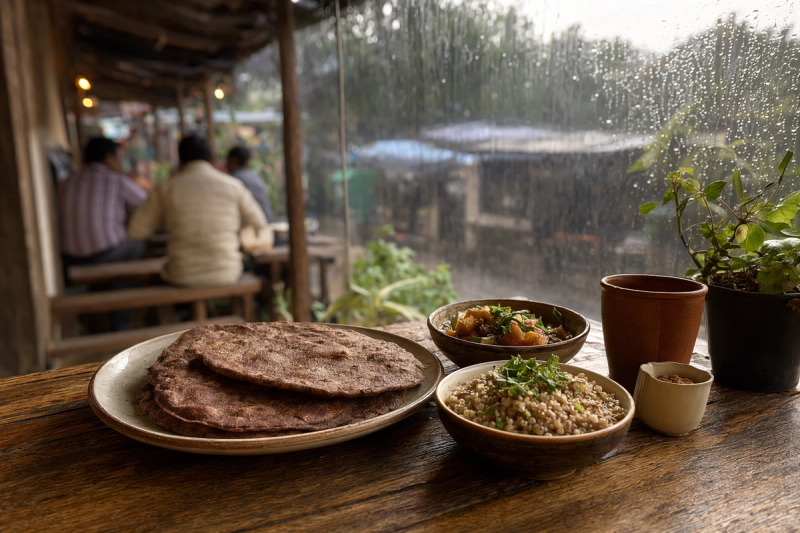
There is a very specific smell India gets in the monsoon. Wet dust, frying chillies, old stone, diesel, coriander, and that warm steamy smell from a tawa that has been working since 7 in the morning. I know, not exactly poetic, but if you’ve stood outside a tiny cafe in Bengaluru while rain bangs on the awning and someone slides a hot ragi dosa onto a steel plate, you’ll get what I mean. This whole millet cafe thing in India isn’t just a health trend anymore. It’s become travel food. Proper, plan-a-trip-around-it food.
My millet trail started accidentally, as most of my better food trips do. I was in Karnataka during a particularly dramatic monsoon week, the kind where your shoes never fully dry and every auto driver looks at the sky like it personally betrayed him. I ducked into a small breakfast place near Malleswaram because I was hungry and cranky, and the board outside said ragi idli, jowar rotti, filter coffee. That was it. No fancy branding, no “ancient grain bowl” nonsense, just wet umbrellas, steel tumblers and people eating like they had known these grains their whole life. Which, honestly, many of them had.
Since then, I’ve chased millets across Bengaluru, Mysuru, Hyderabad, Pune, Jaipur, bits of Gujarat, and a few villages where cafes are not cafes at all, just someone’s front room with a stove and three benches. Ragi, jowar and bajra are not new, obviously. They are older than most of our food trends, older than the smoothie bowl crowd, older than those menu words like “mindful” and “gut-friendly”. But after the International Year of Millets in 2023, and the Indian government’s big push around “Shree Anna”, suddenly city restaurants, airport cafes, boutique homestays and food tours started paying attention. By 2026, at least from what I keep seeing on menus and in conversations with chefs, millets are no longer sitting in the health-food corner looking lonely. They are in dosas, pizza bases, laddoos, craft beer snacks, breakfast bowls, khichdis, tacos even. Some of it works. Some of it… hmm, let’s just say enthusiasm is not always a recipe.
Why Millets Taste Better in the Monsoon, Or Maybe I’m Just Romanticising Rain
#I genuinely believe ragi tastes better when it’s raining. Maybe because ragi mudde with soppu saaru is such a warm, earthy thing to eat when the weather is grey. Maybe because bajra khichdi in Rajasthan hits different when the desert air has cooled after a shower. Or maybe it’s because monsoon travel makes you slow down, and millets are slow food in the best possible way. They don’t flirt with you like butter chicken or biryani does. They are quieter. Nutty, grainy, sometimes slightly bitter, sometimes smoky, and deeply filling. You don’t eat a proper jowar bhakri and then go looking for snacks twenty minutes later.
The big three I kept meeting on this trail were ragi, jowar and bajra. Ragi, or finger millet, is everywhere in Karnataka and parts of Tamil Nadu and Andhra-Telangana. Jowar, or sorghum, belongs beautifully to northern Karnataka, Maharashtra and Telangana food. Bajra, pearl millet, feels like Rajasthan, Gujarat, Haryana and rural winter kitchens, though monsoon versions exist too, especially in khichdi, rotla and porridge-style dishes. Each grain has its own personality. Ragi is dark, almost chocolatey in color, with this mineral earthiness. Jowar is softer, pale and comforting. Bajra is bold, rustic, smoky, and sometimes a bit stubborn if the cook doesn’t know what they’re doing.
| Millet | Where I enjoyed it most | Best monsoon dish | What it tastes like |
|---|---|---|---|
| Ragi | Bengaluru, Mysuru, Coorg road stops | Ragi dosa, ragi mudde with saaru, ragi malt | Earthy, slightly nutty, dense but comforting |
| Jowar | North Karnataka, Pune, Hyderabad cafes | Jowar bhakri with zunka or enne badnekai | Mild, grainy, soft when fresh |
| Bajra | Jaipur, Ahmedabad, Kutch homestays | Bajra khichdi, bajra rotla with ghee | Smoky, rustic, hearty, a little intense |
Bengaluru: Where My Millet Cafe Obsession Properly Began
#If you want an easy starting point for a monsoon millet cafe trail, go to Bengaluru. Not because it invented millet food, no no, the villages did that long before the city discovered menu typography. But Bengaluru has this interesting mix of old Karnataka eateries, organic cafes, modern vegan-ish restaurants, and weekend food pop-ups where millets are taken seriously without being too precious. In Malleswaram, Basavanagudi and Jayanagar, you can still find those old-school breakfast plates where ragi dosa is not a “wellness alternative”, it’s just breakfast. And honestly that is the best version of it.
One rainy morning near Malleswaram, I had a ragi dosa that came out darker than regular dosa, crisp at the edges, soft in the middle, with coconut chutney that tasted freshly ground and a sambar that had enough jaggery to remind you you’re in Karnataka. I ate it standing near the entrance because all the tables were full. A man next to me was explaining to his son why ragi is good for strength, and the kid was more interested in dipping everything into chutney. Same, kid. Same.
Places like Halli Mane in Malleswaram are often mentioned by travelers for traditional Karnataka-style meals, and it’s a good area to wander if you want local breakfast and tiffin culture rather than polished cafe culture. Menus change, so don’t go expecting every millet item every day, but ask. That’s one thing I learned quickly: in India, half the good food is not written properly on the menu. Someone will say, “ragi mudde ide” or “jolada rotti today” and you just say yes before they change their mind.
The best millet meals I had were not the most photogenic ones. They were the hot, steamy, slightly messy plates eaten while my backpack was damp and my phone was at 8 percent battery.
Ragi Mudde Is Not Cute Food, And That’s Why I Love It
#Let’s talk about ragi mudde, because people either love it or look scared of it. It’s basically a ball made from ragi flour and water, cooked and beaten until it becomes smooth and dense. You don’t chew it like bread. You pinch off a bit, dip it into saaru or curry, and swallow it more than chew it. First time I tried it, I definitely did it wrong. I treated it like some kind of dumpling and sat there confused, while a waiter watched me with the gentle pity reserved for tourists and overconfident city people.
But once it clicks, it clicks. With bassaru, soppu saaru, mutton curry, or a spicy lentil gravy, ragi mudde is incredible monsoon food. It fills you from the inside, like edible warmth. A lot of millet cafes now serve smaller, beginner-friendly ragi mudde portions, sometimes with ghee and greens, which is smart because a full village-style meal can knock you out for three hours. I don’t mean sleepy in a bad way. More like your body says, thank you, now sit quietly and listen to the rain.
Mysuru, Coorg Roads, and the Beauty of Breakfast Stops
#The drive from Bengaluru toward Mysuru and further into Coorg during the monsoon is basically one long snack temptation. Coconut stalls, hot bajjis, filter coffee, and then these little places where ragi rotti or akki rotti shows up with chutney and butter. I’m cheating slightly because akki rotti is rice, not millet, but food trips are never perfectly categorized, are they? The point is, this region knows how to do hot griddle breads for wet weather.
At one roadside stop, not famous, not Instagrammy, just a blue-painted place with plastic chairs, I had ragi rotti cooked with onions, green chillies and coriander. It came with a small cube of white butter and chutney so spicy I had to pause mid-sentence. The rain outside was coming sideways. A bus had stopped, people rushed in, everyone steaming slightly from damp clothes. The rotti was crisp, then soft, then smoky. That kind of food makes you suspicious of fancy brunch. Like, why are we paying so much for avocado when this exists?
Hyderabad and Telangana: Jowar Gets Serious Here
#Hyderabad surprised me on the millet front. I went there thinking mostly of biryani, haleem, Irani chai, and all those glorious bakery biscuits, which, yes, still happened. But Telangana food has a deep jowar tradition, and newer cafes and regional restaurants have started showing that off more confidently. You’ll see jonna rotte, jowar upma, millet pongal, and occasionally millet-based dosas in health-conscious breakfast places. In the older parts of the city, food is louder and richer, but in home-style Telangana meals, jowar has a quiet power.
One lunch I still think about was jowar roti with pachi pulusu, dal, leafy greens and a chilli chutney that did not come to play. The roti was served hot, which matters more than people admit. A cold jowar roti can be sad. A hot one, puffed and soft, eaten with ghee and something tangy, is totally different. This is actually the first rule of millet travel: eat it fresh. Don’t judge a grain by the buffet version that has been sitting under a lid since 11:30.
- Ask for jonna rotte or jowar roti in Telangana-style places, especially if they serve regional thalis.
- If a cafe has millet pongal during the rains, order it. Pepper, curry leaves, ghee, soft grains — very hard to be unhappy with that.
- Don’t skip chutneys. Millet breads need good chutney like trains need chai vendors.
Pune and Maharashtra: Bhakri, Zunka, Thecha, Happiness
#Pune during monsoon is dangerous if you like eating. Every road seems to lead to something fried, steamed, roasted, or smeared with thecha. The jowar and bajra bhakri culture in Maharashtra is one of my favourite ways to understand millets because it’s so direct. No one is trying to hide the grain. It’s a flatbread, it’s on your plate, deal with it. With zunka, bharli vangi, pithla, curd, raw onion, green chilli thecha… uff.
I had a jowar bhakri meal after getting caught in rain near the old city, and I remember being embarrassingly happy. The bhakri was soft in the centre, slightly dry at the edge, and the pithla was garlicky and yellow and simple in that way simple food becomes perfect when you are tired. Pune’s newer cafes, especially the ones leaning into local ingredients and fitness crowds, have also been playing with millet wraps, millet pancakes, and jowar-based bowls. Some are good, some taste like someone read a nutrition label and forgot joy. My advice? Eat the traditional version first. Then try the modern experiments.
Jaipur, Ahmedabad and Bajra’s Smoky Monsoon Mood
#Bajra is usually thought of as winter food, and fair enough, because bajra rotla with ghee and jaggery in cold weather is basically a hug from someone’s grandmother. But monsoon bajra has its own charm, especially in Rajasthan and Gujarat when the air cools and kitchens bring out khichdi, rabdi-style preparations, and rotla with garlic chutney. Jaipur’s food scene has also become more interesting for travelers looking beyond dal baati churma. Boutique hotels and heritage restaurants are increasingly proud of local grains, and bajra turns up in tasting menus, thalis, and breakfast spreads.
In Ahmedabad, I had bajra rotla at a Gujarati thali place where the server kept returning with ghee like he had made a personal vow that no guest would leave under-lubricated. The rotla was rougher than wheat roti, with that deep roasted smell. With ringan no olo, garlic chutney and chaas, it made total sense. It’s not light food. Nobody eats bajra rotla and says, “I’ll just go for a jog now.” You sit. You digest. You talk nonsense. Travel should allow for this.
If you head toward Kutch, bajra becomes even more emotional somehow. Homestays and rural food experiences often serve bajra rotla with white butter, curd, jaggery, and local vegetables. The landscape is open and dramatic, and then this humble dark flatbread arrives and suddenly the whole region tastes understandable. That sounds dramatic, but I swear food does that sometimes.
The New Millet Cafe Trend: Bowls, Ferments, Bakery Experiments and Airport Menus
#One of the big food travel trends going into 2026 is that millet is moving from “traditional meal” into “portable travel food”. I’ve seen ragi cookies at airport shops, jowar puffs in boutique grocery stores, millet granola in hotel breakfast buffets, bajra crackers with dips, ragi brownies, millet noodles, and cafe menus offering multi-millet khichdi with fermented vegetables. Some chefs are doing beautiful work with fermentation too, because millets love soaking and fermenting. Ragi dosa batter, mixed millet idli, jowar sourdough-style breads, kanji-like drinks — these are where old technique and new cafe thinking meet.
Of course, not every innovation needs applause. I once ate a “ragi red velvet waffle” that tasted like confusion wearing cream cheese. Another time, a millet pizza base was so hard it could have been used during road construction. But I’ve also had a ragi banana pancake in a small Goa cafe that was genuinely lovely, and a jowar taco with smoked aubergine in Bengaluru that made me annoyingly excited. Millets don’t need to imitate wheat all the time, but when cooks understand texture, they can be playful.
- Best modern use of ragi: fermented dosas, pancakes, malt drinks, brownies when not too sweet.
- Best modern use of jowar: bhakri, wraps, soft flatbreads, savoury bowls, lightly crisp crackers.
- Best modern use of bajra: rotla, khichdi, rustic cookies, winter-monsoon porridges, spiced snack mixes.
How to Plan a Monsoon Millet Cafe Trail Without Overplanning It
#I know everyone wants the perfect itinerary now, saved maps and reels and top-ten lists, but millet travel rewards wandering. Still, a loose route helps. Start in Bengaluru for ragi and cafe culture, go to Mysuru or Coorg road for breakfast stops, fly or train to Hyderabad for jowar-heavy Telangana meals, move west to Pune for bhakri and pithla, then go north-west toward Ahmedabad or Jaipur for bajra. If you have more time, add Hampi and north Karnataka, because jolada rotti meals there are not optional if you care about this stuff. They are the syllabus.
Monsoon travel has practical issues, obviously. Trains get delayed, roads flood, shoes smell bad, and your stomach may not appreciate your ambition if you eat five chutneys before noon. Carry a small towel, ORS sachets, and don’t be heroic with raw salads in random places. Eat where food is moving fast and cooked hot. Millet dishes are often high-fibre, which is great, but if your regular diet is mostly white bread and coffee, don’t suddenly eat ragi mudde, bajra khichdi and jowar bhakri all in one day and blame India. Build up, boss.
What to Order If You’re New to Ragi, Jowar and Bajra
#If you’re new to millets, start friendly. Ragi dosa is probably the easiest entry point because it feels familiar if you already like dosa. Ragi malt is lovely on rainy mornings, either sweet with jaggery or savoury with buttermilk, depending where you are. Jowar bhakri with pithla or dal is another beginner-safe choice, especially when served hot. Bajra can be more intense, so try bajra khichdi before jumping into a giant dry rotla, unless you have good curry and ghee with it.
And please don’t treat millets like punishment food. This annoys me a bit. People say “healthy” and then remove all the ghee, chutney, spice, pickle and joy, and then complain millets are boring. Traditional cooks knew what they were doing. Ragi needs saaru. Jowar needs something wet or oily or spicy. Bajra loves ghee, curd, garlic, jaggery, buttermilk. Balance is the point. The grain is earthy, the accompaniments wake it up.
- For breakfast: ragi dosa, millet idli, jowar upma, ragi malt.
- For lunch: ragi mudde meals, jowar bhakri thali, bajra khichdi with kadhi.
- For snacks: ragi cookies, bajra crackers, jowar chivda, millet paniyaram if you find it.
- For rainy evenings: hot millet pongal, peppery rasam, filter coffee, and absolutely no rushing.
The People Behind the Plates Matter More Than the Grain Trend
#The more I travelled for millet food, the more I realised the interesting story isn’t just cafe innovation. It’s farmers, home cooks, women’s collectives, old regional restaurants, and small millers who kept these grains alive when polished rice and wheat became the default “modern” foods. In many places, millets were treated as poor people’s food for decades, which is a cruel little irony because now city cafes sell them at premium prices with nice lighting. I don’t say that to be cynical, exactly. Trends can bring money and attention. But it’s worth remembering where the knowledge came from.
I met a woman near Dharwad who made jolada rotti so fast it looked like magic. No rolling pin, just palms, rhythm, heat. She laughed when I asked if I could try. I produced something shaped like a torn map of South America. She cooked it anyway, because she was kind. That rotti, even my ugly one, tasted smoky and alive. You can’t learn that from a cafe menu description. You learn it from watching hands that have done the same movement thousands of times.
My Favourite Millet Moments From the Road
#If I had to pick the meals that stayed with me, it wouldn’t be the most expensive ones. It would be that ragi dosa in rainy Bengaluru, eaten too fast while standing. The jowar bhakri in Pune with pithla that stained my fingers yellow. The bajra rotla in Ahmedabad with too much ghee, if there is such a thing. A ragi malt at a homestay near Chikmagalur when the hills were wrapped in mist and everything smelled of coffee plants. A jowar roti lunch in Hyderabad that made me rethink what “simple food” even means.
There were failures too. A soggy millet burger somewhere I won’t name because maybe they were having a bad day. A ragi cupcake that tasted like damp cardboard and regret. A very earnest cafe bowl with six grains and zero salt. But honestly, the bad meals made the good ones clearer. Millets are not magic by themselves. They need skill, seasoning, freshness and context. Same as any ingredient.
Final Thoughts: Follow the Rain, Follow the Griddle
#A monsoon millet cafe trail through India is not polished travel. Your plans will get wet. Your cab will be late. The best dish may come from a place with no signboard and one tube light. But if you love food that carries landscape inside it, ragi, jowar and bajra are worth chasing. They taste like drylands meeting rain, like old kitchens adjusting to new menus, like farmers’ food finally getting the respect it should’ve had all along.
Start with cafes if that feels easy, but don’t stop there. Eat in old tiffin rooms, highway stops, thali places, homestays, state canteens, regional restaurants and markets. Ask what’s fresh. Ask what locals are eating. Order the thing you’re not totally sure about. And when the rain starts again, sit with your hot plate and don’t rush. That’s the whole point, I think. If you’re collecting more food travel ideas around India and beyond, have a wander through AllBlogs.in sometime — it’s the kind of rabbit hole I usually fall into before booking my next hungry trip.