If you’ve travelled in India during peak summer, you already know one thing: heat is not just “weather”. It becomes a full personality. It sits on your head, sticks to your back, makes you fight with your own backpack, and by 2 pm you start questioning all your life decisions. I’ve felt this in Jaipur lanes, Hampi boulders, Goa in May, Chennai railway platforms, and even Bangkok once where the humidity was doing full-time drama. So this whole neck fan vs handheld fan vs cooling towel debate is not some fancy gadget discussion for me. It’s survival, boss.
Earlier I used to laugh at people wearing those U-shaped neck fans. Like, arre what is this mini AC collar? Then one Rajasthan trip changed my attitude. Same with cooling towels. I thought it’s just gym people ka item. But when you’re walking from City Palace to Hawa Mahal in 42 degree heat and your water bottle is warm enough to make chai, suddenly every cooling hack looks very attractive. Over the last couple of years, I’ve carried all three: a neck fan, a cheap handheld fan, and a microfiber cooling towel. Not always together, because I’m not trying to open an electronics shop in my daypack. But enough times to know what works where.
First, Let’s Talk About Travel Heat Properly, Not Just “Garmi Hai”
#Indian travel heat is different in different places. Rajasthan and parts of Gujarat can feel like standing near a tandoor, dry and sharp. Kerala, Goa, Chennai, Kolkata, Andamans, even Mumbai in May, that heat is sticky and sweaty. Delhi NCR in May-June is a full combo meal: hot winds, pollution, traffic, and metro crowds. Hill stations also are not always cool now, btw. Shimla, Mussoorie, Manali, even Munnar can get surprisingly warm in the day if you’re walking with luggage or climbing around viewpoints.
The practical thing is this: no fan or towel is going to save you if you’re roaming at 1 pm in open sun without water. Heat exhaustion is real. IMD heatwave alerts have become something I actually check before trips now, same like checking train PNR. If there’s an orange or red alert, I plan sightseeing early morning and late evening. Many forts, markets and temples are best done before 11 am anyway, when locals are also active and the light is nice for photos. Afternoon is for thali, nimbu soda, shower, nap. Very underrated travel plan.
Quick Comparison: Neck Fan, Handheld Fan, Cooling Towel
#| Travel cooling item | Best for | Weak point | Typical India price range |
|---|---|---|---|
| Neck fan | Hands-free walking, queues, sightseeing, theme parks, local markets | Bulky, battery dependent, can be noisy, not great if hair gets caught | ₹900 to ₹3,500 |
| Handheld fan | Budget travel, trains, buses, hostels, quick face cooling | One hand always busy, easy to forget somewhere | ₹300 to ₹1,200 |
| Cooling towel | Dry heat, treks, forts, beach walks, no battery situations | Needs water, less magical in heavy humidity | ₹150 to ₹700 |
My honest answer? There is no one winner for every trip. Sorry if you wanted a clean answer, but travel is messy. For Rajasthan and Hampi type dry heat, cooling towel plus handheld fan is surprisingly solid. For Singapore, Bangkok, Goa, Mumbai, Chennai kind of humid heat, neck fan feels more useful because air movement matters a lot. For budget backpacking, handheld fan wins because it’s cheap, light, and if it breaks, you don’t cry.
Neck Fan: The Most Dramatic Looking, But Also the Most Convenient
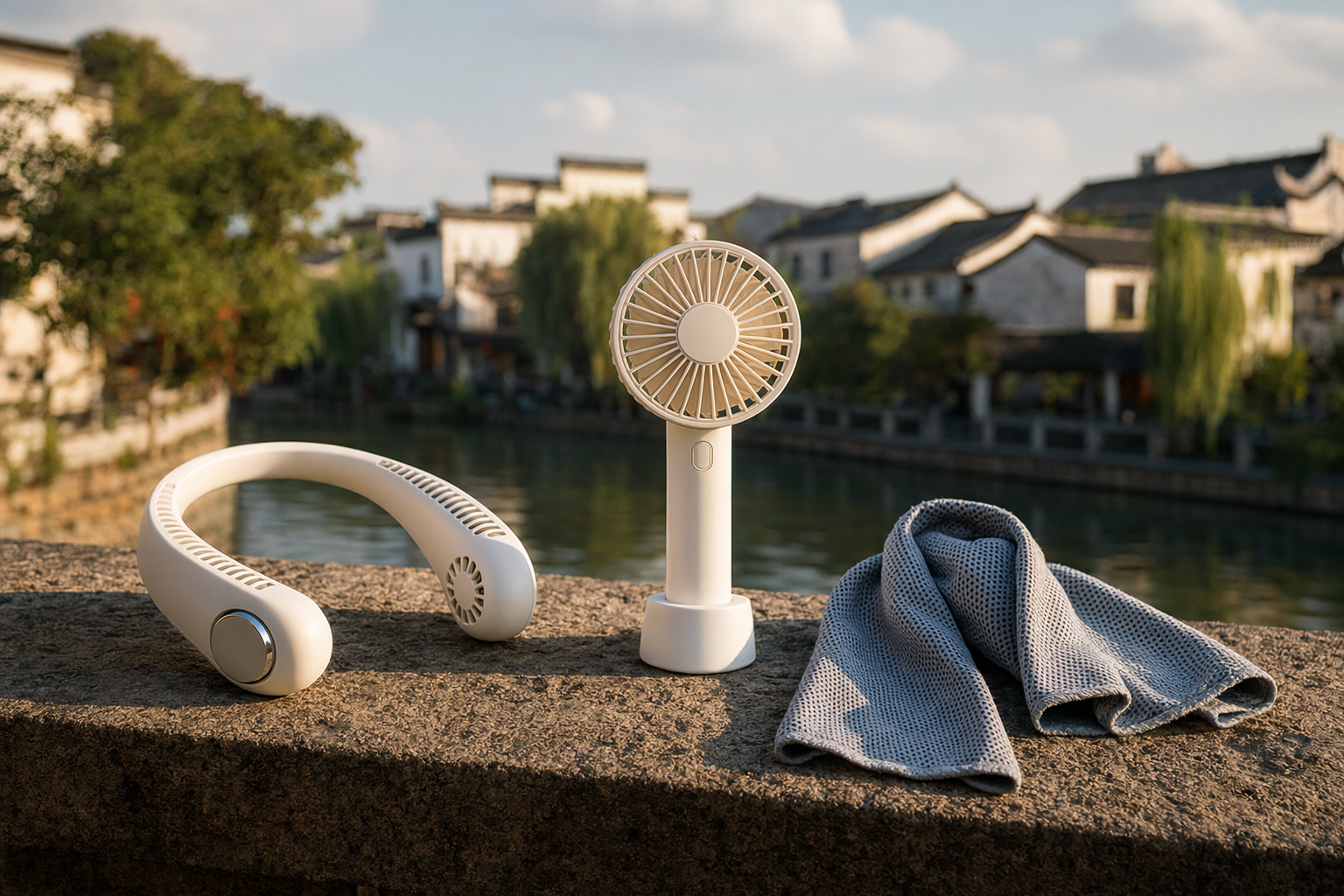
#A neck fan is basically a U-shaped fan you wear around your neck, with vents blowing air towards your face and neck. Some have visible blades, some are bladeless style, and newer ones have multiple speed modes, Type-C charging, and 3 to 8 hours battery depending on speed. The one I used was around ₹1,800 from an online sale. Not premium, not roadside cheap. Somewhere in between, which is where most of us Indian travellers live anyway.
The first time I properly appreciated it was in Jaipur. I was staying near MI Road in a budget hotel, around ₹1,600 per night for a basic AC room, nothing fancy but clean enough. Morning was manageable, but by the time I reached Jantar Mantar and then walked towards Hawa Mahal side, the heat started pressing down. With the neck fan on low speed, I could keep both hands free: one for phone maps, one for water or camera. That sounds small, but in crowded bazaars it matters. You don’t want to hold a fan, bargain for juttis, protect your sling bag, and wipe sweat all at the same time. Not possible unless you have four hands like some mythological character.
But neck fans have issues. They are not silent. On high speed, people sitting next to you in a quiet museum or bus may look at you. Not always angrily, but that “bhai kya machine chala rakha hai” face. Also, if you have long hair, be careful with open-blade designs. Tie your hair. Even bladeless ones can pull small strands near the intake sometimes. And yes, it looks slightly funny in photos. I stopped caring after one trip, honestly. Comfort over Instagram, atleast in summer.
- Best neck fan use: walking tours, fort visits, queues at temples or attractions, local markets, airports, railway platforms.
- Avoid depending on it: if you forget to charge things, if you pack super light, or if you hate anything around your neck.
- Travel tip: keep it in carry-on if it has a lithium battery. Same logic as power banks. Airlines usually don’t like loose lithium batteries in checked luggage.
Handheld Fan: Cheap, Simple, and Weirdly Emotional
#The handheld fan is the most Indian-jugaad friendly option. I bought one in a market in Pondicherry for ₹450 because I was melting near White Town and the sea breeze was taking leave that day. It had USB charging, 3 speeds, and a small stand attachment. Nothing premium. But I used that thing in autos, hotel rooms where AC was slow, beach cafés, and once during a power cut in a homestay. Paisa vasool.
Handheld fans are great because you can direct air exactly where you want. Face, neck, inside your cap, under the collar, even towards a friend who is looking more dead than alive. In trains, especially non-AC sleeper or crowded platforms, it feels like luxury. If you travel by state buses in Tamil Nadu, Karnataka, Rajasthan or Maharashtra during summer, a handheld fan can save your mood. I’m not exaggerating. Sometimes the window seat gives hot air like hair dryer, and then this small fan feels like your only loyal friend.
But haan, the biggest problem is obvious: your hand is occupied. If you’re climbing steps at Amber Fort, holding phone, ticket, water bottle, and fan, you’ll get irritated. Also these cheap fans sometimes don’t last. Battery backup drops after some months, blades collect dust, the charging port becomes loose. Still, for ₹300-₹800, I don’t expect miracles. I usually carry one for train-heavy trips or budget trips where I know AC access will be limited.
Cooling Towel: The Underrated One, Especially for Dry Heat
#Cooling towels are simple. You wet them, wring them, snap or shake them a bit, and put around your neck or head. The cooling comes from evaporation. This is why they work better in dry heat. In Jodhpur, Kutch, Hampi, Badami, parts of Ladakh in summer afternoons, even some Central India routes, a wet cooling towel feels genuinely good. Like instant relief. Not AC level, but enough to calm your body down.
I carried one during a Hampi trip where I stayed in a simple guesthouse near Hospet side, around ₹1,200 per night with fan room and shared vibe. Hampi is stunning, but the boulder landscape can become brutally hot by late morning. The towel around my neck helped more than I expected while cycling near the ruins. I kept re-wetting it from my bottle. Yes, that means extra water use, so don’t do it blindly if water access is limited. But near cafés and guesthouses, it’s easy.
In humid places, cooling towel is more like a damp cloth. Sorry but true. In Goa in May, I used it while walking from a beach shack to my stay and it cooled for maybe 5 minutes, then became warm and clingy. In Kochi also, same story. It still helps to wipe sweat and cover neck from sun, but don’t expect magic because evaporation is slow when air itself is wet. Science doing science, what to do.
My simple rule now: dry heat means cooling towel is hero, humid heat means fan is hero, and peak afternoon means go sit somewhere with lime soda instead of pretending to be brave.
What I Pack for Different Indian Trips
#For Rajasthan between October and March, I usually carry a cooling towel and maybe a handheld fan if I’m doing long train journeys. Winter days can still get warm when walking in forts, especially Jaisalmer, Jaipur and Jodhpur. For April to June Rajasthan, honestly I avoid unless needed. If going, neck fan plus cooling towel plus ORS sachets. Same for Gujarat’s Kutch side, though Rann Utsav season is mostly cooler and much nicer for travel.
For Goa, Kerala, Mumbai, Chennai, Andamans and coastal Karnataka, I pick neck fan or handheld fan. Cooling towel only if I have bag space. Humidity makes everything sweaty, so quick-dry clothes matter more. Stay options in these places vary a lot now. Hostels in Goa or Kochi can be ₹600-₹1,500 per dorm bed, budget hotels ₹1,500-₹3,500, and nice boutique stays or beach resorts can easily go ₹5,000-₹12,000 plus in season. If you’re travelling in shoulder months like September, early October or February-March, prices are more sane and weather is also less angry.
For temple towns like Madurai, Rameswaram, Varanasi, Puri or Tirupati, I prefer handheld fan because you can pack it easily and use it in queues. But check rules at some religious places because certain electronics may not be allowed inside specific temple areas. A cooling towel or cotton gamcha is safer there. Actually, a basic Indian gamcha deserves respect. It works as towel, sun cover, sweat wipe, emergency pillow, everything. Our grandparents knew travel gear before travel gear became expensive.
Seasonal Travel Tips: Best Months, Worst Hours, and Heat Safety
#If you’re planning heat-heavy destinations, best months are generally October to March for North and West India, November to February for desert regions, and December to early March for comfortable coastal travel. April to June is where you need to be careful, especially in plains and dry interiors. Monsoon from June to September gives relief in many places, but then you deal with humidity, slippery steps, delayed trains, leeches in some trekking areas, and sudden road closures in hills. So it’s not automatically easier.
One travel update that’s become important recently: always check weather alerts and local advisories before day trips. Heatwaves, heavy rain, landslides and cyclone warnings are not rare anymore. For hills, check road conditions. For beaches, check lifeguard flags and avoid rough sea days. For cities, use metro where possible. Delhi Metro, Kochi Metro, Chennai Metro, Bengaluru Metro, Mumbai local and metro links can reduce heat exposure a lot compared to sitting in traffic. UPI works almost everywhere now, but keep some cash for water stalls, local buses, small dhabas and parking guys who suddenly become network problem specialists.
- Carry ORS or electrolyte sachets. Coconut water is great, but ORS is more reliable when you’re really drained.
- Avoid black synthetic clothes for sightseeing. Sounds obvious, still we all do it for photos and then suffer.
- Book AC accommodation in peak summer if budget allows. A fan room in 44 degrees can turn into punishment.
- Start early. Like properly early. 6:30 am sightseeing is not madness in hot places, it’s wisdom.
Battery, Charging and Airport Stuff Nobody Tells Clearly
#Neck fans and handheld fans usually have rechargeable lithium-ion batteries. Most are allowed in cabin baggage, but rules can vary by airline and airport staff mood also, let’s be honest. As a safe habit, I keep battery gadgets in hand baggage, not checked luggage. Same with power banks. If your fan has removable batteries, keep them protected so terminals don’t touch metal. For international travel, check airline battery watt-hour limits, though small fans are usually well below limits.
Charging is another practical thing. Many budget stays now have enough plug points, but not always near bed. Hostels are better than before, with dorm beds having sockets, curtains and sometimes USB ports, but old guesthouses may have one sad plug behind a cupboard. Carry a small multi-port charger. Type-C fans are easier because you can use the same cable as phone or power bank. I avoid micro-USB gadgets now unless very cheap, because one more cable means one more thing to forget.
Local Food and Heat: Don’t Ignore This Part
#Food choices make a big difference in travel heat. In Rajasthan summer, I go lighter during the day: curd, chaas, dal-rice, poha, fruits, lemon soda. Heavy laal maas lunch before fort climbing is not a smart move, however tempting. In South India, curd rice is basically medicine. In coastal areas, kokum juice, neer mor, sol kadhi, tender coconut, all are perfect. Street food is part of travel, of course, but in extreme heat I’m careful with cut fruits and uncovered chutneys. Stomach upset plus heat is the worst combo. Been there, not proud.
Also, refill water where safe. Many airports, metro stations, hostels and cafés have filtered water now. In smaller towns I still buy sealed bottles or use my filter bottle. Carrying a cooling towel means you’ll use extra water sometimes, so plan accordingly. If you’re going to lesser-known spots like Gandikota, Badami caves, Dholavira, Mandu or rural homestays, don’t assume water stalls every 200 metres. They may not be there, or they may be closed during afternoon.
So Which One Should You Buy?
#If you travel a lot in hot cities and humid places, buy a decent neck fan. Not the cheapest ₹499 one with scary blades, but something with covered vents, Type-C charging, 3 speed modes and at least 3000 mAh battery if possible. It’s perfect for families too, especially parents who get tired in queues. My mother first called it “faltu gadget”, then used mine during a temple queue and didn’t give it back for half an hour. That is the real review.
If you are a student, backpacker, train traveller, or someone who loses gadgets, get a handheld fan. It’s the best value. You can keep it in a sling bag, use it in hostels, buses, autos, stations, even while eating spicy misal pav when your face is on fire. Look for foldable design, stable base, USB charging and easy-to-clean blades. Battery backup claims are often exaggerated, so assume half of what the box says on high speed.
If you’re going to dry destinations, trekking, forts, cycling trips, or places where charging is uncertain, get a cooling towel. It has no battery, no noise, no airport tension. It also doubles as sun protection for neck. For India, I’d say cooling towel plus handheld fan is the most budget-friendly combo. Neck fan is the comfort upgrade. Not compulsory, but once you use it in the right place, you understand why people swear by it.
Accommodation and Transport Choices Can Beat Any Gadget
#This is something I learnt slowly. A cooling gadget helps, but your travel planning helps more. In summer, stay closer to the main area even if it costs ₹500 extra, because walking 2 km in harsh sun to save money becomes stupidity sometimes. In Jaipur, staying near MI Road, Bani Park or old city access makes sightseeing easier. In Hampi, decide whether you want Hospet convenience or more relaxed village-side stays, depending on current access and transport. In Goa, don’t stay too far inland without your own scooter if you plan beach hopping, because waiting for taxis in heat is painful and expensive.
Typical budget ranges have gone up in many popular places. Dorm beds are often ₹500-₹1,500 depending on city and season. Clean budget AC rooms in tourist towns are usually ₹1,500-₹3,000. Mid-range hotels are ₹3,000-₹6,000, and during festivals or long weekends everything jumps. Jaipur Literature Festival time, Pushkar Mela, Rann Utsav, Goa Christmas-New Year, Hampi Utsav, long weekends in Udaipur and Lonavala, prices can become nonsense. Book early if your dates are fixed. If not, travel weekdays. Your wallet will bless you.
My Final Verdict, After Sweating Too Much for Research
#For me, the winner is not one product. It’s matching the product to the trip. Neck fan for humid cities and hands-free sightseeing. Handheld fan for budget travel, trains, buses and everyday use. Cooling towel for dry heat, forts, treks and no-charging days. If I had to carry only one for a mixed India trip, I’d carry a handheld fan because it’s light and cheap. If I’m travelling with parents or doing long queues, neck fan. If I’m going Rajasthan, Hampi, Kutch or any rocky dry place, cooling towel is coming with me for sure.
And please, don’t treat these as replacement for common sense. Drink water, eat properly, rest in the afternoon, wear cap or scarf, use sunscreen even if you think Indian skin doesn’t need it, because tanning is one thing and sunburn is another headache. Travel heat can make you cranky and ruin a beautiful place for no reason. Sometimes the smartest traveller is not the one who covers 12 spots in a day, but the one who sees 5 properly and still has energy for dinner.
So yeah, that’s my very sweaty, very practical take on neck fan vs handheld fan vs cooling towel for travel heat. I still pack depending on mood and destination, and sometimes I overpack because Indian traveller means “just in case” is in our blood. If you’re planning your next hot-weather trip, sort your cooling gear before you go. Your future self standing outside a fort gate at noon will thank you. And if you want more such real-world travel tips and destination planning ideas, I keep finding useful reads on AllBlogs.in, so maybe check that out too before your next garmi wala adventure.